It’s the net tariff differential, stupid

Free trade was never supposed to be the end-game
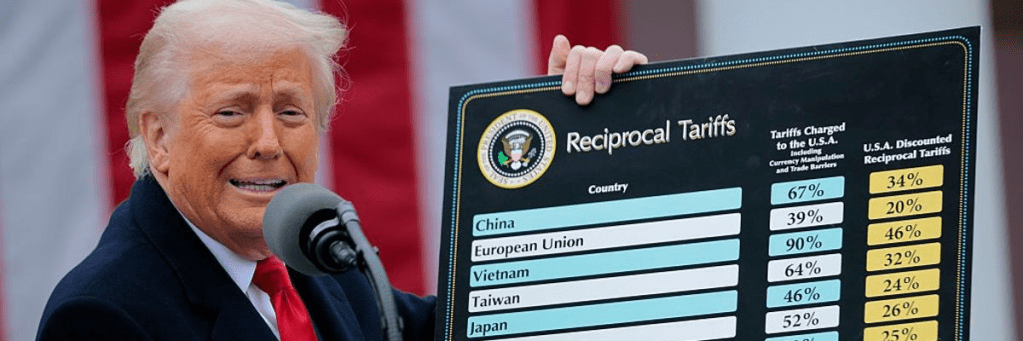
With the dust settling on tariffs, it is opportune to take a moment to consider the sheer scale of change ushered in by Trump on global trade since 2016, and especially with recent events. Trump’s policy is often confused by a vast amount of ‘noise’, which tends to undermine even his own news cycle (see the recent Iran nuclear facility bombing, for instance). Which is a shame, because he has almost entirely remade the landscape, and whether one supports or opposes the theory behind it, it seems irrevocable.

There have been two major components of this earthquake. First, Trump has instated and effectively normalised a global 10% tariff on all US imports, regardless of origin. As noted elsewhere, a ‘universal’ tool like this is by far the most efficient mechanism to charge the world a cost of doing business with America (a concept the youth of today will more easily liken to “gas fees” paid in the world of crypto). It has also raises the policy ‘baseline’ to a figure greater than zero, which I discuss below.

This baseline 10% has both more or less been accepted without reciprocation, by every major trading partner including the EU and China, regardless of vehement struggles over additional duties on top. Whether this 10% is the only tariff, like Britain, or whether it is just the minimum, like Japan and Korea who currently have 25%, the standard has been set and moreover will be very likely here to stay – any future US administration may renegotiate on specifics, but will almost certainly leave the baseline in place. It is now quite simply a fact of commercial life.

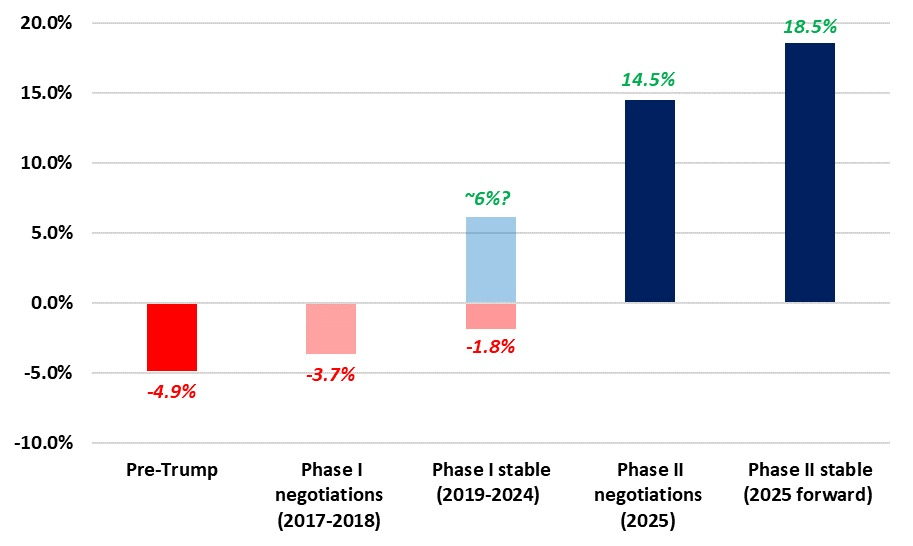
Secondly, there is China. Amidst all the turmoil (which may be part of a grand plan, but frankly who knows), Trump has continued his decade long trade strategy of increasing tariffs and daring China to fight back and contest who holds the most leverage. This bluff has been called several times, and has resulted in the US turning the net tariff differential (the principal measure of ‘success’ in any tariff strategy) in its favour for the first time in living memory.

US net tariff differential with China, 2016-2025

Sources: PIIE, underlying sources
Notes: 1. Trade-weighted tariff rates in 2016 were 8.0% on US exports to China vs 3.9%  on imports; 2. While the notional differential achieved in Phase I was -1.8%, in reality China unofficially suspended many import duties leading to a positive differential under Trump’s first administration; 3. 2025 forward numbers based on latest round of negotiations ending May 2025.

When Trump first emerged on the scene, the institutional trade nexus between the US and China, comprising both WTO and bilateral arrangements, was such that China imposed about 5% more duty on the US than vice versa. Liberal economists contended rather tritely that this was a price worth paying. Yet over the course of both the 2016-2020 presidency and now in his second term, this negative differential was first reduced and now into a major surplus. China, despite raising tariffs of its own, has acquiesced to the new normal that it must pay the US more than the US pays it, for trade. If anything can be considered a ‘win’, this is what it looks like.

In the meantime, we have seen no sign of the supposed economic slowdown as a consequence of the “trade wars” [sic]; there have been plenty of anecdotal examples of exporters eating the additional cost into their bottom lines; and after the initial volatility, the markets have settled down into a rally. Personally, I regard none of these as important for long term strategic reorientation, but among the breathless commentariat fainting at news from the bond markets, it seems to matter.

And what is the point of all this, might you ask? For me, on the subject of tariffs themselves, this policy has been a triumph of common sense. I have argued for years that the US and others needed to ramp up tariffs for several reasons.

One main consideration is that today’s global economy is no longer that of Ricardo’s. The applicability to free trade theory to a landscape of non-tariff barriers, unfungible services, and complexities of cross-border supply chains are extremely limited. Furthermore Ricardo assumed (as all economists tend to) agnostic counterparties motivated and constrained by economic incentives including public wealth and living standards; he did not factor in malevolent strategic actors who would happily pay a cost to bend a supposedly neutral system to their own agenda. Let us be in no doubt: if Ricardo were alive today, he would be pushing for trade tariffs.

Another outcome is the pushing back on the idiot savancy© which has led the technocratic classes to glorify “zero” targets – tariffs, interest rates, inflation, exchange volatility, even carbon emissions (though strangely not taxes or immigration). In most areas of public policy, however, zero is convenient for bureaucracy but wrong for the public. Low rates can occasionally be enjoyed as an output, not an input, but freedom to raise them are the safety valves required for cyclical management of the economy – sometimes you want inflation; sometimes you need currency devaluation. Tariffs, too, are a tool whose starting point (the ‘baseline’) needs room for manoeuvre both up and down – as a decade of near-zero interest rates have demonstrated, autistic ambitions hamstring policy tools needed to meet new challenges (I will write separately about this whole topic). So 10% or so suits the US quite nicely.

How tariffs will end up functioning is an unknown, due in part to how long OECD governments have allowed their muscles to atrophy in recent decades. And nothing scares technocrats more than the unknown. Yet beyond the anecdotal evidence of implementation, we also now know that the first round of Trump’s changes in 2018 led to substantial fiscal outcomes, with customs revenue doubling from US$35bn per year to US$70bn and well beyond.

Source: Bloomberg

This income is forecast to continue rising unless the economy tanks, but little sign of this. How the US government chooses to use this windfall is a separate matter, but the income certainly exists and one reason Biden chose to continue Trump’s tariff policy was that nobody wanted to look this gift horse in the mouth. While revenue raised is not central to the justification for tariffs, they offer an important lesson in how erroneous predictions on effects can be.

Most importantly of all, regardless of whether one supports increased trade protectionism or not (and I accept there are plenty of arguments to be had on either side), Trump continues to challenge the orthodoxy that such sharp directional changes are not even possible. Because for every protagonist arguing against the economics of tariffs, several more are usually hiding behind the sophistry that “he will never be able to do it, anyway”. These are the people cheering on the bond market turmoil or China’s retaliatory duties, unwilling to admit out loud that if it could be done, it might actually make sense for people, even at the cost of being vastly more inconvenient for the beneficiaries of globalisation.

As with defence or immigration, Trump has shown that none of these shibboleths are untouchable. The governing classes, while self-interested in keeping the policies of the last fifty years in place, has been surprisingly ineffective at stopping Trump from turning 180 degrees on tariffs or NATO or Iran, despite loudly arguing that it could “never be achieved”. So it turns out that the system, for better or worse, can be changed. Perhaps after all it is actually Trump who is living Obama’s best life, as he surveys the world around him and tells voters “yes, we can”.


Why companies in Asia are finally going to need real strategy (even if they don’t know it yet)

Most think they have been strategic, when in reality they have just been gambling

My LinkedIn has been showing the first signs of waking up, in recent months, to roles centred around ‘strategy’. This broad term takes into account a range of positions, all of which are yet nebulous, but which nonetheless are being formulated by leadership. This reflects the changing nature of corporate life in the Asia region, where companies are struggling to grow the way they want – but most have not yet worked out why.

To quote one friend of mine, with a background in family offices, “a lot of Asian fortunes are going to be lost in the next decade or two” – principally (though not solely) due to declining asset prices in real estate. Urgency and heroism at these family groups are what is needed, but either these characteristics are not present in the generation governing them, or that energy does not have a constructive home.

The true scale of slowdown in the region has not yet been recognised. Corporate owners generally are too illiterate to distinguish between real and nominal GDP growth (an issue I have written plenty about before); comfortable board rooms in Hong Kong, Singapore or London survey Asia as a market which has slowed – but just a little. After all, real GDP in China dropped from some 10% on average in the first decade of the millennium, to some 7% in the second until 2019 (it has since spooked markets by generating only 5% over the Covid years). SE Asia was never quite that high, with GDP averaging around 5% in both decades. All pretty healthy.

But corporate top lines and bottom-lines are not real, they are nominal. And importantly, nominal GDP fell precipitously over the same period, almost halving in local currency terms from over 18% to 10% over the two decades (in USD term, growth rates have been even lower).

Source: World Bank (full notes at end)

In other words, the age of Asian growth is over. We are well past the phase of the rising tide – not just in China, but more or less across the region. This impacts both corporate performance, as well as property prices. Asian groups have, on the whole, seen their returns stagnate over the last decade compared to the decade before; and importantly they have fallen in line with nominal GDP growth – in other words they are ‘maxing out’ their ability to squeeze more. They have been able to outstrip GDP here and there, but it started running out of wiggle room well before the change in interest rates which seems likely to be with us for some time. Now, the future of growth looks even bleaker.

Source: CapIQ (full notes at end)

So where does this leave us? The reality is that most corporates in Asia have not really had a ‘strategy’ per se, even if they claimed to have. Instead, they made bets in a benign environment, where they really did not have to be very clever to make money. Most sectors across the board grew decently in a +18% CAGR world. Furthermore, a majority of these family groups already owned assets – principally prime real estate – which rewarded rent-seeking and minimised the need for innovation. Where such groups did venture into the unknown (Adrian Cheng in Hong Kong being perhaps the most prominent), things did not go so well. These businesses do not just need a new strategy, they need a strategy in the first place.

So what is ‘strategy’? Well first, it is easier to understand what strategy for such groups is not, particularly some frequent misperceptions and conflations.

  1. Strategy is not tactics (destination is needed before details)
  2. Strategy is not budgets (even though finance is how control is maintained)
  3. Strategy is not transactions (deals come only after we know direction)

Strategy is about what you want to be as an entity, and the broad direction of how to get there. In Asia, the biggest omission from corporate owners (who tend to be family) is not focusing enough on coherence and identity. Conglomerates are perfectly acceptable in their way; we have, since the rise of the tech giants on either side of the Pacific, witnessed a renewed era of conglomeration in the form of Google, Amazon, Tencent and Alibaba. Single sector focus is not important or the only key to generating shareholder value. Rather, bringing together wildly different businesses can be successful where the overall narrative of who you are still holds. You do not need to have operational synergies in order to have an ownership cohesion of even a sprawling empire.

‘Strategy’ is also about power. The preeminent objective for family groups in Asia, with minorities playing a lesser role, is preservation and the ability to keep your destiny in your own hands. Near-term returns are important; dividends are crucial; but above all else, is it control which is paramount. Life is a constant battle for control – against the government, against competitors, against suppliers, against customers. Strategic thinking is designed to look beyond the financials to the power dynamics in the market – for instance owning the loss-making delivery business which allows control of consumption for your upstream FMCG, or owning the low margin bank that finances speculative capital in new industries.

The purpose of ‘strategy’ is therefore to solve the triangle of dynamic forces which determine how a group can move forward. Capabilities either exist or need to be cultivated or acquired; opportunities need to be identified, sourced and validated; and the ability to invest, either through equity or debt or partnerships, has to be planned.

The tricky part is that moving each of these impacts the other two, and ‘strategy’ is therefore about determining how best to balance them to reach the overall aim and keep your identity. Buying new capability through M&A, say, might expand your opportunity set, but weigh on your balance sheet. Restricting your gearing risks not just limiting your opportunities to invest, but also stretch your existing resources in management.

But central to all of this – and where Asian family businesses are particularly lacking – is the need to build or maintain a true identity about who you are and where you are doing. In this region in particular, business owners undervalue how much identity is needed as a pay-off for lack of financial incentivisation and a demand for loyalty (same in politics). Hence identity sits and the very heart of how to think about ‘strategy’, a sine qua non from which all other plans flow. You need a cadre of people who remain loyal to the cause and hence work to protect a family’s interests across generations. They need, more or less, to feel like they are part of a partnership in the traditional sense; mercenary superstar management is the death-knell of the family conglomerate.

Which brings us to organisation. Lots of people think that they “do” strategy; yet more others have such a title; a third group really need to be strategic. The problem is, the three rarely converge. People confuse strategy with tactics, ‘strategy’ titles often mean doing M&A, and leadership is often bogged down trying to manage stakeholders and incremental decisions to really think strategically. Divisions and subsidiaries cannot be left alone to decide their own fates; their management is rightly limited to seeing things through the prism of their own industry. They cannot offer holistic views about the portfolio and they are not positioned to leverage the strengths of a group overall.

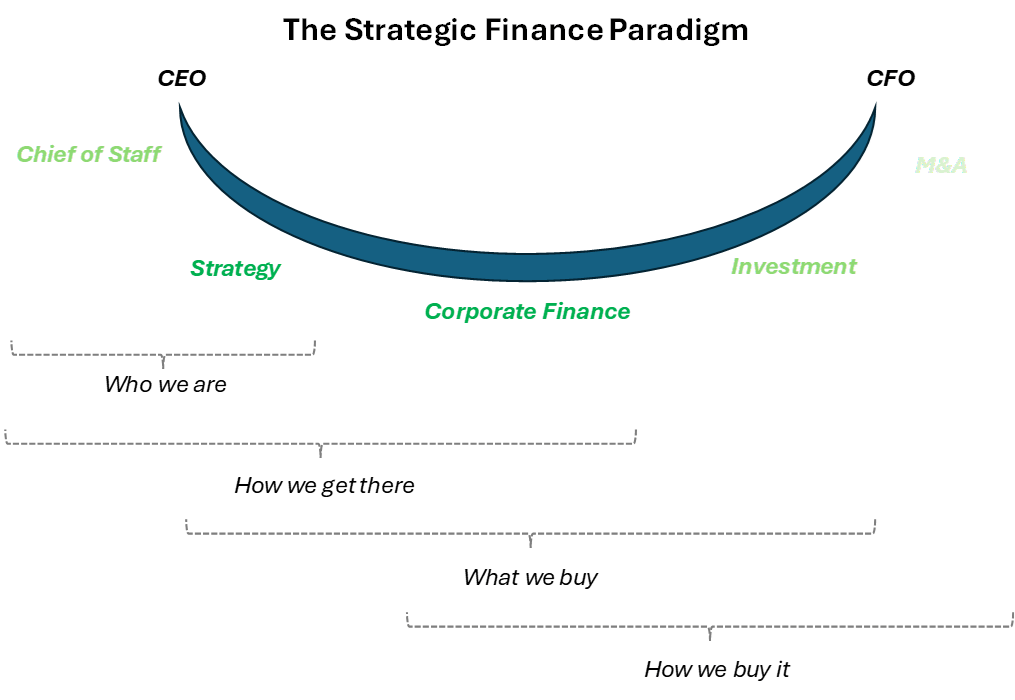
Yet ‘strategy’ is too much for just the Chairman or CEO to undertake, and still less the CFO – although financial control remains key. Getting ownership to think about identity and vision is a skill, and it needs focus. It needs one or more thoroughly invested people at or near the top to shape it and keep the flame alive. As discussed above, there are a range of titles or roles that reach across the spectrum of what I call “strategic finance” – both vision and execution.

And ‘strategy’ will only get more important. Some family groups still live under the auspices of an all-dominant chairman; others want to believe that they should interfere less in their businesses. But one thing binds them both: they underestimate the necessity of a wider, more bought-in middle who understand both the family and the firm, and who are invested in the strategic long-term wellbeing of both. Doing better is not about doing less or doing more, it is about understanding what is strategic and what is not – whether in capital allocation, M&A, organisational structure, portfolio evolution, employment programmes, partnerships or even investor relations.

The urgency and heroism mentioned at the beginning is what Asian family groups will need to survive. They may get lucky with the scion which comes to power, but with or without that, they will need to embrace all those things they found too intellectual, too esoteric, too academic; they will have to start doing ‘strategy’.

Notes:

  1. For GDP growth, data set is in GDP current LCU
  2. “Emerging Asia” comprises China, Hong Kong, Singapore, Thailand, Vietnam, Malaysia, Philippines and Indonesia
  3. “Total Asia” comprises above plus Japan and Korea
  4. “Asian conglomerates” comprises Jardine Matheson, Astra International, CP ALL, Keppel, YTL, First Pacific, Uni-President, Sime Darby, Swire Pacific, ThaiBev, SM, CITIC, Ayala and JG Summit
  5. “Asian property groups” comprises Hongkong Land, Sun Hung Kai, Swire Properties, Henderson, New World, CK ASSET and Wharf REIC
  6. “Japanese trading houses” comprises Marubeni, Itochu, Mitsui, Mitsubishi and Toyota Tsusho

Rather than to be feared, AI is just that dysfunctional kid we never liked

The excitement around AI, both from businesses and finance, is as frothy as it is palpable. My LinkedIn wall, that repository of the most commercially obvious, cannot go two posts without someone bringing up a reference to unemployed lawyers or the NVidia share price. Much like the coming of the Internet, the true market will follow the bubble as surely as this bubble has followed the uneducated speculation. Yet I see far fewer posts from actual operators about AI’s current uses or the direction of travel, due no doubt to that fact that we are still at nascency.

Yet even at this early stage, I would offer a few groundless, untechnical observations about how this is heading, based partly on a recent comment made to me that we are heading away from ‘data science’ and towards ‘content science’. I stand to be proved wrong, of course, but I feel some of the underlying truths will be difficult to challenge. Perhaps in three years’ time it will all look very different, but I will put it down for the record.

1. AI is the student, not the teacher 

To some this may seem obvious, but the reality of GPT and its B2B and B2C offshoots, is that they remain permanently there to be taught by humans.

AI will be able to do huge amounts of work for us in the future, no doubt. We are told that they will replace lawyers and accountants for instance, and the workplace will look different. I would agree with this, they are a future colleague – but the question is which colleague will they be? The nature of it indicates that the role they will perform is basically that of the new graduate trainee, or possibly even the intern. They are there, and a useful resource for sure, but they will not be producing finished products until you give them feedback, repeatedly. After a while you will wish they were able to at least fetch the coffee for you. Within our lifetimes, they will never have their own office to lord it over the saps outside and disappear off to play golf at 2.00pm on a Thursday.

2. AI is a pathological liar

It has been well noted that AI tends to ‘lie’ and many wonder how and why a logical entity would do this. But of course the vast majority of content for generative AI comes from content that is already out there, and that content has been written by fallible human hands.

In the same way that ‘the Internet’ lies – or rather, is full of untruths because those producing content are all well-intentioned – so also the likes of ChatGPT. Machine learning can only summarise existent knowledge, which is at best imperfect and at worst malicious. This is a poor kid that has been born of a dysfunctional, almost sociopathic family, so what chance does it really have of being a good boy and living a normal adult life later? AI will find itself divorced with estranged children and alimony of its own in decades to come. Arguably, the power of AI will actually magnify lies and illogic through its distributive power; the calculation error of a second rate accountant in 2006 will now form a permanent fixture within our reservoir of collective knowledge, when it need not have done before.

3. AI will reduce innovation 

More controversial than the two previous points is that the net effect of AI, itself an ‘innovation’ driving rocket-high share prices, will be to dampen innovation whenever it used – certainly unless visionary leaders really manage it well.

Referring again to the automation processes which everyone believes will be the first to go, the fact is that even while people are stunned by the ability of AI to produce a legal opinion that formerly took a highly paid lawyer days, that opinion will be decidedly unexciting. It can, after all, only be the output of decades of other lawyer’s opinions. As a student, AI is that kid who does not really think but is only able to regurgitate the books he happens to have read whilst sat in the corner of the library alone, friendless. Possibly he does this because of his parents’ acrimonious divorce, I don’t know. Either way, by doing this, and by that homework being accepted as a decent B+, it means that room for original thinking is limited. In fact, it basically means the quality of all work will only ever be a B+.

Optimistically, of course, AI frees us up to spend more time on productive, innovative thinking. But be realistic: when robots are cleaning your house, how many people will use that unexpectedly free Saturday afternoon for reading Nietzsche or climbing Everest; and instead, how many will be sitting with a bag of crisps rewatching old Netflix series and shouting “they were on a break!” at Rachel (note: guilty as charged). Again, given the power of AI’s distribution, this shift from data to content will actually amplify this ‘anti-innovation’. When we sit down to raw data, we are forced to think; when we sit down to semi-finished content, we will not.

*********

These three issues – that AI is a child, that it comes from a broken home, and that it only studies other people’s books – all link to the end point: the limitations of AI mean that while the world of work may change radically, as with now, human innovators will be disproportionately rewarded then as now. Lots of processes will be automated, but what will not be is not only painting, music or fiction writing, but even areas such as marketing and advertising. I have friends who know how to sell, and sell hard. They already get the best of the opportunities in business today, and this will be even more pronounced tomorrow. The lesson is: where human beings work at things which are truly ‘human’, rather in jobs where they are poor substitutes for machines (such as road sweepers, or boy bands), they will always find a layer of economic reward above that of the machines which serve us. Good jobs aren’t dead.

Perhaps therefore the scariest thing about AI is the mirror it is holding up to our own faults and shortcomings. It is preserving and multiplying all of our past errors and sentiments, most of which we would rather forget, like a scene out of Monty Python.

And like that self destructive black sheep cousin, or that girlfriend who only likes guys who are bad for her, AI not learning from its mistakes however much people point them out. Because from its agnostic standpoint, AI will tell there is no right and wrong, good or bad, just the content.

And whose content is that? Yours.

25 years on, who really won the battle over Rolls Royce and Bentley?

Best of German carmaking

Just over 25 years ago, an intricate set of corporate activities led to the former Rolls Royce car business, which included Bentley, to be owned by German acquirers. When all shook out, Volkswagen acquired the operations at Crewe and the Bentley brand, while BMW got the rights to create a new concept using the name “Rolls Royce”.

First, we should be clear that Rolls Royce since 2003, successful though it has been, is a ‘phantom’ [sic] marque. Rather like Mercedes’ attempt with Maybach, it has nothing to do with the Rolls Royce of old but rather is the upscale concept that BMW wanted to create to fill a hole in its offering.

Secondly, it is worth noting that in the real economy, rather differently to much of the digital economy of today, real assets and people are worth money. What VW acquired – and wanted – was the factory, the engineers and designers, the back catalogue and experience – of the Rolls Royce entity. That was, rightly, considered to be worth more than just the brand around the Rolls Royce. In dilettante reporting of the time, it appeared to be some major sleight of hand that BMW emerged with the brand name after VW had handed over £430m for the business. But for observers beyond the bankers and bloggers, VW were perceived to have gotten their money’s worth – and more.

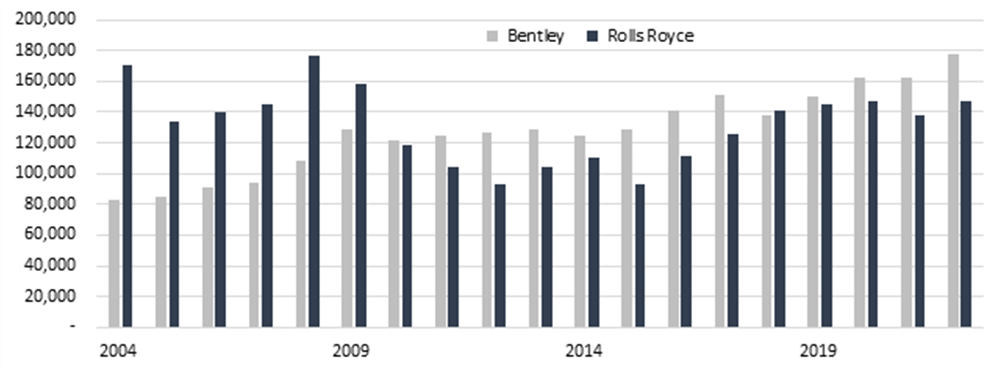
So who has done better since? Well arguably this was a win-win where both carmakers did well with what they took on. While in absolute terms, Bentley has gone on to sell three times the number of vehicles Rolls Royce has (some 200,000 since acquisition, compared to about 65,000 RRs), BMW sell their cars at more than the price of a Bentley.

Total numbers of vehicles sold per year

Source: company accounts

The boring petrol-head bit

The two brands have pursued rather different strategies given who their owners were. VW, while it already had Audi in the stable (but well before it owned Porsche) wanted Bentley to provide a sporting edge which could be scaled up, rather than owning a ‘limousine’ marque. It therefore pushed the new Continental GT, a model which overnight became a success for London bankers and LA rappers alike. For BMW though, the RR brand was very much about creating a classic luxury saloon (if that can really be used for RR) sitting above their already-premium 7-series.

As mentioned elsewhere, VW went about their strategy by providing the patented W12 engine, a personal project of chairman Ferdinand Piëch, used in their unsuccessful Phaeton luxury saloon adventure, to the team at Crewe. Other than this, and giving the Bentley management a general steer on wanting to see a GT, they left the British business to get on with it – with excellent results. With the arrival of Porsche into the mix a decade later in 2012 though, VW finally started getting serious about the saloon segment, with the launch of the Flying Spur and the Mulsanne. Later again it was coming of the Bentayga, the implausible and slightly absurd Bentley SUV, which has sustained sales in recent years.

BMW went a different direction since they were starting with a clean slate. Working outside of the business over the first five years until 2003, designer and Munich-lifer Marek Djordjevic came up with the Phantom model that would kick-start German ownership of the brand. Sales were boosted again with the launch of the Ghost in 2010, the more affordable line of saloons, but in recent years it is the even more implausible and even more absurd Rolls Royce SUV, the Cullinan, which has been the catalyst – comprising more than 50% of sales since its launch and reaching almost 60% in some years. While Bentley has also had success with the SUV, it has never formed as large a part of its portfolio.

In other words, since 2003 Bentley has really lived off the Continental GT offering, reflecting its racing heritage, while Rolls Royce remained a limousine maker who have evolved into SUVs.

The important bit

Rolls Royce, anecdotally, has always been able to price a like-for-like car at a 30%-50% premium to Bentley since they were each taken over. A Wraith costs more than a Continental GT for instance, and the Ghost costs more than a Flying Spur. However taken as a whole, since introducing the Ghost in 2010 BMW has ended up with a portfolio of cheaper price points on average than VW, as total revenue per vehicle shows:

How this has translated into hard profits for their owners is more complicated. The fact is that neither of these businesses have delivered huge amounts of outright profit. Bentley managed to record a bottom line of £684m in 2022, a record, but since 2003 has dipped in and out of profitability overall. RR has managed to record a small and consistent profit over the same period, culminating in a £97m bottom line in 2022. On an adjusted, pre-R&D basis, Bentley has recorded a 21% profit margin over the last decade, compared with 8% for Rolls Royce. In the context of VW’s and BMW’s overall earnings of €15.8bn and €18.6bn respectively, these are drops in the ocean. Bentley accounts for 4.4% of VW’s earnings; RR just 0.5% of BMW’s.

Moreover, the Rolls Royce profit is overstated since BMW does not push R&D costs into the Goodwood accounts. In fact, it is likely still not profitable after two decades of operation. Bentley, due to its Crewe location being self-sufficient, has spent on average £322m on R&D per year over the last decade, leading to several years in the red. One can assume either that Rolls Royce really is just using BMW 7-series intellectual property, or it is spending similar amounts which would imply substantial ongoing losses, of at least -£100m per year as an educated guess. For what it’s worth, Bentley probably wins the financial battle comfortably.

Of course, both are growing, and as noted previously have been growing faster than their owners as a whole, at high single digit CAGR for revenues and even higher profit growth. However both are yet to fully face the challenges of electrification, though BMW are arguably ahead of VW in technology for that (Volvo / Geely, via its Polestar brand, as a full high end EV performance car which serves as a template for what these two venerable names might look to).

Conclusion

Ultimately, the consensus seems to be that both sides got what they wanted out of these brands when they battled to acquire it in 1998. VW got a sporty brand that could scale, which it has done; BMW got a limousine brand which was not designed to be scalable but to really create a layer above its premium positioning. VW wanted the hard assets of the former business including the factory and staff, given the failure of Phaeton; BMW had most of its platform already available for use and could staff up its new Goodwood facility internally. That explained the difference in pricing – BMW spent £50m on the brand and then some £100m on building the new factory, compared with the £430m VW spent buying a going concern. Bentley is meaningfully profitable though, whereas Rolls Royce has yet to contribute financially.

What neither side anticipated then, but both reacted to, was the rise of the SUV, which perhaps suited the saloon platform better than a sport GT one. Each side has done well but RR has really taken off on its SUV offering; the EV challenge will be next. At the end of the day though, the real benefits will have to be chalked up to ‘intangibles’ including prestige for the owner and, one assumes, spillover benefits from any R&D linked to these luxury marques. It is probably really us, the consumer, who has benefited from these two auto giants deciding to maintain what are basically hobby horses; if the Germans were not so vain, we probably would not have the cars we enjoy today ….

Appendix

How acquirers of car brands – even Chinese ones – can succeed

Cars have had a long innings as possibly the most globalised consumer product around is. By which I mean, they have broadly been the product category about which consumers see supply as a single world-wide market: whether you live in Belgium, Brazil or Brunei, you would still be mostly buying cars from the same top ten or so global producers for the last decades. If you are rich, you would probably be looking at the German makers, and latterly Lexus. If you are middle class you might be settling for other Japanese or European brands. If you were stupid you might buy American – but then, not even Americans do much of that.

Another way of looking at it is that cars have had the longest ‘globalisation window’ of almost any product category. As a country develops, it initially prefers foreign brands and the qualities they bring. But when a country really develops, consumption starts to re-indigenise. For instance, while cars and, say, food products both tend to globalise early, people return to their own taste in food quite soon after they become middle class (partly reflecting the lower barriers to (re-)entry). The speed with which McDonald’s or Yum localise compared to Volkswagen is telling.

In part this is because a carmaking industry is actually difficult to establish: Taiwan, for instance, despite having a steel sector, has never managed to create cars; Korea did manage to, but only after throwing the entire weight of its economic development behind that push; Malaysia threw its weight behind the effort, too, but with mixed results. People often refer to the building of aircraft carriers, or a space programme, as the symbol of a country’s total integrated industrial capability, but on a much more mundane level, so are cars.

All this combines to shape the global landscape in automotive OEMs, which have consequently undertaken enormous amounts of M&A over the years – almost all of which have been unsuccessful. Daimler’s ‘merger of equals’ with Chrysler in 1998 went so poorly that it is subject of business school case studies; while the ‘alliance’ between Renault and Nissan – undertaken a year later and heralded as a counterpoint to that merger – itself became mired in problems. Ford made numerous acquisitions of other brands over the years including Jaguar (1989), Volvo (1999) and Land Rover (2000), before selling all of them at a loss. Aston Martin was an honourable exception which proves the rule. GM did even worse that Ford – both Saab and Daewoo more or less shut down.

So successful automotive acquisitions are worth considering, and when one of those is a rare example of successful Chinese overseas industrial investment, even more so. Below are a few examples of ‘takeovers’ of well-known car brands in recent years, and their performance afterwards.

Vehicle sales CAGR since acquisition

Note: parenthesis indicates year of effective acquisition; Rolls Royce and Aston Martin not strictly ‘acquired’, for different reasons

There are a lot of details which I will not go into here, for instance the story behind Rolls Royce and BMW (the subject of another post), suffice to say that quite a few of these marques have had success over a long period of this century. To put this in context, over the same approximate period as above, the main carmakers have seen growth ranging from +4% (the Germans) to -1% (the Americans). So to understand why these acquisitions have helped practically, I will focus unashamedly on the two cars I personally own: Bentley and Volvo.

The history of Bentley and Rolls Royce is again a post for elsewhere, but Volkswagen essentially bought a faded business selling just 400 cars in 1998. For five years they dwelt on the business and how to get the best from leveraging VW’s broader platform, and in 2003 they completely reinvented the brand. Handing over the patented W12 engine – a slightly eccentric and personal project of chairman Ferdinand Piëch – the new owners steered Bentley back to their sporting roots and create the new Continental GT. The car took off, shooting sales instantly to over the 5,000 unit mark where it has remained and grown. Possibly no car better signifies reinvention than this one and VW undoubtedly gave Bentley a new lease of life.

A few years later in 2010, Chinese carmaker Geely shocked the motor world by buying Volvo, then owned by Ford. Driven by another chairman, Li Shufu, this was a test case for Chinese overseas acquisitions in an age where it was slightly less controversial. Observers expected either a total takeover or completely detachment, but as with VW and Bentley, Geely took a nuanced middle way of gentle guidance and leverage of the broader platform. Again, the new owner mulled for five years or so before pushing the redesign of the XC90 SUV in 2015, which saw Volvo’s sleepy sales take off; in 2018 it trumped this with a new version of the XC60 and Volvo’s position as one of the most popular premium SUV brands was cemented. Volvo grew unit sales by 10% CAGR between 2014-2019 prior to Covid, the vast majority of them these two models.

Both these examples show that automotive M&A can work, when there are clear alignments: first, the buyer needs to have a clear idea of what exactly they are intending to do with the new brand; secondly, they should not rush to impose changes, but take time to understand the asset; and lastly, the buyer needs underlying platform benefits to add. The case of Tata, whose control of JLR has been more mixed, is a case in point: they have not really added much to either Jaguar or Land Rover, and while the latter benefited from the global demand for luxury SUVs, Jaguar has been in stasis. Volvo, on the other hand, will be receiving the full support of Chinese EV technology, future proofing the brand yet further.

My final point reflects an earlier post I made about the quality of FID. For the UK and Sweden, these two acquisitions are exactly as hoped: inbound investment and employment but importantly, technology and IP continuing to grow at home. Bentley and Volvo remain unmistakably British and Swedish endeavours to be proud of, regardless of their owners. The same cannot be said for the low-quality investment that MPs so desperately fuss over, such as Nissan’s ‘flagship’ EV investment into Sunderland. Here, the IP is not British, and neither will the skills be; Britain’s sole role in this is to be cheaper and less regulated than its neighbours – not a desirable or sustainable model. While the volumes coming out of Crewe and Goodwood plants are much fewer, the long-term value-add to the UK is much, much greater.

Is the opportunity in the Middle East all it’s cracked up to be?

A truly adventurous expat

With several of my friends having moved, or considering moving, to the Middle East, I wanted to take a moment to consider exactly what the attractions of such a move could be for erudite, sophisticated expats (as opposed to estate agents, headhunters and so on from the Home Counties).

The Middle East is not one place, of course, so I will stick to looking at the two or three locations which are emerging more regularly in conversation: the UAE and Saudi Arabia (hereafter referred to as “the Kingdom” in deference to the Kool-aid drinkers out there – you know who you are). Specifically, it is jobs in Dubai, Abu Dhabi and now Riyadh which appear more frequently, creating the wave of excitement about acronyms which we have become used to: ADQ, ICD, ADIA, PIF and so on.

It strikes me that as an expat looking to take up a second innings in the Gulf after years in, say, East Asia, there are three variants of what might make the story “the real thing”. First, obviously, as a source of investment funds for expats to service; secondly as a final market for commerce and consumption; and lastly, unashamedly as a venue for globalists to pass their time and enjoy ill-gotten gains. I will assess each of these in turn.

As a source of investment funds

This storyline seems pretty unassailable. Sovereign wealth is not the only form of investment money, but they are a useful proxy for the overall picture even if doing so favours the Middle East (China and other major economies have much more substantial capital in the hands of corporates). Gulf SWFs have been accumulating for some time – as an oil and gas banker, even the 2000s were an era to look for their capital. Then along came PIF which blew them all out of the water.

Sovereign wealth AUM by country (US$bn)

Source: SWF Academy / LBS; Note: ‘Other Gulf’ includes Kuwait, Qatar, Oman and Bahrain

However, it is important to consider that the attraction of this money is not only that there is a lot of it, but that the holders must be rather stupid. For all the noise, the scale of SWF money from the Gulf is comparable with Asia – Singapore alone has funds equivalent to the Kingdom, whilst China dwarfs all of them. So why are these same expats not clamouring to work at Temasek or the CIC?

As racist as it sounds, it is because expats want to believe the Middle East is still ‘dumb money’ compared to Asia. And while a case could be made for this – a significant amount of the Gulf money remains undeployed and one assumes they are not yet as sophisticated – one must surely be conscious of the closing window. If it took 20 years for Asian money to wise up, there is no reason to believe Middle East will be slower; indeed it may well be faster.

Additionally, to rely on this argument, we are really saying that expats do not know if they like actually living in these places, but they must because the Gulf has the money and we do not. The expectation is that activity will be largely outbound, allowing expats to service their hosts but spend as much time as possible elsewhere. Geneva without the scenery … an exciting start.

As a commercial market

This is a more productive area to discuss and indeed to hope for. Expats in Asia will be painfully aware that ultimately, the self-sustainability of an economic opportunity relies on underlying indigenous consumption and therefore on population scale.

The markets we are talking about in the Middle East are not enormous. The Kingdom spices things up with its arrival of course, adding 35m people to the cluster of small city states around it, and this should not be dismissed; but it is hardly the stuff of global engine rooms. On a simple basis, unless the ‘Middle East’ can come to encompass two or more of Egypt (113m people), Iran (89m) or Turkey (85m), the scale of the opportunity presents an insurmountable problem for those seeking to make long-term money.

But there are nuances. For instance, what exactly is the region’s ’Middle Class’ and how does it compare? For this quick assessment, I tend to use the Credit Suisse data on wealth distribution as a basis, with the US$10,000 band representing the ‘emerging middle class’ while the US$100,000 speaks to those who are truly middle class. From a consumption perspective, this equates respectively to those who can be ‘mass modern’ consumers (shopping in, for instance, air conditioned modern retail outlets), and those who are ‘mass premium’ consumers (who might, for instance, consider buying a Lexus or holidaying abroad). This is a shorthand but useful nonetheless.

On the positive side, small as the population is, the spending power in the UAE and the Kingdom is probably outsized compared to markets we know and love in Asia. While the adult population of the two countries totals the same as Malaysia, the numbers of upper middle classes are significantly higher. In particular, richer consumers abound here compared to similar sized Asian countries, hinting at a strong market for luxury goods.

On the other hand, while the population has been growing, the prospects of that growth face some headwinds. Unsurprisingly, the Gulf states tend to suffer significant inequality, which is never a strong basis for future development. As has been discussed previously, there is a significant correlation between low starting inequality and the pace of nominal GDP growth, with the likes of China and Vietnam outperforming Indonesia and the Philippines as a result. The Emirates and the Kingdom fare poorly on this which may indicate a lower ceiling of sustained progress.

Combining these together, I think what we are looking at is an exciting enough market, about the size of Singapore + Malaysia with a chance of ultimately becoming Thailand. Let us be clear: if the Kingdom can achieve the level of Thailand, with its relatively strong manufacturing and consumption, it will have done very well indeed. It will not make huge numbers of foreigners hugely rich, but will support a few of them for a few years; and if you are geared towards the luxury end of the market, the region may well reward you handsomely.

As the new globalist hub

Now we come to the most nebulous and most hubristic idea: that following the ‘decline’ of Asia, and therefore the lessening of the attractions of Hong Kong and Singapore, the likes of Dubai can take up the mantle of being the hub of the ‘citizens of the world’ (aka ‘citizens of nowhere’).

If we look at the two previous sections, we have covered some, but not all, of this ground. On the one hand, the sheer volume of investment flow (mostly outbound) will for a few years require international talent until, like developed Asia, they no longer need it. On the other hand, even the most optimistic view of domestic demand shows a ceiling in both amount of foreign employees and for how long they are needed. But what if the Gulf somehow “corners the market” for international expats, becoming the place for the globalised to live as this world ever shrinks into localisation?

First off, we should be clear that following the examples of the Asian city-states, there can really only be a couple of these if they succeed at all. The fundamentals argue in favour of the UAE over the Kingdom at this point, since Dubai is already established and given the seeming hardships still true of Saudi which, regardless of the pace of liberalisation, will still see expats want to party elsewhere. For the record, given the religious nature of society, I do not see Riyadh being able to be as ‘fun’ as Beijing was c 2005-2015 – so that already robs it of one possible selling point.

So assuming that we are talking about Dubai, possibly assisted by Abu Dhabi, the question is whether the allure of regional investment flows can outweigh the domestic demand elsewhere, and if so, by how much to allow expats to feel like the little kings they want to be? It assumes a substantial ongoing decline in Asia, for a start: if even one of Singapore or Hong Kong remain alive, they will immediately draw critical mass away from the Emirates. The UAE strategy is rather Google-esque, since it sort of requires going for broke. You either win everything or you end up not breaking out of the limited regional play.

Could expats from London or New York live in the Emirates and traverse the globe from their new-build beach homes? Certainly there are a few geographical benefits in terms of time zones (albeit not for the US market, a true arbiter). The place is spanking new and Filipina helpers are a dime a dozen. But unlike in Hong Kong, and slightly more like Singapore, expats would have to spend much more of their time on flights since others would be less naturally attracted to travel through. When you factor in that the ‘big neighbour’ is much rougher than China or Indonesia were for the others, it paints a picture of life being a touch less fun.

As a final note, I have not excluded consideration of other jurisdictions, because none of them pass muster. Kuwait is totally off the agenda due to its domestic social policies. Qatar remains too much of a geopolitical risk locally for expats to throw their lot in with compared to the others. Bahrain is the other ‘sanctuary’ city but has surely lost the race to get started vis-a-vis the Emirates. Further afield, Oman and Jordan are on the fringes of the region.

The sad thing is that all of these venues are new-builds: what a cultured foreigner would really want is to live in historical Baghdad, Damascus or Tehran, but these are all off the market. Had any of these cities been the take-off point, the story could be dramatically different.

A baseless prediction

Where does this all leave us? As an Asia expat for over 15 years now, based in Singapore, Hong Kong and Beijing, I will indulge myself on making an outside-in forecast about how attractive the Middle East really is for myself and my friends.

First, I cannot refute that a near-term bubble of at least 3-5 years is still in the offing. Dubai has already had a decent innings but I do expect real estate investment for instance to be well-rewarded. For a few years, too, I expect some decent employment opportunities to emerge for first movers, the equivalent of FILTH during the 1980s and 1990s. Real skills will not be much required in the very first wave. The Gulf will also attract – possibly permanently – currently homeless parts of the global new economy such as crypto.

However I do expect this to change quite quickly, and more so than in Asia. Dubai does not have the colonial and post-colonial legacies of Hong Kong or Singapore commercially, socially, infrastructurally or legally. This means a lesser and shorter rent seeking phase for white people. It also exerts no permanent hold on its larger neighbours the way Hong Kong (for China) and Singapore (arguably Malaysia and Indonesia) do, which means the opportunity will start to ‘leak’ out to the local markets more quickly than they did in Asia. The Emirates will not have a century to be bedded in as the place to do business in Saudi the way Hong Kong did for China. Development, if successful, will more resemble how Vietnam has exploded so indigenously, barely giving regional expats a window to be relevant.

More than anything though, my feeling is that the Middle East just cannot become ‘pleasant’ enough to be sustainable for so many expats. The moment they are not needed they will leave, whereas Hong Kong (and Singapore?) continue to exert an influence over expats even as its best days appear to be behind it. It has mountains; it has seasons; it has a western mentality partially instilled into local people. I don’t doubt that Dubai has been fun, and Abu Dhabi and Riyadh may yet be for a few years; but I don’t believe it will feel as expansive as, say, living in Shanghai has been. And some of that has to be the size and depth of the local civilisation. The globalists will definitely lose interest after a while.

For out-of-work bankers, this will not deter the enthusiasm to look West. Some will have perfectly decent second careers there – albeit probably for a shorter period and likely involving a more frontier lifestyle than they are used to. Good luck to them – expats are nothing if not opportunistic. But to those who believe the Middle East represents a generational opportunity to take up the mantle of a growth engine, I think they will need to moderate their hopes. We will see how right this may be within 5 years.

Mozart and the “Concerto Model” of corporate management

There is a lot to learn from musicians – but it may not be the lessons you might think

Score of Mozart’s Piano Concerto No. 20 in D minor, K. 466

Mozart is considered one of the the greatest of composers in part because he managed to convey both his iconic lyricism as well as pathos across so many different forms. His piano and violin sonatas are sublime; quartets and chamber music absorbing; the body of his choral work, including the masses, are transcendent; and his symphonies went on to inform the whole genre for a century or more.

But amongst musicians, it is commonly considered that there were two types of composition in which even Mozart reached unfathomable heights not only of musicianship, but of intellect. They are his concertos and his operas. Because whilst he expressed the solo voice with great eloquence, and whilst he marshalled the collective with great aplomb, it was in these two forms where soloist and ensemble combined into the most sophisticated and final state of music.

Concertos are a funny thing. The etymology of the term is sometimes misunderstood to be about working together – the Italian term concertare now means literally “to harmonise”. Yet in fact the origins are not from the Italian but rather the Latin, where the same word means “to compete” or “to struggle”. And here is the rub: concertos juxtapose the incision of the solo voice with a background of the group – both indispensable, both mutually dependent. It is an inherently unstable equilibrium pitting two forces against each other, and from its complications comes the greatest beauty.

There are strong parallels to the world of corporate management. A small startup may be considered like a solo performer, a single person’s aura. As a company grows, it might become like string quartet, then a chamber ensemble, then perhaps a fully fledged orchestra with all the bells and whistles including the office boy whose only job is to strike the triangle once in a while (as was, I believe, the role of Sir Simon Rattle as a boy in the Liverpool Youth Orchestra). As it grows, so also arises the need for a conductor, or a CEO, to set the tempo and steer the style without, usually, being too overbearing.

The CEO as he should be

But, in the corporate world, progress through these ranks of scale – even though they allow for the creation of ever greater music – generally loses the voice of the soloist. One might argue that the Principal Violin survives, perhaps equivalent to a COO. But generally the creativity of the individuals is very much subservient to the collective, and just as for much of the orchestral landscape, discipline in the style of a Lully is prized, so also shareholders (the audience) tend to reward monolithicism in the company.

Yet I believe that as with concertos, a greater result can be had by allowing one or more excessively skilled individuals doing their best, expressing themselves, whilst the majority of the employees get on with doing their day jobs. How do modern companies accommodate the soloist? The short answer is that they more or less do not. Corporate culture is the very definition of stifling of the individual.

Which is a shame, since in many cases they would achieve much more by finding a way to bring the best out of their more mercurial stars. Most such talents will recognise the necessity of the orchestra playing with them hand-in-hand; and most of the orchestra will understand the extent to which their overall performance is being elevated by the “stars” – after all, it brings paying customers through the doors.

The “Concerto Model” of management is not easy to achieve. For a start, it requires a conductor or CEO who is assured of where their work ends and the musicians begins. It also benefits from an orchestra containing enough people of merit, self confidence and experience to understand the music and why the stars are necessary. This model is not always necessary of course, for smaller ensembles simply playing Haydn quartets; or for larger orchestras who want nothing more than to be known for their rendition of Dvorak’s Slavonic Dances rather than his Cello Concerto.

But when it works, it surely is more astonishing a musical offering than anything else. To my mind, a well functioning company should sound like the second movement of Tchaikovsky’s Piano Concerto No 2, in itself one of the great piano expositions, but where the orchestra as a whole, and particularly the violin and cello soloist, and then the full fanfare, play their part:

The point is, that with good leadership, nobody needs to be reduced to the ranks and the audience and the musicians themselves can lean into and enjoy internal the striving and competition – all of which is for the greater good. To quote Heraclitus, polemos pater panton. For those that dare, musicians or managers, the world awaits.

However much you think Spurs need to spend, double it

We think Todd Boehly is an idiot, but it may be he alone knows how much investing in a new squad really costs, whilst we continue to underestimate it

The “ENIC Out” movement, which is seemingly gaining traction, has a number of complaints: the pace and scale of commercialisation, the prices of ticketing and matchday experiences, the incoherence of managerial appointments to name a few. But more than anything, there is a sense that Spurs just will not spend what is necessary to take the squad to the next level. The recent overreaction to the momentary news that Pedro Porro might not sign was a case in point.

I have previously written about how poor Tottenham really are and why the fans are somewhat wide of the mark in their financial expectations – particularly when unhelpful and misleading news comes out about “record profits” or our wealth rankings. But here I want to consider how misleading the headline numbers are about what is needed or how much a certain amount buys you, since we supposedly know what the gaps we need plugging are. A central defender and an attacking midfielder, for instance, will likely cost us some £125m between them. Factoring in another young talent and we can round that up to maybe £150m – the amount, incidentally, that ENIC put into the club back in the summer.

But the problem is this: that £150m will get you two players that you need, in theory only. The reality is that one of them will be a dud, and possibly both. We may need at least one more player, if not two more, just to bring us the likelihood of two decent players who fulfil our potential. This is a leads us to a risk-adjusted spending of more like £250m-£300m.

To think about how much we need to risk-adjust, I have gone back to every transfer Tottenham have done since the summer of 2015, and assessed broadly how successful they were for us. Why 2015? Well, it was the summer after the new 2016 Premier League TV rights package was announced in Feb 2015, leading to clubs spending more money in anticipation (the TV rights have stayed static since then). As an example, it was the summer of Anthony Martial’s £36m-rising-to-£58m transfer to Man Utd, a symbol, if ever one were needed, of the new age of spending.

Source: Sports Business Institute

Looking at these transfers, we then need to think about what the “hit rate” has been. For instance, if one in two signings have been successful, this would be a 50% hit rate and based on this, the amount we need to spend to get £150m of value is £300m. If only one in three signings have been a success, we would have to triple our spend, with £150m becoming more like £450m of real spending required.

There are two ways of looking at our hit rate: simple numeric (did a given player succeed?) or weight-adjusted (how much of his transfer fee as he worth?). Neither is perfect. The weight-adjusted number makes it difficult to account for free signings such as Perisic or Lenglet. The simple numeric figure treats players as more or less equal. I lean towards the simple numeric however, because for me the transfer fee is a function of the market you cannot control. Much as players supposedly try to ignore their own transfer fee in terms of the weight of expectation, the reality is that if we need a player for that position, we need him whether he costs £100m or is free.

Based on this, I have had a go at allocating Tottenham’s hit rate over time since 2015:

Source: Transfermarkt
Note: only total final fees are included (eg Lo Celso, Bentancur); exclludes players who are too early to tell

From this analysis, in turns out that indeed our hit rate on weight-adjusted transfers is about one in two, and on the simple numeric basis it is even worse, one in three.  We can argue all day about whether the success allocations I have given are right or wrong, but in the end this will not affect the final percentages much. I think it conveys a sense of, did a given player fulfil the expectations we would have had of them, particularly in making regular first team appearances, whilst he was there?

Taking these numbers therefore, to get the aforementioned £150m of necessary talent through the door, would actually cost ENIC between £300m and £450m of spending, given our track record. Is that a lot of money? Yes – but it also puts into perspective why the other clubs have been spending so much. If they are splashing out £1bn in transfer fees, the likelihood is they are only getting £300m – £500m in actual talent. The headlines are distorted.

So then the question arises, are we better or worse than the others? I have gone into a single other example below, that of Chelsea, due to their recent big spending. Comprehensively analysing other clubs is not only time-consuming, but I also do not know their players well enough. The assessment of Chelsea really is based on a mixture of comments from Match of the Day, Gary Neville and Twitter. I think it’s a reasonable reflection, but stand to be corrected.

It makes interesting reading though:

Chelsea have, if anything, been even worse than us over this period. And this makes intuitive sense of course, since for every N’Dombele they have had a Lukaku and a Pulisic thrown in for good measure. If anything, our possibly better hit rate on a weighted basis means we are more careful with our money, and do better with more expensive signings. Unsurprisingly.

To round this off, I would add one additional measure, which is that Chelsea do of course have a much better academy than us. Against our Harry Kane and, to an extent, Harry Winks, Chelsea’s free production list includes:

We can reasonably say that this has not only produced sellable talent, but has over time strengthened their squad significantly for a period. On this score, we could improve. Are any other clubs materially better than us? Off the top of my head, only Man City feel like they hit the target more frequently than others, and this may be poignant.

To bring this to its conclusion, when we think about our transfer needs, we should be realistic. If we feel we need, say, £150m of talent, double it (or more). If we have £150m to spend, halve it (or less). And do not be distracted by the headline spend of others – whilst they are buying more talent, they are not quite pulling as far ahead of us as we fear. What we need is to either improve our hit rate considerably (the role of Paratici et al), improve our academy, or find a backer who will spend not only what they need, but twice as much as that, just for us to make even a small improvement. Because the absolute money numbers associated with life in the Premier League will continue to astonish us – and Todd Boehly may well be ahead of the game on this.

An Argentine-Brazilian currency is insane, but still interesting

Monetary unions rarely fall down on their economics, but do so rather on the political competencies of the participants

The reaction to this week’s announcement from our Argentine and Brazilian friends, of tentative plans for a monetary union, met with predictable – and mostly justified – derision. “This is insane“, tweeted Olivier Blanchard from that bastion of economic propriety, the IMF. Below the line comments on the FT included one wag which described this as “a version of the Euro where every member is Greece”. And no wonder, since the announcement was accompanied by the kind of hubris more befitting Argentina’s junta days than now – “It is Argentina and Brazil inviting the rest of the region” they said, as though they occupy anywhere near the global status of their erstwhile Brazilian partner these days.

Yet, this is consequently a poignant moment to reflect on currencies, economies and the lessons of the Euro – to date, the only effected currency union in existence (there are a few others, but these are paltry). There are in reality two main drivers of such things: one ‘imperial’, the other ‘democratic’.

The ‘Imperial’ model of monetary union is where the economics of one power dictate the others. Historically this includes arrangements such as the Sterling Area, but in today’s more consensual world it more regularly indicates some states wishing to copy or import the strengths of a neighbour. In the Euro, it was very apparent that the motivation for many countries was the ability to import Germany’s low inflation and depreciation – basically, to emulate and outsource the role of the Bundesbank. This was certainly true of Italy, and even if they do not admit it, the French. The Euro became (and is) and consensual imperial project on behalf of Berlin. I, for one, have no qualms at all about such a thing.

But the Euro, and its predecessor the ERM, was also conceived of as the other model, the ‘democratic’. In this world, the new currency would marry German manufacturing with French agriculture and British finance. This provided not only a balance, but also allowed the EU to exceed the sum of its parts – it relied on complementarity and relative equality. At that point, too, the only countries involved were wealthier ones, not the collection of rich and poor that it became. The problem was that over time, two truths emerged: Britain was too Eurosceptic to join the Project, and France was in fact nowhere near equal to Germany. Therefore, the ‘imperial’ model superseded the ‘democratic’.

This was aided by the fact that Germany, suffering from the after-effects of reunification, entered the final straight pre-Euro in an artificially depressed exchange rate. The best way of looking at this is through this exchange rate effect on current accounts over the period:

Source: Eurostat

The reversion of this undervaluation over time inevitably led to German economic and monetary dominion over the rest of the Eurozone. Economic empire became a reality and, although there are plenty of high profile problems requiring German taxpayer bailouts of, say, Greece, this simply became the “cost of empire”, in exactly the same way the UK home population had to cover the balance sheet of the British Empire after the 1850s.

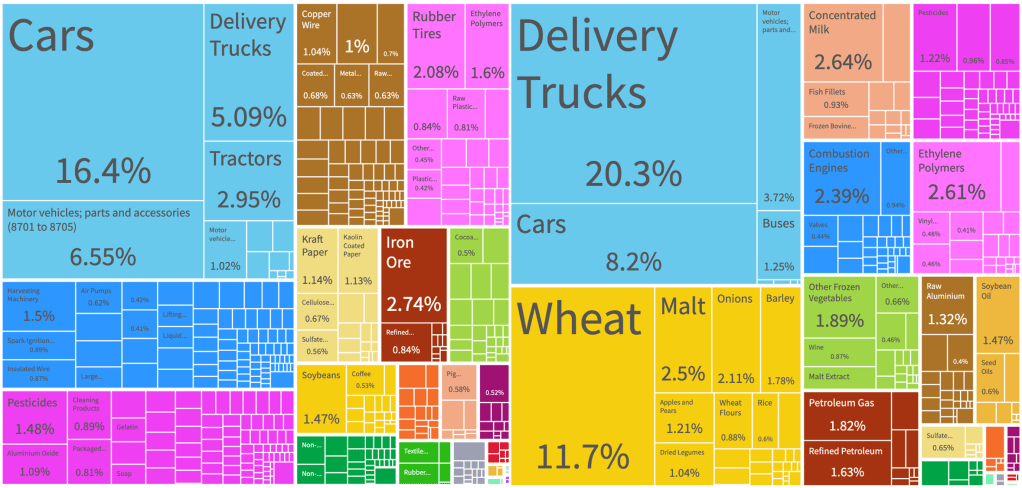
If we therefore look at the proposed Argentine-Brazilian ‘Sur’, we have to ask ourselves before we dismiss it, what are the objectives and how might they be achieved? The Argentina peso is a basket case, but the Brazilian real is not exactly the Deutschmark either. Regardless of recent crises therefore, the Sur must be based on some sort of complementarity: theoretically a commodity exporting superpower whose overwhelming dollar reliance might be transformed into a monetary of its own, aided by some flattening of the cycles between various commodity prices. The trade between the two countries, interestingly, is much more diverse than one might think:

Brazil exports by value to Argentina (left) and vice versa (right) in 2020

Source: The Observatory of Economic Complexity

Now, none of this is to suggest the Sur will work. On the contrary, guessing today, it seems unlikely to ever take form. Neither Brazil or Argentina represent a clear imperial winner over the other. Neither is notably better managed (though Lusophile lobby would contend that Brazil has had a better recent innings). Yet neither are they clearly complementary: although Brazil is Argentina’s largest export destination, at just 14% this is not determinative; on the other hand Argentina accounts for just 4% of Brazil’s exports, dwarfed by its relationships with China and other emerging markets.

In fact, far from being different, Argentina and Brazil are probably too similar. Apart from a history of poor public policy, the strengths outlined above are their weaknesses too: both countries are still overly focused on commodity trade. Dollar-based raw materials account for two thirds of each country’s exports. Indeed logically, both might be better adopting the Dollar instead of looking at such a doctrinaire project – Argentina’s experiment with the peg over the 1990s, whilst it collapsed ignominiously at the end, was in retrospect quite successful at the core objective of halting inflation – which has since returned with a vengeance.

So neither model of currency union are obvious, for now. Yet, the reasons it may succeed or fail ultimately are not economic, since economics is the servant of politics. The Euro’s greatest weakness has not been economic but political, the Project falling between these two contrasting motivations of democracy and empire. If the Sur starts life with a clearer assertion at the outset, it may have some rationale. The lack of an obvious imperial winner between the two countries, ironically, actually gives the project greater clarity – this will be democratic and complementary, or it will be nothing.

It will probably be nothing, of course. Or, we will quickly discover that Argentina is in such a hole that Brazil effortlessly becomes the imperial power in this relationship. Either way, I await the political will behind this idea to manifest, before I judge the dream quite so harshly, and there remains a lot to learn from the Euro along the way.

In defence of … Empire

The Muse bids me consider the good, the bad and the necessary forms of power

Two decades ago, the subject of empire, which had long fallen under the pall of apologetic navel-gazing in academia and in political discourse, experienced something of a revival. On Home Counties coffee tables in around 2003 emerged books such as Niall Ferguson’s Empire: How Britain Made the Modern World and, a couple of years later, his follow up Colossus: The Rise and Fall of American Empire. Both were made into TV series, leading to rather bitchy comments from my own tutors at Oxford over exactly how much of a sell-out he had become. Ferguson moved on soon to NYU and latterly Harvard, where he continues to be a proponent of sorts, of the imperialist revival.

He was not the only one however. A far more academic book, though still accessible, from a few years later in 2009 was John Darwin’s After Tamerlane, which charted the Asiatic land empires over the period 1400-2000 and took a nuanced view on empires, their existence, longevity and, buried amongst the prose, their benefits. The obvious point being that:

[A] propensity in human communities has been the accumulation of power on an extensive scale: the building of empires. Indeed, the difficulty of forming autonomous states on an ethnic basis, against the gravitational pull of cultural or economic attraction (as well as disparities of military force), has been so great that empire (where different ethnic communities fall under a common ruler) has been the default mode of political organization throughout most of history. Imperial power has usually been the rule of the road.

On the other side of the Atlantic, the process of soul-searching brought on by the foreign policy of George W Bush generated much writing, with 2010 alone producing three prominent volumes in the shape of Empires in World History by Jane Burbank and Frederick Cooper, The Rule of Empires written by Timothy Parsons and Empire for Liberty by Richard H. Immerman; this unsurprisingly coinciding with the accession of Barack Obama, probably the most forthright anti-colonialist (and perhaps anti-British) man to occupy the White House since Grover Cleveland in the 1890s.

However, after that burst of activity, Empire has again experienced decline in the perceptions of the liberal public – not least through the sophistry of race relations which re-emerged through the 2010s, accelerated by Trump’s election, BLM and in my world, the absurdity of movements such as #RhodesMustFall (though I am glad to report that as of this moment, Rhodes’ statue still looks down majestically from its cupola on the High). Iraq and Afghanistan have gone the way many feared; perceived Russian and Chinese aggrandizement continues. ‘Empire’ has not had a good innings. Yet the lessons about why they are good, bad or necessary are still overlooked, and I feel obligated to rehearse them once more.

First, Empires bring peace; and their decline brings conflict. Whilst this may sit in cognitive dissonance with how history is taught today, the reality is that for a majority of peoples governed under imperial structures, lives were more stable under this regime than what they might otherwise have. This is not only empirically true – Spain and North Africa for instance were largely left in peace for three centuries between the Punic Wars and the Crisis of the Third Century, despite not being Roman “heartland” – but also logically. See also China, Byzantium, the British and French empires and even the dysfunctional American equivalent (though as Ferguson says, Americans just aren’t very good at empire). Ethnically-focused nation states must be more prone to friction with neighbours than an empire which is first and foremost self-interested in minimising that friction. No successful empire has ever seen greater violence and destruction in its borders, than its alternatives.

Secondly, Empires bring prosperity. Much like any political system, the proof is in the pudding and there are very few examples of empires which successfully exist for long based only on coercion. Even the Empire in Star Wars, for instance, would have had more adherents than resistance and the Jedi should probably have asked themselves why they were in such a minority for so long – probably because their own scattergun and slightly racist alternative proposition could not even persuade Ewoks, let alone the merchants, professionals and other middle classes of the Empire that their mess was better. Most complaints about empire comes from self-indulgence, and nowhere was this more plainly set to rights than in Monty Python, whose sketch in The Life of Brian was a thinly-veiled lampoon of anti-colonial opinion across Asia and Africa:

Lastly, empires bring diversity. Given the propensity to celebrate everything “D&I” these days, it is worth pausing to think about how much empires, rather than nation-states, and created and sustained true multi-culturalism. Ultimately, empires are agnostic about the culture they carry, and as they expand absorb ever greater amounts of what they oversee. It is notable for instance, the Prime Ministers such as Thatcher and Blair were eminently more parochial than similar bourgeois classes a century earlier, whose relatives would have grown up in India, the Sudan and elsewhere serving as bureaucrats and engineers. Whilst Europe has provided some remedy to this parochialism, it is not complete: since the decline of empires in the 1960s, modern (western) nation states and their governing classes know less about the world around them than ever before, leading to everything from half-baked trade pacts like the WTO to neo-conservative adventures in the Middle East. The borders of empires are soft and porous; the borders of nation states are hard – and with it hardened views on identity and inclusion.

Coming from a family that emigrated under the auspices of Empire from China to India to Britain, I take a personal pride in the system that allowed for this to occur. Britain offered an attractive cultural and civilisational prospect, of course, and its contemporary weakness in this needs addressing; but more importantly it was the infrastructure of empire that served so many millions of people so well, for so long. It gave opportunity, egality, stability to the very poorest in society, at the expense, ironically, of the “home” nation.

Empire is here to stay, not just because of legacy but because its really quite a popular system. The definitions may vary over time, but the principles of expansion and peaceful, productive dominion of a periphery by the centre will remain permanent. A decade ago I argued that we were witnessing the emergence of a new “community of empires”, given the way not only Russia and China, but also India, Brazil and others were run. Some of this has come to pass, others are slow burning. But before we continue to trample the legacy of empires, we should remember why they appealed; since they are an inevitability, perhaps it is better we embrace their positives rather than engage in futile self-flagellation.