It’s the net tariff differential, stupid

Free trade was never supposed to be the end-game
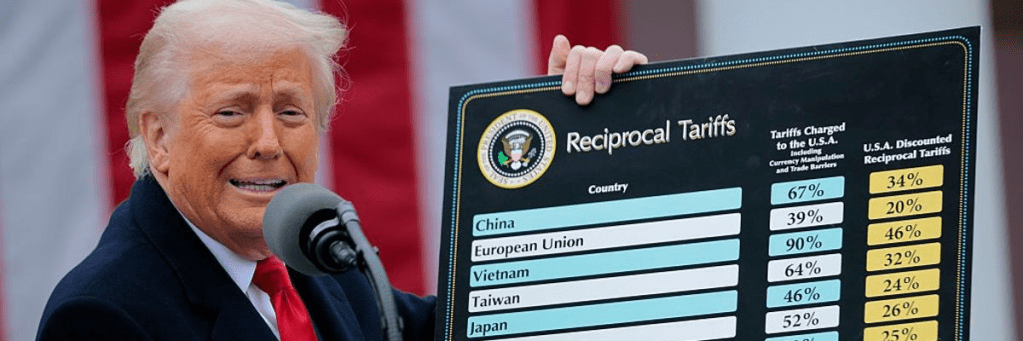
With the dust settling on tariffs, it is opportune to take a moment to consider the sheer scale of change ushered in by Trump on global trade since 2016, and especially with recent events. Trump’s policy is often confused by a vast amount of ‘noise’, which tends to undermine even his own news cycle (see the recent Iran nuclear facility bombing, for instance). Which is a shame, because he has almost entirely remade the landscape, and whether one supports or opposes the theory behind it, it seems irrevocable.

There have been two major components of this earthquake. First, Trump has instated and effectively normalised a global 10% tariff on all US imports, regardless of origin. As noted elsewhere, a ‘universal’ tool like this is by far the most efficient mechanism to charge the world a cost of doing business with America (a concept the youth of today will more easily liken to “gas fees” paid in the world of crypto). It has also raises the policy ‘baseline’ to a figure greater than zero, which I discuss below.

This baseline 10% has both more or less been accepted without reciprocation, by every major trading partner including the EU and China, regardless of vehement struggles over additional duties on top. Whether this 10% is the only tariff, like Britain, or whether it is just the minimum, like Japan and Korea who currently have 25%, the standard has been set and moreover will be very likely here to stay – any future US administration may renegotiate on specifics, but will almost certainly leave the baseline in place. It is now quite simply a fact of commercial life.

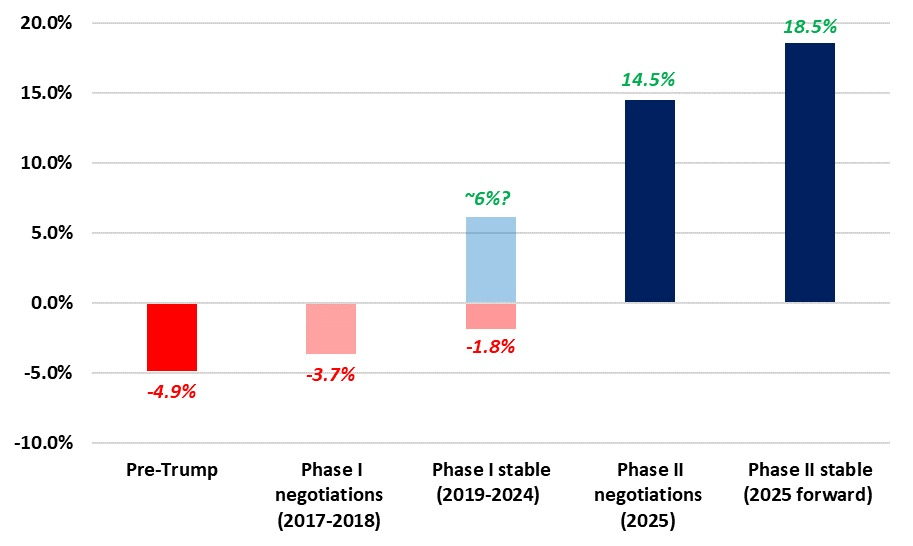
Secondly, there is China. Amidst all the turmoil (which may be part of a grand plan, but frankly who knows), Trump has continued his decade long trade strategy of increasing tariffs and daring China to fight back and contest who holds the most leverage. This bluff has been called several times, and has resulted in the US turning the net tariff differential (the principal measure of ‘success’ in any tariff strategy) in its favour for the first time in living memory.

US net tariff differential with China, 2016-2025

Sources: PIIE, underlying sources
Notes: 1. Trade-weighted tariff rates in 2016 were 8.0% on US exports to China vs 3.9%  on imports; 2. While the notional differential achieved in Phase I was -1.8%, in reality China unofficially suspended many import duties leading to a positive differential under Trump’s first administration; 3. 2025 forward numbers based on latest round of negotiations ending May 2025.

When Trump first emerged on the scene, the institutional trade nexus between the US and China, comprising both WTO and bilateral arrangements, was such that China imposed about 5% more duty on the US than vice versa. Liberal economists contended rather tritely that this was a price worth paying. Yet over the course of both the 2016-2020 presidency and now in his second term, this negative differential was first reduced and now into a major surplus. China, despite raising tariffs of its own, has acquiesced to the new normal that it must pay the US more than the US pays it, for trade. If anything can be considered a ‘win’, this is what it looks like.

In the meantime, we have seen no sign of the supposed economic slowdown as a consequence of the “trade wars” [sic]; there have been plenty of anecdotal examples of exporters eating the additional cost into their bottom lines; and after the initial volatility, the markets have settled down into a rally. Personally, I regard none of these as important for long term strategic reorientation, but among the breathless commentariat fainting at news from the bond markets, it seems to matter.

And what is the point of all this, might you ask? For me, on the subject of tariffs themselves, this policy has been a triumph of common sense. I have argued for years that the US and others needed to ramp up tariffs for several reasons.

One main consideration is that today’s global economy is no longer that of Ricardo’s. The applicability to free trade theory to a landscape of non-tariff barriers, unfungible services, and complexities of cross-border supply chains are extremely limited. Furthermore Ricardo assumed (as all economists tend to) agnostic counterparties motivated and constrained by economic incentives including public wealth and living standards; he did not factor in malevolent strategic actors who would happily pay a cost to bend a supposedly neutral system to their own agenda. Let us be in no doubt: if Ricardo were alive today, he would be pushing for trade tariffs.

Another outcome is the pushing back on the idiot savancy© which has led the technocratic classes to glorify “zero” targets – tariffs, interest rates, inflation, exchange volatility, even carbon emissions (though strangely not taxes or immigration). In most areas of public policy, however, zero is convenient for bureaucracy but wrong for the public. Low rates can occasionally be enjoyed as an output, not an input, but freedom to raise them are the safety valves required for cyclical management of the economy – sometimes you want inflation; sometimes you need currency devaluation. Tariffs, too, are a tool whose starting point (the ‘baseline’) needs room for manoeuvre both up and down – as a decade of near-zero interest rates have demonstrated, autistic ambitions hamstring policy tools needed to meet new challenges (I will write separately about this whole topic). So 10% or so suits the US quite nicely.

How tariffs will end up functioning is an unknown, due in part to how long OECD governments have allowed their muscles to atrophy in recent decades. And nothing scares technocrats more than the unknown. Yet beyond the anecdotal evidence of implementation, we also now know that the first round of Trump’s changes in 2018 led to substantial fiscal outcomes, with customs revenue doubling from US$35bn per year to US$70bn and well beyond.

Source: Bloomberg

This income is forecast to continue rising unless the economy tanks, but little sign of this. How the US government chooses to use this windfall is a separate matter, but the income certainly exists and one reason Biden chose to continue Trump’s tariff policy was that nobody wanted to look this gift horse in the mouth. While revenue raised is not central to the justification for tariffs, they offer an important lesson in how erroneous predictions on effects can be.

Most importantly of all, regardless of whether one supports increased trade protectionism or not (and I accept there are plenty of arguments to be had on either side), Trump continues to challenge the orthodoxy that such sharp directional changes are not even possible. Because for every protagonist arguing against the economics of tariffs, several more are usually hiding behind the sophistry that “he will never be able to do it, anyway”. These are the people cheering on the bond market turmoil or China’s retaliatory duties, unwilling to admit out loud that if it could be done, it might actually make sense for people, even at the cost of being vastly more inconvenient for the beneficiaries of globalisation.

As with defence or immigration, Trump has shown that none of these shibboleths are untouchable. The governing classes, while self-interested in keeping the policies of the last fifty years in place, has been surprisingly ineffective at stopping Trump from turning 180 degrees on tariffs or NATO or Iran, despite loudly arguing that it could “never be achieved”. So it turns out that the system, for better or worse, can be changed. Perhaps after all it is actually Trump who is living Obama’s best life, as he surveys the world around him and tells voters “yes, we can”.


Why David Plouffe won’t win elections, or get matches on Tinder

Plouffe’s inability to recognise why issues like trans rights swayed votes is the reason why he is bringing the outdated Obama era down with a crash

Having kept his head down (with some justification), David Plouffe recently emerged for the first time since the election to contribute to some of the very worst takes about the 2024 election, on Pod Save America.

It’s very easy these days to understand who has experienced an ad, so we were feeding a lot of digital ads to people who might have saw that spot. But at the end of the day, we were spending a lot of time with voters in these battleground states both quantitatively and quantitatively, and this trans ad was not driving vote.”

To say that Plouffe is from a different era is an understatement – he is now the Paul Krugman of electoral politics belonging to a barely recognisable age. In his defence of the failed Harris campaign, however, we can identify a mental anachronism which will continue to drag the Democrats down, even after being shocked by the force of nature that is Trump in three consecutive presidential elections. As a supporter, historically, of Bill Clinton, Gore, Kerry and even Hillary in her 2008 incarnation (not so much eight years later) this pains me. Everyone is offering their views on how “out of touch” the Democrats have become, so here I offer my own.

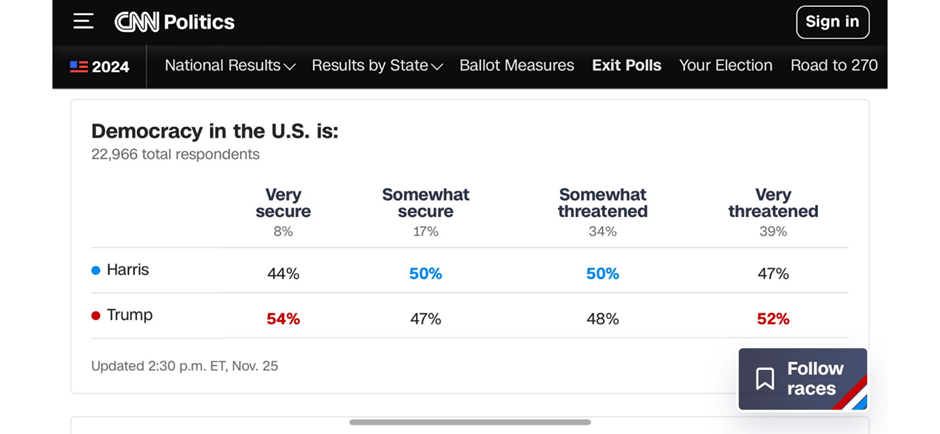
First, the Democrats appeared to make a basic error in interpreting polling on voter priority as monolithic support for their side. The most obvious case was seeing “the state of democracy” as the biggest concern for voters, but assuming that such people must be anti-Trump side. As the exit polls showed, among those who considered democracy threatened around half actually supported Trump, not Harris:

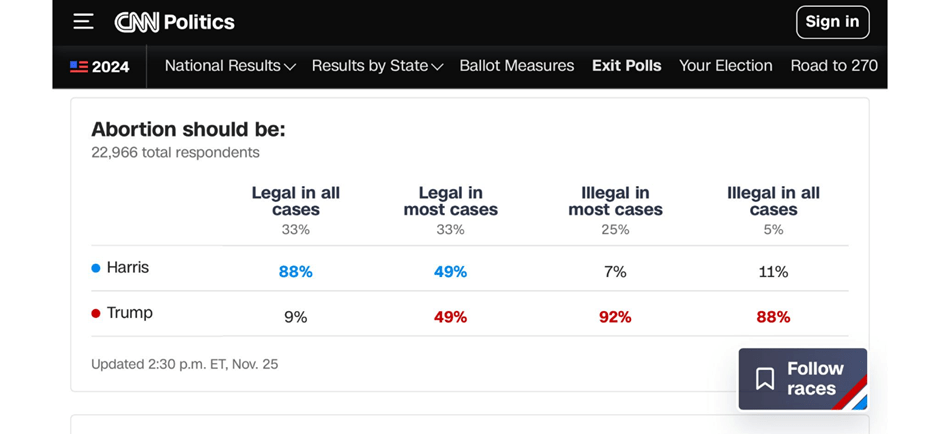
Even if we accept that people voted on the basis of just this one issue, it turns out as many considered the ‘lawfare’ campaign against Trump as a threat to democratic norms as did the events of 6 Jan, and Democrat pursuit of the argument that “Donald Trump is a fascist” were not only failing to gain traction but may actually have been counterproductive. The same applies to abortion, which earlier on in the campaign was considered critical: among the one-third of voters who thought abortion should be “legal in most cases”, voters were split evenly between the two candidates:

If strategists such as Plouffe were not even bothering to dig into the numbers behind the headlines to this basic level, it is hardly surprising that they were wasting their resources based on biased assumptions and projection.

Secondly and more importantly however, is the very use of voter prioritisation polling. Most examples of such polling were single answer (rather than, for instance, allowing respondents to choose as many as were important). This created two problems: the error of forced choice and the error of colouring. Forced choices make people go with obvious and pronounced options even when other issues might cumulatively be more important (eg the economy might be outweighed by adding immigration + crime together). Colouring is the consideration that a seemingly insignificant issue by itself still adds a great deal of colour to the candidate or party, influencing voting subtly.

The fact is that most people do not vote on ‘policies’ other than very occasionally when a policy is so simple that it cuts through all the political noise to become totemic. These are so rare that we are hard-pressed to even recall many instances – although Trump’s promises on trade treaties in 2016 comes to mind (as well, perhaps, as his “no tax on tips” policy this year). Elsewhere, the chance to buy your council house under Margaret Thatcher in 1987 is an example from the UK, as was Jeremy Corbyn’s land value tax proposal in 2017. Rather than policies, voters pit a general sense of where policy proposals are headed (eg “lower taxes”, “tough on crime” etc) against a matrix of what a candidate is ‘famous’ for. If the candidate is not well known for the economy for instance, no amount of policy proposals on that subject will mean anything. People vote for their impressions about a candidate, not so much the content.

Which leads to the issue of trans rights, which Plouffe so airily dismissed as “not driving vote”. He was of course correct that it affects tiny numbers of people, and directly animates only a few more; but he is wrong that Harris’ well known past history on trans matters did not colour voters’ impressions of who she was and what she tends to care about. Certainly, she did not come across as tending to care about immigration or inflation, two subjects Trump did convey; on the other hand the trans dsicussion, while not shifting votes directly, added up to an impression of her priorities. On a broader level, it brought into focus her judgement – “is a politician sanctioning free transgender operations for prisoners really worrying about the same things as me?”. Issues can be obscure without being innocuous.

(The same, by the way, was true of Brexit where for years the polling had told us that the issue of “Europe” was not a priority:

Yet this totally missed the point that while in a forced choice, it was not important, at the same time its many facets coloured huge chunks of the public discourse about Britain and the efficacy and power of its government to effect change on matters such as the economy or immigration. Rightly or wrongly, the democratic overhang created by EU membership far overshadowed the importance of the actual issue in voters’ minds and this manifested as a groundswell of discontent which could barely be contained – if Cameron had not asked the question in 2016, a future prime minister would have had to do so within the ensuing years).

None of this nuance emerges in Plouffe’s narrow and mechanical interpretation of voter issues, but it does not take a genius to see how it all connected in the minds of a voter who is only semi-engaged. I will use the parallel of Tinder, where I doubt David Plouffe would have much success, to illustrate the point.

If we strip away the 50% of women and 99% of men who swipe left or right based purely on the photo (although this, too, may be instructive to campaign directors), we are left users of the app having only a quick glance of the few things written down on a profile to decide their choice. Now, imagine a man includes the sentence “vegetarian” in his profile, and consider the consequences. Few women will be so militantly carnivore that they swipe left for this reason alone; but there is no doubting that it somehow adds colour to the profile which will make them think twice. “What does this guy care about?” “What sort of restaurant would we have to go to?”, “Will he force me to only eat lettuce?” and so on. Nobody will admit to vegetarianism having been the deciding factor for their swiping, but you can be sure that it did its job in making that profile underperform in finding matches.

Such structural misunderstandings significantly weakened the strategy Plouffe and his crew were running, well before we get to the litany of “unforced errors” which surely did not help in what was supposed to be a tight race: bear-hugging the Cheneys on campaign; encouraging abortion ballot initiatives in the same election meaning voters could split their ticket and vote for Trump and for abortion; avoiding Joe Rogan and not distancing from Biden; and the ignored sense of scandal surrounding both pretending Biden was mentally capable until June, and then replacing him without a primary. But these need not be litigated here, because the Plouffe team had made historic mistakes in reading voters’ preferences well before the campaign minutiae.

It is, in a sense, rather poetic that the governing classes in both parties (and in the UK) who for so long have sought to reduce politics to a pseudo-science of well-placed dog whistles and esoteric metrics about the economy, should be hoisted on their own petard. Trump offered little if any direct policy solutions to the questions of immigration or inflation, but voters felt he understood it in his marrow. The Democrats need not had offered policy answers either, they simply needed to find a candidate or a message which showed they too understood the problem. But having spent three decades telling voters that life is all about the statistical evidence, about management, about professionalism and about making sure the ‘system’ worked, voters then went on to rightly judge them on these very metrics. Prices were up, groceries less affordable, government seemingly ineffective. If you live by technocracy, you will die by technocracy.

Lichtman’s model may still be good, even if his 2024 prediction is wrong

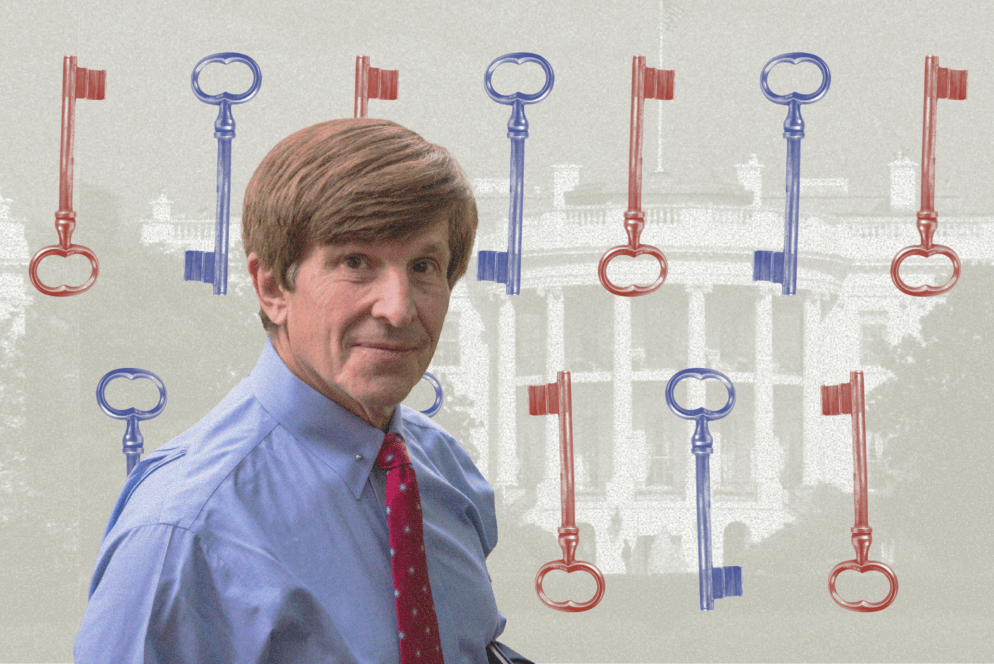
An absurd online tussle has commenced over Allan Lichtman’s ‘Thirteen Keys’ thesis over the coming US presidential elections, where not only are endless amounts wasted on challenging his predictions (“He is biased! No he’s not! He’s pro-Democrat! He wears a wig!” etc), but actually being threatening to the poor septuagenarian. Even in the heated environment of this contest, as JD Vance says, this is not worth it.

Yet it presents a good opportunity to think about how robust his model actually is. For the record, I like this type of macro historical analysis, and I think it has value. In particular I like the discipline it instils in not subjecting the election only to the noise of the latest polling. On the other hand, I have a sneaking suspicion (famous last words, perhaps) that Lichtman’s actual predictions this year, which are for a Harris victory, may be wide of the mark. Would this render the model broken?

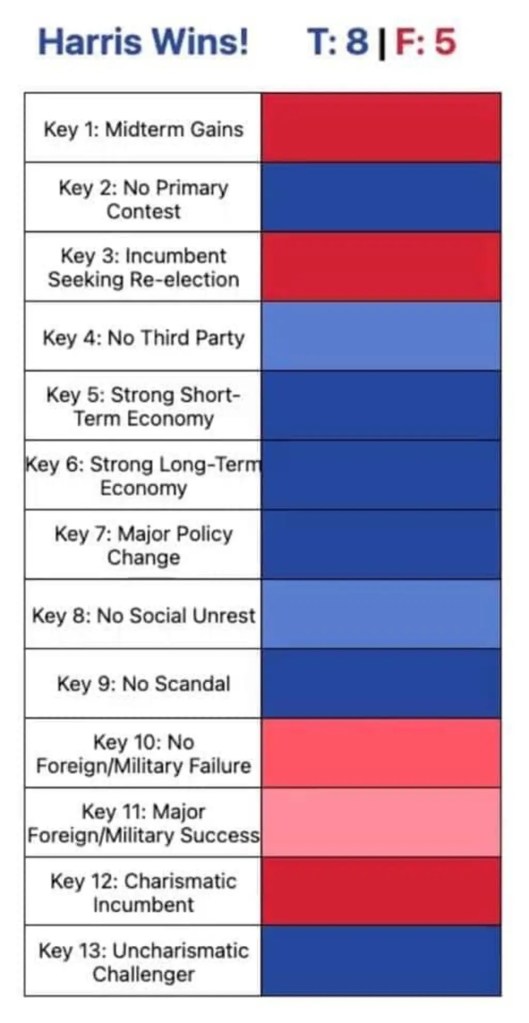
I don’t think so. Trump may well win this year, but if he does so it will be less about Lichtman’s model being wrong so much as Lichtman’s own interpretation of it. Let us bear in mind that the model is just that – a neutral series of tests (explained in detail here) – but Lichtman then has to take these tests and package them into an opinion (below is the most recent I can find). There is plenty of room for subjectivity. Currently, he sees the lie of the land like this:

Critics of Lichtman’s model – and there have been many – mainly focus on the keys that are obviously open to interpretation and are therefore ‘subjective’. Nate Silver for instance notes that the two “charisma” tests are very much in the eye of the beholder, while others would complain that the definition of a “major policy change” or foreign policy “success” or “failure”.

However I am less interested in those tests so much as the supposedly binary ones. Because the problem is that the whole political system has been shaken in the last decade, resulting in what I think are some structural problems in Lichtman’s definitions – his underlying intent is correct but the manifestation of the issue he has identified no longer conforms to how he has set the keys up. Below, I focus on a few examples.

Key 2: No primary contest

Now this may seem obvious and technically true, but I think Lichtman may not be seeing the wood for the trees this year and ignoring his own wisdom. If we take a step back, the point of there being “no primary contest” is essentially that the incumbent party has not had a bruising encounter which exposes disunity in the ranks of the incumbent party seeking re-election (apparently the same is not true for the opposition, which I have some sympathy with).

But considering what has occurred in 2024, I am not clear that this is true in spirit, even if it by letter. The fact is that many Democrat supporters either a) resented Biden being deposed the way he was, or b) did not like Kamala’s unchallenged rise to the nomination. I personally know a few who have not forgiven the party for what appears to have been a hugely opportunistic change (and let’s be clear, it was perfectly possible to have still had some sort of debate leading up to the Convention, something championed by many including Ezra Klein and numerous others here and here). While Harris acceded unopposed at the Convention, her elevation left quite a bitter taste in many corners of the party.

Thus, while technically the incumbent party did not have a divisive primary, there has in fact been discontent around the selection procedure, so awarding the key to the Democrats in this case is structurally dubious.

Key 3: Incumbent seeking re-election

In this case Lichtman has given a key to Trump which is questionable. Of course, again strictly speaking, Harris has not been President and is therefore a new candidate. And even allowing for sitting VPs such as Al Gore not being considered ‘incumbent’, the peculiar issues surrounding 2024 again makes this seemingly binary key more nuanced.

Is Harris an incumbent? Who is the incumbent? Not only has Harris been part of a long-running trend whereby VPs have been more active in the Executive (Gore and Cheney, and now Harris), but she has now basically been Acting President due to Biden’s incapacitation. She was elevated only after the incumbent had been selected and had started to campaign for the presidency; she has inherited almost his entire infrastructure and strategy and by choice or not, has been unable to distance herself from the Biden administration. To my mind, unlike when a VP runs after an 8 year term (such as Gore in 2000, or HW Bush in 1988), I think the public will likely see Harris as a continuity of the regime, for better or ill. In Lichtman’s model she should therefore get credit for more or less being an incumbent.

Key 4: No third party candidate

Here is perhaps the most far-reaching and controversial challenge to Lichtman’s definitions. Again, of course, this is technically true since Lichtman defines “third party candidate” to mean an officially non-aligned candidate who polls more than~5% of the popular vote. In other words he is limiting himself to the Ross Perots and Barry Goldwaters of electoral history. But with 2016, I think this part of the model has been completely blown out of the water.

Trump, in 2016, was essentially the first third party candidate to win the presidency. Yes, he ended up tackling the Republican primary and using that as a vessel into politics, but he famously had previously been a Democrat and moreover, disagreed with much of the incumbent GOP platform and heritage. Trump’s greatest moment in the primaries was arguably his anger at calling out the Republican establishment over the Iraq War, and being roundly booed for his troubles:

To look at the purpose of Lichtman’s key, it exists to highlight that a significant third party usually indicates discontent with the system, which tends to favour the challenger (this I think is a debateable point but generally I can understand his perspective). No third party therefore favours the incumbent. Yet if a challenger has essentially captured the opposition vessel for effectively becoming a third party candidate, this no longer applies. The same would be true, back in 2016, of a potential Sanders candidacy for the Dems would have seem him as an outsider also. I previously expressed the 2016 worldview like this:

PhyPhi - post 2016 politics

So ultimately we are judging Lichtman’s model by his own narrow interpretation, since as far as I know nobody else is doing an independent version using the same system. But just as an example, if I switched the three examples above around, the 8/5 balance becomes 7/6, and we would be left with discussions over imponderables such as the fact that there are millions of Obama-Trump voters, which belies the thinking that Trump does not win over people from the other side (the definition of “charistmatic challenger”). Indeed whether Trump, in or out of power, would ever be not a “challenger” is itself a question for Lichtman.

For the record, my own interpretation of the Lichtman model offers a 8/5 in favour of Trump. In addition to the key changes above, I would change the charismatic challenger key as explained, and I also sense the “scandal” key to be more prominent than Lichtman believes, because I think there is a whiff of wrongdoing around how long or how early senior Democrats have been hiding Biden’s senile incapacitation. But, as others have noted, these are down to personal views and the polls continue to tell us the race is close.

On balance, I would say that Lichtman’s model is one which we can proceed with with caution for fun, but I would urge psephological geeks (such as myself) to drill into the underlying keys and render their own interpretation, rather than rely on Lichtman’s. Separate the man and his keys, and you may be better off.

Forgotten Fantasisti: Domenico Morfeo

Part of an occasional series translating some of the most interesting foreign language football writing

“I could, but I don’t want to”

Football observers, who are often amateur anthropologists, have long held that Latin American players carry their varied ancestry from the Old World with them; in particular, that those of Argentina often demonstrate their Italian roots. Domenico Morfeo, on the other hand, despite being born in Pescina in 1976 and having never left for foreign shores, could easily have been mistaken for such an emigrant. The delicate left foot, the innate confidence, the prosaic facial expression contrasted with the dynamic sense and touch of the ball, might all have been found on the streets of Buenos Aires or Montevideo. Yet destiny was to take him on a long, winding road of turns and dead-ends until he finally returned home, in a series of migrations that were little more than local.

A subtle left winger with great dribbling ability, vision of the game, the ability to provide pinpoint and balletic poise, close control and shooting precision made him a complete fantasista. Set against this was his diminutive size and delicate physique. Laziness and obstinacy of character round out the picture, the cracks through which his natural talents eventually slipped away. Trained at the academy of Atalanta Bergamo, he stood out while playing for their Primavera team such that at national youth level, one would often see Morfeo on the pitch while a certain Francesco Totti was left on the bench.

He made his debut at Atalanta at the age of 17, registering 3 goals in 9 appearances in the initial season. He went on to complete his apprenticeship by playing the following full season in Serie B and then two campaigns in Serie A, until at just 22 he had chalked up 83 appearances and scored 22 goals. Over those same years, Morfeo participated in the European Under-21 Championships with gli Azzurri, winning a gold medal in Spain I May 1996 in Spain, triumphing on penalties against the hosts. He was the final penalty-taker, capitalising on a mistake from Raul; this was the Italy of Cannavaro and Nesta, of Panucci, Tommasi and Totti – all coached by Cesare Maldini.

Morfeo found his way back to the motherland of Atalanta many times

The first spur for Morfeo’s career came with the move to Cecchi Gori’s ambitious Fiorentina. But here also emerged the early signs of his character limitations, in a side containing giants of the game such as Batistuta and Rui Costa, as well as the excellent Oliveira. 5 goals in 28 appearances in his first season was a modest if respectable haul, but lower than might be expected. The following season, Fiorentina signed another forward, Edmundo (‘O Animal’), another competitor in terms of talent and on-field personality potentially pushing Morfeo down the pecking order.

The new role designed for him by Trappatoni did not help, either, relegating him to the wing where Morfeo did not have the physicality and pace to express himself. Approaching a critical phase for his development, he found himself loaned out first to Milan (where he did in fact win a Serie A championship, albeit as a non-playing protagonist) and the to Cagliari. The instability doubtless watered down his performances.

Domenico finally seemed to find his true self in Verona, at the court of another ‘Ceasar’ just starting to make his mark in Serie A. This one, Prandelli, was familiar with Morfeo’s talent through Atalanta’s Primavera, who he had coached to victory in the Viareggio Tournament in 1992. Arriving during the winter transfer window while the team appeared on the verge of relegation, Morfeo finally demonstrated the full repertoire of ability that everyone had suspected for years. With 5 goals and countless contributions in 10 games, he dragged the gialloblu to safety.

Morfeo now returned to Florence, full of expectations, yet things would still not go his way: after just half a season he departed on another tour, this time to his motherland of Atalanta. After this, at his athletic peak of 26-27 years old, he strung together a couple of modest seasons first at Fiorentina itself (18 appearance and 2 goals), and then at Moratti’s Inter where he reunited with former teammates Toldo and Batistuta (17 appearances and a single goal).

One of Morfeo’s 17 appearances in the Champions League, where he scored 3 and assisted 1

It was to be once again Prandelli who would bring Morfeo back to an environment more suited to his ability to express himself. Prandelli wanted Morfeo with him at Parma, where the team needed to find itself again after the glory years of the Tanzi era. Here, finally, Domenico was able to play with reasonable continuity for four seasons, being selected for around two-thirds of the club’s fixtures and scoring a few goals here and there – the high point being 8 goals in the 2004-5 season. Moreover his contributions were often decisive, particularly in providing assists to the front men in a notable pairing with Gilardino. Long and short passing, backheels and placed shots, it was finally magic again for Morfeo.

The fifth and final season at Parma marked the bitter end of the relationship. Then at 32, Morfeo appeared to be on the verge of dropping down to Serie A to join Brescia; but, even with the paperwork signed, the now worn-out talent from Abruzzo reneged on his contract having only taken to the field for a single Coppa Italia match. In 2009, another of his former mentors from Atalanta, Emiliano Mondonico, summoned him to Cremona, but even this was not a success: 4 miserable appearances marked the end of this career as a professional.

What remains to us of Domenico Morfeo is at the same time both too highly acclaimed to be forgotten, but also clouded in disappointment; a sense of “I could, but I don’t want to” which is difficult to comprehend. He possessed great class and ended with some reasonable numbers (54 goals and 51 assists in 282 games in Serie A, during that league’s golden age), but fans are hard-pressed to remember them unless they happened to be there in the ground during a moment of magic. Ultimately this is probably Morfeo’s greatest enigma – the King of the Lesser Tens.

**********************

Preface to the original article, from the Mondo Sportivo column ‘The Children of Lesser Gods”, authored by Paolo Chicherchia:

This is the first instalment of a new column dedicated to all those fantasisti which have intermittently shone, like actors on suburban amateur dramatic stages, without ever making that final step up to true quality: provincial playmakers, directors caged within their own limitations, clear talents lumbered with pub physiques, deft-footed hot-heads, wasteful artists, unlucky stars and fragile champions, often considered “the next big thing”. All of them have floated outside the ranks of the greats of the game, but all of them have created magic in that No 10 shirt so beloved by football fans.

Why companies in Asia are finally going to need real strategy (even if they don’t know it yet)

Most think they have been strategic, when in reality they have just been gambling

My LinkedIn has been showing the first signs of waking up, in recent months, to roles centred around ‘strategy’. This broad term takes into account a range of positions, all of which are yet nebulous, but which nonetheless are being formulated by leadership. This reflects the changing nature of corporate life in the Asia region, where companies are struggling to grow the way they want – but most have not yet worked out why.

To quote one friend of mine, with a background in family offices, “a lot of Asian fortunes are going to be lost in the next decade or two” – principally (though not solely) due to declining asset prices in real estate. Urgency and heroism at these family groups are what is needed, but either these characteristics are not present in the generation governing them, or that energy does not have a constructive home.

The true scale of slowdown in the region has not yet been recognised. Corporate owners generally are too illiterate to distinguish between real and nominal GDP growth (an issue I have written plenty about before); comfortable board rooms in Hong Kong, Singapore or London survey Asia as a market which has slowed – but just a little. After all, real GDP in China dropped from some 10% on average in the first decade of the millennium, to some 7% in the second until 2019 (it has since spooked markets by generating only 5% over the Covid years). SE Asia was never quite that high, with GDP averaging around 5% in both decades. All pretty healthy.

But corporate top lines and bottom-lines are not real, they are nominal. And importantly, nominal GDP fell precipitously over the same period, almost halving in local currency terms from over 18% to 10% over the two decades (in USD term, growth rates have been even lower).

Source: World Bank (full notes at end)

In other words, the age of Asian growth is over. We are well past the phase of the rising tide – not just in China, but more or less across the region. This impacts both corporate performance, as well as property prices. Asian groups have, on the whole, seen their returns stagnate over the last decade compared to the decade before; and importantly they have fallen in line with nominal GDP growth – in other words they are ‘maxing out’ their ability to squeeze more. They have been able to outstrip GDP here and there, but it started running out of wiggle room well before the change in interest rates which seems likely to be with us for some time. Now, the future of growth looks even bleaker.

Source: CapIQ (full notes at end)

So where does this leave us? The reality is that most corporates in Asia have not really had a ‘strategy’ per se, even if they claimed to have. Instead, they made bets in a benign environment, where they really did not have to be very clever to make money. Most sectors across the board grew decently in a +18% CAGR world. Furthermore, a majority of these family groups already owned assets – principally prime real estate – which rewarded rent-seeking and minimised the need for innovation. Where such groups did venture into the unknown (Adrian Cheng in Hong Kong being perhaps the most prominent), things did not go so well. These businesses do not just need a new strategy, they need a strategy in the first place.

So what is ‘strategy’? Well first, it is easier to understand what strategy for such groups is not, particularly some frequent misperceptions and conflations.

  1. Strategy is not tactics (destination is needed before details)
  2. Strategy is not budgets (even though finance is how control is maintained)
  3. Strategy is not transactions (deals come only after we know direction)

Strategy is about what you want to be as an entity, and the broad direction of how to get there. In Asia, the biggest omission from corporate owners (who tend to be family) is not focusing enough on coherence and identity. Conglomerates are perfectly acceptable in their way; we have, since the rise of the tech giants on either side of the Pacific, witnessed a renewed era of conglomeration in the form of Google, Amazon, Tencent and Alibaba. Single sector focus is not important or the only key to generating shareholder value. Rather, bringing together wildly different businesses can be successful where the overall narrative of who you are still holds. You do not need to have operational synergies in order to have an ownership cohesion of even a sprawling empire.

‘Strategy’ is also about power. The preeminent objective for family groups in Asia, with minorities playing a lesser role, is preservation and the ability to keep your destiny in your own hands. Near-term returns are important; dividends are crucial; but above all else, is it control which is paramount. Life is a constant battle for control – against the government, against competitors, against suppliers, against customers. Strategic thinking is designed to look beyond the financials to the power dynamics in the market – for instance owning the loss-making delivery business which allows control of consumption for your upstream FMCG, or owning the low margin bank that finances speculative capital in new industries.

The purpose of ‘strategy’ is therefore to solve the triangle of dynamic forces which determine how a group can move forward. Capabilities either exist or need to be cultivated or acquired; opportunities need to be identified, sourced and validated; and the ability to invest, either through equity or debt or partnerships, has to be planned.

The tricky part is that moving each of these impacts the other two, and ‘strategy’ is therefore about determining how best to balance them to reach the overall aim and keep your identity. Buying new capability through M&A, say, might expand your opportunity set, but weigh on your balance sheet. Restricting your gearing risks not just limiting your opportunities to invest, but also stretch your existing resources in management.

But central to all of this – and where Asian family businesses are particularly lacking – is the need to build or maintain a true identity about who you are and where you are doing. In this region in particular, business owners undervalue how much identity is needed as a pay-off for lack of financial incentivisation and a demand for loyalty (same in politics). Hence identity sits and the very heart of how to think about ‘strategy’, a sine qua non from which all other plans flow. You need a cadre of people who remain loyal to the cause and hence work to protect a family’s interests across generations. They need, more or less, to feel like they are part of a partnership in the traditional sense; mercenary superstar management is the death-knell of the family conglomerate.

Which brings us to organisation. Lots of people think that they “do” strategy; yet more others have such a title; a third group really need to be strategic. The problem is, the three rarely converge. People confuse strategy with tactics, ‘strategy’ titles often mean doing M&A, and leadership is often bogged down trying to manage stakeholders and incremental decisions to really think strategically. Divisions and subsidiaries cannot be left alone to decide their own fates; their management is rightly limited to seeing things through the prism of their own industry. They cannot offer holistic views about the portfolio and they are not positioned to leverage the strengths of a group overall.

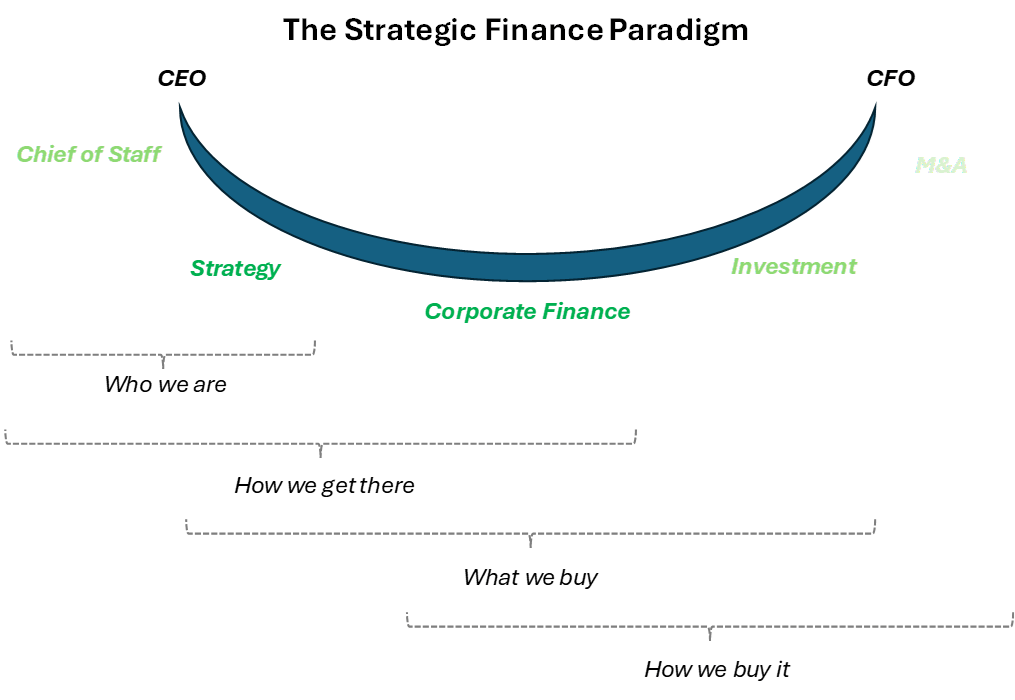
Yet ‘strategy’ is too much for just the Chairman or CEO to undertake, and still less the CFO – although financial control remains key. Getting ownership to think about identity and vision is a skill, and it needs focus. It needs one or more thoroughly invested people at or near the top to shape it and keep the flame alive. As discussed above, there are a range of titles or roles that reach across the spectrum of what I call “strategic finance” – both vision and execution.

And ‘strategy’ will only get more important. Some family groups still live under the auspices of an all-dominant chairman; others want to believe that they should interfere less in their businesses. But one thing binds them both: they underestimate the necessity of a wider, more bought-in middle who understand both the family and the firm, and who are invested in the strategic long-term wellbeing of both. Doing better is not about doing less or doing more, it is about understanding what is strategic and what is not – whether in capital allocation, M&A, organisational structure, portfolio evolution, employment programmes, partnerships or even investor relations.

The urgency and heroism mentioned at the beginning is what Asian family groups will need to survive. They may get lucky with the scion which comes to power, but with or without that, they will need to embrace all those things they found too intellectual, too esoteric, too academic; they will have to start doing ‘strategy’.

Notes:

  1. For GDP growth, data set is in GDP current LCU
  2. “Emerging Asia” comprises China, Hong Kong, Singapore, Thailand, Vietnam, Malaysia, Philippines and Indonesia
  3. “Total Asia” comprises above plus Japan and Korea
  4. “Asian conglomerates” comprises Jardine Matheson, Astra International, CP ALL, Keppel, YTL, First Pacific, Uni-President, Sime Darby, Swire Pacific, ThaiBev, SM, CITIC, Ayala and JG Summit
  5. “Asian property groups” comprises Hongkong Land, Sun Hung Kai, Swire Properties, Henderson, New World, CK ASSET and Wharf REIC
  6. “Japanese trading houses” comprises Marubeni, Itochu, Mitsui, Mitsubishi and Toyota Tsusho

Postecoglou really does have a philosophy – you just don’t understand it

And you might not actually like it if you did

One of the most curious things about Postecoglou’s tenure at Spurs is how little observers seem to actually comprehend what he is saying. In turn, this leads to not really understanding what he is doing, either. This blog should not come across as just trying to defend Ange against the grain of results like this last weekend at Newcastle; but I think it is worth trying to at least understand what he says, in order to either agree or disagree with it.

So let us start with the background of recent comments Ange made about fourth place. He has, of course, made comments allowing us to interpret all sorts of things, such as “let them dream” and “if I’m not mistaken, we are three points off the top”. With regards to the Champions League places, his exact words were as follows:

“I don’t see fourth as the prize. I don’t want to finish fourth if we haven’t grown and developed as a team. Part of the narrative is to push you in these kinds of positions where you think that fourth is some kind of achievement that gives you something for next year.”

“Fourth would be great if I feel like we’re growing as a team, and we’re creating something that is going to bring us success next year. But fourth is not our goal… If we finish fifth, and if I think we’ve got a team to challenge next year, then I won’t be disappointed.”

MSN et al

As mentioned, this led to bemusement and incredulity at both ends of the spectrum, oddly enough. Critics inferred that by saying this, he was releasing himself from any accountability over finishing fourth and getting the club into the Champions League. Proponents went the other way, telling us that he was saying that fourth is no ceiling, and we should be aiming higher than that (Maddison unhelpfully made similar comments this week).

Maybe this confusion reflects the intellect of the average commentator, but the likes of Dan Kilpatrick and Jack Pitt-Brooke need to be told that Ange is saying neither of these two things. He was alluding to some very some basic points:

  1. There is no prize in football other than winning. Any place below 1st is still a failure and trying to moderate how much of a failure you are by distinguishing between 2nd, 4th or 5th is sophistry designed to make supporters feel better.
  2. The nuance of exactly where you finish, especially when it is below first, do not tell the story he is bothered with. Excluding the exogenous factor of Champions League financial income, there is little which indicates that the team in fourth is somehow better, or on a more positive trajectory, than the team in fifth.

It is not so much that the league table lies, it is that for a ‘project manager’ the table is irrelevant as a measure of progress. The only measure of progress is … progress. And progress is not defined by the noise of individual performances (like yesterday), or where you are in the table. It is about what you see and feel when you watch the team play every week. “Are we a better team than before? Yes, or no?

And this brings us to the broader issue of Angeball philosophy**. This way of thinking, much more than the tactical use of inverted fullbacks, that Postecoglou is similar to Guardiola and Bielsa and some others. Because like it or not, the idea is that games aren’t a managed period of 100 minutes with beginning, middle and end; they should be a steady and constant stream of football. The blowing of the whistle signalling the end of one match or the beginning of another are merely inconveniently imposed breaks in an ongoing flow of action and implementation of the manager’s tactics and ‘plays’.

This was most clearly expressed when he noted that he didn’t want his teams being dictated to by the minutes on the clock or the score line. You don’t try and win things during certain parts of the game and sit back for others. You don’t react to ‘game state’. Every minute is just another minute of Angeball, trying to score goals, and it doesn’t matter who your opponent is or what the score is. It doesn’t even matter who you have on the pitch.

And this brings us to the increasing clamour regarding a need for a ‘Plan B’. Advocates of this are truly not understanding Ange, particularly when they start sentences with “I get what he’s trying to do, but … “. As far as Ange is concerned, the whole of this season is one long practice session. Changing things up tactically to win individual matches is all well and good, but is more or less just a waste of valuable match minutes where they should be practicing Plan A against real opposition. A match won through tactical changes is a match wasted. There is no Plan B – at least, not until every member of the squad has so internalised Angeball that he can finally look beyond it.

Guardiola pioneered this rather robotic nature of football, and with the likes of Messi in his team he was able to win La Liga titles and the occasional Champions League (though of course it was often noted that he ‘underperformed’ in the latter and “should have won more”). But the point was that every minute of a Guardiola team is another clean slate of Guardiola football, not an emotive reaction to events on the field. The end of a game against Burnley should be seamless with the beginning of the next match against Bayern. Details are mere noise.

This all being true, Spurs fans are arguably even more entitled to be more concerned about things currently, not less. As I said, I am not writing to defend Ange per se. The real question is whether Tottenham will ever invest in the squad to such an extent that they can reach a zen state of high quality football, inhuman and unsentimental. I have noted more than a few times that our squad is way, way off that level, and in the meantime the disparity between philosopher and the pragmatist is starker than ever.

Fans want to take every game as it comes. Fans see some games as more important to win than others. I’m sorry to tell you, that Ange Postecoglou – and for that Guardiola – just doesn’t agree with you.

** A previous post discussed football managers in the context of empiricism vs rationalism. Postecoglou is undoubtedly a rationalist, in the vein of great project managers such as Guardiola and even Pochettino. In philosophical terms, he is perhaps the Parmenides battling, in the current landscape, against the Heraclitus of Unai Emery. Arguably, to reach the top he will end up needing to reconcile both and eventually become the Democritus of English football.

Rather than to be feared, AI is just that dysfunctional kid we never liked

The excitement around AI, both from businesses and finance, is as frothy as it is palpable. My LinkedIn wall, that repository of the most commercially obvious, cannot go two posts without someone bringing up a reference to unemployed lawyers or the NVidia share price. Much like the coming of the Internet, the true market will follow the bubble as surely as this bubble has followed the uneducated speculation. Yet I see far fewer posts from actual operators about AI’s current uses or the direction of travel, due no doubt to that fact that we are still at nascency.

Yet even at this early stage, I would offer a few groundless, untechnical observations about how this is heading, based partly on a recent comment made to me that we are heading away from ‘data science’ and towards ‘content science’. I stand to be proved wrong, of course, but I feel some of the underlying truths will be difficult to challenge. Perhaps in three years’ time it will all look very different, but I will put it down for the record.

1. AI is the student, not the teacher 

To some this may seem obvious, but the reality of GPT and its B2B and B2C offshoots, is that they remain permanently there to be taught by humans.

AI will be able to do huge amounts of work for us in the future, no doubt. We are told that they will replace lawyers and accountants for instance, and the workplace will look different. I would agree with this, they are a future colleague – but the question is which colleague will they be? The nature of it indicates that the role they will perform is basically that of the new graduate trainee, or possibly even the intern. They are there, and a useful resource for sure, but they will not be producing finished products until you give them feedback, repeatedly. After a while you will wish they were able to at least fetch the coffee for you. Within our lifetimes, they will never have their own office to lord it over the saps outside and disappear off to play golf at 2.00pm on a Thursday.

2. AI is a pathological liar

It has been well noted that AI tends to ‘lie’ and many wonder how and why a logical entity would do this. But of course the vast majority of content for generative AI comes from content that is already out there, and that content has been written by fallible human hands.

In the same way that ‘the Internet’ lies – or rather, is full of untruths because those producing content are all well-intentioned – so also the likes of ChatGPT. Machine learning can only summarise existent knowledge, which is at best imperfect and at worst malicious. This is a poor kid that has been born of a dysfunctional, almost sociopathic family, so what chance does it really have of being a good boy and living a normal adult life later? AI will find itself divorced with estranged children and alimony of its own in decades to come. Arguably, the power of AI will actually magnify lies and illogic through its distributive power; the calculation error of a second rate accountant in 2006 will now form a permanent fixture within our reservoir of collective knowledge, when it need not have done before.

3. AI will reduce innovation 

More controversial than the two previous points is that the net effect of AI, itself an ‘innovation’ driving rocket-high share prices, will be to dampen innovation whenever it used – certainly unless visionary leaders really manage it well.

Referring again to the automation processes which everyone believes will be the first to go, the fact is that even while people are stunned by the ability of AI to produce a legal opinion that formerly took a highly paid lawyer days, that opinion will be decidedly unexciting. It can, after all, only be the output of decades of other lawyer’s opinions. As a student, AI is that kid who does not really think but is only able to regurgitate the books he happens to have read whilst sat in the corner of the library alone, friendless. Possibly he does this because of his parents’ acrimonious divorce, I don’t know. Either way, by doing this, and by that homework being accepted as a decent B+, it means that room for original thinking is limited. In fact, it basically means the quality of all work will only ever be a B+.

Optimistically, of course, AI frees us up to spend more time on productive, innovative thinking. But be realistic: when robots are cleaning your house, how many people will use that unexpectedly free Saturday afternoon for reading Nietzsche or climbing Everest; and instead, how many will be sitting with a bag of crisps rewatching old Netflix series and shouting “they were on a break!” at Rachel (note: guilty as charged). Again, given the power of AI’s distribution, this shift from data to content will actually amplify this ‘anti-innovation’. When we sit down to raw data, we are forced to think; when we sit down to semi-finished content, we will not.

*********

These three issues – that AI is a child, that it comes from a broken home, and that it only studies other people’s books – all link to the end point: the limitations of AI mean that while the world of work may change radically, as with now, human innovators will be disproportionately rewarded then as now. Lots of processes will be automated, but what will not be is not only painting, music or fiction writing, but even areas such as marketing and advertising. I have friends who know how to sell, and sell hard. They already get the best of the opportunities in business today, and this will be even more pronounced tomorrow. The lesson is: where human beings work at things which are truly ‘human’, rather in jobs where they are poor substitutes for machines (such as road sweepers, or boy bands), they will always find a layer of economic reward above that of the machines which serve us. Good jobs aren’t dead.

Perhaps therefore the scariest thing about AI is the mirror it is holding up to our own faults and shortcomings. It is preserving and multiplying all of our past errors and sentiments, most of which we would rather forget, like a scene out of Monty Python.

And like that self destructive black sheep cousin, or that girlfriend who only likes guys who are bad for her, AI not learning from its mistakes however much people point them out. Because from its agnostic standpoint, AI will tell there is no right and wrong, good or bad, just the content.

And whose content is that? Yours.

Why Palestine – like Tibet and Kashmir – is just boring

A less boring version of events

With the latest conflict now settling down to the usual name-calling and posturing, we are once again confronted with the insolubility of the Middle East problem. For those like myself who grew up with another version of this – the sectarian tensions in Northern Ireland and its impact on politics and society in the UK at large – this is all too familiar. And for myself, much as I felt with that episode of history, I cannot help but be bored each time it starts again, because there is actually no solution which will bring a lasting peace until, as with Northern Ireland, we start to move beyond political conceptions on which states and borders are based.

Before I get to my historical analysis however, I would also give a nod towards the issue of foreign observers and their inability to grasp real motivations of those on the ground. Graeme Wood made the point, during the rise of ISIS in 2015, that the hand-wringing in Washington and Brussels would never help until they acknowledged the underlying religious inspiration behind the Caliphate. People do genuinely act on matters of theology; it is not all (or even mainly) a matter of economics and the Marxist interpretations. But of course, western observers, whose political classes are by and large either atheist or at best agnostic, could never comprehend this and would therefore keep wanting to bring a knife to a gun fight. The naive but enduring hope that improving the economy and jobs would somehow solve the problem that Islam presents is really a problem of the observer, not the subject.

However to return to a more Realist angle, I have no interest in how to solve the current Palestinian problem, but I do have an interest in the historical provenance. Because like it or not, the Israel issue is one of several which have their roots in intellectual limitations of state-makers in the immediate aftermath of World War II, roughly from 1946-1954. We saw the same problems erupt as India gained independence and split between Hindu, Muslim and Sikh; and in the slower issues built up in the corners of China as Mao consolidated around the Qing Dynasty imperial borders. In every case, conflict and bloodshed were born of trying to fit the square peg of empire into the round holes of nation-statehood.

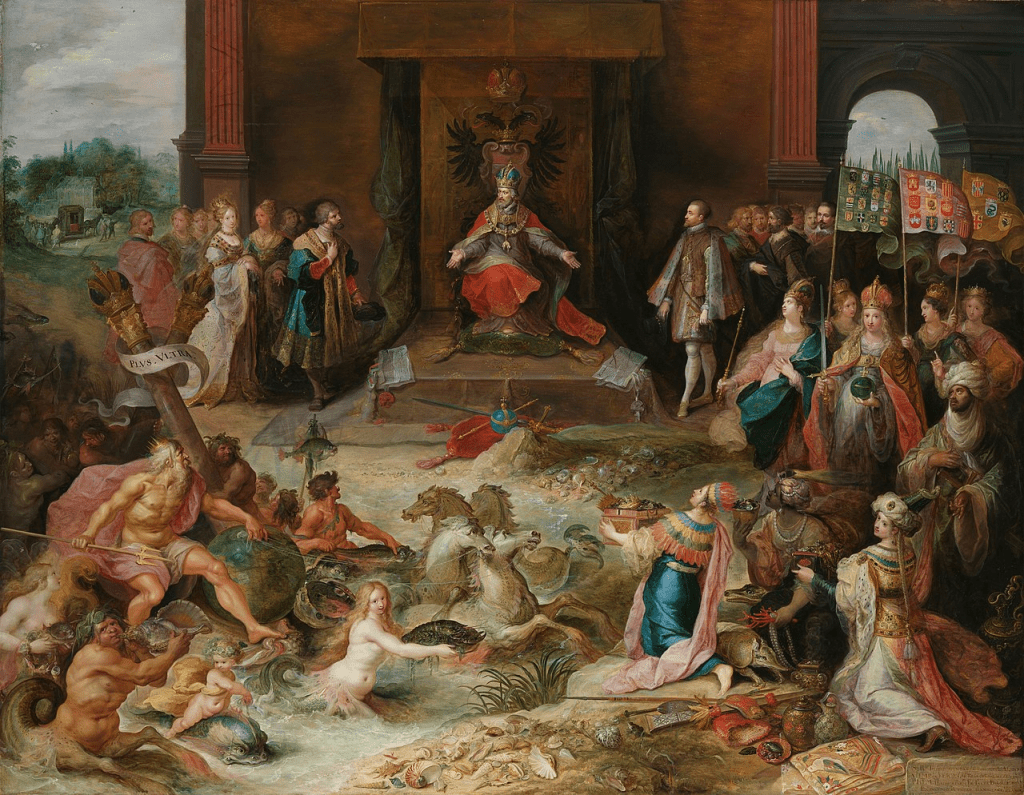
The ‘nation-state’ itself is, of course, a somewhat recent phenomenon. While it is a little trite to date them specifically to Westphalia in 1648, it is certainly true that a century earlier at the Peace of Augsburg, the connection between rulers and the ruled based on ethno-cultural identity was barely existent. The splendid Charles V, in his twilight in 1555, was the legitimate ruler of inheritances including Spain and the New World, Austria and the Holy Roman Empire, and Burgundy. Nobody on the streets of Vienna, Antwerp or Madrid complained about his ethnicity – even if they might complain about misrule. This detachment between where a ruler came from and his authority only changed with the advent of new weapons, increasingly expensive wars, and the compensation offered by rulers to their subjects for ever-higher taxes to fund the military. ‘Nationality’ was a part payment for the debt being incurred by princes as they required greater blood and treasure – “we need more from you, but you’re now fighting for your own people!”.

Allegory on the abdication of Emperor Charles V in Brussels

So nation-states, in other words, with their hard borders and inherent desire for ethnic, cultural, religious and linguistic cohesion, were a creation of European diplomacy just a few hundred years ago. And it served them fine, even as the rest of the world tended still towards the more nuanced and subtle lines of empire – today a byword for violence but in actual fact a creator of peace for most people. In simple terms, for instance, it made perfect sense for Tibet to exist within the Chinese imperial sphere; but made very little sense for it to be incorporated into a new Chinese nation-state. Likewise the Northwest Territories to the Raj. Most of all, in Jerusalem the centuries of occasionally tense but balanced coexistence between Arab, Jew and Christian was brought to an end with the creation of the Israeli state in 1947.

All three of these examples – and plenty of others besides – would have benefited from revolutionaries who looked past the (even then already dated) concept of European nation-statehood. In each case a forward-looking, more federalised concept of governance could easily have been introduced. In Europe itself, political leadership was looking at a post-national world which would lead eventually to the European Union. So why was none of this progressiveness around in Israel, India or China?

First is pure laziness. A vast number of unfounded charges are laid at the feet of the British Empire (which left the majority of its people better off than before), but the one criticism which sticks is the undignified rush to decolonisation, and the unintellectual approach used for it. Britain of course, as demonstrated with the EU, is in any case the wrong source of inspiration for ‘post-nationalism’, but at the time the navel-gazing was due to self-obsession. The credit for all the good that Empire brought, was more than a little diminished by the inglorious process of its end.

But the bigger issue was the lack of imagination from the heroes seeking to create new countries of China, India and Israel. Mao and Zhou, Gandhi and Nehru, Weizmann and Ben-Gurion were all leaders steeped in the orthodoxy of western historical teaching, and could conceptualise of nothing else other than the national structure of western powers (despite, ironically, the fact that those same imperial powers tended not to apply statehood in the empire, resulting in a measure of peace). When Churchill called Gandhi “a seditious Middle Temple lawyer, now posing as a fakir… striding half-naked up the steps of the Viceregal Palace” it was as much a comment about his cultural background as it was about his privilege. Gandhi suffered, as they all did, from a sort of Stockholm syndrome where because Europe comprised all nation-states, so should their newly independent post-imperial entities.

Not all such Westphalian myopia ended in disaster. A few successful examples included Lee Kwan-Yew’s establishment of Singapore, or the stability achieved for long periods in Thailand or Japan. But in general, the larger conflicts today still exist because someone, somewhere, could not get their minds around the temporary and cyclical nature of national constructs, instead pursuing hard-bordered strategies that had to end in bloodshed. They were not helped by their former masters, to be sure; but ultimately it is difficult for these founding fathers, all of whom played up their own supposed knowledge of history, not to take the majority of the blame.

The crises in Palestine and elsewhere, such as they are, are the fault of aspirant statesmen who could not think outside the box. None of them had a proper historical grounding, and generations since are paying for it. This insolubility deserves ennui, not obsession.

25 years on, who really won the battle over Rolls Royce and Bentley?

Best of German carmaking

Just over 25 years ago, an intricate set of corporate activities led to the former Rolls Royce car business, which included Bentley, to be owned by German acquirers. When all shook out, Volkswagen acquired the operations at Crewe and the Bentley brand, while BMW got the rights to create a new concept using the name “Rolls Royce”.

First, we should be clear that Rolls Royce since 2003, successful though it has been, is a ‘phantom’ [sic] marque. Rather like Mercedes’ attempt with Maybach, it has nothing to do with the Rolls Royce of old but rather is the upscale concept that BMW wanted to create to fill a hole in its offering.

Secondly, it is worth noting that in the real economy, rather differently to much of the digital economy of today, real assets and people are worth money. What VW acquired – and wanted – was the factory, the engineers and designers, the back catalogue and experience – of the Rolls Royce entity. That was, rightly, considered to be worth more than just the brand around the Rolls Royce. In dilettante reporting of the time, it appeared to be some major sleight of hand that BMW emerged with the brand name after VW had handed over £430m for the business. But for observers beyond the bankers and bloggers, VW were perceived to have gotten their money’s worth – and more.

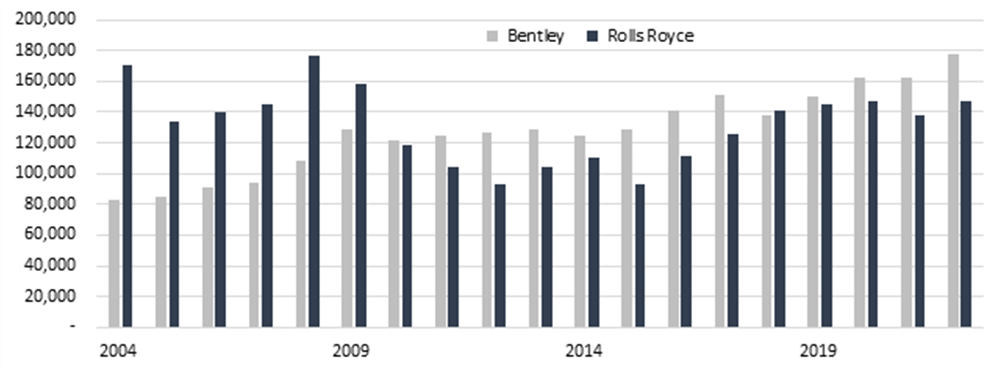
So who has done better since? Well arguably this was a win-win where both carmakers did well with what they took on. While in absolute terms, Bentley has gone on to sell three times the number of vehicles Rolls Royce has (some 200,000 since acquisition, compared to about 65,000 RRs), BMW sell their cars at more than the price of a Bentley.

Total numbers of vehicles sold per year

Source: company accounts

The boring petrol-head bit

The two brands have pursued rather different strategies given who their owners were. VW, while it already had Audi in the stable (but well before it owned Porsche) wanted Bentley to provide a sporting edge which could be scaled up, rather than owning a ‘limousine’ marque. It therefore pushed the new Continental GT, a model which overnight became a success for London bankers and LA rappers alike. For BMW though, the RR brand was very much about creating a classic luxury saloon (if that can really be used for RR) sitting above their already-premium 7-series.

As mentioned elsewhere, VW went about their strategy by providing the patented W12 engine, a personal project of chairman Ferdinand Piëch, used in their unsuccessful Phaeton luxury saloon adventure, to the team at Crewe. Other than this, and giving the Bentley management a general steer on wanting to see a GT, they left the British business to get on with it – with excellent results. With the arrival of Porsche into the mix a decade later in 2012 though, VW finally started getting serious about the saloon segment, with the launch of the Flying Spur and the Mulsanne. Later again it was coming of the Bentayga, the implausible and slightly absurd Bentley SUV, which has sustained sales in recent years.

BMW went a different direction since they were starting with a clean slate. Working outside of the business over the first five years until 2003, designer and Munich-lifer Marek Djordjevic came up with the Phantom model that would kick-start German ownership of the brand. Sales were boosted again with the launch of the Ghost in 2010, the more affordable line of saloons, but in recent years it is the even more implausible and even more absurd Rolls Royce SUV, the Cullinan, which has been the catalyst – comprising more than 50% of sales since its launch and reaching almost 60% in some years. While Bentley has also had success with the SUV, it has never formed as large a part of its portfolio.

In other words, since 2003 Bentley has really lived off the Continental GT offering, reflecting its racing heritage, while Rolls Royce remained a limousine maker who have evolved into SUVs.

The important bit

Rolls Royce, anecdotally, has always been able to price a like-for-like car at a 30%-50% premium to Bentley since they were each taken over. A Wraith costs more than a Continental GT for instance, and the Ghost costs more than a Flying Spur. However taken as a whole, since introducing the Ghost in 2010 BMW has ended up with a portfolio of cheaper price points on average than VW, as total revenue per vehicle shows:

How this has translated into hard profits for their owners is more complicated. The fact is that neither of these businesses have delivered huge amounts of outright profit. Bentley managed to record a bottom line of £684m in 2022, a record, but since 2003 has dipped in and out of profitability overall. RR has managed to record a small and consistent profit over the same period, culminating in a £97m bottom line in 2022. On an adjusted, pre-R&D basis, Bentley has recorded a 21% profit margin over the last decade, compared with 8% for Rolls Royce. In the context of VW’s and BMW’s overall earnings of €15.8bn and €18.6bn respectively, these are drops in the ocean. Bentley accounts for 4.4% of VW’s earnings; RR just 0.5% of BMW’s.

Moreover, the Rolls Royce profit is overstated since BMW does not push R&D costs into the Goodwood accounts. In fact, it is likely still not profitable after two decades of operation. Bentley, due to its Crewe location being self-sufficient, has spent on average £322m on R&D per year over the last decade, leading to several years in the red. One can assume either that Rolls Royce really is just using BMW 7-series intellectual property, or it is spending similar amounts which would imply substantial ongoing losses, of at least -£100m per year as an educated guess. For what it’s worth, Bentley probably wins the financial battle comfortably.

Of course, both are growing, and as noted previously have been growing faster than their owners as a whole, at high single digit CAGR for revenues and even higher profit growth. However both are yet to fully face the challenges of electrification, though BMW are arguably ahead of VW in technology for that (Volvo / Geely, via its Polestar brand, as a full high end EV performance car which serves as a template for what these two venerable names might look to).

Conclusion

Ultimately, the consensus seems to be that both sides got what they wanted out of these brands when they battled to acquire it in 1998. VW got a sporty brand that could scale, which it has done; BMW got a limousine brand which was not designed to be scalable but to really create a layer above its premium positioning. VW wanted the hard assets of the former business including the factory and staff, given the failure of Phaeton; BMW had most of its platform already available for use and could staff up its new Goodwood facility internally. That explained the difference in pricing – BMW spent £50m on the brand and then some £100m on building the new factory, compared with the £430m VW spent buying a going concern. Bentley is meaningfully profitable though, whereas Rolls Royce has yet to contribute financially.

What neither side anticipated then, but both reacted to, was the rise of the SUV, which perhaps suited the saloon platform better than a sport GT one. Each side has done well but RR has really taken off on its SUV offering; the EV challenge will be next. At the end of the day though, the real benefits will have to be chalked up to ‘intangibles’ including prestige for the owner and, one assumes, spillover benefits from any R&D linked to these luxury marques. It is probably really us, the consumer, who has benefited from these two auto giants deciding to maintain what are basically hobby horses; if the Germans were not so vain, we probably would not have the cars we enjoy today ….

Appendix

How acquirers of car brands – even Chinese ones – can succeed

Cars have had a long innings as possibly the most globalised consumer product around is. By which I mean, they have broadly been the product category about which consumers see supply as a single world-wide market: whether you live in Belgium, Brazil or Brunei, you would still be mostly buying cars from the same top ten or so global producers for the last decades. If you are rich, you would probably be looking at the German makers, and latterly Lexus. If you are middle class you might be settling for other Japanese or European brands. If you were stupid you might buy American – but then, not even Americans do much of that.

Another way of looking at it is that cars have had the longest ‘globalisation window’ of almost any product category. As a country develops, it initially prefers foreign brands and the qualities they bring. But when a country really develops, consumption starts to re-indigenise. For instance, while cars and, say, food products both tend to globalise early, people return to their own taste in food quite soon after they become middle class (partly reflecting the lower barriers to (re-)entry). The speed with which McDonald’s or Yum localise compared to Volkswagen is telling.

In part this is because a carmaking industry is actually difficult to establish: Taiwan, for instance, despite having a steel sector, has never managed to create cars; Korea did manage to, but only after throwing the entire weight of its economic development behind that push; Malaysia threw its weight behind the effort, too, but with mixed results. People often refer to the building of aircraft carriers, or a space programme, as the symbol of a country’s total integrated industrial capability, but on a much more mundane level, so are cars.

All this combines to shape the global landscape in automotive OEMs, which have consequently undertaken enormous amounts of M&A over the years – almost all of which have been unsuccessful. Daimler’s ‘merger of equals’ with Chrysler in 1998 went so poorly that it is subject of business school case studies; while the ‘alliance’ between Renault and Nissan – undertaken a year later and heralded as a counterpoint to that merger – itself became mired in problems. Ford made numerous acquisitions of other brands over the years including Jaguar (1989), Volvo (1999) and Land Rover (2000), before selling all of them at a loss. Aston Martin was an honourable exception which proves the rule. GM did even worse that Ford – both Saab and Daewoo more or less shut down.

So successful automotive acquisitions are worth considering, and when one of those is a rare example of successful Chinese overseas industrial investment, even more so. Below are a few examples of ‘takeovers’ of well-known car brands in recent years, and their performance afterwards.

Vehicle sales CAGR since acquisition

Note: parenthesis indicates year of effective acquisition; Rolls Royce and Aston Martin not strictly ‘acquired’, for different reasons

There are a lot of details which I will not go into here, for instance the story behind Rolls Royce and BMW (the subject of another post), suffice to say that quite a few of these marques have had success over a long period of this century. To put this in context, over the same approximate period as above, the main carmakers have seen growth ranging from +4% (the Germans) to -1% (the Americans). So to understand why these acquisitions have helped practically, I will focus unashamedly on the two cars I personally own: Bentley and Volvo.

The history of Bentley and Rolls Royce is again a post for elsewhere, but Volkswagen essentially bought a faded business selling just 400 cars in 1998. For five years they dwelt on the business and how to get the best from leveraging VW’s broader platform, and in 2003 they completely reinvented the brand. Handing over the patented W12 engine – a slightly eccentric and personal project of chairman Ferdinand Piëch – the new owners steered Bentley back to their sporting roots and create the new Continental GT. The car took off, shooting sales instantly to over the 5,000 unit mark where it has remained and grown. Possibly no car better signifies reinvention than this one and VW undoubtedly gave Bentley a new lease of life.

A few years later in 2010, Chinese carmaker Geely shocked the motor world by buying Volvo, then owned by Ford. Driven by another chairman, Li Shufu, this was a test case for Chinese overseas acquisitions in an age where it was slightly less controversial. Observers expected either a total takeover or completely detachment, but as with VW and Bentley, Geely took a nuanced middle way of gentle guidance and leverage of the broader platform. Again, the new owner mulled for five years or so before pushing the redesign of the XC90 SUV in 2015, which saw Volvo’s sleepy sales take off; in 2018 it trumped this with a new version of the XC60 and Volvo’s position as one of the most popular premium SUV brands was cemented. Volvo grew unit sales by 10% CAGR between 2014-2019 prior to Covid, the vast majority of them these two models.

Both these examples show that automotive M&A can work, when there are clear alignments: first, the buyer needs to have a clear idea of what exactly they are intending to do with the new brand; secondly, they should not rush to impose changes, but take time to understand the asset; and lastly, the buyer needs underlying platform benefits to add. The case of Tata, whose control of JLR has been more mixed, is a case in point: they have not really added much to either Jaguar or Land Rover, and while the latter benefited from the global demand for luxury SUVs, Jaguar has been in stasis. Volvo, on the other hand, will be receiving the full support of Chinese EV technology, future proofing the brand yet further.

My final point reflects an earlier post I made about the quality of FID. For the UK and Sweden, these two acquisitions are exactly as hoped: inbound investment and employment but importantly, technology and IP continuing to grow at home. Bentley and Volvo remain unmistakably British and Swedish endeavours to be proud of, regardless of their owners. The same cannot be said for the low-quality investment that MPs so desperately fuss over, such as Nissan’s ‘flagship’ EV investment into Sunderland. Here, the IP is not British, and neither will the skills be; Britain’s sole role in this is to be cheaper and less regulated than its neighbours – not a desirable or sustainable model. While the volumes coming out of Crewe and Goodwood plants are much fewer, the long-term value-add to the UK is much, much greater.