Can we actually cut the trade deficit? Yes, we can.

Economists turn out to be as stupid as journalists are lazy
Except, er, they have …

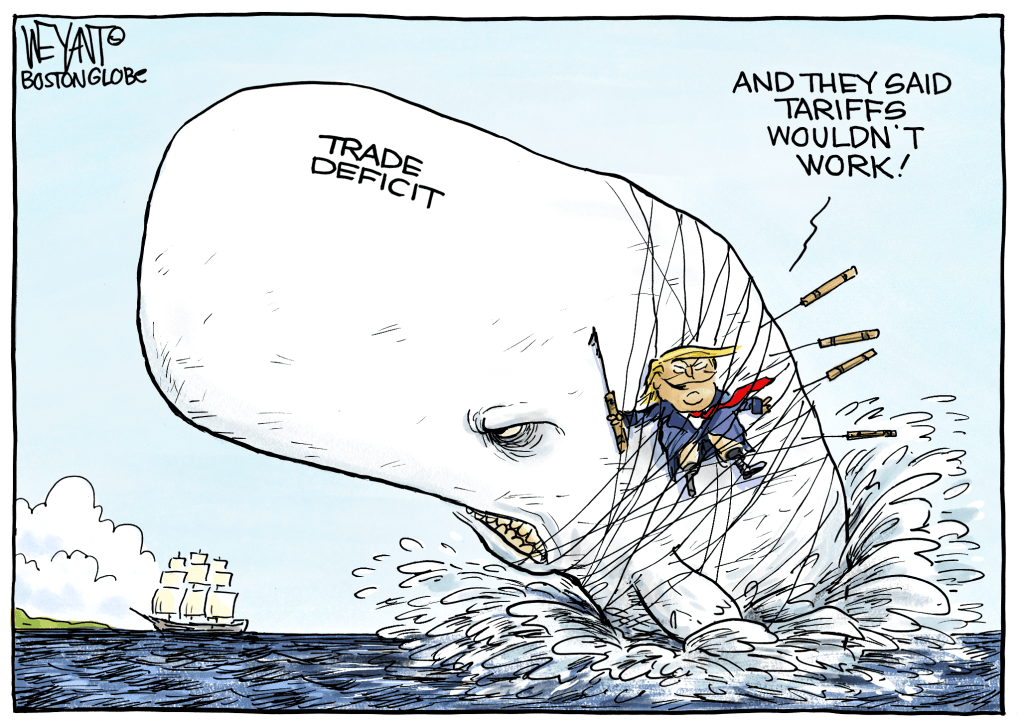
It will never work anyway!”, comes the common refrain thrown at almost all disruption attempts in the last decade in response to the broadly technocratic and deterministic policies of the last half a century since the oil shock. Trump’s implementation of trade tariffs is a prime example of this. Critics of the policy broadly fell into two buckets. On the one hand, were those who predicted major and immediate crises of various sorts – an economic slump in the US, an inflation crisis, a currency collapse, an escalating trade war with no winners and no end. On the other hand, smug ‘super administrators’ focused with glee on the idea that the policy would never even achieve its stated objective of cutting the much discussed trade deficit.

The Cassandra-like forecasts of the first bucket would appear somewhat challenging after the fact. In the year since tariffs were implemented seriously, the US economy has been robust and by far the standout performer among OECD economies, while continuing to attract more outside investment than China or India (and by the way, the stock market is not doing poorly either). Inflation has stabilized from its Biden-era highs, and even the Fed agrees that tariffs have added at most 0.2%-0.4% to prices – never ideal but hardly the stuff of calamity. In the meantime, there has been no ‘trade war’, with the universal 10% levy imposed with almost no resistance and in the singular matter of China, as I have written about previously, the US has managed to achieve a positive tariff differential for the first time since the 1990s, and China has had to suck it up.

But it is the second charge – that the trade deficit cannot be brought down – that is currently doing the rounds. Journalists in particular react to monthly numbers a bit like football fans judge their manager by their last result. Economists are even worse, driven by a form of theoretical blindness. However it has now been a year since tariffs were brought in, and well worth examining what has occurred as a whole.

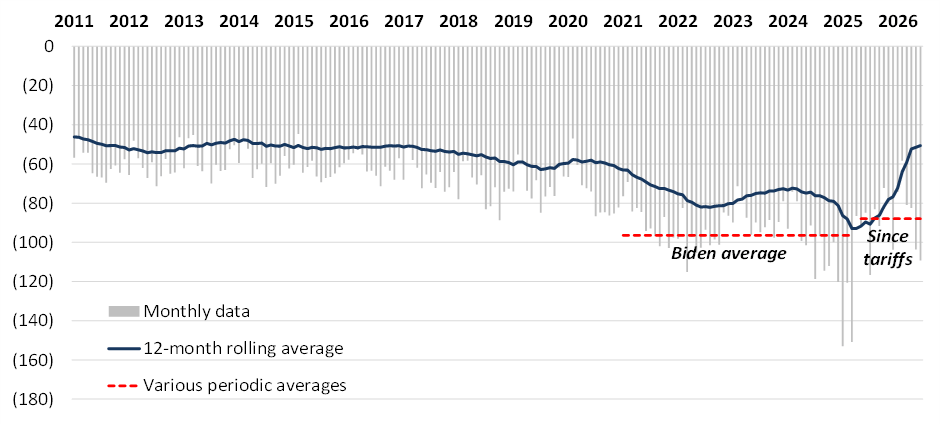
Notional trade deficit over last 15 years (monthly vs 12 month rolling average)
Source: US International Trade Commission database

Even taking the critics at face value, using unadjusted monthly numbers, the deficit has fallen from an average of US$96bn per month in the four and a half years from Biden through to Liberation Day, to an average of US$88bn per month since, almost a -10% reduction. Using a simple mathematical concept like a rolling 12-month average (as shown above and something beyond the ken of most reporters, it seems) highlights this direction much more clearly. So far, so simple: the deficit is down and falling.

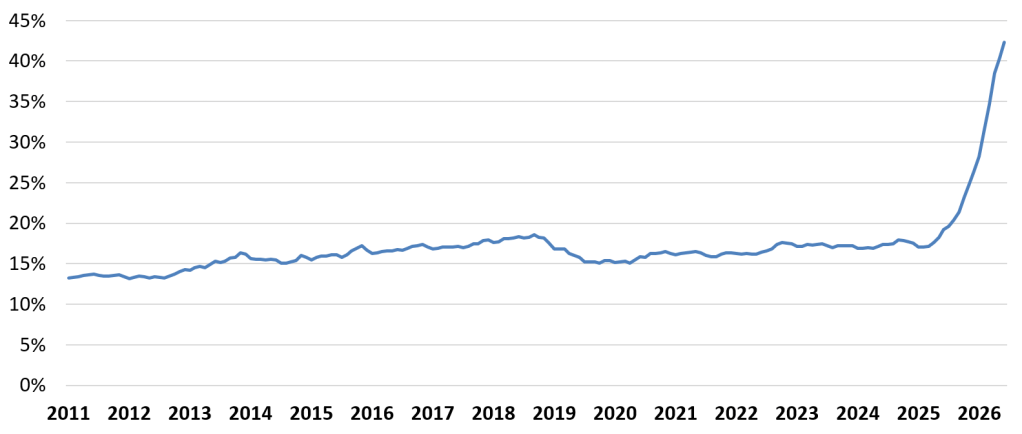
However this is not the end of the story. When assessing the impact of the tariffs on the trade deficit, the focus should really be on the industries being protected, rather than the whole economy, for obvious reasons. Major exemptions were instituted for strategic necessity – tariffs were not implemented clumsily and without thought. In particular, in the last few years we have entered a once-in-a-generation industrialization race regarding AI, which has led to huge distortions in the trade imbalance. Over the same period as above, imports under Harmonized Tariff Schedule (HTS) codes for semiconductor products (key categories 8541, 8542, 8471, 8473 and 8517) have jumped enormously and on purpose as America seeks to get ahead of the game in data centres and compute power.

Semiconductor (aka AI spend) as % of total trade deficit
Source: US International Trade Commission database

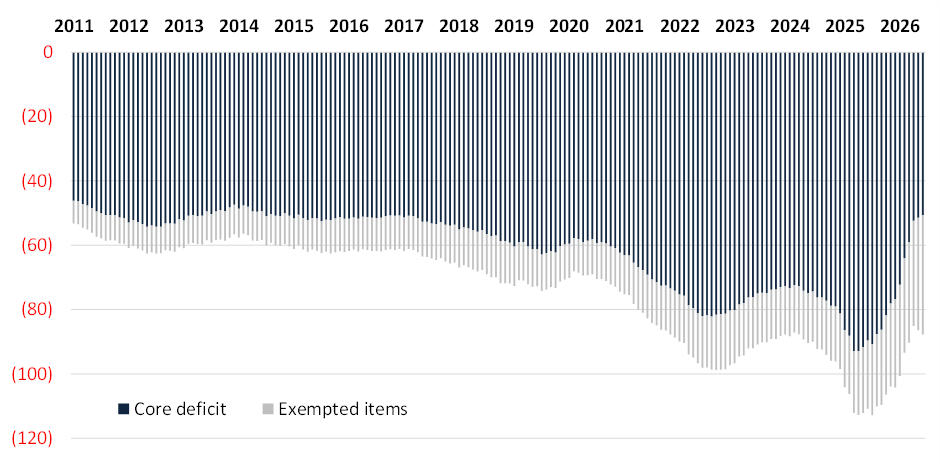
This has little to do with the aims and objectives of the so-called ‘trade war’, and does not take away from Rust Belt jobs. The success of tariffs from even the narrow perspective of the trade deficit, can only be understood through its impact on the industries being targeted, or their substitutes. On an intuitive basis (and despite what economists love to think) the importer of, say, cars is not going to substitute their purchasing power into less taxed segments such as semiconductors – there is no fungibility of capital occurring across unrelated segments. So there is a distinction to be made between the ‘core deficit’ and the exempted items, making the effects of tariffs even clearer.

US trade deficit over last 15 years (12 month rolling average)
Source: US International Trade Commission database

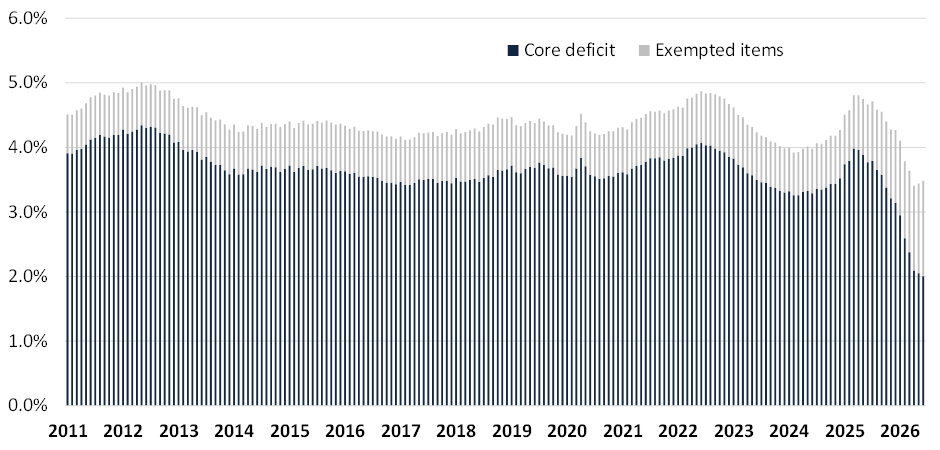
On a nominal basis, the trade deficit in the truly relevant industries has actually declined precipitously to levels not seen since the Obama administration. It has been reduced by more than a third from the highs of the Biden era – indeed the average ‘core deficit’ since Liberation Day is -13.4% lower than the entire 15 years preceding it. It has fallen to record lows as a result of tariffs.

Yet even this is not the whole story. In today’s money, the current total deficit is $88bn, while the ‘core deficit’ number stands at $51bn. You may choose to look at whichever number you like, but one must also factor in the time value of money. The US$88bn total deficit was last this low in Q4 2021, but US$88bn today is not the same as US$88bn five years ago. Likewise the last time the ‘core deficit’ was this low was way back in Q1 2017, a totally different world. The key metric to measure against is GDP of the day, basically allowing deficits to be benchmarked against a form of ‘inflation’. When examined in this light, the true and remarkable scale of the deficit reduction becomes apparent.

US trade deficit over last 15 years as % of GDP
Source: US International Trade Commission database, US Federal Reserve database

In short, the US trade deficit has fallen to levels not seen for decades – exactly as would be foretold if analysts did not keep needing to overthink it. And it has fallen against a backdrop of a strengthening economy which is seemingly more strongly positioned against its competitors than ever, a fact underlined by FDI being maintained at by far and away No 1 (with the US at US$277bn in 2025), a far cry from the 2000s and 2010s when China led on this metric.

There is plenty to dissect in this, and these statistics do not in themselves prove that tariffs are good for the economy, or even that reshoring is happening. Nonetheless there are only a few explanations as to why GDP can continue to grow even as the deficit reduces, and the likelihood is that these reasons are ‘good growth’. A major component of it has been the US ability to increase productivity and replace imports effectively, most of which helps with job growth – another area which has “surprised” economists on the upside. While there are other potential reasons – currency effects and exogenous slowdown – these will not account for the bulk of what is happening.

Ultimately the debate over tariffs should always have been a long-term one, over whether free trade or whether selective trade benefits an economy and a society more. The scaremongering over near-term effects is always counterproductive to the critique and often wrong, as has been demonstrated here. Above all though, critics need to learn what I first noted a decade ago: that trying to tell people that changes “will not work” makes them increasingly angry over the lack of agency politicians represent. Argue that it is bad, by all means, but there is no point implying that the great system of global economy and relations makes independent national policies redundant. Nobody is here to listen to that and even bad independence will be rewarded over good dependence. In the end the answer has to be, “yes, we can”.
Are transfer fees really more expensive? Not really.

While nominal spending is getting higher and higher, clubs are actually getting players cheaper than ever

The voice of sanity

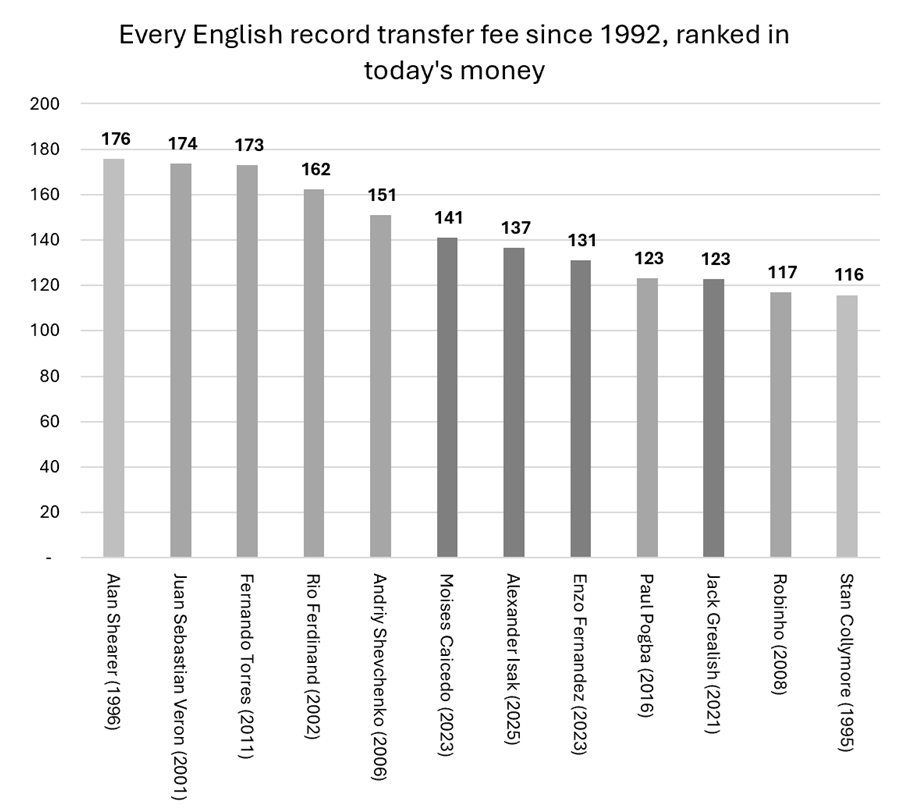
Transfer fees have gone crazy”, according to those eternal barometers of sanity, TalkSport listeners, as they react to the transfers this summer of Morgan Rogers (£117m to Chelsea), Elliot Anderson (£116m to Man City) and even Sandro Tonali (up to £100m to Tottenham), not to mention Izak and Wirtz to Liverpool last summer. And in a sense, fees do seem to have picked up, given that the record was not broken for 7 seasons between the signing of Paul Pogba by Man Utd in 2016, and the arrival of Enzo Fernandez to Chelsea in 2023. Since then, transfer fees of over £100m have come thick and fast, leading to charges of inflation and insanity.

However people should remember that transfer fee inflation has been a fact of life since the beginning of football. Moreover, football inflation is not the same as CPI, ie the price of a pint of milk; rather it reflects the increasing amount of money coming into the game. To that end, I am updating my proprietary transfer fee inflator index, last written about almost a decade ago. As the data demonstrates, transfer fees today still pale in comparison to some of the biggest deals signed in the past.

There are a few other calculators floating around – for instance here, here and here – but none of them are satisfactory for me. For a start most do not seem to start earlier than 2000, which leaves out a lot of Premier League inflation. Secondly the Kieran Maguire index, which seems to produce reasonable results, rebases to 2019 cost of money and also there are no details that I can find on the calculation.

A recap on my methodology: since inflation is a function of supply and demand, I have based my inflator on the total Premier League TV rights money each year. The biggest change since my last post on this subject is the inclusion of overseas rights into the calculation, the value of which overtook UK domestic rights for the first time in 2023 (for those sad enough to be interested, I include a complete set of data in the appendices). Using the growth of the TV rights money as base line inflation, I then adjust transfer fees accordingly to reflect what their true cost was compared to TV income of the day. It is not perfect, but it is as good a proxy as I can think of to find a measure of ‘football inflation’ rather than normal consumer inflation.

Note: Shading reflects recency

The results speak for themselves. The most expensive transfers in Premier League history, have far outstripped recent deals in ‘today’s money’. Alan Shearer’s £15m transfer to Newcastle in 1995 is about £176m in modern terms, substantially higher than any of the sums being paid this year. Likewise the transfers of Veron in 2001 and most amusingly, Fernando Torres in 2011, which come in close behind. Incidentally Alan Shearer’s first transfer, from Southampton to Blackburn in 1992, falls just out of scope but probably comes in at around the £100m mark too. At these prices, Elliott Anderson or Tonali look cheap as chips by historical standards.

Furthermore, the reverse is also true. The £100m player of today is actually the £25m player of 2010, or the £10m player of 1998, the dates between which I suspect the formative views on transfer fees for many readers (and TalkSport listeners) was set. Certainly these historical numbers account for the reluctance of Daniel Levy or Arsène Wenger, and other ‘old men’ of football, to reject the pricing they saw in the market later on in their careers. They had become antiquated, with the only response that the market was “madness”.

How then, one might ask, do English clubs compare to their European counterparts? It is difficult to make an apples-to-apples comparison, since European TV money has not matched that of the Premier League for a couple of decades now; additionally their earning streams (particularly for Real Madrid and Barcelona) are not structured in the same way as English clubs. For the sake of a completeness, I have calculated what European transfer fees look like in today’s money based on English football inflation, in the appendix. However I do not believe this is an accurate way of looking at it.

A better way to understand what top European transfer fees have been is simply to compare transfer records in Europe vs England to the closest possible point in time. Using this method, we can see that in general, European clubs have committed to much higher headline prices than English clubs typically have – albeit these are driven by only a few clubs.

Note: Euro-sterling exchange rate using average of June-July in each relevant year; where possible, same year transfers have been used but where not, the English transfer used is one year preceding

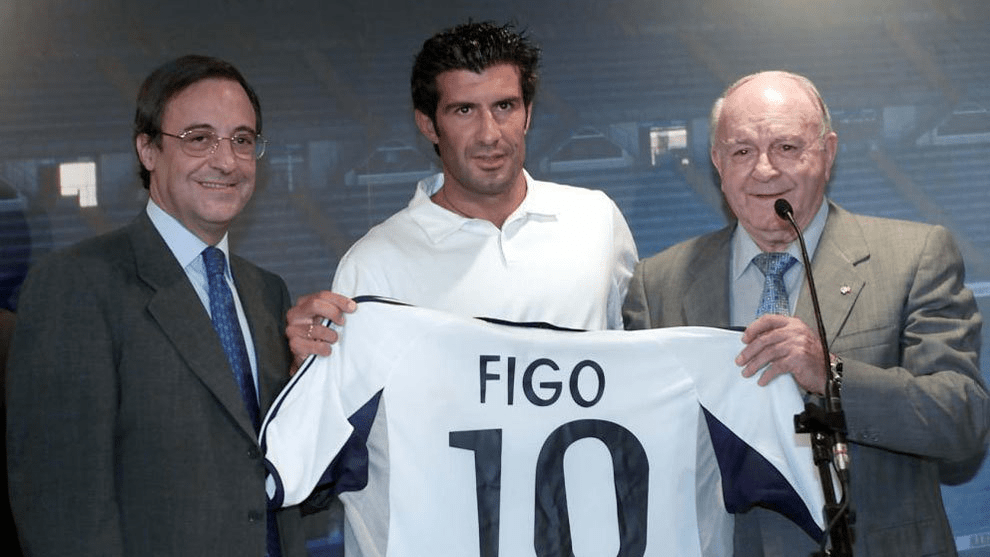
Gianluigi Lentini’s move from Torino to Capello’s AC Milan in 1992, for instance, was truly a shock to the world in 1992, at almost £13m. It was 3.6 times the highest amount paid in England at that time, which was Alan Shearer’s transfer to Blackburn. Shearer’s next move, to Newcastle, was the closest England has had to a record, benchmarking close to Ronaldo’s record jump from Barcelona to Inter a year later. By the time the next headline was being made in England, with Veron’s purchase by Man Utd in 2002, Zidane was shuffling over to Real for close on twice the amount of money – indeed the Veron fee weighed in at less than that of Figo the year before (£38m), and Christian Vieri three years earlier (£32m).

Since that time, English clubs have actually spent conspicuously less at the top end of fees, even as they have powered to more overall spending. Nobody has come close to matching Neymar’s almost £200m move to PSG for instance, way back from the pre-Covid years. It seems unlikely they will do so any time soon. As a side note, the history of transfer records stands as a real testimony to the shifting fortunes of financial leadership in European football. In the 1990s, records were all set by Serie A; by the 2000s, this was now being set by the two Spanish giants; and in the years before Covid, PSG alone set records – not only the €222m for Neymar but also the €180m spent on Mbappe.

Note: exchange rate same as above; all transfer records have been included

In summary, while headline numbers continue to increase, in the context of club TV money the transfer fees of today are actually quite modest. £100m is the new normal for key players and this is less than was paid for many stars in the last three decades – fees are higher but they aren’t more expensive. English clubs have still never hit the astronomical heights that European counterparts have, either. So lament crazy prices by all means – but we have not really seen anything crazy, unless you want to make the case that Elliot Anderson is not as good a midfielder as Juan Sebastian Veron.

Appendices

1. Comprehensive transfer fee inflation model

Note: multiple and discount factor are derived from each new TV deal, announced in nominal terms, interpolated between the relevant years; Premier League domestic TV money peaked with the 2017-2020 deal, but still grew factoring in foreign rights. To use the table, take any historical transfer fee and its year, and multiply it in order to see the price in today’s money. Or in reverse, take a transfer fee of today, to see what its equivalent number was back when you were young.

2. Evolution of the European transfer record since 1992 (nominal top, re-based to Premier League inflation bottom)

Spain leads football innovation off the field, not just on it

Given the dominance of Real Madrid and Barcelona on La Liga, and the importance of men like Florentino Perez in European football discourse, the outside observer would be forgiven for overlooking the role of the governing bodies. After all, surely the biggest clubs – which vastly overshadow their domestic peers in a way that does not happen in the Premier League – call the shots?

But surprisingly, the Spanish football federation has not only frequently come out on top against their biggest club members, but has also been a historical pioneer in football governance in a way which has set the agenda across the continent.

Transfer windows

In 1995, La Liga instituted the first modern restrictions on player trading, allowing changes of club only during a long summer break and a shorter winter slot. Strange to think, that across Europe until then, all major leagues allowed unlimited transfers until each of their deadline days – end of January for Italy, February in Germany and France and absurdly the 31 March in England, mere weeks before the season ended. At the time, transfer windows were designed to protect smaller clubs by not allowing Real or Barca to take their rivals’ best players mid-campaign, and Spain even prevented mid-season moves if a player had already played 5 matches for their club. FIFA then went on to adopt this system wholesale, bringing cross-border alignment to all leagues by 2002 to the system we know today.

If no Spain, then no Harry Redknapp hanging out of his car window on transfer deadline days

Buyout clauses

By the time of the Bosman ruling in 1995, Spain already had a system of buyout clauses described by World Soccer magazine, amongst others, as “positively futuristic”. In fact though, Spain had laid the groundwork for this a decade earlier when they actually had their own version of Bosman, leading to the Royal Decree 1006 which freed players to break contracts with their clubs. Clubs in turn responded by introducing the buyout clause – the difference with today being that the buying club actually gave the transfer value to the players themselves, who in turn paid their employer out and became a free agent. The most (in)famous example of this in action was Figo’s transfer from Barcelona to Real Madrid in 2000 for an astronomical €61m. Since that time, clubs around Europe began to normalise such clauses such that they are now commonplace.

Figo celebrating a victory for players’ rights

Image rights

In response to a change in the taxation rules in 1996, Spanish clubs began to split player compensation into two parts: salary and the use of image rights. This was revolutionary in two ways: first, it helped create a new world of tax avoidance which spread to most other leagues; secondly, it focused marketing attention on the image rights portion of football. Marketing agencies began to specialise in this segment which in turn changed the way the advertising industry used football. Image rights became a major political issue under Florentino Perez’s first Galacticos stint, but by then the Premier League and others had already taken up the baton. The reductio ad absurdum of this arrived through incidents such as Paulo Dybala’s transfer to England falling through in 2019 due to his image rights being sold and owned to third parties. At a club level, Barcelona’s rescue package in 2023, where they sold 25% of their future TV rights, is in some ways a continuation of this.

Salary caps

Before the coming of FFP in Europe, and then PSR and now SCR in England, Spain already developed a (seemingly quite heavy-handed) scheme for cost controls. Taking inspiration from US sports franchising, La Liga implemented a total squad salary cap from 2013 onwards, after several years where smaller clubs had come a cropper in the 2000s trying to chase down Real Madrid’s Galactico model. Many of them, moreover, were incurring ever greater debts to still buy players, while owing money on transfers and even wages to the current squad. In order to protect socio-owned clubs from themselves, La Liga actively calculated budgets and prevented new signings from being registered, a personal project from autocratic president Javier Tebas. The most high profile outcome of this was Barcelona’s inability to re-sign Lionel Messi – who was actually still at the club – on to a new contract in the summer of 2021 and hence pushing him out to PSG. Certainly not a case of the big clubs holding the system to ransom.

Messi lamenting the financial austerity only La Liga understood

Neutral venue matches

To be fair, in this area the Premier League did technically start earlier through its “39th Week” proposal in 2008, where the idea was to create an entire new round of fixtures to be played in various venues worldwide. However they backed down on it fairly quickly, where ten years later in 2018 Tebas (yes, it be he again) not only signed a new sports rights deal with Relevant Sports but went as far as to organise the Girona vs Barcelona fixture in Miami, scheduled for January 2019. While both clubs agreed to it, pressure from RFEF, UEFA and FIFA caused Tebas to back down – only for Relevant Sports to bring the lawsuits which forced UEFA itself to finally capitulate in 2025. Matches abroad are now permissible, all thanks to Spain.

Not only that, but Spain has been proactive in wanting to host others. The best example was Spain jumping at the chance to own the 2018 Libertadores Cup replay in Madrid between Boca Juniors and River Plate, after violence prevented the original fixture. However even further back, Spain offered to host everyone from Yugoslavian refugees Red Star Belgrade during their civil war, through to a number of Champions League matches during the height of Covid (not the final mini tournament, but several quarter-finals when logistics were much less sure).

Creation of a breakaway big money league

The most historical example of Spanish innovation is the creation of a more commercially orientated league setup, in anticpation of forthcoming revenues such as television rights. Spanish clubs broke away from the RFEF to form La Liga all the way back in 1984, a decade earlier than the Premier League. While in some respects, this act was as reminiscent of the Football League creation in 1888 as anything else, the similarities with more recent examples is the focus on commercialisation (the FA / Football League split was a contest over professionalisation vs amateurism as much as anything). La Liga was followed not only by the Premier League in 1992, but also the Bundesliga (2001), Serie A (2010) and the Ligue 1 (2022).

A side spur of this is the whole Superleague question. La Liga and the RFEF of course vociferously fought the idea of the Superleague, but ironically the culture of La Liga is what first set Real Madrid and Barcelona off on that direction alongside Juventus. And strange though it sounds to English or German ears, the idea of the Superleague is nowhere near as unpopular in Spain as it has been elsewhere, because the long-term culture to try new things has been cultivated over decades.

Championing employees and fans

*******

There are numerous reasons why Spain has always been so innovative in football governance. Some of this is deeplying in the legal and corporate culture of the country, including the focus on labour law post the Franco regime and the relatively litigious nature of the economy. Some of it has been driven by individuals such as Tebas or Perez. Above all though, Spanish football has always kept a weary eye on its place in the competitive landscape, particularly with regards Italy in the 1990s and then England since the 2000s. The authorites recognise the marketing strength of the big clubs, but also know that the whole product has to be sustainable in order to leverage that reach.

UEFA has headed off the Superleague for now, but the instincts which that proposal embodied – the innovative, the commercial, the litigious – had its roots mainly in Spain. And while the Premier League leads in revenues and sponsorship deals, it seems very likely that the next wave of innovations around governance will come once again from Spain. Ex Hispania semper aliquid novi, as Pliny might have said.

Remember blockchain? AI will bring it back into the limelight

AI may finally give blockchain its clear commercial case, by bringing physics into the digital world

Neon blockchain network linking secure data cubes and verified content

In the face of AI’s popularity with investors, blockchain and its uglier cousin crypto seem like yesterday’s news. Yes, a lot of fortunes were made and they are permanent, but attention and capital have moved on to the latest idea that threatens to change ‘everything’. Where crypto promised to overhaul finance and kill central banks, AI is positioned as the white collar job destroyer – although amusingly nobody really knows which way it will go. The Financial Times, lover of all things based on the 1990s consensus, famously offered this insight – and only partly in jest:

Meanwhile blockchain, while somewhat understood in digital circles, has continued to look for its true ‘moment’ where the use-case becomes compelling and, more importantly, monetizable. What we know is that true digitalisation has, even today, yet to arrive onto the financial services scene. While banks can slap apps on to their front end for customer interface, in truth the vast majority of financial services are still very much analogue – often even paper based – with digital as a gloss on top. In that sense, there is still huge headroom for full real digitalisation to be implemented, but it seems like a boring B2B process which will generate earnings but probably for the Accentures of this world.

But if we take a step back, what does blockchain really achieve which is useful every day? More than anything, the thing to remember is that blockchain brings the laws of physics online. This is an extremely simple point to digest but an equally difficult concept to appreciate the magnitude of. Blockchain means finally that irreplicability, and finity, are possible with digital assets in a way that for the first three decades of the internet’s existence they were not. And this is not about creating NFTs for art, though that is one niche application; it is about mass, common items that we use everyday.

Put simply, consider the real world: if Toyota produces 100,000 examples of a certain car, it is a mass produced item. Almost all the 100,000 vehicles are basically the same. Yet from an atomical perspective, they are each different, and the 100,001st car that Toyota produces requires yet more mass and energy that the first 100,000 did not use (remember, E = mc²). Moreover, while the 100,000 that Toyota produces are all ‘original’, an imitator which produces a similar car cannot produce it exactly, however hard they try. Physics prohibits it since they will use different machinery in a different geography using different materials. Toyota ‘owns’ those cars they produced, at source.

However in the digital world, there are no such constraints. If you receive a pdf file, even with a password protection, you can still replicate it as many times as you want. Yes, your ability to send these to other people costs power and bandwidth resources, but the fact is that the 100,001st copy of this pdf effectively does not differ from the 100,000th, or even the 1st. They can be exact replicas because there is not ‘atomic level’ online. Blockchain however, changes this. The purpose of the proof of work concept is that you now do know if you have one of the original 100,000 copies of a pdf, not the 100,001st pirated copy; and this in turn allows you to trade or sell it, something impossible before.

Now how does this all lead to AI? If my social media is to be judged, AI will fast take over much media content creation including pictures and videos (indeed we should probably coin new terms for these AI-generated outputs). My Instagram feed, for instance, is probably getting close to being 50% AI-generated and the comments sections enjoy calling them out. For the moment, there is still a novelty value in AI imaging and content. AI usage today still represents a clear cost benefit which can be applied across the industry, helping make content more quickly and cheaply. Furthermore, AI output quality still has room to improve (quite a lot of room, frankly).

Yet this improvement is the very reason blockchain becomes relevant again. I am certain that as AI starts to permeate the landscape and especially when it begins to seem indistinguishable from real life, consumers will start to finally want to pay a premium – for the real thing. Real actors in real studios, or God forbid out in the real world, will have its own desirability, for all their imperfections. While AI is driving content towards being almost free, its commoditisation means that the other end of the spectrum is where the monetisation case will be.

Nowhere is this more easily understood than in porn, which famously occupied as much as 30% of total internet usage. This is an industry that is being quickly penetrated by AI content, as both traditional studios and OnlyFans creators use artificial ways to supplement production in order to increase regularity and volume of new output. Intuitively, this will be one of the first areas where discerning consumers will desire – and start paying for – content that in some way is stamped as ‘authentic’. While everyday porn will become increasingly free, authentic human porn will start to command higher and higher prices – indeed the rise of OF is itself already a testament to the demand for this.

Back to blockchain, the best and from what I can see only way for this authentication to occur, is through ‘proof of work’ to be input at source. This means that at the point of production, the raw content is stamped as real life, and whatever edits and production are done afterwards, the veracity of the original filming is kept. It also means that next generation content creation tools such as video recording cameras and equipment, will have blockchain encoded within the machine themselves, going on-chain at the ‘point of click’ – the most logical point of verification. The same of course will be true for audio equipment and music generation and so on.

In this sense, beyond the boring world of financial instruments (crypto exchanges such as Binance now already offer direct trading of conventional securities such as equities and ETFs), blockchain will become the bedrock of how to monetise ‘true content’. So while AI is taking the headlines and absorbing capital and investment bandwidth today, blockchain should find a second wind in terms of its direct relevance to our lives. Physics is back.

Why companies in Asia are finally going to need real strategy (even if they don’t know it yet)

Most think they have been strategic, when in reality they have just been gambling

My LinkedIn has been showing the first signs of waking up, in recent months, to roles centred around ‘strategy’. This broad term takes into account a range of positions, all of which are yet nebulous, but which nonetheless are being formulated by leadership. This reflects the changing nature of corporate life in the Asia region, where companies are struggling to grow the way they want – but most have not yet worked out why.

To quote one friend of mine, with a background in family offices, “a lot of Asian fortunes are going to be lost in the next decade or two” – principally (though not solely) due to declining asset prices in real estate. Urgency and heroism at these family groups are what is needed, but either these characteristics are not present in the generation governing them, or that energy does not have a constructive home.

The true scale of slowdown in the region has not yet been recognised. Corporate owners generally are too illiterate to distinguish between real and nominal GDP growth (an issue I have written plenty about before); comfortable board rooms in Hong Kong, Singapore or London survey Asia as a market which has slowed – but just a little. After all, real GDP in China dropped from some 10% on average in the first decade of the millennium, to some 7% in the second until 2019 (it has since spooked markets by generating only 5% over the Covid years). SE Asia was never quite that high, with GDP averaging around 5% in both decades. All pretty healthy.

But corporate top lines and bottom-lines are not real, they are nominal. And importantly, nominal GDP fell precipitously over the same period, almost halving in local currency terms from over 18% to 10% over the two decades (in USD term, growth rates have been even lower).

Source: World Bank (full notes at end)

In other words, the age of Asian growth is over. We are well past the phase of the rising tide – not just in China, but more or less across the region. This impacts both corporate performance, as well as property prices. Asian groups have, on the whole, seen their returns stagnate over the last decade compared to the decade before; and importantly they have fallen in line with nominal GDP growth – in other words they are ‘maxing out’ their ability to squeeze more. They have been able to outstrip GDP here and there, but it started running out of wiggle room well before the change in interest rates which seems likely to be with us for some time. Now, the future of growth looks even bleaker.

Source: CapIQ (full notes at end)

So where does this leave us? The reality is that most corporates in Asia have not really had a ‘strategy’ per se, even if they claimed to have. Instead, they made bets in a benign environment, where they really did not have to be very clever to make money. Most sectors across the board grew decently in a +18% CAGR world. Furthermore, a majority of these family groups already owned assets – principally prime real estate – which rewarded rent-seeking and minimised the need for innovation. Where such groups did venture into the unknown (Adrian Cheng in Hong Kong being perhaps the most prominent), things did not go so well. These businesses do not just need a new strategy, they need a strategy in the first place.

So what is ‘strategy’? Well first, it is easier to understand what strategy for such groups is not, particularly some frequent misperceptions and conflations.

  1. Strategy is not tactics (destination is needed before details)
  2. Strategy is not budgets (even though finance is how control is maintained)
  3. Strategy is not transactions (deals come only after we know direction)

Strategy is about what you want to be as an entity, and the broad direction of how to get there. In Asia, the biggest omission from corporate owners (who tend to be family) is not focusing enough on coherence and identity. Conglomerates are perfectly acceptable in their way; we have, since the rise of the tech giants on either side of the Pacific, witnessed a renewed era of conglomeration in the form of Google, Amazon, Tencent and Alibaba. Single sector focus is not important or the only key to generating shareholder value. Rather, bringing together wildly different businesses can be successful where the overall narrative of who you are still holds. You do not need to have operational synergies in order to have an ownership cohesion of even a sprawling empire.

‘Strategy’ is also about power. The preeminent objective for family groups in Asia, with minorities playing a lesser role, is preservation and the ability to keep your destiny in your own hands. Near-term returns are important; dividends are crucial; but above all else, is it control which is paramount. Life is a constant battle for control – against the government, against competitors, against suppliers, against customers. Strategic thinking is designed to look beyond the financials to the power dynamics in the market – for instance owning the loss-making delivery business which allows control of consumption for your upstream FMCG, or owning the low margin bank that finances speculative capital in new industries.

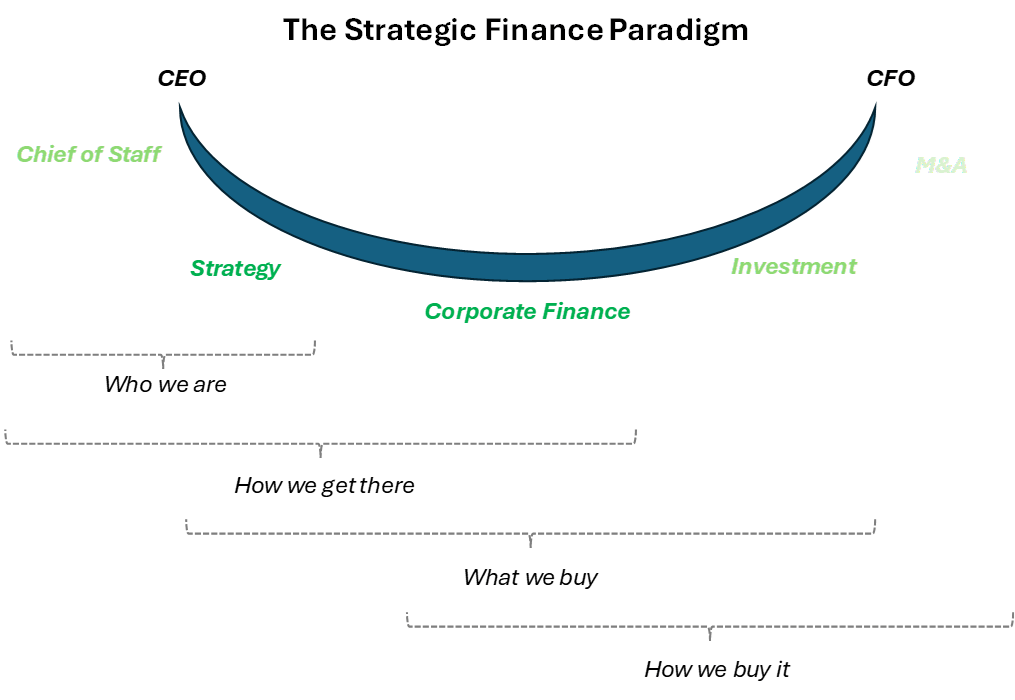
The purpose of ‘strategy’ is therefore to solve the triangle of dynamic forces which determine how a group can move forward. Capabilities either exist or need to be cultivated or acquired; opportunities need to be identified, sourced and validated; and the ability to invest, either through equity or debt or partnerships, has to be planned.

The tricky part is that moving each of these impacts the other two, and ‘strategy’ is therefore about determining how best to balance them to reach the overall aim and keep your identity. Buying new capability through M&A, say, might expand your opportunity set, but weigh on your balance sheet. Restricting your gearing risks not just limiting your opportunities to invest, but also stretch your existing resources in management.

But central to all of this – and where Asian family businesses are particularly lacking – is the need to build or maintain a true identity about who you are and where you are doing. In this region in particular, business owners undervalue how much identity is needed as a pay-off for lack of financial incentivisation and a demand for loyalty (same in politics). Hence identity sits and the very heart of how to think about ‘strategy’, a sine qua non from which all other plans flow. You need a cadre of people who remain loyal to the cause and hence work to protect a family’s interests across generations. They need, more or less, to feel like they are part of a partnership in the traditional sense; mercenary superstar management is the death-knell of the family conglomerate.

Which brings us to organisation. Lots of people think that they “do” strategy; yet more others have such a title; a third group really need to be strategic. The problem is, the three rarely converge. People confuse strategy with tactics, ‘strategy’ titles often mean doing M&A, and leadership is often bogged down trying to manage stakeholders and incremental decisions to really think strategically. Divisions and subsidiaries cannot be left alone to decide their own fates; their management is rightly limited to seeing things through the prism of their own industry. They cannot offer holistic views about the portfolio and they are not positioned to leverage the strengths of a group overall.

Yet ‘strategy’ is too much for just the Chairman or CEO to undertake, and still less the CFO – although financial control remains key. Getting ownership to think about identity and vision is a skill, and it needs focus. It needs one or more thoroughly invested people at or near the top to shape it and keep the flame alive. As discussed above, there are a range of titles or roles that reach across the spectrum of what I call “strategic finance” – both vision and execution.

And ‘strategy’ will only get more important. Some family groups still live under the auspices of an all-dominant chairman; others want to believe that they should interfere less in their businesses. But one thing binds them both: they underestimate the necessity of a wider, more bought-in middle who understand both the family and the firm, and who are invested in the strategic long-term wellbeing of both. Doing better is not about doing less or doing more, it is about understanding what is strategic and what is not – whether in capital allocation, M&A, organisational structure, portfolio evolution, employment programmes, partnerships or even investor relations.

The urgency and heroism mentioned at the beginning is what Asian family groups will need to survive. They may get lucky with the scion which comes to power, but with or without that, they will need to embrace all those things they found too intellectual, too esoteric, too academic; they will have to start doing ‘strategy’.

Notes:

  1. For GDP growth, data set is in GDP current LCU
  2. “Emerging Asia” comprises China, Hong Kong, Singapore, Thailand, Vietnam, Malaysia, Philippines and Indonesia
  3. “Total Asia” comprises above plus Japan and Korea
  4. “Asian conglomerates” comprises Jardine Matheson, Astra International, CP ALL, Keppel, YTL, First Pacific, Uni-President, Sime Darby, Swire Pacific, ThaiBev, SM, CITIC, Ayala and JG Summit
  5. “Asian property groups” comprises Hongkong Land, Sun Hung Kai, Swire Properties, Henderson, New World, CK ASSET and Wharf REIC
  6. “Japanese trading houses” comprises Marubeni, Itochu, Mitsui, Mitsubishi and Toyota Tsusho

25 years on, who really won the battle over Rolls Royce and Bentley?

Best of German carmaking

Just over 25 years ago, an intricate set of corporate activities led to the former Rolls Royce car business, which included Bentley, to be owned by German acquirers. When all shook out, Volkswagen acquired the operations at Crewe and the Bentley brand, while BMW got the rights to create a new concept using the name “Rolls Royce”.

First, we should be clear that Rolls Royce since 2003, successful though it has been, is a ‘phantom’ [sic] marque. Rather like Mercedes’ attempt with Maybach, it has nothing to do with the Rolls Royce of old but rather is the upscale concept that BMW wanted to create to fill a hole in its offering.

Secondly, it is worth noting that in the real economy, rather differently to much of the digital economy of today, real assets and people are worth money. What VW acquired – and wanted – was the factory, the engineers and designers, the back catalogue and experience – of the Rolls Royce entity. That was, rightly, considered to be worth more than just the brand around the Rolls Royce. In dilettante reporting of the time, it appeared to be some major sleight of hand that BMW emerged with the brand name after VW had handed over £430m for the business. But for observers beyond the bankers and bloggers, VW were perceived to have gotten their money’s worth – and more.

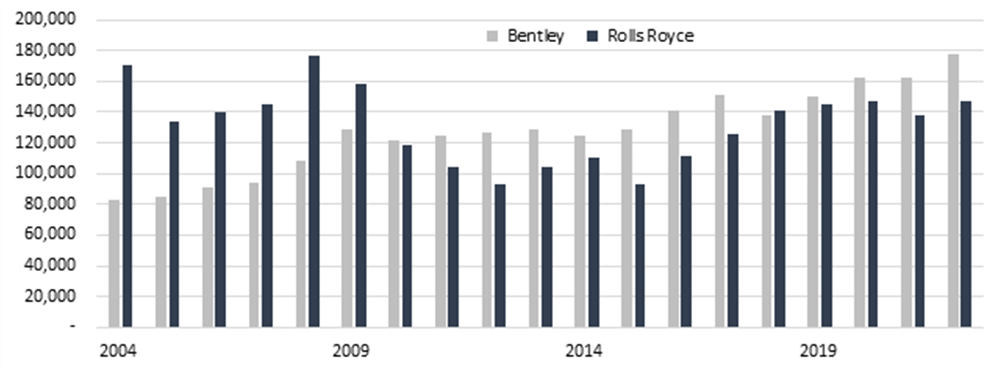
So who has done better since? Well arguably this was a win-win where both carmakers did well with what they took on. While in absolute terms, Bentley has gone on to sell three times the number of vehicles Rolls Royce has (some 200,000 since acquisition, compared to about 65,000 RRs), BMW sell their cars at more than the price of a Bentley.

Total numbers of vehicles sold per year

Source: company accounts

The boring petrol-head bit

The two brands have pursued rather different strategies given who their owners were. VW, while it already had Audi in the stable (but well before it owned Porsche) wanted Bentley to provide a sporting edge which could be scaled up, rather than owning a ‘limousine’ marque. It therefore pushed the new Continental GT, a model which overnight became a success for London bankers and LA rappers alike. For BMW though, the RR brand was very much about creating a classic luxury saloon (if that can really be used for RR) sitting above their already-premium 7-series.

As mentioned elsewhere, VW went about their strategy by providing the patented W12 engine, a personal project of chairman Ferdinand Piëch, used in their unsuccessful Phaeton luxury saloon adventure, to the team at Crewe. Other than this, and giving the Bentley management a general steer on wanting to see a GT, they left the British business to get on with it – with excellent results. With the arrival of Porsche into the mix a decade later in 2012 though, VW finally started getting serious about the saloon segment, with the launch of the Flying Spur and the Mulsanne. Later again it was coming of the Bentayga, the implausible and slightly absurd Bentley SUV, which has sustained sales in recent years.

BMW went a different direction since they were starting with a clean slate. Working outside of the business over the first five years until 2003, designer and Munich-lifer Marek Djordjevic came up with the Phantom model that would kick-start German ownership of the brand. Sales were boosted again with the launch of the Ghost in 2010, the more affordable line of saloons, but in recent years it is the even more implausible and even more absurd Rolls Royce SUV, the Cullinan, which has been the catalyst – comprising more than 50% of sales since its launch and reaching almost 60% in some years. While Bentley has also had success with the SUV, it has never formed as large a part of its portfolio.

In other words, since 2003 Bentley has really lived off the Continental GT offering, reflecting its racing heritage, while Rolls Royce remained a limousine maker who have evolved into SUVs.

The important bit

Rolls Royce, anecdotally, has always been able to price a like-for-like car at a 30%-50% premium to Bentley since they were each taken over. A Wraith costs more than a Continental GT for instance, and the Ghost costs more than a Flying Spur. However taken as a whole, since introducing the Ghost in 2010 BMW has ended up with a portfolio of cheaper price points on average than VW, as total revenue per vehicle shows:

How this has translated into hard profits for their owners is more complicated. The fact is that neither of these businesses have delivered huge amounts of outright profit. Bentley managed to record a bottom line of £684m in 2022, a record, but since 2003 has dipped in and out of profitability overall. RR has managed to record a small and consistent profit over the same period, culminating in a £97m bottom line in 2022. On an adjusted, pre-R&D basis, Bentley has recorded a 21% profit margin over the last decade, compared with 8% for Rolls Royce. In the context of VW’s and BMW’s overall earnings of €15.8bn and €18.6bn respectively, these are drops in the ocean. Bentley accounts for 4.4% of VW’s earnings; RR just 0.5% of BMW’s.

Moreover, the Rolls Royce profit is overstated since BMW does not push R&D costs into the Goodwood accounts. In fact, it is likely still not profitable after two decades of operation. Bentley, due to its Crewe location being self-sufficient, has spent on average £322m on R&D per year over the last decade, leading to several years in the red. One can assume either that Rolls Royce really is just using BMW 7-series intellectual property, or it is spending similar amounts which would imply substantial ongoing losses, of at least -£100m per year as an educated guess. For what it’s worth, Bentley probably wins the financial battle comfortably.

Of course, both are growing, and as noted previously have been growing faster than their owners as a whole, at high single digit CAGR for revenues and even higher profit growth. However both are yet to fully face the challenges of electrification, though BMW are arguably ahead of VW in technology for that (Volvo / Geely, via its Polestar brand, as a full high end EV performance car which serves as a template for what these two venerable names might look to).

Conclusion

Ultimately, the consensus seems to be that both sides got what they wanted out of these brands when they battled to acquire it in 1998. VW got a sporty brand that could scale, which it has done; BMW got a limousine brand which was not designed to be scalable but to really create a layer above its premium positioning. VW wanted the hard assets of the former business including the factory and staff, given the failure of Phaeton; BMW had most of its platform already available for use and could staff up its new Goodwood facility internally. That explained the difference in pricing – BMW spent £50m on the brand and then some £100m on building the new factory, compared with the £430m VW spent buying a going concern. Bentley is meaningfully profitable though, whereas Rolls Royce has yet to contribute financially.

What neither side anticipated then, but both reacted to, was the rise of the SUV, which perhaps suited the saloon platform better than a sport GT one. Each side has done well but RR has really taken off on its SUV offering; the EV challenge will be next. At the end of the day though, the real benefits will have to be chalked up to ‘intangibles’ including prestige for the owner and, one assumes, spillover benefits from any R&D linked to these luxury marques. It is probably really us, the consumer, who has benefited from these two auto giants deciding to maintain what are basically hobby horses; if the Germans were not so vain, we probably would not have the cars we enjoy today ….

Appendix

How acquirers of car brands – even Chinese ones – can succeed

Cars have had a long innings as possibly the most globalised consumer product around is. By which I mean, they have broadly been the product category about which consumers see supply as a single world-wide market: whether you live in Belgium, Brazil or Brunei, you would still be mostly buying cars from the same top ten or so global producers for the last decades. If you are rich, you would probably be looking at the German makers, and latterly Lexus. If you are middle class you might be settling for other Japanese or European brands. If you were stupid you might buy American – but then, not even Americans do much of that.

Another way of looking at it is that cars have had the longest ‘globalisation window’ of almost any product category. As a country develops, it initially prefers foreign brands and the qualities they bring. But when a country really develops, consumption starts to re-indigenise. For instance, while cars and, say, food products both tend to globalise early, people return to their own taste in food quite soon after they become middle class (partly reflecting the lower barriers to (re-)entry). The speed with which McDonald’s or Yum localise compared to Volkswagen is telling.

In part this is because a carmaking industry is actually difficult to establish: Taiwan, for instance, despite having a steel sector, has never managed to create cars; Korea did manage to, but only after throwing the entire weight of its economic development behind that push; Malaysia threw its weight behind the effort, too, but with mixed results. People often refer to the building of aircraft carriers, or a space programme, as the symbol of a country’s total integrated industrial capability, but on a much more mundane level, so are cars.

All this combines to shape the global landscape in automotive OEMs, which have consequently undertaken enormous amounts of M&A over the years – almost all of which have been unsuccessful. Daimler’s ‘merger of equals’ with Chrysler in 1998 went so poorly that it is subject of business school case studies; while the ‘alliance’ between Renault and Nissan – undertaken a year later and heralded as a counterpoint to that merger – itself became mired in problems. Ford made numerous acquisitions of other brands over the years including Jaguar (1989), Volvo (1999) and Land Rover (2000), before selling all of them at a loss. Aston Martin was an honourable exception which proves the rule. GM did even worse that Ford – both Saab and Daewoo more or less shut down.

So successful automotive acquisitions are worth considering, and when one of those is a rare example of successful Chinese overseas industrial investment, even more so. Below are a few examples of ‘takeovers’ of well-known car brands in recent years, and their performance afterwards.

Vehicle sales CAGR since acquisition

Note: parenthesis indicates year of effective acquisition; Rolls Royce and Aston Martin not strictly ‘acquired’, for different reasons

There are a lot of details which I will not go into here, for instance the story behind Rolls Royce and BMW (the subject of another post), suffice to say that quite a few of these marques have had success over a long period of this century. To put this in context, over the same approximate period as above, the main carmakers have seen growth ranging from +4% (the Germans) to -1% (the Americans). So to understand why these acquisitions have helped practically, I will focus unashamedly on the two cars I personally own: Bentley and Volvo.

The history of Bentley and Rolls Royce is again a post for elsewhere, but Volkswagen essentially bought a faded business selling just 400 cars in 1998. For five years they dwelt on the business and how to get the best from leveraging VW’s broader platform, and in 2003 they completely reinvented the brand. Handing over the patented W12 engine – a slightly eccentric and personal project of chairman Ferdinand Piëch – the new owners steered Bentley back to their sporting roots and create the new Continental GT. The car took off, shooting sales instantly to over the 5,000 unit mark where it has remained and grown. Possibly no car better signifies reinvention than this one and VW undoubtedly gave Bentley a new lease of life.

A few years later in 2010, Chinese carmaker Geely shocked the motor world by buying Volvo, then owned by Ford. Driven by another chairman, Li Shufu, this was a test case for Chinese overseas acquisitions in an age where it was slightly less controversial. Observers expected either a total takeover or completely detachment, but as with VW and Bentley, Geely took a nuanced middle way of gentle guidance and leverage of the broader platform. Again, the new owner mulled for five years or so before pushing the redesign of the XC90 SUV in 2015, which saw Volvo’s sleepy sales take off; in 2018 it trumped this with a new version of the XC60 and Volvo’s position as one of the most popular premium SUV brands was cemented. Volvo grew unit sales by 10% CAGR between 2014-2019 prior to Covid, the vast majority of them these two models.

Both these examples show that automotive M&A can work, when there are clear alignments: first, the buyer needs to have a clear idea of what exactly they are intending to do with the new brand; secondly, they should not rush to impose changes, but take time to understand the asset; and lastly, the buyer needs underlying platform benefits to add. The case of Tata, whose control of JLR has been more mixed, is a case in point: they have not really added much to either Jaguar or Land Rover, and while the latter benefited from the global demand for luxury SUVs, Jaguar has been in stasis. Volvo, on the other hand, will be receiving the full support of Chinese EV technology, future proofing the brand yet further.

My final point reflects an earlier post I made about the quality of FID. For the UK and Sweden, these two acquisitions are exactly as hoped: inbound investment and employment but importantly, technology and IP continuing to grow at home. Bentley and Volvo remain unmistakably British and Swedish endeavours to be proud of, regardless of their owners. The same cannot be said for the low-quality investment that MPs so desperately fuss over, such as Nissan’s ‘flagship’ EV investment into Sunderland. Here, the IP is not British, and neither will the skills be; Britain’s sole role in this is to be cheaper and less regulated than its neighbours – not a desirable or sustainable model. While the volumes coming out of Crewe and Goodwood plants are much fewer, the long-term value-add to the UK is much, much greater.

Mozart and the “Concerto Model” of corporate management

There is a lot to learn from musicians – but it may not be the lessons you might think

Score of Mozart’s Piano Concerto No. 20 in D minor, K. 466

Mozart is considered one of the the greatest of composers in part because he managed to convey both his iconic lyricism as well as pathos across so many different forms. His piano and violin sonatas are sublime; quartets and chamber music absorbing; the body of his choral work, including the masses, are transcendent; and his symphonies went on to inform the whole genre for a century or more.

But amongst musicians, it is commonly considered that there were two types of composition in which even Mozart reached unfathomable heights not only of musicianship, but of intellect. They are his concertos and his operas. Because whilst he expressed the solo voice with great eloquence, and whilst he marshalled the collective with great aplomb, it was in these two forms where soloist and ensemble combined into the most sophisticated and final state of music.

Concertos are a funny thing. The etymology of the term is sometimes misunderstood to be about working together – the Italian term concertare now means literally “to harmonise”. Yet in fact the origins are not from the Italian but rather the Latin, where the same word means “to compete” or “to struggle”. And here is the rub: concertos juxtapose the incision of the solo voice with a background of the group – both indispensable, both mutually dependent. It is an inherently unstable equilibrium pitting two forces against each other, and from its complications comes the greatest beauty.

There are strong parallels to the world of corporate management. A small startup may be considered like a solo performer, a single person’s aura. As a company grows, it might become like string quartet, then a chamber ensemble, then perhaps a fully fledged orchestra with all the bells and whistles including the office boy whose only job is to strike the triangle once in a while (as was, I believe, the role of Sir Simon Rattle as a boy in the Liverpool Youth Orchestra). As it grows, so also arises the need for a conductor, or a CEO, to set the tempo and steer the style without, usually, being too overbearing.

The CEO as he should be

But, in the corporate world, progress through these ranks of scale – even though they allow for the creation of ever greater music – generally loses the voice of the soloist. One might argue that the Principal Violin survives, perhaps equivalent to a COO. But generally the creativity of the individuals is very much subservient to the collective, and just as for much of the orchestral landscape, discipline in the style of a Lully is prized, so also shareholders (the audience) tend to reward monolithicism in the company.

Yet I believe that as with concertos, a greater result can be had by allowing one or more excessively skilled individuals doing their best, expressing themselves, whilst the majority of the employees get on with doing their day jobs. How do modern companies accommodate the soloist? The short answer is that they more or less do not. Corporate culture is the very definition of stifling of the individual.

Which is a shame, since in many cases they would achieve much more by finding a way to bring the best out of their more mercurial stars. Most such talents will recognise the necessity of the orchestra playing with them hand-in-hand; and most of the orchestra will understand the extent to which their overall performance is being elevated by the “stars” – after all, it brings paying customers through the doors.

The “Concerto Model” of management is not easy to achieve. For a start, it requires a conductor or CEO who is assured of where their work ends and the musicians begins. It also benefits from an orchestra containing enough people of merit, self confidence and experience to understand the music and why the stars are necessary. This model is not always necessary of course, for smaller ensembles simply playing Haydn quartets; or for larger orchestras who want nothing more than to be known for their rendition of Dvorak’s Slavonic Dances rather than his Cello Concerto.

But when it works, it surely is more astonishing a musical offering than anything else. To my mind, a well functioning company should sound like the second movement of Tchaikovsky’s Piano Concerto No 2, in itself one of the great piano expositions, but where the orchestra as a whole, and particularly the violin and cello soloist, and then the full fanfare, play their part:

The point is, that with good leadership, nobody needs to be reduced to the ranks and the audience and the musicians themselves can lean into and enjoy internal the striving and competition – all of which is for the greater good. To quote Heraclitus, polemos pater panton. For those that dare, musicians or managers, the world awaits.

Just how rich is Tottenham Hotspur, really? Not very.

Daniel Levy

With the virus having suspended football, this seems like a good moment to finally sit down and look at exactly how “rich” Tottenham Hotspur is as a football club, and therefore think about the question of how much we can afford to spend.

The Swiss Ramble recently performed its annual analysis of Spurs’ finances, and it is an exercise I like and admire very much since it attempts to put into perspective the club’s performance and context amongst the elite. Yet it has a major limitation, which is that it focuses almost exclusively on “profitability”, as this excerpt shows:

Swiss Ramble

Source: Swiss Ramble twitter account

The problem, of course, is that profitability tells us very little about cash available, since the items on the P&L (including the profits after taxes) are mostly not real cash items. Instead they are filled with such concepts as depreciation and the gains recognized on the sale of players as assets. Essentially, these are accounting items. And I find it a dangerous way to look at a football club because it raises false expectations about how “rich” we are and therefore how much we should be able to pay for transfers.

I prefer to apply a financial perspective by looking at football clubs as one would any other business, through the company’s balance sheet and cashflow statements. The balance sheet gives us a sense of how indebted the company might be. But more importantly I like to look at the cashflow statement for a few reasons:

  1. Real cash items – the cashflow statement gets rid of non-cash items such as depreciation and replaces it with real cash such as capex
  2. Transfers – it more accurately captures the actual money going in and out on transfers including all hidden costs as well as payments spread over time – a £60m fee paid over three years should be seen as such and not lumped into one number
  3. Stadium investment – it captures all hidden costs but also allows for financing raised against the project, ending the “the stadium pays for itself” speculation.

Helpfully most financial accounts break down transfer spending in quite some detail, which in turn allows for me to get to my core concept: the pre-transfer free cashflow (“PTFCF”). For this I take the net cash inflow / outflow, and add back transfer spending which I assume to be discretionary. This brings us to a calculation which tells us how much “spare” money we would have available to spend in a given year, if we had wanted to.

Taking the June 2019 figures, this metric then allows us to judge – somewhat – our performance in the transfer window.

Pre-Transfer Free Cashflow by club for year ended June 2019 (£m)

PTFCF 2019

We can see from this analysis that Tottenham came a fair way off Man Utd, Chelsea and Liverpool (and one assumes Man City, who do not publish a cashflow statement or give any notes to their Intangible Fixed Asset investments). Arsenal were the big losers of last year given their Europa League participation, and Chelsea show themselves as doing well despite not qualifying for the Champions’ League. To be clear, generating a negative cashflow (just like generating a loss) does not mean you have no money to spend; only that you must do so unsustainably out of your “savings”, which will show up on the net debt (which we will get to).

If we look at the year prior, this becomes even more stark, and highlights the fact that Tottenham, contrary to some assertions, was under real financial pressure during the stadium building process starting in 2017.

Pre-Transfer Free Cashflow by club for year ended June 2018 vs net transfer investment for the following year (£m)

PTFCF 2018

Note: Since transfer spending runs July-June and mostly occurs during the summer transfer window, a June 2018 year ending is best contrasted with the June 2019 transfer spending.

At this point, Spurs were actually incurring a substantial negative PTFCF due to stadium costs, not least since much expenditure for large capital projects is paid up-front, for land acquisition and so on. Man Utd and Chelsea spent far more than they were generating – one might say generously, “investing for the future”; Liverpool were spending about as much as they might expect; and only Arsenal were spending significantly below their capacity, buoyed no doubt by the knowledge that they were not in the Champions’ League. Indeed Tottenham’s tiny net expenditure of ~£3m was quite flattering under the circumstances.

In fact, if we look at how Tottenham have performed on average against the rest of the Top Six (excluding Man City), we have had a tenuous few years.

Three-year rolling average Pre-Transfer Free Cashflow (£m)

PTFCF 2015-2019

On a rolling three-year average, the other clubs have managed a PTFCF of around £80m per year over the last five years, whereas Tottenham, having clawed our way into contention by 2016, have actually seen the gap widen again in the subsequent years. In other words, we really are not that well-off, are some way behind the other Big Six teams, and cannot spend the money on transfers that some fans seem to believe we now should. The stadium remains a massive gamble and has to succeed as a standalone business for us to begin making up the difference with the other clubs.

To cap things off, let us just look at the “savings”. A net debt position is typical of most companies and football clubs are no exception. Furthermore, the ratio of that debt to net assets or ‘shareholders’ funds” shows the relative indebtedness of a business.

Top Six clubs net debt (£m) and gearing for year ended June 2019

Gearing and net debt

On both measures, Tottenham are more precarious than our peers. Not only is net debt larger in absolute terms, carrying with it the funding for the stadium; but alone amongst the Big Six, our gearing is at more than 100%. No doubt much of the stadium borrowing is ring-fenced to a degree, and probably operates on a project finance basis; nonetheless the cost of the debt will weigh Spurs down through interest payments for some time – and the analysis gives a sense of how much better off Man Utd really are than us, for instance. Daniel Levy, who is no stranger to this situation, will clearly not be minded to let spending get out of hand.

Some of this will be well-known and obvious to observers. The reason I raise it is the danger of football fans demanding spending beyond what is possible – and Spurs have been particularly under the microscope for this. The Swiss Ramble’s analysis – whilst perfectly legitimate and technically correct – conveys a very misleading impression over our financial clout. Headlines about record revenues and profits on the P&L, lead to questions (from those who should know better) of “where has all that money gone?”. In the end, Spurs just are not yet that big a club, and whilst I am confident that we will reach our goals, it will still take some time before we can splash out.


**************************************

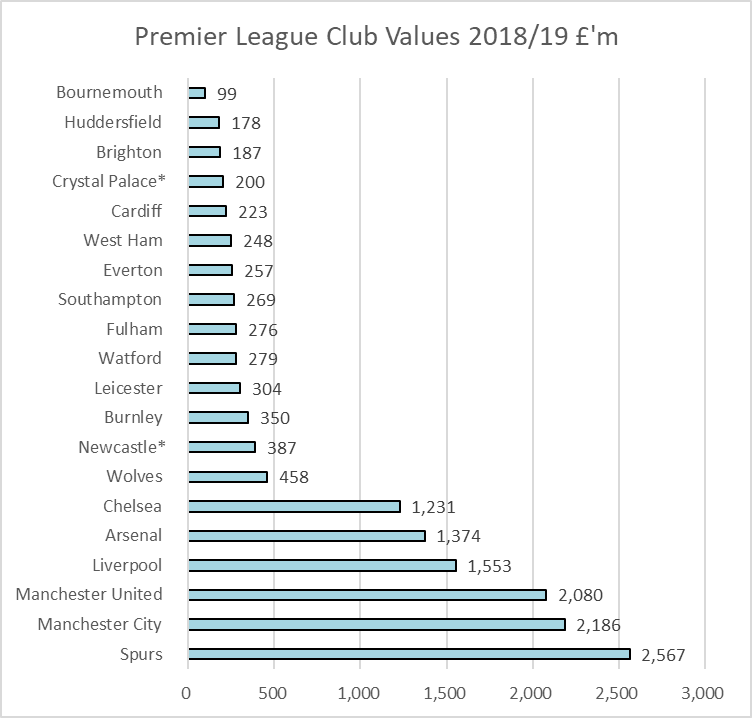
Browsing the internet after posting, I came across the University of Liverpool’s football finances website, which has recently just posted about Premier League club values for 2018-2019, which, whilst doing some equally interesting things,  has rather fallen rather into the same trap. Their proprietary “Markham Multivariate Model” is based on net profit adjusted for one-off items, but unadjusted for non-cash items. The formula is quite off-the-wall in other aspects too but I will let that lie for now.

Nonetheless it leads to what I think is just as unhelpful an output (below), saying:

Spurs overtook both Manchester clubs at the top of the table on the back of reaching the Champions League final, a fourth-place finish in the Premier League and a wage bill barely half that of Manchester United.

UoL club valuations

Even from the eyes of a purely financial investor, this cannot be true. Spurs’ true hidden value, if you want to see it this way, is the stadium value and its future earnings but as far as I can see this has not been captured by Markham. If you strip that out, however well managed our wage bill is, a DCF of Tottenham vs the other clubs would not come to this conclusion. My opinion: head in hands.

The Chinese New Economy: Alibaba as Sauron and why the old economy will be the winners

Sauron eye

Anyone familiar with the Chinese new economy will be aware of the rise of the internet giants of Alibaba and Tencent, along with their satellite businesses. Most will also be aware of the largely exclusive ecosystems within which Chinese online life is led – platforms that encompass everything from messaging to shopping to transport to payments and beyond.

It seems astonishing to remember that barely five years ago many commentators fretted over whether China could ever achieve real innovation. The Harvard Business Review for instance posed the question “Why Can’t China Innovate?”, baldly stating:

Can China lead? Will the Chinese state have the wisdom to lighten up and the patience to allow the full emergence of what Schumpeter called the true spirit of entrepreneurship? On this we have our doubts.

This of course is all rather a fading memory now. Innovation can broadly be divided into three areas: upstream (essentially, “how it works”), midstream (“how it’s made”) and downstream (“how it’s used”). For years, China as a manufacturing hub had made quite noteworthy progress on midstream innovation but most uneducated observers – including many in government – have an unhealthy obsession with upstream blue-sky invention. Yet as we can see with the likes of Berners-Lee, inventors are rarely rewarded and rightly so, since the real creativity and invention from the likes of Steve Jobs, Mark Zuckerberg and Jeff Bezos is in the downstream. Jobs was an arch innovator in how technology is actually used and therefore spread through an economy, with a vision of how lives are actually impacted and changed. Chinese companies, particularly through the big online giants, are clearly doing the same: modern life in China is now lived in quite an advanced but different manner to modern life in OECD countries. Alibaba and Tencent have contributed towards the creation of a real and organic Chinese modernity and technological innovation within China arguably outpaces even the US even leaving aside issues of theft.

So it is worth spending a moment to look at these two major ecosystems and how they really behave – who they are, as it were. First, there is a question of why ecosystems exist in China in the first place in a way which outside of China they do not. Amazon comes the closest of the American tech players to demand a closed ecosystem but even they seem to find limits. Western shareholders have always rewarded single-capacity specialization, and often find the idea of any conglomerate absurd, let alone a tech company offering bicycles and banking.

In China though, this has been natural, for two reasons. First, there is the historical socio-anthropological tendency within Chinese society to build a “closed loop universe” within one’s own family or clan, which has extended to the national level through the Communist Party and SOEs. My own preference for explaining this remains Karl Wittfogel’s hydraulic empire theory, which tells us that most ancient civilisations relied on centralized power to deliver water to its people, enshrining the principles of autocracy and top-down governance at the government and family level. This in turn typically leads to closed-loop systemic thinking since everything has to work together or else nothing works – diversity of thought is only bad news. Secondly though, and somewhat ironically, these ecosystems have become so broad precisely because they are making up for assurances which the Chinese government cannot offer. When you make a purchase on TMall, you have more faith in the Alibaba-backed guarantee that your products will be delivered and that your payment is safe, than one does with the disparate parts of the national banking, postal or legal system offered by the government. The tech giants had to offer a total universe, or else consumers would have been reluctant to actually engage with the new business model in the first place.

Chinese ecosystems (2)

Source: SCMP

So much for why they exist – the bigger issue is how to understand who they are, what their personalities and identities are and how they should be understood from the outside. One possibly analogy, given their conflict, is that of the Cold War. In this world, Alibaba are the Soviet Union – a sprawling empire with a strong centralized view on how things are supposed to be done. Tencent on the other hand are the United States, a beacon of freedom and inspiration but which has its own agenda focused on generating and owning consumption. JD.com are Britain: commercially-minded, focused on trade and fully acquiescent into the American (Tencent) world. Lastly you have Meituan – which owes its existence to Tencent, but like France to the US is entirely ungrateful and maintains the pretence of wanting an ecosystem of its own.

Upon reflection however, a new analogy came to me which may be a touch more accurate, which is Middle Earth. In this version of events, Alibaba are indisputably Sauron, the lurking, evil presence which looks across the lands of men with an unrelenting will to dominion. They provide you the tools to “help” only so that they can own them and you. They invest in you because they need to control your system from the inside. Resistance is futile; eventual subjugation can be the only outcome. The interesting one is Tencent, who I liken to the High Elves of Rivendell. The things about the Elves is this: they are generally on the side of good, and can facilitate it; but they are not themselves a force for good since they sit far away from the battle, detached from it all. They too provide tools, but they may not tell you how to use them; their attention is ultimately elsewhere. The forces of Men ranged against Sauron – let us assume these are essentially a proxy for traditional retail and consumer business in the region – ultimately have to find the solution for themselves, aided at times by the Elves but not reliant on them. If I were to stretch this analogy ad absurdum, perhaps this makes the Dwarves JD.com with their grubby focus on gold and commerce; whilst Meituan the slightly nobler Rohirrim, since they, er, move around a lot on delivery scooters like the horses of the Riddermark. Which start-up will be the valiant hobbit which destroys Alibaba, God only knows.

The serious point to all this is that for old economy companies, it feels like making a choice is inevitable. But the more one looks at the giants of the new economy, the more apparent it is that in the conflict of “internet+” vs “+internet”, it will likely be the latter – especially established asset owners – that win out. In particular, it is difficult to imagine that in this inflated global asset price environment, that the business which need, as Alibaba and JD.com especially are doing, to build out a network of physical infrastructure can be the eventual winner. Well, maybe one early mover can, but the world is not about to be flooded with online victors – by and large, the winners will be whoever of the old economy players adapts best to the new, rather than a new economy player.

And this then comes down to the vision thing. I have another analogy: I call it the “Physics & Philosphy” dilemma™. P&P is a little known but highly intellectual degree at Oxford (arguably the most esoteric of all) which combines two subjects that are not immediately connected. Yes, it is true that in the first term, courses such as Logic may play a part in both areas but then it would appear the two diverge. Yet we should see this like the rings of Saturn: you start off at one point travelling in two opposite directions on the ring, and whilst they move far apart to begin with in the end they meet again. In P&P, the questions at the other end of the circle see the two disparate subjects poetically rejoin on questions such as: what lies beyond the Universe? What happens if time stops? What if light bends? What is not obvious when you start the degree, become enormously obvious by the time you end it.

And seeing what is on the other end of this ring – what exists on the “dark side of the planet” as it were – is the very thing that marks out business geniuses from mere mortals. It took Amazon 14 years to become profitable, but there seems little doubt that Bezos had an idea of what lurked out of his sight in the distance. Likewise Jobs as he labored through various versions of Apple. But the point is, old economy companies can equally achieve this. We know the famous examples of IBM and Intel reinventing themselves based on their competencies; Apple itself did so. Further back in history are companies like Berkshire Hathaway and General Electric, and even Nokia who started life in rubber products. Reinvention is hard, but the world has not ended just because a series of new giants seem to own everything in sight. If the old economy is to learn anything, it is that with courage and vision, and a will to innovate internally if imperfectly, the future is still going to be theirs. For every Amazon which succeeds, there will still be a dozen Walmarts and Targets which make it, stronger than before.

The technology giants will go down in history mostly as the midwives of change, delivering the new baby to their old economy counterparts. We are already seeing them do this, below the surface as Alibaba and JD.com start to crystalise value in real businesses where they can (finance, technology etc rather than the core e-commerce platforms which have rarely made money for anyone). In many ways they are merely pioneering the examples of what the future looks like, so that old economy companies can learn from it but probably implement it better – the Chinese O2O supermarket businesses are a case in point. Indeed the cheerleading nature of the new economy player’s roles in businesses like retail, ahead of its time, loss-leading and ultimately doomed as a standalone business, begs another more controversial comparison. The tech giants are St John the Baptist, crying in the wilderness; the old economy players are Jesus.