It’s the net tariff differential, stupid

Free trade was never supposed to be the end-game
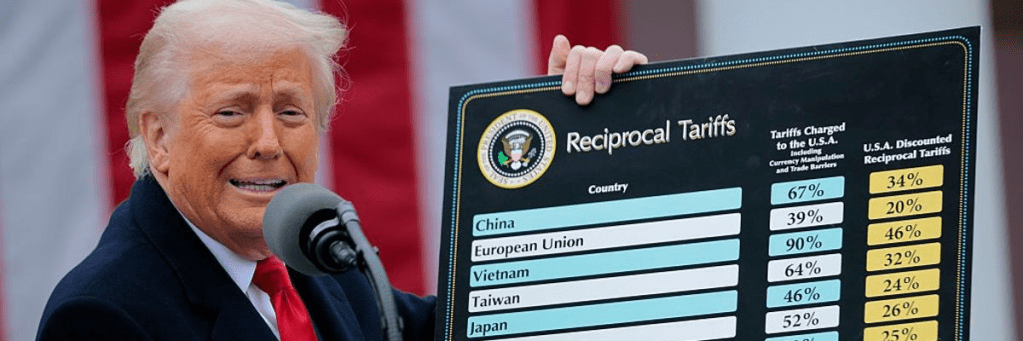
With the dust settling on tariffs, it is opportune to take a moment to consider the sheer scale of change ushered in by Trump on global trade since 2016, and especially with recent events. Trump’s policy is often confused by a vast amount of ‘noise’, which tends to undermine even his own news cycle (see the recent Iran nuclear facility bombing, for instance). Which is a shame, because he has almost entirely remade the landscape, and whether one supports or opposes the theory behind it, it seems irrevocable.

There have been two major components of this earthquake. First, Trump has instated and effectively normalised a global 10% tariff on all US imports, regardless of origin. As noted elsewhere, a ‘universal’ tool like this is by far the most efficient mechanism to charge the world a cost of doing business with America (a concept the youth of today will more easily liken to “gas fees” paid in the world of crypto). It has also raises the policy ‘baseline’ to a figure greater than zero, which I discuss below.

This baseline 10% has both more or less been accepted without reciprocation, by every major trading partner including the EU and China, regardless of vehement struggles over additional duties on top. Whether this 10% is the only tariff, like Britain, or whether it is just the minimum, like Japan and Korea who currently have 25%, the standard has been set and moreover will be very likely here to stay – any future US administration may renegotiate on specifics, but will almost certainly leave the baseline in place. It is now quite simply a fact of commercial life.

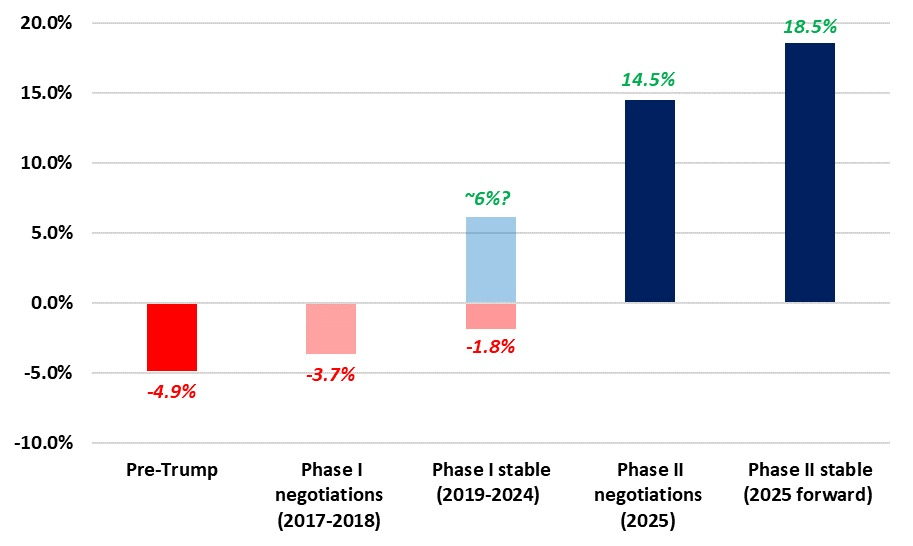
Secondly, there is China. Amidst all the turmoil (which may be part of a grand plan, but frankly who knows), Trump has continued his decade long trade strategy of increasing tariffs and daring China to fight back and contest who holds the most leverage. This bluff has been called several times, and has resulted in the US turning the net tariff differential (the principal measure of ‘success’ in any tariff strategy) in its favour for the first time in living memory.

US net tariff differential with China, 2016-2025

Sources: PIIE, underlying sources
Notes: 1. Trade-weighted tariff rates in 2016 were 8.0% on US exports to China vs 3.9%  on imports; 2. While the notional differential achieved in Phase I was -1.8%, in reality China unofficially suspended many import duties leading to a positive differential under Trump’s first administration; 3. 2025 forward numbers based on latest round of negotiations ending May 2025.

When Trump first emerged on the scene, the institutional trade nexus between the US and China, comprising both WTO and bilateral arrangements, was such that China imposed about 5% more duty on the US than vice versa. Liberal economists contended rather tritely that this was a price worth paying. Yet over the course of both the 2016-2020 presidency and now in his second term, this negative differential was first reduced and now into a major surplus. China, despite raising tariffs of its own, has acquiesced to the new normal that it must pay the US more than the US pays it, for trade. If anything can be considered a ‘win’, this is what it looks like.

In the meantime, we have seen no sign of the supposed economic slowdown as a consequence of the “trade wars” [sic]; there have been plenty of anecdotal examples of exporters eating the additional cost into their bottom lines; and after the initial volatility, the markets have settled down into a rally. Personally, I regard none of these as important for long term strategic reorientation, but among the breathless commentariat fainting at news from the bond markets, it seems to matter.

And what is the point of all this, might you ask? For me, on the subject of tariffs themselves, this policy has been a triumph of common sense. I have argued for years that the US and others needed to ramp up tariffs for several reasons.

One main consideration is that today’s global economy is no longer that of Ricardo’s. The applicability to free trade theory to a landscape of non-tariff barriers, unfungible services, and complexities of cross-border supply chains are extremely limited. Furthermore Ricardo assumed (as all economists tend to) agnostic counterparties motivated and constrained by economic incentives including public wealth and living standards; he did not factor in malevolent strategic actors who would happily pay a cost to bend a supposedly neutral system to their own agenda. Let us be in no doubt: if Ricardo were alive today, he would be pushing for trade tariffs.

Another outcome is the pushing back on the idiot savancy© which has led the technocratic classes to glorify “zero” targets – tariffs, interest rates, inflation, exchange volatility, even carbon emissions (though strangely not taxes or immigration). In most areas of public policy, however, zero is convenient for bureaucracy but wrong for the public. Low rates can occasionally be enjoyed as an output, not an input, but freedom to raise them are the safety valves required for cyclical management of the economy – sometimes you want inflation; sometimes you need currency devaluation. Tariffs, too, are a tool whose starting point (the ‘baseline’) needs room for manoeuvre both up and down – as a decade of near-zero interest rates have demonstrated, autistic ambitions hamstring policy tools needed to meet new challenges (I will write separately about this whole topic). So 10% or so suits the US quite nicely.

How tariffs will end up functioning is an unknown, due in part to how long OECD governments have allowed their muscles to atrophy in recent decades. And nothing scares technocrats more than the unknown. Yet beyond the anecdotal evidence of implementation, we also now know that the first round of Trump’s changes in 2018 led to substantial fiscal outcomes, with customs revenue doubling from US$35bn per year to US$70bn and well beyond.

Source: Bloomberg

This income is forecast to continue rising unless the economy tanks, but little sign of this. How the US government chooses to use this windfall is a separate matter, but the income certainly exists and one reason Biden chose to continue Trump’s tariff policy was that nobody wanted to look this gift horse in the mouth. While revenue raised is not central to the justification for tariffs, they offer an important lesson in how erroneous predictions on effects can be.

Most importantly of all, regardless of whether one supports increased trade protectionism or not (and I accept there are plenty of arguments to be had on either side), Trump continues to challenge the orthodoxy that such sharp directional changes are not even possible. Because for every protagonist arguing against the economics of tariffs, several more are usually hiding behind the sophistry that “he will never be able to do it, anyway”. These are the people cheering on the bond market turmoil or China’s retaliatory duties, unwilling to admit out loud that if it could be done, it might actually make sense for people, even at the cost of being vastly more inconvenient for the beneficiaries of globalisation.

As with defence or immigration, Trump has shown that none of these shibboleths are untouchable. The governing classes, while self-interested in keeping the policies of the last fifty years in place, has been surprisingly ineffective at stopping Trump from turning 180 degrees on tariffs or NATO or Iran, despite loudly arguing that it could “never be achieved”. So it turns out that the system, for better or worse, can be changed. Perhaps after all it is actually Trump who is living Obama’s best life, as he surveys the world around him and tells voters “yes, we can”.


Why David Plouffe won’t win elections, or get matches on Tinder

Plouffe’s inability to recognise why issues like trans rights swayed votes is the reason why he is bringing the outdated Obama era down with a crash

Having kept his head down (with some justification), David Plouffe recently emerged for the first time since the election to contribute to some of the very worst takes about the 2024 election, on Pod Save America.

It’s very easy these days to understand who has experienced an ad, so we were feeding a lot of digital ads to people who might have saw that spot. But at the end of the day, we were spending a lot of time with voters in these battleground states both quantitatively and quantitatively, and this trans ad was not driving vote.”

To say that Plouffe is from a different era is an understatement – he is now the Paul Krugman of electoral politics belonging to a barely recognisable age. In his defence of the failed Harris campaign, however, we can identify a mental anachronism which will continue to drag the Democrats down, even after being shocked by the force of nature that is Trump in three consecutive presidential elections. As a supporter, historically, of Bill Clinton, Gore, Kerry and even Hillary in her 2008 incarnation (not so much eight years later) this pains me. Everyone is offering their views on how “out of touch” the Democrats have become, so here I offer my own.

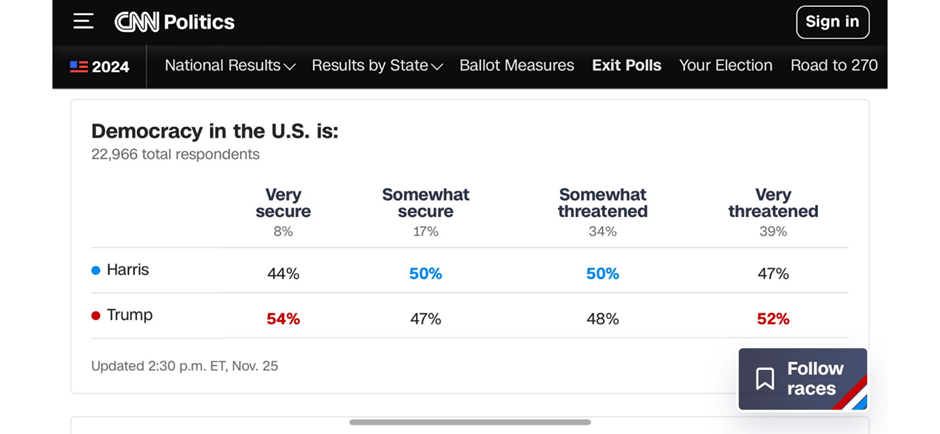
First, the Democrats appeared to make a basic error in interpreting polling on voter priority as monolithic support for their side. The most obvious case was seeing “the state of democracy” as the biggest concern for voters, but assuming that such people must be anti-Trump side. As the exit polls showed, among those who considered democracy threatened around half actually supported Trump, not Harris:

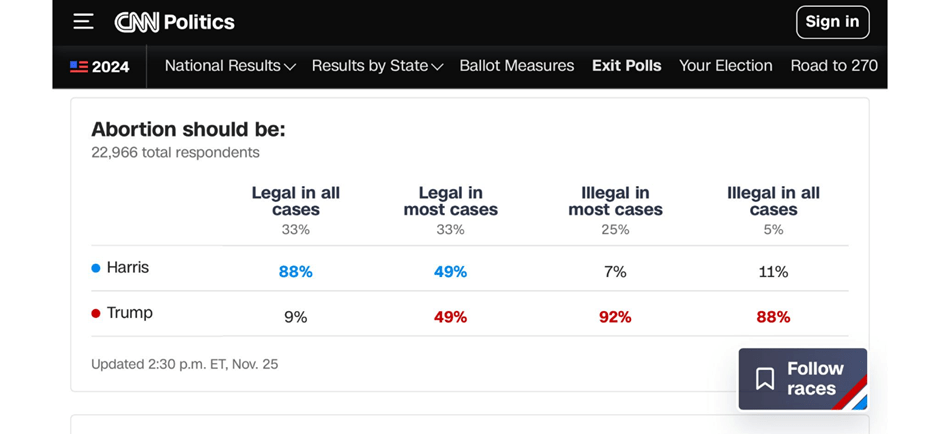
Even if we accept that people voted on the basis of just this one issue, it turns out as many considered the ‘lawfare’ campaign against Trump as a threat to democratic norms as did the events of 6 Jan, and Democrat pursuit of the argument that “Donald Trump is a fascist” were not only failing to gain traction but may actually have been counterproductive. The same applies to abortion, which earlier on in the campaign was considered critical: among the one-third of voters who thought abortion should be “legal in most cases”, voters were split evenly between the two candidates:

If strategists such as Plouffe were not even bothering to dig into the numbers behind the headlines to this basic level, it is hardly surprising that they were wasting their resources based on biased assumptions and projection.

Secondly and more importantly however, is the very use of voter prioritisation polling. Most examples of such polling were single answer (rather than, for instance, allowing respondents to choose as many as were important). This created two problems: the error of forced choice and the error of colouring. Forced choices make people go with obvious and pronounced options even when other issues might cumulatively be more important (eg the economy might be outweighed by adding immigration + crime together). Colouring is the consideration that a seemingly insignificant issue by itself still adds a great deal of colour to the candidate or party, influencing voting subtly.

The fact is that most people do not vote on ‘policies’ other than very occasionally when a policy is so simple that it cuts through all the political noise to become totemic. These are so rare that we are hard-pressed to even recall many instances – although Trump’s promises on trade treaties in 2016 comes to mind (as well, perhaps, as his “no tax on tips” policy this year). Elsewhere, the chance to buy your council house under Margaret Thatcher in 1987 is an example from the UK, as was Jeremy Corbyn’s land value tax proposal in 2017. Rather than policies, voters pit a general sense of where policy proposals are headed (eg “lower taxes”, “tough on crime” etc) against a matrix of what a candidate is ‘famous’ for. If the candidate is not well known for the economy for instance, no amount of policy proposals on that subject will mean anything. People vote for their impressions about a candidate, not so much the content.

Which leads to the issue of trans rights, which Plouffe so airily dismissed as “not driving vote”. He was of course correct that it affects tiny numbers of people, and directly animates only a few more; but he is wrong that Harris’ well known past history on trans matters did not colour voters’ impressions of who she was and what she tends to care about. Certainly, she did not come across as tending to care about immigration or inflation, two subjects Trump did convey; on the other hand the trans dsicussion, while not shifting votes directly, added up to an impression of her priorities. On a broader level, it brought into focus her judgement – “is a politician sanctioning free transgender operations for prisoners really worrying about the same things as me?”. Issues can be obscure without being innocuous.

(The same, by the way, was true of Brexit where for years the polling had told us that the issue of “Europe” was not a priority:

Yet this totally missed the point that while in a forced choice, it was not important, at the same time its many facets coloured huge chunks of the public discourse about Britain and the efficacy and power of its government to effect change on matters such as the economy or immigration. Rightly or wrongly, the democratic overhang created by EU membership far overshadowed the importance of the actual issue in voters’ minds and this manifested as a groundswell of discontent which could barely be contained – if Cameron had not asked the question in 2016, a future prime minister would have had to do so within the ensuing years).

None of this nuance emerges in Plouffe’s narrow and mechanical interpretation of voter issues, but it does not take a genius to see how it all connected in the minds of a voter who is only semi-engaged. I will use the parallel of Tinder, where I doubt David Plouffe would have much success, to illustrate the point.

If we strip away the 50% of women and 99% of men who swipe left or right based purely on the photo (although this, too, may be instructive to campaign directors), we are left users of the app having only a quick glance of the few things written down on a profile to decide their choice. Now, imagine a man includes the sentence “vegetarian” in his profile, and consider the consequences. Few women will be so militantly carnivore that they swipe left for this reason alone; but there is no doubting that it somehow adds colour to the profile which will make them think twice. “What does this guy care about?” “What sort of restaurant would we have to go to?”, “Will he force me to only eat lettuce?” and so on. Nobody will admit to vegetarianism having been the deciding factor for their swiping, but you can be sure that it did its job in making that profile underperform in finding matches.

Such structural misunderstandings significantly weakened the strategy Plouffe and his crew were running, well before we get to the litany of “unforced errors” which surely did not help in what was supposed to be a tight race: bear-hugging the Cheneys on campaign; encouraging abortion ballot initiatives in the same election meaning voters could split their ticket and vote for Trump and for abortion; avoiding Joe Rogan and not distancing from Biden; and the ignored sense of scandal surrounding both pretending Biden was mentally capable until June, and then replacing him without a primary. But these need not be litigated here, because the Plouffe team had made historic mistakes in reading voters’ preferences well before the campaign minutiae.

It is, in a sense, rather poetic that the governing classes in both parties (and in the UK) who for so long have sought to reduce politics to a pseudo-science of well-placed dog whistles and esoteric metrics about the economy, should be hoisted on their own petard. Trump offered little if any direct policy solutions to the questions of immigration or inflation, but voters felt he understood it in his marrow. The Democrats need not had offered policy answers either, they simply needed to find a candidate or a message which showed they too understood the problem. But having spent three decades telling voters that life is all about the statistical evidence, about management, about professionalism and about making sure the ‘system’ worked, voters then went on to rightly judge them on these very metrics. Prices were up, groceries less affordable, government seemingly ineffective. If you live by technocracy, you will die by technocracy.

Lichtman’s model may still be good, even if his 2024 prediction is wrong

An absurd online tussle has commenced over Allan Lichtman’s ‘Thirteen Keys’ thesis over the coming US presidential elections, where not only are endless amounts wasted on challenging his predictions (“He is biased! No he’s not! He’s pro-Democrat! He wears a wig!” etc), but actually being threatening to the poor septuagenarian. Even in the heated environment of this contest, as JD Vance says, this is not worth it.

Yet it presents a good opportunity to think about how robust his model actually is. For the record, I like this type of macro historical analysis, and I think it has value. In particular I like the discipline it instils in not subjecting the election only to the noise of the latest polling. On the other hand, I have a sneaking suspicion (famous last words, perhaps) that Lichtman’s actual predictions this year, which are for a Harris victory, may be wide of the mark. Would this render the model broken?

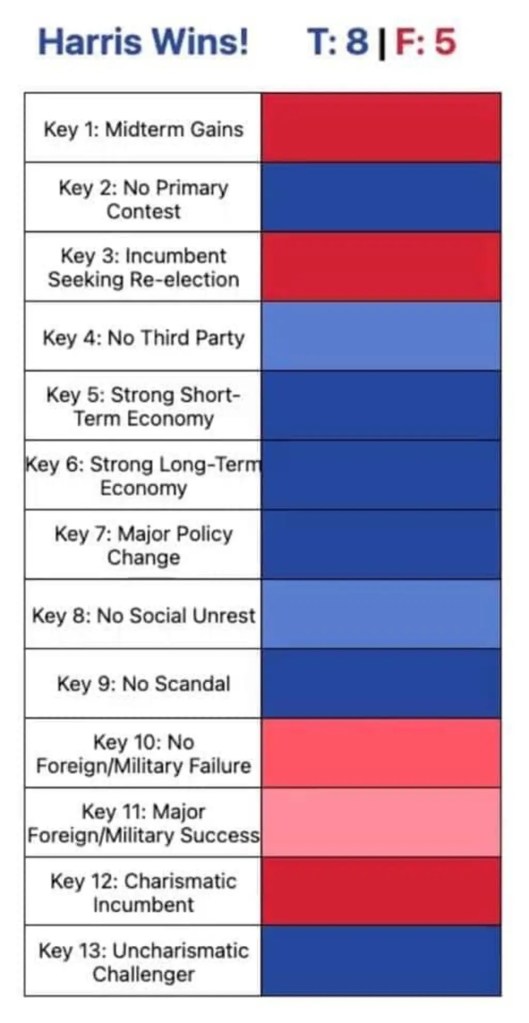
I don’t think so. Trump may well win this year, but if he does so it will be less about Lichtman’s model being wrong so much as Lichtman’s own interpretation of it. Let us bear in mind that the model is just that – a neutral series of tests (explained in detail here) – but Lichtman then has to take these tests and package them into an opinion (below is the most recent I can find). There is plenty of room for subjectivity. Currently, he sees the lie of the land like this:

Critics of Lichtman’s model – and there have been many – mainly focus on the keys that are obviously open to interpretation and are therefore ‘subjective’. Nate Silver for instance notes that the two “charisma” tests are very much in the eye of the beholder, while others would complain that the definition of a “major policy change” or foreign policy “success” or “failure”.

However I am less interested in those tests so much as the supposedly binary ones. Because the problem is that the whole political system has been shaken in the last decade, resulting in what I think are some structural problems in Lichtman’s definitions – his underlying intent is correct but the manifestation of the issue he has identified no longer conforms to how he has set the keys up. Below, I focus on a few examples.

Key 2: No primary contest

Now this may seem obvious and technically true, but I think Lichtman may not be seeing the wood for the trees this year and ignoring his own wisdom. If we take a step back, the point of there being “no primary contest” is essentially that the incumbent party has not had a bruising encounter which exposes disunity in the ranks of the incumbent party seeking re-election (apparently the same is not true for the opposition, which I have some sympathy with).

But considering what has occurred in 2024, I am not clear that this is true in spirit, even if it by letter. The fact is that many Democrat supporters either a) resented Biden being deposed the way he was, or b) did not like Kamala’s unchallenged rise to the nomination. I personally know a few who have not forgiven the party for what appears to have been a hugely opportunistic change (and let’s be clear, it was perfectly possible to have still had some sort of debate leading up to the Convention, something championed by many including Ezra Klein and numerous others here and here). While Harris acceded unopposed at the Convention, her elevation left quite a bitter taste in many corners of the party.

Thus, while technically the incumbent party did not have a divisive primary, there has in fact been discontent around the selection procedure, so awarding the key to the Democrats in this case is structurally dubious.

Key 3: Incumbent seeking re-election

In this case Lichtman has given a key to Trump which is questionable. Of course, again strictly speaking, Harris has not been President and is therefore a new candidate. And even allowing for sitting VPs such as Al Gore not being considered ‘incumbent’, the peculiar issues surrounding 2024 again makes this seemingly binary key more nuanced.

Is Harris an incumbent? Who is the incumbent? Not only has Harris been part of a long-running trend whereby VPs have been more active in the Executive (Gore and Cheney, and now Harris), but she has now basically been Acting President due to Biden’s incapacitation. She was elevated only after the incumbent had been selected and had started to campaign for the presidency; she has inherited almost his entire infrastructure and strategy and by choice or not, has been unable to distance herself from the Biden administration. To my mind, unlike when a VP runs after an 8 year term (such as Gore in 2000, or HW Bush in 1988), I think the public will likely see Harris as a continuity of the regime, for better or ill. In Lichtman’s model she should therefore get credit for more or less being an incumbent.

Key 4: No third party candidate

Here is perhaps the most far-reaching and controversial challenge to Lichtman’s definitions. Again, of course, this is technically true since Lichtman defines “third party candidate” to mean an officially non-aligned candidate who polls more than~5% of the popular vote. In other words he is limiting himself to the Ross Perots and Barry Goldwaters of electoral history. But with 2016, I think this part of the model has been completely blown out of the water.

Trump, in 2016, was essentially the first third party candidate to win the presidency. Yes, he ended up tackling the Republican primary and using that as a vessel into politics, but he famously had previously been a Democrat and moreover, disagreed with much of the incumbent GOP platform and heritage. Trump’s greatest moment in the primaries was arguably his anger at calling out the Republican establishment over the Iraq War, and being roundly booed for his troubles:

To look at the purpose of Lichtman’s key, it exists to highlight that a significant third party usually indicates discontent with the system, which tends to favour the challenger (this I think is a debateable point but generally I can understand his perspective). No third party therefore favours the incumbent. Yet if a challenger has essentially captured the opposition vessel for effectively becoming a third party candidate, this no longer applies. The same would be true, back in 2016, of a potential Sanders candidacy for the Dems would have seem him as an outsider also. I previously expressed the 2016 worldview like this:

PhyPhi - post 2016 politics

So ultimately we are judging Lichtman’s model by his own narrow interpretation, since as far as I know nobody else is doing an independent version using the same system. But just as an example, if I switched the three examples above around, the 8/5 balance becomes 7/6, and we would be left with discussions over imponderables such as the fact that there are millions of Obama-Trump voters, which belies the thinking that Trump does not win over people from the other side (the definition of “charistmatic challenger”). Indeed whether Trump, in or out of power, would ever be not a “challenger” is itself a question for Lichtman.

For the record, my own interpretation of the Lichtman model offers a 8/5 in favour of Trump. In addition to the key changes above, I would change the charismatic challenger key as explained, and I also sense the “scandal” key to be more prominent than Lichtman believes, because I think there is a whiff of wrongdoing around how long or how early senior Democrats have been hiding Biden’s senile incapacitation. But, as others have noted, these are down to personal views and the polls continue to tell us the race is close.

On balance, I would say that Lichtman’s model is one which we can proceed with with caution for fun, but I would urge psephological geeks (such as myself) to drill into the underlying keys and render their own interpretation, rather than rely on Lichtman’s. Separate the man and his keys, and you may be better off.

Why Palestine – like Tibet and Kashmir – is just boring

A less boring version of events

With the latest conflict now settling down to the usual name-calling and posturing, we are once again confronted with the insolubility of the Middle East problem. For those like myself who grew up with another version of this – the sectarian tensions in Northern Ireland and its impact on politics and society in the UK at large – this is all too familiar. And for myself, much as I felt with that episode of history, I cannot help but be bored each time it starts again, because there is actually no solution which will bring a lasting peace until, as with Northern Ireland, we start to move beyond political conceptions on which states and borders are based.

Before I get to my historical analysis however, I would also give a nod towards the issue of foreign observers and their inability to grasp real motivations of those on the ground. Graeme Wood made the point, during the rise of ISIS in 2015, that the hand-wringing in Washington and Brussels would never help until they acknowledged the underlying religious inspiration behind the Caliphate. People do genuinely act on matters of theology; it is not all (or even mainly) a matter of economics and the Marxist interpretations. But of course, western observers, whose political classes are by and large either atheist or at best agnostic, could never comprehend this and would therefore keep wanting to bring a knife to a gun fight. The naive but enduring hope that improving the economy and jobs would somehow solve the problem that Islam presents is really a problem of the observer, not the subject.

However to return to a more Realist angle, I have no interest in how to solve the current Palestinian problem, but I do have an interest in the historical provenance. Because like it or not, the Israel issue is one of several which have their roots in intellectual limitations of state-makers in the immediate aftermath of World War II, roughly from 1946-1954. We saw the same problems erupt as India gained independence and split between Hindu, Muslim and Sikh; and in the slower issues built up in the corners of China as Mao consolidated around the Qing Dynasty imperial borders. In every case, conflict and bloodshed were born of trying to fit the square peg of empire into the round holes of nation-statehood.

The ‘nation-state’ itself is, of course, a somewhat recent phenomenon. While it is a little trite to date them specifically to Westphalia in 1648, it is certainly true that a century earlier at the Peace of Augsburg, the connection between rulers and the ruled based on ethno-cultural identity was barely existent. The splendid Charles V, in his twilight in 1555, was the legitimate ruler of inheritances including Spain and the New World, Austria and the Holy Roman Empire, and Burgundy. Nobody on the streets of Vienna, Antwerp or Madrid complained about his ethnicity – even if they might complain about misrule. This detachment between where a ruler came from and his authority only changed with the advent of new weapons, increasingly expensive wars, and the compensation offered by rulers to their subjects for ever-higher taxes to fund the military. ‘Nationality’ was a part payment for the debt being incurred by princes as they required greater blood and treasure – “we need more from you, but you’re now fighting for your own people!”.

Allegory on the abdication of Emperor Charles V in Brussels

So nation-states, in other words, with their hard borders and inherent desire for ethnic, cultural, religious and linguistic cohesion, were a creation of European diplomacy just a few hundred years ago. And it served them fine, even as the rest of the world tended still towards the more nuanced and subtle lines of empire – today a byword for violence but in actual fact a creator of peace for most people. In simple terms, for instance, it made perfect sense for Tibet to exist within the Chinese imperial sphere; but made very little sense for it to be incorporated into a new Chinese nation-state. Likewise the Northwest Territories to the Raj. Most of all, in Jerusalem the centuries of occasionally tense but balanced coexistence between Arab, Jew and Christian was brought to an end with the creation of the Israeli state in 1947.

All three of these examples – and plenty of others besides – would have benefited from revolutionaries who looked past the (even then already dated) concept of European nation-statehood. In each case a forward-looking, more federalised concept of governance could easily have been introduced. In Europe itself, political leadership was looking at a post-national world which would lead eventually to the European Union. So why was none of this progressiveness around in Israel, India or China?

First is pure laziness. A vast number of unfounded charges are laid at the feet of the British Empire (which left the majority of its people better off than before), but the one criticism which sticks is the undignified rush to decolonisation, and the unintellectual approach used for it. Britain of course, as demonstrated with the EU, is in any case the wrong source of inspiration for ‘post-nationalism’, but at the time the navel-gazing was due to self-obsession. The credit for all the good that Empire brought, was more than a little diminished by the inglorious process of its end.

But the bigger issue was the lack of imagination from the heroes seeking to create new countries of China, India and Israel. Mao and Zhou, Gandhi and Nehru, Weizmann and Ben-Gurion were all leaders steeped in the orthodoxy of western historical teaching, and could conceptualise of nothing else other than the national structure of western powers (despite, ironically, the fact that those same imperial powers tended not to apply statehood in the empire, resulting in a measure of peace). When Churchill called Gandhi “a seditious Middle Temple lawyer, now posing as a fakir… striding half-naked up the steps of the Viceregal Palace” it was as much a comment about his cultural background as it was about his privilege. Gandhi suffered, as they all did, from a sort of Stockholm syndrome where because Europe comprised all nation-states, so should their newly independent post-imperial entities.

Not all such Westphalian myopia ended in disaster. A few successful examples included Lee Kwan-Yew’s establishment of Singapore, or the stability achieved for long periods in Thailand or Japan. But in general, the larger conflicts today still exist because someone, somewhere, could not get their minds around the temporary and cyclical nature of national constructs, instead pursuing hard-bordered strategies that had to end in bloodshed. They were not helped by their former masters, to be sure; but ultimately it is difficult for these founding fathers, all of whom played up their own supposed knowledge of history, not to take the majority of the blame.

The crises in Palestine and elsewhere, such as they are, are the fault of aspirant statesmen who could not think outside the box. None of them had a proper historical grounding, and generations since are paying for it. This insolubility deserves ennui, not obsession.

Is the opportunity in the Middle East all it’s cracked up to be?

A truly adventurous expat

With several of my friends having moved, or considering moving, to the Middle East, I wanted to take a moment to consider exactly what the attractions of such a move could be for erudite, sophisticated expats (as opposed to estate agents, headhunters and so on from the Home Counties).

The Middle East is not one place, of course, so I will stick to looking at the two or three locations which are emerging more regularly in conversation: the UAE and Saudi Arabia (hereafter referred to as “the Kingdom” in deference to the Kool-aid drinkers out there – you know who you are). Specifically, it is jobs in Dubai, Abu Dhabi and now Riyadh which appear more frequently, creating the wave of excitement about acronyms which we have become used to: ADQ, ICD, ADIA, PIF and so on.

It strikes me that as an expat looking to take up a second innings in the Gulf after years in, say, East Asia, there are three variants of what might make the story “the real thing”. First, obviously, as a source of investment funds for expats to service; secondly as a final market for commerce and consumption; and lastly, unashamedly as a venue for globalists to pass their time and enjoy ill-gotten gains. I will assess each of these in turn.

As a source of investment funds

This storyline seems pretty unassailable. Sovereign wealth is not the only form of investment money, but they are a useful proxy for the overall picture even if doing so favours the Middle East (China and other major economies have much more substantial capital in the hands of corporates). Gulf SWFs have been accumulating for some time – as an oil and gas banker, even the 2000s were an era to look for their capital. Then along came PIF which blew them all out of the water.

Sovereign wealth AUM by country (US$bn)

Source: SWF Academy / LBS; Note: ‘Other Gulf’ includes Kuwait, Qatar, Oman and Bahrain

However, it is important to consider that the attraction of this money is not only that there is a lot of it, but that the holders must be rather stupid. For all the noise, the scale of SWF money from the Gulf is comparable with Asia – Singapore alone has funds equivalent to the Kingdom, whilst China dwarfs all of them. So why are these same expats not clamouring to work at Temasek or the CIC?

As racist as it sounds, it is because expats want to believe the Middle East is still ‘dumb money’ compared to Asia. And while a case could be made for this – a significant amount of the Gulf money remains undeployed and one assumes they are not yet as sophisticated – one must surely be conscious of the closing window. If it took 20 years for Asian money to wise up, there is no reason to believe Middle East will be slower; indeed it may well be faster.

Additionally, to rely on this argument, we are really saying that expats do not know if they like actually living in these places, but they must because the Gulf has the money and we do not. The expectation is that activity will be largely outbound, allowing expats to service their hosts but spend as much time as possible elsewhere. Geneva without the scenery … an exciting start.

As a commercial market

This is a more productive area to discuss and indeed to hope for. Expats in Asia will be painfully aware that ultimately, the self-sustainability of an economic opportunity relies on underlying indigenous consumption and therefore on population scale.

The markets we are talking about in the Middle East are not enormous. The Kingdom spices things up with its arrival of course, adding 35m people to the cluster of small city states around it, and this should not be dismissed; but it is hardly the stuff of global engine rooms. On a simple basis, unless the ‘Middle East’ can come to encompass two or more of Egypt (113m people), Iran (89m) or Turkey (85m), the scale of the opportunity presents an insurmountable problem for those seeking to make long-term money.

But there are nuances. For instance, what exactly is the region’s ’Middle Class’ and how does it compare? For this quick assessment, I tend to use the Credit Suisse data on wealth distribution as a basis, with the US$10,000 band representing the ‘emerging middle class’ while the US$100,000 speaks to those who are truly middle class. From a consumption perspective, this equates respectively to those who can be ‘mass modern’ consumers (shopping in, for instance, air conditioned modern retail outlets), and those who are ‘mass premium’ consumers (who might, for instance, consider buying a Lexus or holidaying abroad). This is a shorthand but useful nonetheless.

On the positive side, small as the population is, the spending power in the UAE and the Kingdom is probably outsized compared to markets we know and love in Asia. While the adult population of the two countries totals the same as Malaysia, the numbers of upper middle classes are significantly higher. In particular, richer consumers abound here compared to similar sized Asian countries, hinting at a strong market for luxury goods.

On the other hand, while the population has been growing, the prospects of that growth face some headwinds. Unsurprisingly, the Gulf states tend to suffer significant inequality, which is never a strong basis for future development. As has been discussed previously, there is a significant correlation between low starting inequality and the pace of nominal GDP growth, with the likes of China and Vietnam outperforming Indonesia and the Philippines as a result. The Emirates and the Kingdom fare poorly on this which may indicate a lower ceiling of sustained progress.

Combining these together, I think what we are looking at is an exciting enough market, about the size of Singapore + Malaysia with a chance of ultimately becoming Thailand. Let us be clear: if the Kingdom can achieve the level of Thailand, with its relatively strong manufacturing and consumption, it will have done very well indeed. It will not make huge numbers of foreigners hugely rich, but will support a few of them for a few years; and if you are geared towards the luxury end of the market, the region may well reward you handsomely.

As the new globalist hub

Now we come to the most nebulous and most hubristic idea: that following the ‘decline’ of Asia, and therefore the lessening of the attractions of Hong Kong and Singapore, the likes of Dubai can take up the mantle of being the hub of the ‘citizens of the world’ (aka ‘citizens of nowhere’).

If we look at the two previous sections, we have covered some, but not all, of this ground. On the one hand, the sheer volume of investment flow (mostly outbound) will for a few years require international talent until, like developed Asia, they no longer need it. On the other hand, even the most optimistic view of domestic demand shows a ceiling in both amount of foreign employees and for how long they are needed. But what if the Gulf somehow “corners the market” for international expats, becoming the place for the globalised to live as this world ever shrinks into localisation?

First off, we should be clear that following the examples of the Asian city-states, there can really only be a couple of these if they succeed at all. The fundamentals argue in favour of the UAE over the Kingdom at this point, since Dubai is already established and given the seeming hardships still true of Saudi which, regardless of the pace of liberalisation, will still see expats want to party elsewhere. For the record, given the religious nature of society, I do not see Riyadh being able to be as ‘fun’ as Beijing was c 2005-2015 – so that already robs it of one possible selling point.

So assuming that we are talking about Dubai, possibly assisted by Abu Dhabi, the question is whether the allure of regional investment flows can outweigh the domestic demand elsewhere, and if so, by how much to allow expats to feel like the little kings they want to be? It assumes a substantial ongoing decline in Asia, for a start: if even one of Singapore or Hong Kong remain alive, they will immediately draw critical mass away from the Emirates. The UAE strategy is rather Google-esque, since it sort of requires going for broke. You either win everything or you end up not breaking out of the limited regional play.

Could expats from London or New York live in the Emirates and traverse the globe from their new-build beach homes? Certainly there are a few geographical benefits in terms of time zones (albeit not for the US market, a true arbiter). The place is spanking new and Filipina helpers are a dime a dozen. But unlike in Hong Kong, and slightly more like Singapore, expats would have to spend much more of their time on flights since others would be less naturally attracted to travel through. When you factor in that the ‘big neighbour’ is much rougher than China or Indonesia were for the others, it paints a picture of life being a touch less fun.

As a final note, I have not excluded consideration of other jurisdictions, because none of them pass muster. Kuwait is totally off the agenda due to its domestic social policies. Qatar remains too much of a geopolitical risk locally for expats to throw their lot in with compared to the others. Bahrain is the other ‘sanctuary’ city but has surely lost the race to get started vis-a-vis the Emirates. Further afield, Oman and Jordan are on the fringes of the region.

The sad thing is that all of these venues are new-builds: what a cultured foreigner would really want is to live in historical Baghdad, Damascus or Tehran, but these are all off the market. Had any of these cities been the take-off point, the story could be dramatically different.

A baseless prediction

Where does this all leave us? As an Asia expat for over 15 years now, based in Singapore, Hong Kong and Beijing, I will indulge myself on making an outside-in forecast about how attractive the Middle East really is for myself and my friends.

First, I cannot refute that a near-term bubble of at least 3-5 years is still in the offing. Dubai has already had a decent innings but I do expect real estate investment for instance to be well-rewarded. For a few years, too, I expect some decent employment opportunities to emerge for first movers, the equivalent of FILTH during the 1980s and 1990s. Real skills will not be much required in the very first wave. The Gulf will also attract – possibly permanently – currently homeless parts of the global new economy such as crypto.

However I do expect this to change quite quickly, and more so than in Asia. Dubai does not have the colonial and post-colonial legacies of Hong Kong or Singapore commercially, socially, infrastructurally or legally. This means a lesser and shorter rent seeking phase for white people. It also exerts no permanent hold on its larger neighbours the way Hong Kong (for China) and Singapore (arguably Malaysia and Indonesia) do, which means the opportunity will start to ‘leak’ out to the local markets more quickly than they did in Asia. The Emirates will not have a century to be bedded in as the place to do business in Saudi the way Hong Kong did for China. Development, if successful, will more resemble how Vietnam has exploded so indigenously, barely giving regional expats a window to be relevant.

More than anything though, my feeling is that the Middle East just cannot become ‘pleasant’ enough to be sustainable for so many expats. The moment they are not needed they will leave, whereas Hong Kong (and Singapore?) continue to exert an influence over expats even as its best days appear to be behind it. It has mountains; it has seasons; it has a western mentality partially instilled into local people. I don’t doubt that Dubai has been fun, and Abu Dhabi and Riyadh may yet be for a few years; but I don’t believe it will feel as expansive as, say, living in Shanghai has been. And some of that has to be the size and depth of the local civilisation. The globalists will definitely lose interest after a while.

For out-of-work bankers, this will not deter the enthusiasm to look West. Some will have perfectly decent second careers there – albeit probably for a shorter period and likely involving a more frontier lifestyle than they are used to. Good luck to them – expats are nothing if not opportunistic. But to those who believe the Middle East represents a generational opportunity to take up the mantle of a growth engine, I think they will need to moderate their hopes. We will see how right this may be within 5 years.

An Argentine-Brazilian currency is insane, but still interesting

Monetary unions rarely fall down on their economics, but do so rather on the political competencies of the participants

The reaction to this week’s announcement from our Argentine and Brazilian friends, of tentative plans for a monetary union, met with predictable – and mostly justified – derision. “This is insane“, tweeted Olivier Blanchard from that bastion of economic propriety, the IMF. Below the line comments on the FT included one wag which described this as “a version of the Euro where every member is Greece”. And no wonder, since the announcement was accompanied by the kind of hubris more befitting Argentina’s junta days than now – “It is Argentina and Brazil inviting the rest of the region” they said, as though they occupy anywhere near the global status of their erstwhile Brazilian partner these days.

Yet, this is consequently a poignant moment to reflect on currencies, economies and the lessons of the Euro – to date, the only effected currency union in existence (there are a few others, but these are paltry). There are in reality two main drivers of such things: one ‘imperial’, the other ‘democratic’.

The ‘Imperial’ model of monetary union is where the economics of one power dictate the others. Historically this includes arrangements such as the Sterling Area, but in today’s more consensual world it more regularly indicates some states wishing to copy or import the strengths of a neighbour. In the Euro, it was very apparent that the motivation for many countries was the ability to import Germany’s low inflation and depreciation – basically, to emulate and outsource the role of the Bundesbank. This was certainly true of Italy, and even if they do not admit it, the French. The Euro became (and is) and consensual imperial project on behalf of Berlin. I, for one, have no qualms at all about such a thing.

But the Euro, and its predecessor the ERM, was also conceived of as the other model, the ‘democratic’. In this world, the new currency would marry German manufacturing with French agriculture and British finance. This provided not only a balance, but also allowed the EU to exceed the sum of its parts – it relied on complementarity and relative equality. At that point, too, the only countries involved were wealthier ones, not the collection of rich and poor that it became. The problem was that over time, two truths emerged: Britain was too Eurosceptic to join the Project, and France was in fact nowhere near equal to Germany. Therefore, the ‘imperial’ model superseded the ‘democratic’.

This was aided by the fact that Germany, suffering from the after-effects of reunification, entered the final straight pre-Euro in an artificially depressed exchange rate. The best way of looking at this is through this exchange rate effect on current accounts over the period:

Source: Eurostat

The reversion of this undervaluation over time inevitably led to German economic and monetary dominion over the rest of the Eurozone. Economic empire became a reality and, although there are plenty of high profile problems requiring German taxpayer bailouts of, say, Greece, this simply became the “cost of empire”, in exactly the same way the UK home population had to cover the balance sheet of the British Empire after the 1850s.

If we therefore look at the proposed Argentine-Brazilian ‘Sur’, we have to ask ourselves before we dismiss it, what are the objectives and how might they be achieved? The Argentina peso is a basket case, but the Brazilian real is not exactly the Deutschmark either. Regardless of recent crises therefore, the Sur must be based on some sort of complementarity: theoretically a commodity exporting superpower whose overwhelming dollar reliance might be transformed into a monetary of its own, aided by some flattening of the cycles between various commodity prices. The trade between the two countries, interestingly, is much more diverse than one might think:

Brazil exports by value to Argentina (left) and vice versa (right) in 2020

Source: The Observatory of Economic Complexity

Now, none of this is to suggest the Sur will work. On the contrary, guessing today, it seems unlikely to ever take form. Neither Brazil or Argentina represent a clear imperial winner over the other. Neither is notably better managed (though Lusophile lobby would contend that Brazil has had a better recent innings). Yet neither are they clearly complementary: although Brazil is Argentina’s largest export destination, at just 14% this is not determinative; on the other hand Argentina accounts for just 4% of Brazil’s exports, dwarfed by its relationships with China and other emerging markets.

In fact, far from being different, Argentina and Brazil are probably too similar. Apart from a history of poor public policy, the strengths outlined above are their weaknesses too: both countries are still overly focused on commodity trade. Dollar-based raw materials account for two thirds of each country’s exports. Indeed logically, both might be better adopting the Dollar instead of looking at such a doctrinaire project – Argentina’s experiment with the peg over the 1990s, whilst it collapsed ignominiously at the end, was in retrospect quite successful at the core objective of halting inflation – which has since returned with a vengeance.

So neither model of currency union are obvious, for now. Yet, the reasons it may succeed or fail ultimately are not economic, since economics is the servant of politics. The Euro’s greatest weakness has not been economic but political, the Project falling between these two contrasting motivations of democracy and empire. If the Sur starts life with a clearer assertion at the outset, it may have some rationale. The lack of an obvious imperial winner between the two countries, ironically, actually gives the project greater clarity – this will be democratic and complementary, or it will be nothing.

It will probably be nothing, of course. Or, we will quickly discover that Argentina is in such a hole that Brazil effortlessly becomes the imperial power in this relationship. Either way, I await the political will behind this idea to manifest, before I judge the dream quite so harshly, and there remains a lot to learn from the Euro along the way.

In defence of … Empire

The Muse bids me consider the good, the bad and the necessary forms of power

Two decades ago, the subject of empire, which had long fallen under the pall of apologetic navel-gazing in academia and in political discourse, experienced something of a revival. On Home Counties coffee tables in around 2003 emerged books such as Niall Ferguson’s Empire: How Britain Made the Modern World and, a couple of years later, his follow up Colossus: The Rise and Fall of American Empire. Both were made into TV series, leading to rather bitchy comments from my own tutors at Oxford over exactly how much of a sell-out he had become. Ferguson moved on soon to NYU and latterly Harvard, where he continues to be a proponent of sorts, of the imperialist revival.

He was not the only one however. A far more academic book, though still accessible, from a few years later in 2009 was John Darwin’s After Tamerlane, which charted the Asiatic land empires over the period 1400-2000 and took a nuanced view on empires, their existence, longevity and, buried amongst the prose, their benefits. The obvious point being that:

[A] propensity in human communities has been the accumulation of power on an extensive scale: the building of empires. Indeed, the difficulty of forming autonomous states on an ethnic basis, against the gravitational pull of cultural or economic attraction (as well as disparities of military force), has been so great that empire (where different ethnic communities fall under a common ruler) has been the default mode of political organization throughout most of history. Imperial power has usually been the rule of the road.

On the other side of the Atlantic, the process of soul-searching brought on by the foreign policy of George W Bush generated much writing, with 2010 alone producing three prominent volumes in the shape of Empires in World History by Jane Burbank and Frederick Cooper, The Rule of Empires written by Timothy Parsons and Empire for Liberty by Richard H. Immerman; this unsurprisingly coinciding with the accession of Barack Obama, probably the most forthright anti-colonialist (and perhaps anti-British) man to occupy the White House since Grover Cleveland in the 1890s.

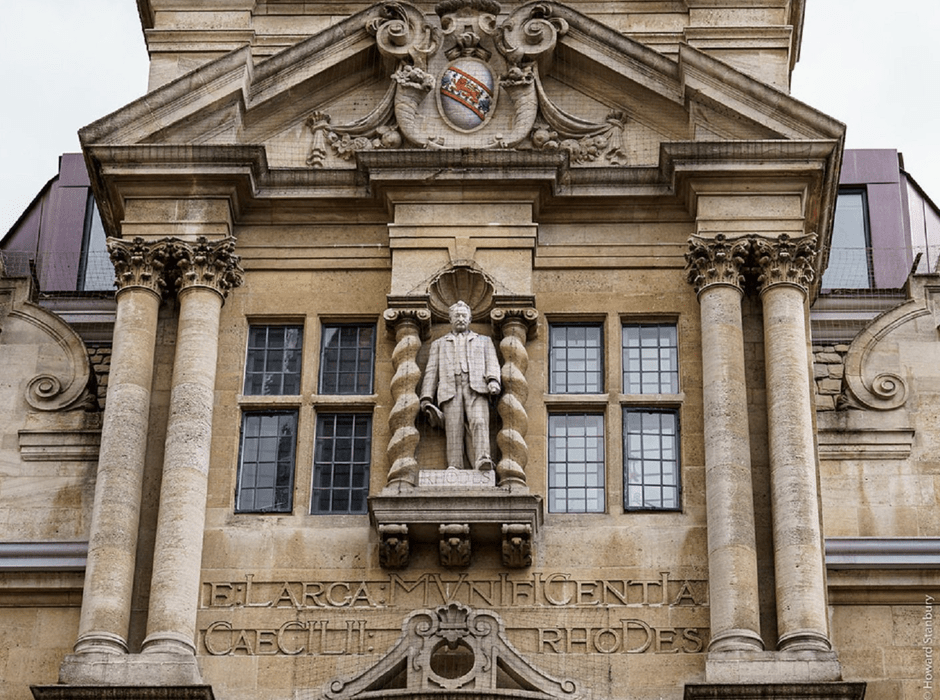
However, after that burst of activity, Empire has again experienced decline in the perceptions of the liberal public – not least through the sophistry of race relations which re-emerged through the 2010s, accelerated by Trump’s election, BLM and in my world, the absurdity of movements such as #RhodesMustFall (though I am glad to report that as of this moment, Rhodes’ statue still looks down majestically from its cupola on the High). Iraq and Afghanistan have gone the way many feared; perceived Russian and Chinese aggrandizement continues. ‘Empire’ has not had a good innings. Yet the lessons about why they are good, bad or necessary are still overlooked, and I feel obligated to rehearse them once more.

First, Empires bring peace; and their decline brings conflict. Whilst this may sit in cognitive dissonance with how history is taught today, the reality is that for a majority of peoples governed under imperial structures, lives were more stable under this regime than what they might otherwise have. This is not only empirically true – Spain and North Africa for instance were largely left in peace for three centuries between the Punic Wars and the Crisis of the Third Century, despite not being Roman “heartland” – but also logically. See also China, Byzantium, the British and French empires and even the dysfunctional American equivalent (though as Ferguson says, Americans just aren’t very good at empire). Ethnically-focused nation states must be more prone to friction with neighbours than an empire which is first and foremost self-interested in minimising that friction. No successful empire has ever seen greater violence and destruction in its borders, than its alternatives.

Secondly, Empires bring prosperity. Much like any political system, the proof is in the pudding and there are very few examples of empires which successfully exist for long based only on coercion. Even the Empire in Star Wars, for instance, would have had more adherents than resistance and the Jedi should probably have asked themselves why they were in such a minority for so long – probably because their own scattergun and slightly racist alternative proposition could not even persuade Ewoks, let alone the merchants, professionals and other middle classes of the Empire that their mess was better. Most complaints about empire comes from self-indulgence, and nowhere was this more plainly set to rights than in Monty Python, whose sketch in The Life of Brian was a thinly-veiled lampoon of anti-colonial opinion across Asia and Africa:

Lastly, empires bring diversity. Given the propensity to celebrate everything “D&I” these days, it is worth pausing to think about how much empires, rather than nation-states, and created and sustained true multi-culturalism. Ultimately, empires are agnostic about the culture they carry, and as they expand absorb ever greater amounts of what they oversee. It is notable for instance, the Prime Ministers such as Thatcher and Blair were eminently more parochial than similar bourgeois classes a century earlier, whose relatives would have grown up in India, the Sudan and elsewhere serving as bureaucrats and engineers. Whilst Europe has provided some remedy to this parochialism, it is not complete: since the decline of empires in the 1960s, modern (western) nation states and their governing classes know less about the world around them than ever before, leading to everything from half-baked trade pacts like the WTO to neo-conservative adventures in the Middle East. The borders of empires are soft and porous; the borders of nation states are hard – and with it hardened views on identity and inclusion.

Coming from a family that emigrated under the auspices of Empire from China to India to Britain, I take a personal pride in the system that allowed for this to occur. Britain offered an attractive cultural and civilisational prospect, of course, and its contemporary weakness in this needs addressing; but more importantly it was the infrastructure of empire that served so many millions of people so well, for so long. It gave opportunity, egality, stability to the very poorest in society, at the expense, ironically, of the “home” nation.

Empire is here to stay, not just because of legacy but because its really quite a popular system. The definitions may vary over time, but the principles of expansion and peaceful, productive dominion of a periphery by the centre will remain permanent. A decade ago I argued that we were witnessing the emergence of a new “community of empires”, given the way not only Russia and China, but also India, Brazil and others were run. Some of this has come to pass, others are slow burning. But before we continue to trample the legacy of empires, we should remember why they appealed; since they are an inevitability, perhaps it is better we embrace their positives rather than engage in futile self-flagellation.

British politics is now unconnected to power – we need leaders who understand this

We should look to candidates who prioritise things they can actually do something about

Politics is fundamentally about power, one would think. Liz Truss barely had any when she arrived; now she has gone. Sunak has a little, but not a lot, more. Boris had it in spades in December 2019, but had lost it by earlier this year. Elsewhere I have written about the extent to which Cameron’s 2015 election victory represents something of a modern high, by mandate and power, albeit subsequently wasted.

Yet the politics of the UK these days is largely reminding me of the quote, usually misattributed to Kissinger, that “academic politics is the most vicious and bitter form of politics, because the stakes are so low”, aka Sayre’s Law. The fact is that, like academics eyeing each other warily across the High Table (Maurice Bowra’s adage that he felt “more dined against than dining” was just such an exposition), politicians of the United Kingdom of Great Britain and Northern Ireland are now squabbling over an ever-diminishing realm of authority, and this should impact electoral choices.

The Truss-Kwarteng debacle a few weeks ago demonstrates the limitations of what an “independent” medium-sized country actually are. Whilst on the face of it we can deplore financial markets and globalisation, and say to ourselves that this happens even to the greatest powers – Bill Clinton’s healthcare reform in 1994 foundered “fucking bond traders” – we also know that size matters. Taking on the financial markets as a large economy is different to taking one on as a small one. This is a rather Manichean world and Britain is showing itself to have neared the dividing line.

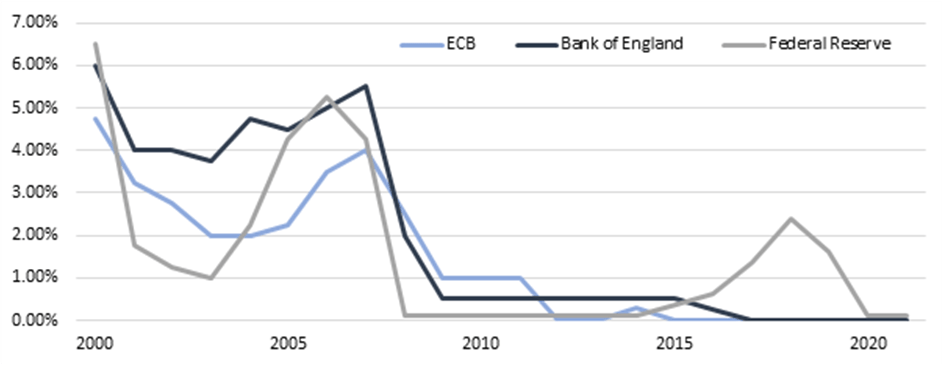
Of course, this could all have been better managed and the specifics of the Truss administration made a bad situation worse. But with Sunak coming in, we can judge whether simply a more articulate and deft touch would make the difference, much as Leopold II succeeded Joseph’s reforms in the 1790s. In fact, he will not, because Sunak understands precisely that Britain can ill-afford to operate outside the bounds of economic convention dictated to us, from the major institutions via the capital markets. Britain cannot have a truly independent monetary or fiscal policy, and Sunak will not want to test this again. This is because of two factors: first, Britain simply is not big enough, with an economic hinterland of adequate heft, to support Sterling and the government borrowing markets on its own. It is almost uniquely globalised in terms of its financing and the shift to this model in recent decades (see my previous note on exchange rates) means that Brexit or not, this will not improve. Secondly, Britain is buffeted about by two economic forces – the EU and the US – who do carry their weight. Interest rates in both will effectively dictate British interest rates; the only scope for freedom are in those occasional periods of divergence between the two:

Source: IMF database, figures annual

Interest rates are of course only one lever of economic power (albeit an important one in a financialised economy); but the recent reaction to Kwarteng’s budget shows that fiscal tools are equally to be judged by the narrow minds of financiers of little imagination, and it was not only the exchange rate that collapsed for a time, but also the cost of borrowing which rose (Clinton’s “bond traders” in action). The notions that Britain could just “do its own thing” was always fanciful, at least without accompanying “pain” which no politicians are as yet prepared for.

So what does all this mean? Well for me, as an active Conservative Party campaigner and even one-time candidate, it means thinking about leaders who will actually will do something because they are focused on areas which a domestic agenda can still influence. Truss vs Sunak was a false dichotomy because neither promised actionable agendas. I supported Kemi during the last leadership contest, first because I agree with her, and secondly because those areas were one a Prime Minister of the United Kingdom of Great Britain and Northern Ireland can actually do something about.

I am more or less talking about kulturkampf in a broad sense. Readers of this blog will know that I prioritise issues of identity above most other things because nation-building is both important and something of a lost art in the globalisation age. Kemi’s most impressive speech for me was her response to the House during Black History Month in 2020, where she laid out some very obvious but important points about British culture:

“Our history is our own; it is not America’s. Too often, those who campaign against racial inequality import wholesale a narrative and assumptions that have nothing to do with this country’s history and have no place on these islands. Our police force is not their police force. Since its establishment by Robert Peel, our police force has operated on the principle of policing by consent. It gives me tremendous pride to live, in 2020, in a nation where the vast majority of our police officers are still unarmed.

On the history of black people in Britain, again, our history of race is not America’s. Most black British people who came to our shores were not brought here in chains, but came voluntarily because of their connections to the UK and in search of a better life. I should know: I am one of them. We have our own joys and sorrows to tell. From the Windrush generation to the Somali diaspora, it is a story that is uniquely ours. If we forget that story and replace it with an imported Americanised narrative of slavery, segregation and Jim Crow, we erase the history of not only black Britain, but of every other community that has contributed to society.”

I commend everyone to watch this.

We can debate the specifics of her message here, but the important point is that she can campaign and do something about this. There is a culture war to be won, through the media, through institutions, through agency capture and other machinations if we really want. These are all within the remit of a leader. What she cannot do anything about, is bring interest rates into the realm of fairness for savers and the hard working rather than constantly inflating domestic household debt. At least, not for now – although if you get the identity question right, at some point down the line you can begin to ask the people for the sacrifice needed to finally rectify the economy and bring it back to something which serves the population and not the other way around.

Britain needs to break out of its mindset that it still carries the kind of status and power which allows for true independence. It is this wrongheadedness which led to one specific strand of Brexit support for which I have no sympathy whatsoever – the Dan Hannan school of “Singapore on Thames”. If these politicians spent half as much of their time trying to change things that are changeable, instead of pursuing doctrinaire dreams of economic engineering, Brexit might actually be made to work. In the meantime, the economic shackles we live under continue to demonstrate what a poor economic choice Brexit was. Better panem et circenses.

Not all emerging markets are the same (Part 2)

Tent vs marquee economies (or why Indonesia is bad and Vietnam is good)

I previously looked at the SE Asia economic picture overall and drew out some pretty stark contrasts. I want now to focus specifically on two markets I know well, both of whom have cheerleaders: Indonesia and Vietnam. Only one of them, I would suggest, has a bright future. Against these, as ever, I find it useful to benchmark against China, the one regional example of an economy that has made progress.

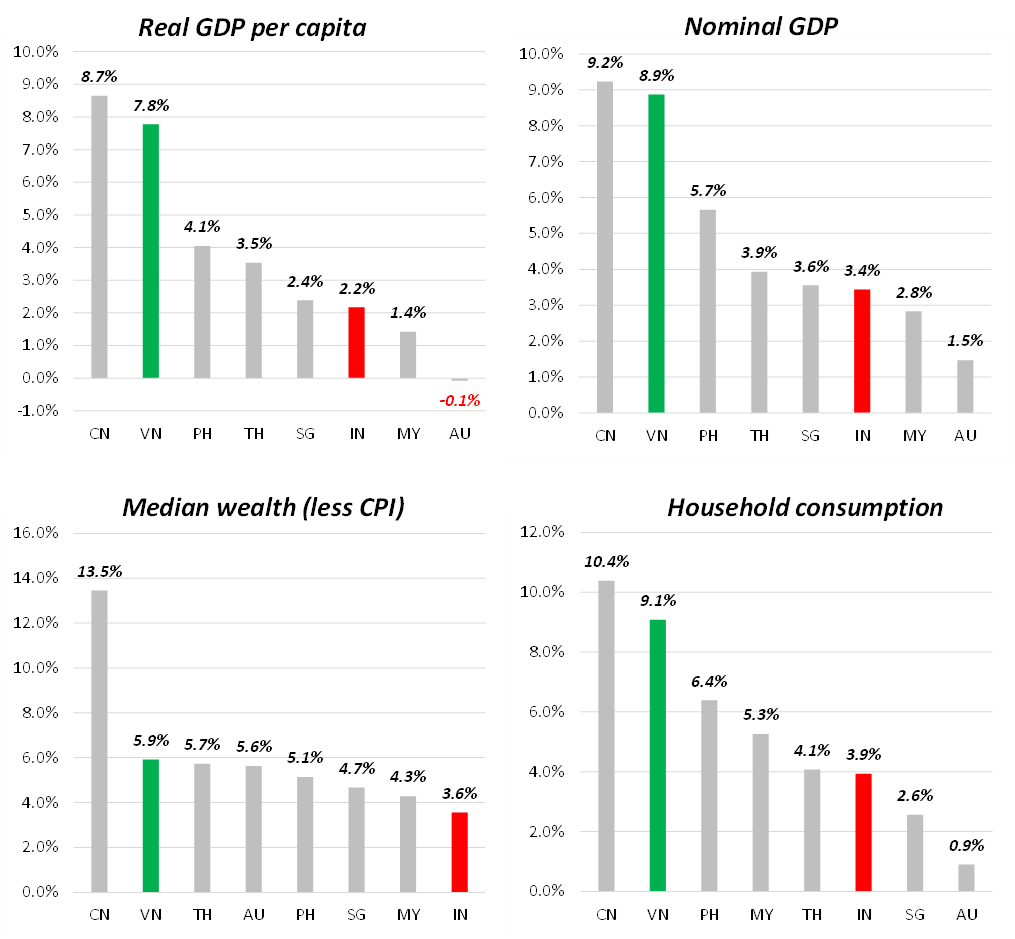
In fact, based on statistics previously discussed, even in a basic way Indonesia has constantly under-performed Vietnam (and indeed most peers) over the period 2010-2020:

Source: World Bank, Credit Suisse Global Wealth Report 2022

It is poignant that once we move beyond real GDP, the variation is marked. Both Indonesia and Vietnam have experienced significant population growth – but even factoring that in, Vietnam has sped ahead on a per capita basis. In terms of nominal GDP, Vietnam comes close to China levels of growth and, incidentally, does so with a currency which has not depreciated against the dollar anywhere near as much. In median wealth, Vietnam, coming from a low base and with CPI not much less than Indonesia, is still notably ahead. And lastly in household consumption – that portion of GDP growth that we consider “good growth” – Vietnam is more than double Indonesia even though the latter experienced the greater part of a commodity boom during the period. In other words, Vietnam, from a standing start, has led everyone in the region bar China; and is the only country to come close to matching China’s remarkable overall levels of growth.

So much for the past – but what about the future? Well the problem comes in understanding the structure of the economy, and in particular the effects of inequality, inflation and where relevant, currency depreciation. Indonesia’s under-performance is due to both a long-standing inequality and inability to distribute the proceeds of growth into a mass middle class, as well as peculiar governmental weakness at tackling inflation and currency depreciation, which are linked.

Source: World Bank, Credit Suisse Global Wealth Report 2022, Bloomberg

As a demonstration of the former, I tend to use my own measure of inequality, which is to look at the “wealth multiple” of mean-to-median assets per capita. The higher the multiple, the more unequal the economy. I find Gini coefficients to be too muted in their outcomes, and most of the public sources such as the World Bank still inhabit a pre-Piketty world focusing on income distribution rather than asset distribution – but all this will be in a future post. What is important is how much higher Indonesia’s wealth multiple is compared to the two post-Communist economies which are doing better (for the record, others such as the Philippines are unsurprisingly even worse). Both Indonesia and Vietnam have experienced high levels of inflation – but, of course, this comes against the background of Vietnam’s much higher rates of nominal GDP growth. And above all, whilst most of currencies have weakened against the dollar, none have been so spectacular in their depreciation as the Rupiah.

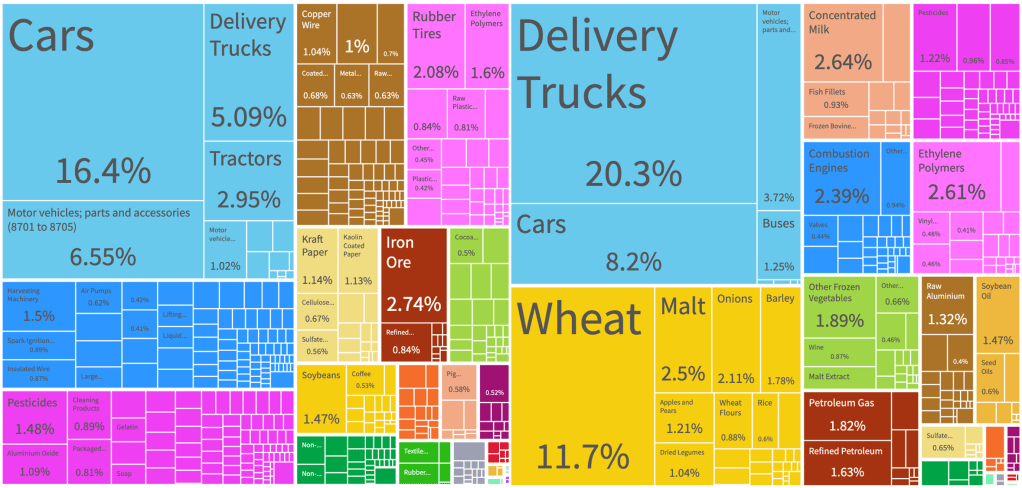
2020 exports by industry for Indonesia (left) and Vietnam (right)

Source: The Observatory of Economic Complexity

Indonesia has been sustained by commodity cycles in the past and may benefit from another which has recently commenced – but the problem is, this is only arrow in its quiver. For me, there are two broad models of economic emergence, which I visualise as “tents” and “marquees”. A tent is simple, and has a couple of simple poles which hoist the whole fabric. These poles can raise a high summit point, but they are frail and narrow. A marquee takes longer to assemble, but has multiple poles and is usually more robust. Indonesia’s reliance on commodities – and its marked inability to produce an export-quality value-adding sector (for instance, manufacturing) – makes it a tent. Vietnam, whilst its summit point is still lower than that of Indonesia, is supported by multiple sectors. Importantly, this also means producing a wider “middle”, which somewhat depicts the creation of a real middle class.

Tent vs marquee models of economic development

In short, whether you are an entrepreneur, a foreign investor, or just the common man on the street, Vietnam is a much better prospect than Indonesia. This reality belies the generic theoretical focus on demographics and real GDP, and correlates to the empirical and anecdotal evidence from the streets. Anyone who goes to Jakarta and then Saigon will feel a difference in energy and enterprise. In Indonesia – much like Thailand or the Philippines – a few rich incumbent families own practically everything. Jakarta, by another shorthand metric I like to use, has no pavements: the rich go by car and the poor have nowhere to go. Saigon has middle classes who walk around urban landscapes. Likewise, the streets of Saigon are full of absurd little shops where the emerging consumer is upgrading their life (not anything I would personally buy, but nonetheless); Indonesia instead has little between the gleaming malls and the warung.

From a business level, it shows through as well: the long-hoped-for mass ownership of four-wheel vehicles in Indonesia has never really materialised – passenger car growth over the decade is half that of China and Vietnam, and behind even Thailand. Modern retail (for instance hypermarkets) has never yet had its day in the sun, instead being swamped with by the low-end providers like Alfamart and Indomaret. Banking has not had the traction expected, particularly in additional services; but meanwhile low-end app-based financing is common place. And at the end of the day, Indonesia’s new economy champions still tend to feel much lower in quality of management than even their regional competitors – Go-Jek vs Grab, for instance.

The reasons for all this are manifold, and would warrant a full academic paper (although some of the topics around cultural traditions may not even make it past the censors of modern publishing). But what is clear is that, following from the previous post, there are better and worse markets and Vietnam and Indonesia, often compared together amidst a group, are good examples of this contrast. I would hazard that Indonesia’s presumed consumption take-off may simply never materialise. People talk of Indonesia sitting at the heart of the revolution in EVs – which is questionable – but even if it happens this may never feed through to the population. Certainly, alone amongst the beneficiaries of the last commodity boom over 2006-2012, Indonesia saw little gain for median families, and such wage growth as came was washed out by its rampant inflation. Indonesia seems destined only to be constantly extracted from, by local families or foreigners. Personally, if I had a dollar to invest today, the choice between these two is pretty clear.

The Return of Theresa May?

The shenanigans of the Conservative Party gives me a moment for some fun: what if the Tories really did cast out another leader now, just a few weeks into her tenure?

First, I should emphasise that I do not predict at this point that Liz Truss will be removed. Nonetheless, neither do I think it completely unlikely, since MPs will grasp at almost anything which they think may help them get re-elected and, let’s be honest, nobody wants to face unemployment in this current environment.

So my logic is as follows:

  1. Liz Truss may be deposed by MPs seeking to try and move on quickly from the current crisis (25% chance)
  2. MPs will not give members a choice again, if this occurs. Instead, they will avoid the whole thing by presenting a single candidate as a fait accomplis (100% certain).
  3. MPs will look to the past, not the future, when seeking their consensus candidate. With an election only two years away, I do not believe many will want to “try something new”, but rather look for a caretaker that minimises the damage from an election that seems almost certainly lost (70% likely).
  4. There are only a few candidates suitable for this role, balancing out their status, past experience and willingness to serve. I believe only former PMs, Chancellors or high profile leadership candidates would be options. May is on obvious candidate (100% true).

There are really only a few names who can make this list. Boris is too recent and probably uninterested. Sunak and Javid, two former Chancellors, will both want to distance themselves from this irretrievable mess and believe they still have future careers. Several others, such as Hammond or Rory Stewart, are no longer MPs. To my mind, only three people would “do their duty” and lead in the current circumstances” Michael Gove, Jeremy Hunt and Theresa May.

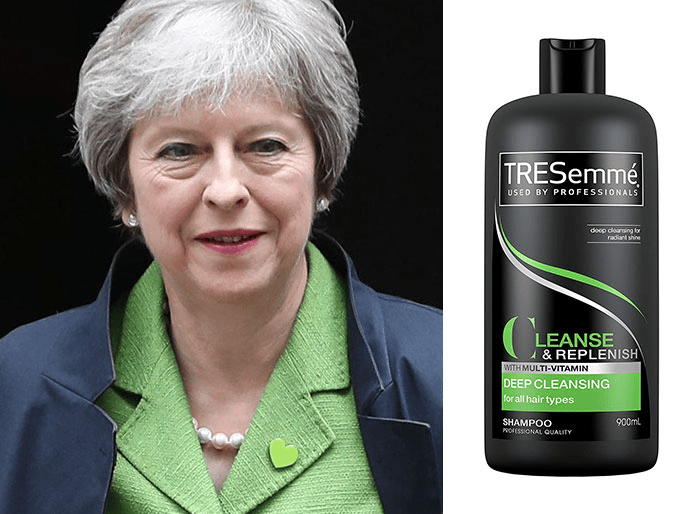
So who knows what will happen? Gove seems too opportunist. Hunt might work but is a little faceless. I do think Theresa May has one quality, which is that she is dogged and hard-working and will provide some reassurance. Moreover, she has dealt almost entirely in crises. As a caretaker, there would be many worse. All this gives me the chance to return to one of my favourite memes: