The Lessons of History – why confabulation may be worse than amnesia

It is normal for any society to look back to their past for paradigms of “greatness”. In Will and Ariel Durant’s masterful work The Lessons of History, they wrote that:

To break sharply with the past is to court the madness that may follow the shock of sudden blows or mutilations. As the sanity of the individual lies in the continuity of his memories, so the sanity of a group lies in the continuity of its traditions; in either case a break in the chain invites a neurotic reaction.

In other words, a grasp of history is important and as a historian myself, I am quite skeptical of those in public life who clearly do not have or act on such a grasp – Tony Blair in the build-up to the Iraq War being a case in point.

But what is the right history to look to? What of the rich tapestry of our past really tells us about the tenets of our national character? History will always be twisted to aid politics; but the current ahistoricism amongst the governing classes has I believe reached something of a new low – and it matters for policy. Reaching for the correct memory is as important as having memories at all.

Britain, for instance, has an imperial history which as a nation it has yet to move on from despite the best efforts of the PC brigades. The signs of it – from the remnants of actual empire (now reduced to the Falklands and Gibraltar) to the permanent seat on the UNSC – still pervade much establishment and tabloid newspaper thinking. But whereas many British subconsciously see the height of empire as the regal majesty of the Delhi Durbar, the real Britain was something altogether less dignified. The British character, I would submit, is one of unruly mobbishness at heart which can be seen throughout society from football hooligans through to the Bullingdon Club – perhaps the best representations of contemporary life being the social diversity of rioters in 2011, and the undignified rush to loot cargo from a sinking ship in 2007.

Hooligans

British hooliganism – two sides of the same historical coin

Rather than harking back to formal empire therefore, the British memory should look more to the Gordon Riots, to Clive of India and James Cook, than to parades at Spithead. Because in this riotous assembly, were also the seeds of Britain’s real greatness: as privateers and traders, entrepreneurs and innovators rather than organisers. In the 18th century Britain stumbled across empires in India and America, and created the Industrial Revolution; arguably, as soon as Britain’s organization skills were brought to bear in the 19th century, the Empire started its decline.

America, too, has the Anglospheric trait of tending towards natural lawlessness as shown by moments such as Hurricane Katrina (in contrast to an example like Fukushima). But there is a deeper romance to the American story as told in elementary schools across the land, of idealism, diversity and tolerance. This too, though, is misremembered. America became great not because of its tolerance, but because of its moments of judicious intolerance and plain ruthlessness – against indigenous people, against Britain, and later against Japan and the Soviet Union (the fraught relationship with Britain was the theme of a 2005 paper of mine). Yes, there were waves of immigration which fed into the so-called “melting pot”, but America would be much less of a country today had it been run with the kinder, gentler governance associated with neighbouring Canada for instance (even if this may also be exaggerated).

Some Americans will not like to see this as the basis of their history, but the reality is that the country’s “manifest destiny” – to rule the continent and then the world – was not built on being nice to people. The American Revolution was not mainly a principled stand of Enlightenment values, but an opportunistic socio-economic power grab by one set of elites from another*. There is a reason why Andrew Jackson, until recent events, was held high in the pantheon of bank notes. And this memory, tinged with a harsh edge and violence, is every bit as important for the country as self-congratulatory myths about the Founding Fathers or Abraham Lincoln. Just as Britain is more Clive than Hardinge, so America is more Jackson than Lewis and Clark.

Jackson Lewis Clark

Andrew Jackson,  Meriwether Lewis and William Clark

As an example of how these falsified memories impact policy, let us take the rhetoric surrounding immigration, an issue applicable to both the US and Britain. The common liberal mantra is the fallacy that “this country was built on immigration!”, a cry heard around hipster cafes from Primrose Hill to the West Village. Factually true, but rather irrelevant. Yes, there has been plenty of immigration in the past, although few have come close in scale to what has occurred in recent years. Yes, immigrants by and large contribute enormously to skills, ambition and demographics in both these countries. But it is not immigration itself which has been good; it is appropriate amounts of immigration when building on a platform of strong host culture. It is an “and”, not an “or” – the tired, poor, yearning huddled masses in the US would be nothing had not the violent ruthlessness of mostly white, protestant Anglophone Americans established a country of enormous land and resources. In other words, there are two pillars to this story of progress, not one:

  1. preserve a coherent indigenous identity;
  2. then add immigration as needed.

But the one-dimensional appreciation of history from those that dominate the media and education misses all this. Immigration is put on a pedestal in and of itself, as though it somehow generates positive impacts on a standalone basis. National identity is practically a dirty word – or has been captured by cynics who believe it can be watered down to nothing by adding foreign elements into the mix via the “we were all immigrants once” fallacy. To do this is the sow the seeds of destruction for any nation-state. Just as Blair had no regard for the longer sweep of history in the Middle East, so also the likes of Corbyn or Pelosi for their own country (although strangely Bernie Sanders actually did – and consequently struggled with certain corners of Liberaldom).

But the point is this: whether we are talking about British lack of self-discipline or American violence, these are not actually bad characteristics. People should not be judging these with opprobrium – they can be positives which lead to other strengths. Anglo-American consumerism and short-term thinking helps the whole world in terms of innovation and just plain growth. If Americans did not love spending money so much, the rest of us would not have iPhones. A planet of Germany’s and Japan’s would achieve nothing. Finding a place in the world is partly about adapting – but only on the basis of recognizing what one’s inherent strengths are. Politicians should not be complaining about these characteristics or still less, try to change them. They should be trying to harness them in productive ways – opportunism becomes enterprise, violence becomes robustness. The world certain needs all of these.

I will finish on a macro view. A former boss of mine once asserted that there are three types of competitiveness in the corporate world: price, quality and innovation. Capture one, and you will survive; capture two, and you will succeed; capture all three and you will rule the marketplace. Countries are not dissimilar, and it is no surprise that the one nation which comes closest to an adequate level of all three is also the only hyperpower – America. Historically, even during the Industrial Revolution, Britain was not known for quality, but rather for inventiveness in products and processes. Since emerging, Germany always had a superior record on pure quality, but they have rarely created anything completely new. Nations have their place; national identity will be a determinant of it.

Britain, post-Brexit, needs to thoroughly reflect on which of these features it possesses and how it pursues them (in my opinion, clearly led by innovation not quality)**. It may seem obvious to say that she needs to see herself as an underdog, yet shockingly few statesmen have really digested this fact. America, in this period of potential decline, also needs to rediscover which qualities it still has. Problems like the rise of China and the new “community of empires” will not solve themselves. But for either country to successfully confront their dilemmas, a closer examination of the collective, subconscious social memory is needed; for without it, we face the insanity Durant outlined so long ago.


———————————————————————————————————————————–

* Perhaps this will be a major point of debate, but as something of a historian in the era (see eg my 2005 paper on the Anglican Bishop Controversy) the American Revolution was by and large a moment when local elites, separately in Boston and Virginia, found Britain a convenient scapegoat for directing local discontent against. By the 1740s, ports such as Boston and the southern backcountry were facing, for the very first time in colonial history, economic stagnation and the rise of an underclass. A war (The French & Indian) put this on hold, but by 1763 the Boston families and the Tidewater oligarchies needed to stir a conflict for their legitimacy. They got one with Britain, and this, much more than tiresome debates about Lockean Liberalism vs Republicanism (rf Bailyn, Pocock et al), or “taxation without representation”, lies at the heart of the rebellion – and partly explains the surprisingly strong loyalist sentiment throughout the war.

** I will also add that one of the only intelligible and plausible post-Brexit British identities I have heard comes from a potential future guest blogger here, namely that Britain could become an Israel – in other words, a medium-sized maverick which punches above its weight simply through unpredictability. Better not decommission those nuclear weapons, in which case.

The End of Entrepôts – why the future is big, not small

Lugard

Photo: Lord Lugard with the Legco in 1909

It is one of the most oft-repeated fallacies in modern politics that the future is destined to be ever smaller and fragmented. One only has observe the fetishization of breakaway movements such as Scotland or Catalonia and hear the accompanying, knowing murmurs telling us that in political terms at least, atomization is the way of the future – small is beautiful. Some still reach further back, summoning up the collapse of the Soviet Union as proof that all large entities must collapse.

This is completely at odds with reality, on a number of levels. First, recent history has, far from being driven by a narrative of devolution, instead been dominated by the rise of “big countries” which in turn are resurrecting their own brand of Great Power relations. The corresponding decline in relevance of smaller entities is pronounced – most noticeably in the shape of individual European nations which have seen their weight fall off considerably. The 2010 Copenhagen agreement, where Obama sidelined the Europeans to reach straight for emerging giants, was an early sign of this; the gradual extinction of the Quadrilateral in determining trade policy was another.

Indeed in my 2013 paper on China and multilateralism, I noted that the world is if anything heading towards a new “community of empires”, with both the foreign and domestic policies of China, Brazil and India joining the US and Russia in pursuing an unrelentingly imperial logic. In response, those outside of their orbit are banding together to form what are prima facie trade blocs, but which are in reality the beginnings of something much more. Whether the European Union, ASEAN or Mercosur, nation-states are ceding sovereignty slowly but surely for the express purpose of aggregating their power in the world beyond. Even in unexpected corners of functioning humanity such as East Africa, union is the name of the game. Status and size do not have a linear correlation; as one reaches critical mass, the relationship becomes exponential. A power ten times as large as its neighbours is far more than ten times as important.

At the heart of this is a simple thesis: in the long run, the power of any country will be determined by the size of its population (with a shared identity – more of that another time), somewhat adjusted for a country’s natural resource base. In the long run, all else is mere noise. Yes, certain countries or civilisations may exercise disproportionate power for a period of time, even centuries. This can have any number of causes but often it is because of temporary technological disparities – temporary because in the long run, all technology will permeate meaning that we arrive back at where we started: population. Any vision of a world where the largest population blocks are not the most important countries must be premised on a smaller, more nimble country actively and exploitatively keeping larger population blocks subject. This was a kernel of much of European colonialism of the 19th century (which should not be conflated with a general model of imperialism exercised in human history).

Now in the long run, as Keynes says, we are all dead. So does it matter? I would say yes it does, particularly for those living in and around the rising powers of Asia such as China, Indonesia and to a lesser extent, India. Because some of these changes are no longer concerns for the long term, but coming to maturity now.

One lesson is this: the age of entrepôts such as Hong Kong and Singapore is fast coming to an end. In the future, there will be no space for such outposts any longer, at least in their current form. This is because the very existence of such centres is a lingering post-colonial legacy, based on an economic system that is now no longer extant. City-states like Singapore thrive because they are a form of offshoring, and the offshoring they offer is reaching the end of its useful life.

We should be crystal clear that offshoring has two forms: there is offshoring for work a country does not want to do, and offshoring for work it cannot do. On the one hand, there is what we classically understand as “offshoring” where one jurisdiction offers a cheaper way of producing goods and services for a richer one – offshoring from below. Textiles in Bangladesh fall into this, as does the core of China’s economic rise during the 1990s and 2000s. The second form is what hubs such as Hong Kong, Singapore, Dubai and even London offer to an extent – offshoring  from above. They provide capabilities that other poorer, less developed countries cannot do themselves.

The problem is that much of the world is catching up. There is precious little that can be done in Hong Kong today that cannot be done in China; yet Hong Kong really only exists to serve the Chinese economy, much as some lament its progress to becoming “just another” Chinese port. Singapore is safer for the moment, but it is still implausible to imagine that Malaysia, much less Indonesia, will allow the island to remain an offshoring hub for high value-added industries such as finance. As with China, they will end up doing everything themselves. The post-colonial legacy of substantially inadequate skills and infrastructure will be bridged, if not today, then tomorrow. At that point, the city-states will have precious little left. This is a problem not faced by Bangladesh – but then no-one wants to be Bangladesh. There is a reason why entrepôts barely exist in the OECD and if they do, they service a tiny, marginal sliver of their neighbours’ economic life as Jersey or the British Virgin Islands do. It is because there is no room at the top.

Britain suffers from many of the same issues. Plenty have lauded the supposed rebirth of the British automotive industry, and in a few instances, this is well justified. But for every Aston Martin or Morgan, where real value-add and R&D is achieved in the UK, there is a far bigger presence of Nissan or Toyota. The latter however, are essentially a little Bangladesh model – investment into the UK occurs not because of any inherent capabilities, but because we are marginally cheaper and have fewer regulatory restrictions (unionization etc) than regional neighbours. This is not much of a national dream.

The other side of the UK is that of the entrepôt. Here I am referring to her services exports – but not the headline-grabbing financial services sector, which will be pretty easily replicable elsewhere, but rather industries such as advertising, publishing, design and architecture which are more genuinely unique. And one can tell that they are unique, since whereas the UK can barely export any financial services to the big empire economies of the US or China, it sells large quantities of stylish design. The problem is, this is nowhere near enough to support an independent UK – the idea of the UK becoming a “Singapore of Europe” is beyond fanciful, as I have noted before.

Singapore has been conspicuous in how strongly it clings to and pushes for ASEAN. And the reason is clear: if ASEAN does not succeed in binding the region together, Singapore will soon have nothing to offer its larger neighbours. Only a union of sorts will allow it to continue holding a position of import. Hong Kong’s commercial residents have long acquiesced to the fact that it will have to be another Chinese city, albeit one offering some special rules and playing a specific role. Hong Kong’s flagship airline’s troubles reflect the decline of hub-and-spoke trade in favour of point-to-point, and are a microcosm of how the whole economy is developing. Dubai will play off the inability of regional giants to pull their weight (Iran, Egypt and Turkey) but if and when they do, it too will face the same problems of reinvention.

But the old model of “Singapore” is a complacent and condescending anachronism – and those pushing the model for countries like Britain are living a sheer fantasy.

Explaining the Umbrella and Sunflower protests

As a brief follow-on from my previous piece on Taiwan, I have done a quick and dirty analysis on what is driving youth discontent in Greater China, and specifically what has arisen in Hong Kong and Taiwan in recent years.

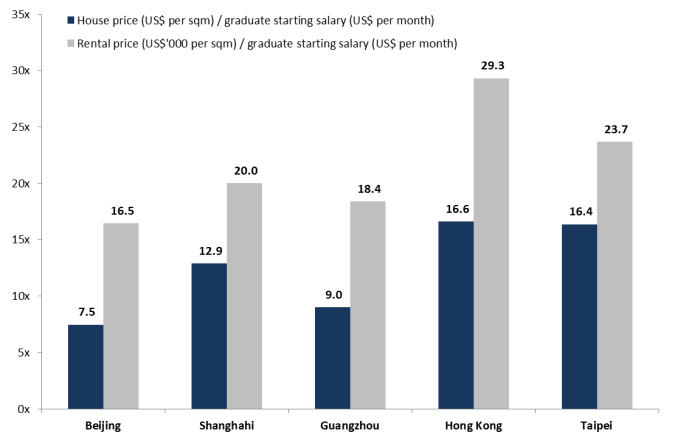
In this single chart, I believe I capture what I would call the “aspiration deficit” in being a young person in these two jurisdictions today. Here I have calculated the house pricing and rental in key cities as a multiple of graduate starting salaries.

Graduate salaries

Sources:

  1. Graduate salaries for PRC cities from Baidu News, as per 2017
  2. Graduate salary for Hong Kong from SCMP, as per 2016
  3. Graduate salary for Taiwan from Taipei Times, as per 2016
  4. House price and rental data from Knight Frank Greater China Property Market Report Q3 2017, based on Luxury Residential

The caveats: this is not designed to give any sort of rule of thumb about how long it takes to save for a flat, or how much is used up of income to pay for rent. I may even come up with a better methodology going forward – if the data allows. Instead, this exercise is simply a measure of what pressure there is on the dreams of those who newly come onto the job market, having been promised that their four years at university would lead them to a better life. This is why the luxury Residential market is I think an adequate metric on which to judge.

What is shows is quite how desperate prospects are for many of those in Hong Kong and Taiwan. Their earnings are stagnant, yet house pricing is going up. Welfare is better than in China, but the infrastructure is beginning to creak. The idea of looking after themselves – let alone looking after their parents – seems distant; and of course having children in this environment is ever less appetising. This is perhaps the single largest contributor to the upheavals experienced from students and other youth in the Umbrella and Sunflower movements – and it explains why so many young people see their future in China or elsewhere abroad.

To bring this back to politics, I wrote some time ago on the problems Beijing has had in relying on local tycoons to press their case in Hong Kong:

… less obvious has been how housing prices are preventing young local Hong Kong residents from starting lives properly, and in this as with much else the fault lies in a government that has existed to serve the tycoons – let us call them the Oligarchs – instead of the people. Beijing has been complicit in this since it decided to use the Oligarchs as a shortcut towards legitimacy after the handover. In colonial times, many tycoons were respected by locals as examples of being able to escape the unspoken racial glass ceiling, but since 1997 these Oligarchs have gone on to really take local people for a ride. Beijing is now paying the price for siding with the rich against the poor for so long. There is a limited amount of time that this can continue before Beijing must begin to change sides.

The same, in a sense, is true of Taiwan, where the big business lobby has been allowed to get rich off mainland China, repatriate their earnings and create asset bubbles in Taiwan that put home ownership increasingly beyond the reach of locally based graduates. It is a death spiral for aspiration – and it is this, much more than any real impact on living standards – which diminishes the legitimacy of any regime.

American poverty is neither urban nor rural – it’s small, mostly white towns

A vacant, boarded up house is seen in the once thriving Brush Park neighborhood with the downtown Detroit skyline behind it in Detroit,

It has been a year since Trump entered the White House, and eighteen months since the Brexit vote. Yet the media still display an astonishing lack of understanding about several aspects both of US wage stagnation, as well as how it interacted with voting.

The Brookings Institute came out with an important piece recently which has not received the attention it deserved. They produced five maps, showing the winners and losers in median wage change across the US between 1999 and 2016. Some of the results are obvious: the first map, of “winners”, shows that wages in the tech hubs and in government subsidised DC have done rather well; the last map, showing where wages have done the worst – step forward Detroit amongst others – is also a well-worn narrative.

But it is the penultimate map which should be most concerning. I have long argued that American liberals take far too narrow a view of poverty, and see the role of government as essentially providing urban answers to urban problems, which are the most visually obvious to those inside the Beltway. This ends up focusing on helping ethnic and other minorities, albeit usually in a less-than-constructive method. Altogether ignored is where much of the real poverty lies – as this map shows:

metro_20171012_alan-berube_fig4-struggling-v3

It repays some close study. The problem areas are not Detroit or Flint or Cleveland. The problems are that 10 urban areas of over 1 million inhabitants – and another 59 towns of between 100,000 and 1 million – have experienced median wage declines of 10% – 15% over the period. On the basis of this study, that’s 50 million people constituting the single largest group, and are not all names you would expect:

While the group contains a handful of large Sunbelt metro areas still laboring to rebound from the late 2000s housing crash (e.g., Miami, Orlando, Phoenix, Tucson) and a few major industrial centers in the Midwest (e.g., Chicago, Indianapolis, Milwaukee), small- to mid-sized urban areas predominate in this category. Most are manufacturing centers that lost significant numbers of middle-income jobs in the 2000s that have not been replaced, including 10 urban areas in Wisconsin, six each in Michigan and Ohio, and five each in Georgia and Indiana. A few have shown some green shoots in the 2010s after a rough decade, including Ann Arbor and Kalamazoo in Michigan, and Oshkosh in Wisconsin. Others, however, have slipped considerably since 2009, such as Charleston, W.Va., Davenport, Iowa, and Springfield, Ill.

This reinforces two lessons. The first is that the often quoted cliché about urban vs rural voters is a false one; neither America (nor Britain) are about large urban centres. By my last count, well fewer than half (43%) of Americans lived in conurbations of over a million people. Fewer again (33%) lived in cities of over two million. The genuinely rural population is also small (15%). Instead, real American life is about small market and post-industrial towns.

Politics focused on what happens in New York or LA, and contrasted perniciously against what happens “out on the ranch”, is not helpful to anyone. Reporters and politicians know all about the urban indigent, even if they do not do much about it; but they seem to know nothing of the small-town working poor. That is what Trump and Sanders were all about. It is also the case with Britain, as was identified in an excellent piece in 2007 by Blair Freebairn.

The obsession with reporting on urban areas is one I have discussed before in relation to media misinformation about street protests in the developing world.

Neatly compact urban street protests are highly photogenic and easily captured on camera. Crowds sell news … It is difficult for outside observers to empathize with anyone other than those who are so passionately occupying the capital. It also involves much greater effort and investment in time – time which is not afforded by the twenty-four hour news cycle.

The great tragedy is that the same misguided focus is applicable at home, where we discovered last year that journalists who should know better, did not.

The second lesson is the danger of economists and economic commentators continue to fall victim to the intellectual Tyranny of the Mean, whereby average numbers still form the focus at the expense of median data. What I should hope is by now a very commonly seen chart shows the disparity which still leads to the incredulous question: “who are all these poor white people?”

US_GDP_per_capita_vs_median_household_income

There is little sense in technocrats informing voters that their economy has been growing, or that living standards have been rising, when no-one recognizes it as such. The disparity shown here is not only obvious as a chart, but more importantly in how voters feel about the economy. Median calculations are not perfect, but a good starting point would be for all economists to rethink along median lines each and every time they put out a statistic or indicator.

All said and done, it seems to me most liberals have still not grasped the underlying lessons of the last few years. Obama, of course, had precisely zero to say on the issues that would come to dominate 2016 – he barely seemed curious about such trends, for someone so supposedly intellectual. Fighting the urban-rural battle is to continue the last war. Small white towns are where it’s at right now, and telling them they’ve been doing okay is not going to win any votes.

Taiwan’s spiral of economic and political decline

Taipei-City-Skyline-Storm

My attention was drawn to this piece, detailing a new book – Unfinished Miracle: Taiwan’s Economy and Society in Transition – which feels like it could be quite important. Whilst I await the final version, I nonetheless would offer a few thoughts on Taiwan, and not least its asymmetric relationship with China.

Few states are as substantially bound to and distorted by a single other large, connected country as Taiwan is by China (for the record, I do not acknowledge Taiwan as a sovereign nation but will for the purposes of this blog post refer to it in the short hand). The only other examples which spring immediately to mind are the relationships between the US and Britain, and between Brazil and Portugal – and both of those are largely historical cases. In each instance, the existence of the larger and younger frontier came to capture the economic imagination of the wealthier, older land – such that in many cases there was a disproportionate focus on these opportunities at the expense of other potentially more profitable ones.

Taiwan’s love-hate relationship with the Mainland along these same lines appears to be the heart of the thesis offered in the new book. In particular, the writers detail the “three-way trade” in which Taiwanese companies operate an export model using Chinese assets rather than domestic Taiwanese ones, creating employment and generating returns in China rather than at “home”:

One can see from employment figures that Taiwanese enterprises have created far more jobs overseas than in Taiwan. The top 500 companies employ about 2.5 million people abroad (mostly in China) but only 1.5 million people at home. According to estimates, for every 29 people these companies employ in China, they employ one less person in Taiwan.

Not every point makes sense to me. For instance the authors start off with the matter of SMEs accounting for a declining proportion of direct exports – which may well be true but I will have to wait for the book to see why it is relevant. After all any economy, as it develops and consolidates along the value chain, should see local export champions aggregate value so that a few higher end entities become the point of export, rather than SMEs serving as offshore suppliers to a foreign aggregator.

article-ck-5a2136e3f0456

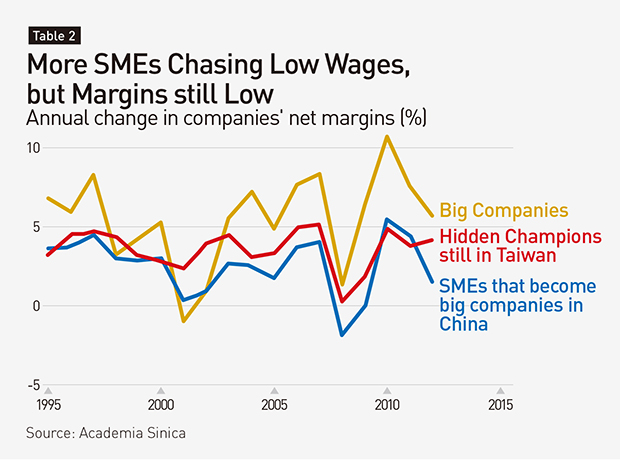
But the issue of how and where Taiwanese companies are making money is of great consequence. If the article is correct, Taiwanese companies are struggling to improve their gross margins despite moving their workforce into the PRC. This is clearly an issue about where they sit on the value chain. But there is another, even more gigantic elephant looming in the room: Taiwan is becoming nothing more than a remittance economy barely differing from the Philippines.

article-ck-5a2136c94bf7c

Consider that an estimated two million Taiwanese live abroad – one million in China alone (and half a million just in the Shanghai area). And these are not the old and invalid – they are the young, the brightest, the entrepreneurial two million out of a total workforce of only 11.8m people. Those that can, leave; those that can’t, remain. The social and cultural disjuncture between the diaspora and those staying at home, where graduate salaries are now lower than comparable roles in Shanghai or Beijing, is increasingly stark.

Furthermore, whilst domestic salaries are stagnating, business engaged in the offshore model discussed in this paper (“SMEs that become big companies in China”) are making huge returns, and often repatriating large amounts as a consequence. The earnings made from Chinese exports is leading to a huge asset bubble, particularly in property prices. Those same left-behind graduates are therefore experiencing not only depressed wages, but increasingly unaffordable housing. Even Chinese tourism is driving up the cost of living. The ongoing polarization of Taiwanese politics has its roots in this dichotomy. It is a perfect storm into which the DPP and the Sunflower Movement have emerged, but without any noticeable plan and only trite promises.

Political unrest is an outcome of the country’s inevitable economic model – inevitable because of China’s clever strategy of stymying Taiwanese attempts to trade elsewhere; but giving privileged access to China itself. This integration by stealth has paid huge dividends in terms of making the Taiwanese understand which side their bread is buttered. And it has led to two tangential outcomes – but only one is positive.

First, Taiwan has become a major centre for RMB internationalization. Much of the corporate earnings on the Mainland end up flooding back into Taiwan in its original currency. The island province therefore already constitutes the world’s second largest offshore RMB pool after Hong Kong (which occupies its leadership position for other reasons). Ordinary people are already getting used to RMB banking and wealth products on a day-to-day level, whilst corporates are beginning to issue RMB Formosa bonds. Mainland China is a fact of life for many people, accounting for the relative prima facie ambivalence towards independence.

Secondly and more worryingly, left-behind Taiwan has become increasingly parochial, with a poverty of means being matched by a poverty of ambition. Indeed the Taiwanese even have a term for this, the monstrous concept of 小確幸 which tells them that “good enough is good enough”, the ultimate expression of a “small country” mentality. Fewer and fewer overseas voters – “those that can” – bother to return for elections, especially in midterms, leading to legislative gridlock. And the media, who are left to focus on “those that can’t”, enter a downward spiral of navel-gazing such that news is more akin to a parish newsletter than real journalism.*

All this makes it far more problematic either for the KMT or any “One China” platform to succeed; and easier for peddlers of cheap myths for independence. In this sense, the Chinese strategy of binding Taiwan close may have the unexpected effect of creating a more troublesome rump population who have so little that they also have nothing to lose.

Taiwan’s economic decline is something of a tragedy. Of the four Tigers, its comparative decline is the most visual: Taipei looks like a city that simply stopped developing in c. 1990. Yet for many of us, it is a hugely romantic – and romanticized – version of much that is good about China. Unless someone can come up with a plan of action that captures the essence of all this, the island will continue slipping into a sea of irrelevance, regardless of any formal takeover by the PRC. That will be a situation where everyone is a loser.


* My own speculative thesis is that Taiwan, despite being very educated, has a lower per capita consumption of international quality media such as the Financial Times, the Economist or the Wall Street Journal than other equally non Anglophone societies such as Japan or Korea, or China.

A currency by any other name ….

Crypto currencies

With all the traction that crypto-currencies have been gaining in the media, it would be rude for me not to weigh in. One observation I would make is that since even my cousin has been invited to speak as an expert on the subject, we can probably safely assume that it is a bubble of the highest order – as alluded to by Charles Schwab in their recent analysis of similar phenomenon.

Cryptocurrency_and_bubbles

Source: Charles Schwab & Co.

On a more serious note however, I remain skeptical mainly because Bitcoin, Ethereum and the rest cannot fulfil one of the three primary functions of money. Yes, they can be used as a medium of exchange, and already are. Yes, I could see a point at which they could become a unit of account. But there is currently no pathway to being a store of value other than the value confidence ascribes to it. This is because it has no central bank or a state to back it up.

Proponents of “cryptos” like to mock conventional money by labelling them “fiat” currencies – in other words, money which has artificial value only on the orders of the government issuing them. “Look,” some gleefully point out, “most money today is not even backed by physical assets such as gold!” By doing so, they miss the point on two levels. First, the very purpose of money is to be an instrument of the state through its national treasury or central bank. In this resides the stability of the economy and society at all levels. Secondly, therefore, the official backing of recognisable assets such as gold is helpful but ultimately irrelevant. A functional government has the resources of an entire country at its disposal, which is why it has the power to issue, or at least back, legal tender in the first place.

At the heart of this lies a necessary understanding of the concept and role of “recourse”. In 2013 I wrote a paper on the why the dollar, despite pessimism from those seeing the end of American dominance, will likely remain the global reserve currency for a long time. Faith in a currency is more than just a confidence trick; it is more even than just the backing by specific collateral. What belief in a given currency rests on is belief in the power of a government to mobilise the totality of its resources in an extreme circumstance, for instance war. To wit:

Eichengreen has nowhere identified a much more substantial reason as to why institutions across the world, from central banks to investors, choose a given reserve currency: namely, the ability of the issuing party to hold recourse over actual assets. Whether these assets are physical (in the form of industrial facilities or natural resources) or financial, it is a government’s ability to ultimately take control over them – to mobilise them in support of government policy and national necessity – that is the final arbiter of how safe that country’s currency is to you as a holder. This is particularly true of non-resident holders abroad, since they do not suffer downside from asset seizures but are instead a totally arms-length counterparty.”

I went on to explore the concept of Total Resource Mobilisation (TRM) capacity as a mainstay of how a country – and with it, its currency – is supported. I noted that one  the interesting historical example was the delayed decline of the Sterling Area well after Britain had ceased to be the primary global trader – because of a perception that Westminster still held recourse over an empire. For all the contemporary fears of American decline – in trade, hard and soft power and its institutions – the dollar has been unmoved as a reserve currency, as shown by the statistics.

Dollar reserves

Source: Bank of International Settlements

The same lessons are true of the new virtual currencies. A form of money without a form of state will render the inherent value of that money limited to only supply, demand and confidence –  all fine, but these do not offer a store of value. With no central bank, and no government to back it, there is no recourse for comfort – no “liquidation value” to act as the backstop as it currently does for all real currencies.

On a side note, I also wonder if those pushing the new currencies are being rather too geeky about the whole thing. I have no doubt that in many ways, the technology behind cryptocurrencies are superior to conventional ones. But being more perfect does not necessarily mean it will supersede the less perfect product – indeed history is littered with examples of technically superior inventions which did not end up “winning”, not least because its backers were too worried about theoretical perfection: Microsoft vs Unix, for instance; Betamax vs VHS; even arguably the internal combustion engine vs diesel. The dollar is easily forged, and stolen, and inflated; but it is good enough, and that is good enough.

This is not to say that I see no use for Bitcoin and its ilk. I accept that they can perform a useful function, particularly as a cross-border payment system – which, incidentally, is what many of those currently inside the industry currently see it as. These currencies have the benefits both of allowing anonymity and, potentially, offering greater security of online transfer. But then the real competitors for cryptocurrencies are not so much the Dollar, Euro or RMB, but rather the nexus of Visa / Mastercard, UnionPay and even Western Union. I can also accept that since we are only at the beginning of the cycle,  the ultimate level of valuation of these currencies may still grow. However, short of finally moving into a post-national world, I do not believe they will replace national currencies. The eschatological nature of these crypto-evangelists concerns me.

As ever, it is a lack of awareness about macro historical trends which concerns me – a deficiency which would always see good money thrown after bad. I am going to stick my neck out and short this – and if anyone has any clever ways of shorting the whole sector, let me know!

China is reinventing the equity markets – and Britain’s aspirations are shrinking

First, the exposition:

  1. Exuberance for equity as a class of investment reflects how confident a given society is in their future; preference for fixed income indicates the opposite
  2. China has been reinventing the equity markets for some time now, becoming the first country since the rise of the US to really have the risk appetite for it
  3. In doing so it is breaking the convention of maturing countries in the region (Japan, Korea, Taiwan) as well as ageing civilisations such as Europe
  4. As with so much else, China is the new America

The above can be seen in a number of ways. Consider this: despite the scare stories about rising Chinese debt, it is in fact equity (both institutional and private capital) which has mostly funded fixed asset investment in recent years – averaging 66% over the last decade versus just 52% over the decade before. Anecdotally too, we know that all around us in China new startups have no problems accessing micro-equity from friends and family for the most spurious of businesses.

Self-raised funding as a % of fixed asset investment in China, 1995 – 2016

Self-raised funds.png

Source: National Bureau of Statistics

Note: the NBS splits out five categories of funding for FAI, namely Government Budgetary Funds, Domestic Loans, Foreign Investment, Self-Raising Funds and Other Funds. It is reasonable to assume that Self-Raising Funds constitutes equity investment, and that a portion of Foreign Investment may also do.

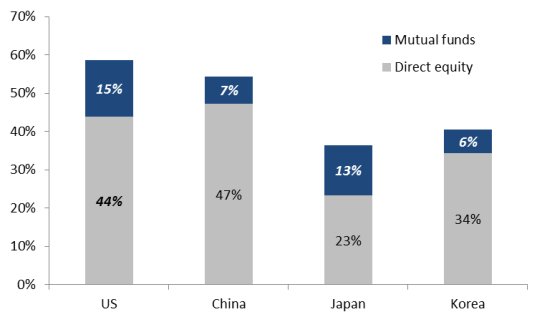
Likewise, institutional equity and equity linked investments account for a higher proportion of Chinese asset allocation than their East Asian peers – and are more reminiscent of the US in approaching 60% of allocations. Conservative Japan and Korea are the reverse. Small wonder then, that annual stock turnover in China is far higher than other markets (around 5.0x compared to c. 1.5x in the US, Korea and Japan) given the limited supply of listed equity.

Equity proportion of total non-cash household financial assets, 2016

China vs peers portfolio allocation.png

Source: Goldman Sachs Investment Research, 2016

Again, this reflects the fundamentals of not only an economy, but the society on which it sits. Buoyant equity markets reflect confidence not just in business, but in the system and the role of a country in the world. This is especially true when we think about equity provided by the retail markets, either through stock markets, or its proxies, or through earlier stage funding such as seed and venture funding where China is now the world’s second largest market. The basic principle is that when tomorrow seems like it will be better than today, people will gamble.

China still has a long way to go, of course. Its stock market capitalization per capita at c. US$6,000, still lags its peers and is just one thirteenth that of the US (and no, PPP is not appropriate here). Its private equity market, though already Asia’s largest, still has some way to catch up also at only one-third of North America. Nonetheless, China seems to be well placed to pick up the baton from the US of driving the whole culture of equity and all its attendant benefits.

And it matters. The point about equity is not just that it is one source of funding, but rather that it is a source of long-term funding and seeding for growth. A country that begins preferring fixed income to equity is giving up on its future, but also giving up on the idea of being a leader in innovation and technology. It is no coincidence that America has been the world’s great equity proponent for the last century and the cradle of  most technology; or that China is following in its footsteps. These are the hallmarks of “big countries” that make their own rules and are a force in the world.

On the other hand, a country like the UK should be very worried indeed: equity in portfolio allocations has declined alarmingly from well before the 2008 crisis. This reflects some ageing – but the ageing profile is less severe than many of its neighbours. Rather, I believe it reflects a psychological retreat from aspiration.

Changes in broad strategic asset allocation for UK plans, 2003 – 2017

UK asset allocations

Source: Mercer European Asset Allocation Survey 2017

This, much more than Brexit or the reduction of blue water navy capacity, indicates the decline of British aspirations. On a recent podcast, someone asked “but how close is China to really producing an Apple?”; the curt reply came, “how close is Britain?”, alluding to the even greater absurdity of such a prospect. If this continues, Britain will certainly no longer be a “big country”.

Private equity with Chinese characteristics

Elsewhere, I intend to reflect on my pet theme that China is reinventing – and indeed single-handedly resurrecting – equity as an asset class. In my opinion, this reflects an underlying self-confidence and correlates with the emergence of other equity cultures such as the Netherlands in the 18th century, England / Britain in the 19th and America in the 20th century, in contrast to the contemporary Japans, Koreas and Taiwans of this world.

In the meantime, developments in Chinese private equity are also worth noting. For a start, when we talk about private equity in Asia ex-Japan, we are effectively talking about just one country: the PE market in Greater China reached US$222bn in 2016, whereas SE Asia combined only managed US$37bn. The ASEAN region has not yet emerged as a market of material scale.

However the prevailing orthodoxies of PE in China are also showing that the market will not come to simply resemble OECD behavior. As many observers will know, Chinese funds operate in a grey area between classic private equity and venture capital, and sometimes throw in an element of special situations or even hedge funds to boot. This comes through in the types of deals that are done – whereas conventional buyouts still account for almost 80% of the N American market, in China this is just 20%. Instead, growth capital and PIPEs account for a much larger chunk, itself revealing that PE funds typically take smaller stakes in Chinese targets and rarely buy the whole company.

Asian private equity deals by type (2012 – 2016)

PE by type

Source: AVCJ and Prequin via Bain Asia Pacific Private Equity Report 2017

Why is this? There are a number of reasons which play a part:

  1. Stage of development – the simple point that in a high growth market, sellers may be younger and in any case desire to have a greater piece of the future upside that a company might yet deliver. It also means that there is less appetite for use of debt in the transaction.
  2. Exit liquidity – by far the biggest problem PE funds have had in emerging markets is a clear pathway to exit. Recent turmoil in the Chinese stock markets for instance cause a lower risk appetite for funds, who may find it easier to sell a stake than to shepherd the company to IPO.
  3. Control issues – perhaps the most important matter, PE funds do not always have the confidence to take a company over completely since they will be susceptible to the vagaries of China country risk. A partner of some sort often seems necessary to keep a company functioning the way it has been historically.
  4. LP involvement – this leads neatly to the preponderance of strategic investors who exist in the market, and who it is better to work with than against. LP involvement in deals stands at 29% in APAC and an enormous 57% of deals over US$1bn, compared to a global average of just 17%.

LP involvement in transactions

LP involvement

Source: Bain Asia Pacific Private Equity Report 2017

So where does all this leave us? In my mind, there are a range of different players in the Chinese PE market, and they fulfill a range of roles. On the one hand, there are the classic international players, but often these are not capable of realistically doing a deal on their own without some sort of local partner angle. On the other end of the scale, you have the very Chinese funds who retain many of the classic characteristics of Chinese business ambiguity in their dealings – at times almost seemingly linked to the state. In between you have the good stuff – the international firms who have really localized and look and smell like Chinese funds; and the few local funds who have really made an effort to westernize in their business practices, if not their focus.

Here, purely subjectively based on my own experience, is an overview of the landscape of funds in and around China:

Chinese PE.png

This will cause many an argument, I am sure. But I have tried think about ways of reflecting the degree of “localisation” too. The best I could come up with involving an excel spreadsheet was to analyse where these funds were keeping their staff – the more onshore, the more localised they might be supposed. The results were interesting if not conclusive:

PE by office.png

Source: company websites

Warburg Pincus and Blackstone represent good counterpoints. Warburg is by common consensus one of the most successful foreign funds in China, and its staffing reflects this since more than half of the Asia employees are based in Beijing and Shanghai. This reflects the 26 Greater China deals they have done against the 4 in ASEAN. Blackstone on the other hand, prefer to hub-and-spoke out of Hong Kong (a business model which has had its day, as I have written before). Their deal count is correspondingly lower. It need not be added that sheer numbers of staff can help, but only if they are the right staff in the right places.

The lesson of all this is simple: China will be a very large, profitable private equity market, but it will do so on its own terms. As with much else, assuming that China will develop along the lines of its OECD counterparts is a recipe for disaster. Whilst it has some of the framework for creating a functioning market, the behavior will be totally different. Foreign participants will have a role, but they will have to adapt. This will be, as Deng Xiaoping said, private equity “with Chinese characteristics”; but perhaps we can also add, it does not matter if it is a local cat or a foreign cat, as long as it catches deals?

Why Simplified Chinese does not mean simplistic

Far from being an act of vandalism, the Simplification process should be recognised as an intellectual achievement rivaling Johnson’s dictionary

Simplified

The most extraordinary aspect of perusing the National Museum in Taipei is not just the artifacts on display, but the story it tells about Chinese history. Among the other unparalleled treasures, there is a room of printed texts from throughout the ages and it is almost incomprehensible to those of us schooled in the West that upon seeing some writings which look completely recognizable and fresh in terms of style and font, to look down at the label and discover it is in fact an original from the Song, the Tang or, in some cases, the late Han dynasty. In English, we could barely make out Chaucer in its original form, let alone Beowulf; yet an educated Chinese person could visually (if not intellectually) make out every word from these texts.

Purely as a numbers game, it seems inevitable that Simplified Chinese characters, as established by China in various rounds of reform from 1956 onwards, will win out in representing the Chinese language. By every measure, Simplified outstrips Traditional complex characters in usage and the education of new learners whether ethnically Chinese or foreign. Yet if one examines the rhetoric that still emanates from Greater China and in particular Taiwan, it becomes clear that although this is known, the declining world of Traditional Chinese still grips the moral high ground. But the common, non-academic proponents of Traditional labor under two common misconceptions.

The first and most obvious fallacy is that simplified writing reform was undertaken as random vandalism. It is frequently cited that learners of both languages often arrive at the conclusion that much of the shortening has been the work of Communist progressivism, purposefully disregarding the features of an ancient civilization. Yet this is far from the case. Only a small portion of the simplification process involved wholesale substitution of components or, in extreme cases, hatcheting of words. On the contrary, many of the new forms reached back into various strains of traditional Chinese including ancient alternative and vulgar forms, commonly used short hand and caoshu (cursive) print representations. The thousands of delegates meeting in 1956 searched far and wide for forms which could be best reconciled sympathetically with the language which already existed, and in many cases did so quite elegantly. The fact is that the simplification process, for all its imperfections, remains a monumental intellectual achievement which stands alongside Johnson’s first dictionary.

The second mistake is to ignore the fact that impetus for language reform has been long-standing, and natural. Simplification  had been discussed throughout the 19th century and a lesser version had even been implemented (albeit only for six months) in China under the Kuomintang in 1935. Lu Xun, China’s most prominent writer of the 20th century, had gone as far as to say that “if Chinese characters are not destroyed, then China will die”. Yet this is not the only evidence of natural evolution – Japan simplified its version of Chinese (kanji) in 1946 and the introduction of shinjitai was itself a form of linguistic reform. Likewise have the Koreans and Vietnamese slowly changed the usage of their hanzi (mostly for local terms) to the extent that both, like Japanese, have characters unique to their own language. And of course, controversial reordering of language is not just limited to logographic languages, as the much-debated 1996 German reform demonstrated. Of course, the timing and extent of the jiantizi was very much a choice of the Communist Party but they were only tapping into what was an ongoing debate about how the language should move forward. For sure, reform was not just a Communist conspiracy.

The question should therefore really center on whether the process has been executed well, and it is here that the communities in Taiwan and overseas have been particularly vocal. Without going into the details here, the reality is that there were good and poor simplifications in the process. Some of the less controversial changes might include the word meaning “to learn,” changing 學 [xué] to 学 for instance, since the original does rather evoke the over-burdening of a child’s head with the excesses of Traditional stroke counts. Likewise the adjustments of the word for “energy,” as 氣 [qì] to 气, or “to be” as 為 [wèi] becoming 为, which are both so “elemental” that not much is lost. Indeed the adoption of 台 [tái] (from 臺) even in Taiwan, is indicative of the necessity of some changes.

Against this are the changes whose aesthetics are so difficult to swallow, such as the change from 廣 [guǎng] to 广; the unsatisfactory merging of words based on phonetics such as both 髮 [fā] and 發 [fā] become 发; and those changes which are perceived as being purely political such as the conversion of 華 [huá] to 华, and the so-called “国-phenomenon” as identified by Zhao and Balduff in Planning Chinese Characters (2007). The most prominent rallying cry of all for the Traditional Chinese community is of course was the heartless [pun intended] extraction of 心 [xīn] out of 愛 to give us the word for love as 爱 [ài]. Without doubt, these could have been done more sensitively.

The balance sheet is mixed, and Simplified Chinese is not to be defended in and of itself per se. However (and leaving aside the arguments over literacy which – very broadly – support Simplified), the reforms have one important anthropological argument in their favor: they recognize constant evolutionary change. On the Mainland, there have been effectively five rounds of reform in 1956, 1964, 1977, 1986 and 2009; in Taiwan the written language has remained ossified, with a commensurate impact on its viability. The problem across the Strait and elsewhere in the Traditional Chinese world is that the social, intellectual and political opposition to Simplified script leads to the ultimate fallacy: that Traditional as we know it today is, effectively, “perfect.” It has been done, the process has finished and there is nothing left to fix. This can be neither logically or empirically true.

The truth is that, had the Communists never won the war, and had Mao and others not pushed the reform agenda strongly, Chinese written script would have changed at some point. Around the margins, evolutionary use would have materialized; and it is quite possible that a centralized standardization of some sort may have been instituted. Modern Chinese would therefore be something in between today’s Traditional and Simplified. It is probably time for the Traditional school to recognize that, even if they do not agree with everything that has been done, the cause was more natural and noble than has been given credit for.

This piece was originally published in Caixin Online in April 2015.

The three things Tottenham really need

Battle of Stamford Bridge

Usually my football postings try at least nominally to make the link with economics. But with the transfer deadline approaching, I feel like offering up a more qualitative analysis of where Pochettino needs to improve the squad. These are not specifics, but rather some broad principles.

So what is it that Spurs need?

1. A first XV (not a first XI)

I find it staggering the number of commentators who still get caught up on the idea that it is difficult for us to recruit because we cannot improve much on our supposed “first team”. As I have written before, whatever the level of your club and corresponding objectives, there is a basic threshold for quality. In our case, as potential title challengers, that is of the very highest level. Once that level has been determined, any squad will need at least 15 or so players who are of the required standard. They must all be “first team” players, even though only 11 play on the day. This is so basic that I just do not understand why it is still discussed.

For Tottenham in their current tactical style, this means:

  • 2 strikers
  • 3-4 attacking midfielders
  • 3 central / defensive midfielders
  • 3-4 central defenders

Only the goalkeeper can be expected to be a single regular and an understudy. Full-backs and wing-backs (the latter becoming one of the most high profile and specialized role across Europe) are perhaps also forgiven due to their relatively specialist nature, though the Kyle Walker / Kieran Trippier combination was really the very least we needed in terms of quality.

Some flexibility helps alleviate this, for instance Eric Dier’s switching between midfield and defence. But if you add it all up, we are talking about a “first team” of between 14 – 16 players, ideally a few more. I would say that we currently have about 11, excluding Davies and Trippier but including Son and Lamela. That is not enough for a title challenge.

2. Game changers

In the two recent defeats against Chelsea, much was made of the strength of the respective squads, which is true as far as it goes. But I have noticed that Poch also does not really have players who can really change things against the run of play “out of nothing”. Dele is the possible exception, Eriksen inconsistent. The point is that these players can all play well – but only if the team plays well. A game changer is a player who, like Hazard or the much-underestimated Willian at Chelsea, can pull things out when the team is playing poorly.

Our lack of this ability is why we seem to win relatively few games when we are not playing well – Crystal Palace away was one of the few occasions last season that I can remember. But the problem is: game changers are typically not great team players. The whole point is that they are egotistical prima donnas who pull something out of the bag precisely because at that moment, they are ignoring their team mates’ performances and just doing what they want. If the team is functioning, that’s wasteful selfishness; if the team is not functioning, it can be a life-saver. But game-changers are not Poch players.

3. Bastards

Lastly, we have the ongoing issue of our relative naivety at controlling matches (something which has reared its head this season against Burnley and arguably against Chelsea too). There is a valid accusation that Poch demonstrates a lack of stylistic flexibility, namely sticking at all times to the pressing style, but at this point last season he was also accused of tactical rigidity and ended up coming up with the 3-4-2-1 as a “Plan B”, so perhaps he just needs time to work on a more Mourinho-esque counter-attacking style.

But what he lacks in the squad are real bastards. People with experience and the skills to wind opponents up in big games. Chelsea is once again a great example of a squad almost any of whom would be bottled round the back of the pub just because they are annoying. Spurs, on the other hand, are not only too naïve, but too “nice”. There are glimpses of something more edgy from Rose and Dembele on occasion, and Dele is beginning to learn how to wind people up. But really, we have not had a really aggressive little bastard since Edgar Davids – it is the very definition of our historic “soft underbelly”.

Again, though, I suspect that bastards really are not considered suitable for Poch’s teams. One reason our squad is so nice is that they are so young, and have been growing up as Poch’s children effectively. How do you generate a Roy Keane or John Terry in that situation? Almost all the great “nearly” sides, from Newcastle in 1995 to Liverpool in 2013 have shown this weakness. We look set to join them.

*******

So with two days left, what are some answers? Well strengthening the wing-backs will be crucial – Aurier and possibly Sessignon would be good news (or eventually a Rose for Shaw swap). Adding more creative firepower would be great. But really we also need a gritty central man who has a bit of a temper. I have said it before and will say it again: perhaps it is time to reinvent Sissoko as that man. He showed a great elbow last year at Bournemouth!