Why Britain could demand asymmetric labour access to the EU – and why it might be best for both sides

Freedom of movement

The disputes over Brexit negotiations have mostly been premised on the idea of reciprocity – or rather, retaliation. If we do not give them rights, they will not give them to us. This has been particularly true when discussion freedom of movement, possibly the single most important driver of Brexit voting in 2016. On the face of it, there seems to be logic in the EU demanding that EU nationals be allowed to freedom of movement into the UK if the UK wants the same thing in return. However this may belie the reality, which is that asymmetric access is perfectly viable and indeed valid.

To give one example of where this makes sense, let us examine Chinese policy with regards Hong Kong. Here, Hong Kong residents have an almost unhindered access to the Mainland and its economy, not only in terms of movement and residency, but also asset ownership including real estate and businesses. Chinese Mainlanders on the other hand face extremely stringent rules on coming to Hong Kong and particularly for settling here. Work visas are required almost exactly as they are of any foreigners. Yet this is essentially just one country with ultimately one government. And yet it suits both sides.

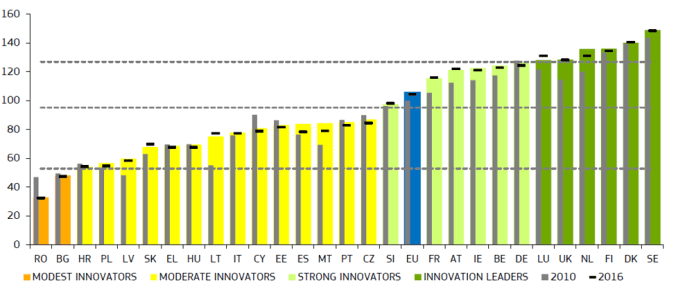
Why? Well there are two main reasons for allow one-way borders. The first is when one area needs skills the other has. This was historically true of Hong Kong and the services it provided to mainland China in terms of capital and skills, although today this is no longer so relevant. In the case of Britain and the EU, there are arguably skills which those across the channel, all things being equal, would prefer to have. Banking and finance might be part of this, but it seems unlikely. Much more relevant is that Britain is far more innovative than the rest of Europe and particularly so compared to the larger countries. In the European Commission’s innovation rankings for instance, Britain comes fifth but well ahead of Germany, as well as France, Italy and Spain. This is something the EU would surely rather not lose: startups and business ideas which could change the world but which need a large market to be tested and improved. For this reason, one-sided migration would be net positive.

European countries ranked by innovation

European innovation

Source: European Innovation Scoreboard 2018 (European Commission)

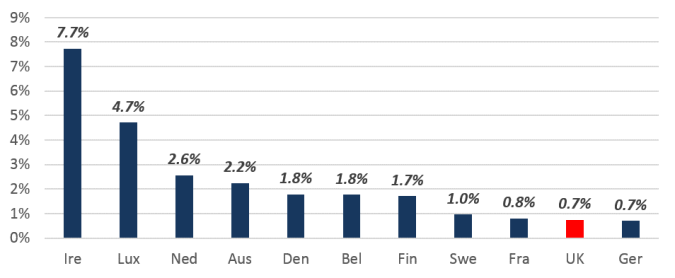
The second reason is the defensive one and relies on a resource Britain has an abundance of: parochialism. One of the reasons China has no particular fear of opening the border to Hong Kong is that there is very little chance that people will want to cross the border and stay there. Oddly enough, Britain is in the same boat, since Britons have historically been far less likely to move to another European country than many others, especially those of a working age. If we look at northern European migrants to other northern European destinations (in other words, intra-EU migration which strips out the retirement population) Britain figures as one of the least mobile populations behind even France. Only Germany is marginally behind and this is due to its outstanding export economy.

Total intra-Northern European emigrants as a percentage of total population

Intra-European migration

Source: People on the Move (Bruegel Jan 2018)

This reflects only “rich” Europe; if eastern and southern Europe were included the numbers would be even more stark. This peculiarly British parochialism can be seen in everything from the lack of language learning in British schools through to the reluctance of British footballers to move to European leagues which are better for their career. In other words, the British are much more disinclined to move and settle in the EU than the other way around, so that offering asymmetric access will only help business without causing any employment displacement.

This is a classic and enjoyable case of hidden asymmetry, the defining theme of this blog. The simple fact is that just because access is unequal does not mean that it is imbalanced or not beneficial to both sides. Reciprocity may seem “fair” on the face of it but may not actually be relevant – when there are cultural asymmetries as in this case, there is a good case to argue that reciprocity is not needed. Unless indeed retaliation is the core objective.

The hidden costs of parenting – why PPP could become PPPP

stress-cost-of-kids

Purchasing power parity or “PPP” has for many years been as good a proxy as any for allowing comparability between figures such as different countries’ GDP. China’s economy, for example, has a nominal GDP of just US$12 trillion, compared to America’s US$19.4 trillion. Yet when re-based on PPP, China’s GDP is actually US$23.2, making it the largest in the world. I for one accept that this is a useful indicator of economic strength, in the sense that China as a country is able to mobilise more economic resources than its nominal GDP would strictly suggest, since labour and capital there are cheaper. Likewise, a preferred measure of living standards is that of GDP per capita at PPP, or sometimes (better) average wages at PPP. In this way, some comparability may be afforded which accounts for street food in China appearing so much cheaper than in the West for instance.

Yet a friend of mine recently noted that in a sense, PPP-based comparisons of wages and living standards were very much geared towards the individual. A great leveler, he reckoned (as a relatively new parent complaining about the costs of the endeavor) was the arrival of children into his life. Because whilst in theory a basket of goods for PPP calculation includes items needed for raising children, in reality behavioral differences distort its reality. PPP, he felt, did not reflect the full costs of parenting and its effects seemed most intuitive to a single person. When considering where to live, PPP in his life could and perhaps should be re-adjusted to Parental PPP or “PPPP”.

There are three main buckets to consider in making any such adjustments:

1. Direct additional costs of education
2. Consumption choices
3. Real estate costs

The theory here is as follows: wherever you live in the world, the likelihood is that you will as a parent attempt to make up for the deficiencies of the world around you as best you can, in the interest of your children. This comes out of your own resources, and actually in many countries where life is “cheap”, when it comes to raising children those expenses shoot right up again. For instance, as a single person one may choose to drink tap water; as a parent one begins to invest in water cleansing machinery or bottled water (especially in Asia). Education is an important element too, since although many countries provide free universal education, parents recognize their limitations and will correspondingly pay for tuition and other aid. A surprisingly large selection of countries such China actually see parents effectively paying for education despite it being notionally free – and this is before getting to the issue of boarding schools paid for by expats. Lastly, real estate requirements are different and in some parts of the world rents / price counter-intuitively increase with the size of a property, commanding a premium due to restricted space.

So a comprehensive, scientific adjustment to PPP would require a sophisticated model which includes all these factors. To test it though, I instead looked at a simplistic account using only one factor that I could readily find, HSBC’s analysis of how much parents pay for their children’s education in several countries:

Cost of parenting
Source: HSBC – The Value of Education report 2017

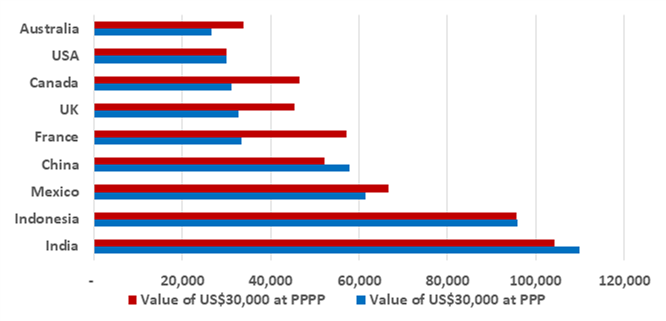
Using this data as a rough proxy for all-in childcare costs (imperfect, but it is all I have to hand) I then readjusted the standard PPP index as provided by the OECD. The assumption I have made is that one-third of a parent’s income is used on children, a figure broadly in-line with statistics also published by the OECD. Thus I left two-thirds of income adjusted on the official OECD PPP basis, whilst the remaining one-third I have adjusted using a new index created by comparing total childcare spend. The results look like this:

Value of 30000

Basic and clumsy though this analysis is, it shows some interesting trends. First, as my friend suspected, the “real” living costs for a parent in places like China and India may be in fact higher than initially assumed, due to a surprisingly high need for private spend. But even more notable is how much value is added by the welfare societies of France and the UK, where the median family does not spend anything like as much for education particularly at the tertiary level. Median wages go a lot further in Europe and Canada than in the US under this system – and indeed US$30,000 almost matches the value of US$30,000 in China. The same kind of logic no doubt applies to issues such as universal healthcare. Assuming my calculations are even remotely accurate, life is fundamentally as cheap in Europe as it is in China, whilst life in the US remains the most expensive.

This methodology is very preliminary, full of assumptions and no doubt lacking. I would be happy to hear opinions on how best to improve it. However the basic theory is strong, namely that PPP may have a simple underlying flaw due to not accounting for changes in life cycle; in some cases PPP probably needs to become PPPP to be meaningful for public policy and for investment purposes alike. Essentially, single life remains localised whilst parenthood is becoming globalised. Since parenting costs are only going to increase as we go forward, the issue becomes particularly prominent. PPPP could be the future.

**************

For those keen to see the underlying data, below is the table of calculations:

PPPP table

How all politics really works – in one simple chart

Introducing the General Theory of Government 

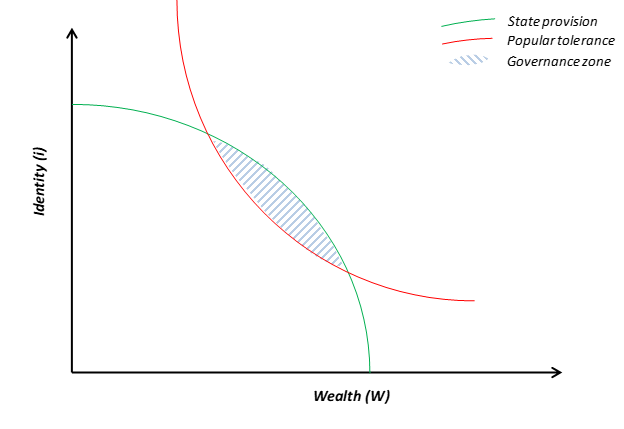
The events of 2016 were curious because of their dichotomy: on the one hand, they were such a shock to the political classes, on the other hand they were also entirely predictable. Yet the commentariat both then and since appeared to miss (or simply forget) the most basic and obvious premise of how all politics works: namely that the ruler has to offer the ruled a mixture of both material and psychological well-being. The desire for identity is as legitimate a concern as any amount of wealth, and any government that fails to provide one or the other over a long period of time will suffer the occasional revolt. Understanding this explains Brexit, Trump and any other examples one might care to mention.

I do not claim this to be revolutionary, but given its lack of profile and given the impending elections in the US which will doubtless cause another round of soul-searching, I think it is useful to visualize this concept in a simple, easy to comprehend model. With no further ado therefore, all politics can be represented in this single chart:

General Theory - basic model

The Wealth-Identity Trade-off Model

It should be easy to see where I am going with this. Into the x-axis goes all those things which politicians want to focus on: taxes, welfare spending, the cost of living. Into the y-axis are all those things politicians seem not to think exist anymore such as ethnicity, religion and language. And, in a democracy at least, any government which consistently offers too little of one or other of these parameters, will find themselves cast out. We have for perhaps too long been living in a world where the governing classes have not only mistaken how to deliver W (Sanders, &c), but completely ignored i (Trump, Farage &c). Political parties across the spectrum have spent the last few decades obsessing over the x-axis whilst assuming that the y-axis will tend to itself. Rectifying this will be, as I have alluded to before, the dominant theme of the next two decades at least in the West.

I would hope this is all intuitive enough not to need vast amounts of explanation, but in a series of posts I intend to outline the basic premise of the General Theory and specifically its core idea, the Wealth-Identity Trade-off Model (WITM™). I will go on to examine how and when a society ceases to function properly; what a society really comprises within the model (“Median Man”, or “MM“); and lastly look at some applied examples in the world today and perhaps yesterday.

What I am proposing is not in itself, I think novel; however like all good things I believe this theory synthesizes simple, intuitive ideas which have at best not been expressed before in such a manner, or perhaps may not have been coherently identified. To anyone who disagrees with this, or who have contrary opinions, I look forward to hearing them. Additionally, since these are blog posts which may one day find their way into a book, I will not footnote everything in detail. However I trust that enough is articulated to allow the reader to comprehend what I intend.

The Kavanaugh debacle

Let me humbly offer my view on what has happened here on Kavanaugh. It’s only a theory but I am pretty convinced of it.

The GOP went for a pretty extreme originalist in picking Kavanaugh (see the positioning below). Unlike Gorsuch, he is far from unimpeachable as a jurist; unlike Amy Barrett, his backstory is not popular. He is a party hack who’s real scandal is not this sexual one but rather his role in the Bush administration in 2003, for which any half competent opposition could have hung him out to dry. Therefore, he was not an easy win for the GOP.

Why then did they do this? I think because they saw the midterms coming and decided on a gamble of enormous proportions: put up a controversial figure and dare the Democrats to vote him down. If he somehow got through, they got their man in (and not just a conservative judge like Gorsuch, but an actual partisan); if he failed or the process was dragged out, it would be the catalyst needed for their midterm turnout which was threatening to be flat.

What they did not count on was the ensuing sexual scandal, which whilst allowing the Democrats to get all excited was not obviously a partisan consolidating issue. The Democrats had a real chance to derail Kavanaugh’s nomination without suffering a backlash. However, the other thing the GOP did not factor in was the total incompetence of the Democrats in taking this easy path rather than the correct path to blocking him.

The Democrats have consequently managed a thing of genius – treading the only narrow, delicate path they could to somehow come out of the Kavanaugh debacle even worse than the Republicans (various recent polls show a closing of the generic congressional voting polls and in Trump’s own approvals, despite the fact that Trump has almost nothing to do with any of this). The GOP had to make another gamble in the end: namely that they, even as a stupid party, were still not the stupidest party in the room. The Democrats managed that honour, and the Republicans’ last gasp gamble seems to have worked.

Extraordinary from all sides.

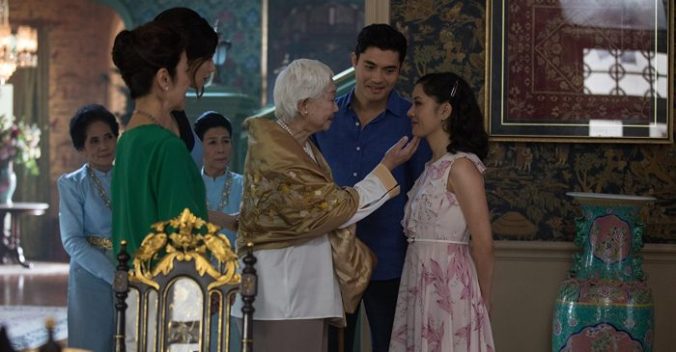
Critics of the film Crazy Rich Asians don’t really understand it

Family

I will admit it: I liked Crazy Rich Asians. In fact, I liked the movie so much that I went to watch it twice at the cinema. This does not appear to put me in good company, since most of the film’s fans seem to be motivated by trite Asian empowerment, whilst normally thoughtful commentators are calling it a “disappointment” and a “missed opportunity”. Inevitably, the film has also fallen victim to those saying it is not representative enough of the Singaporean society it aims to depict.

Yet all of these views rather miss the point, and miss the film’s true genius. Yes, Crazy Rich Asians contains a charming if generic tale of the poor-girl-conquers-rich-family; yes, the film gives uneducated western audiences Asia’s own Lifestyles of the Rich and Famous, of which many would be unaware; and yes, it is a glorious exposition of pan-Asian pride and “arrival” – the film’s opening sequence in a London hotel almost seems a gratuitous assertion of the changing balance of power between Asia and the West. Yet all of this represents only a superficial comprehension of the film, and mostly, one still understood through an inherently western lens.

Rather, Crazy Rich Asians is a profound social commentary about the state of the Chinese diaspora, its diversity and depth, and the gravitational forces that are pulling it apart. What Jon Chu (and author Kevin Kwan) have done is bring into focus the central question vexing much of Beijing, Kuala Lumpur and Los Angeles: who owns Chinese identity? To understand the real meaning of this film is to understand the transcendent nature of what it means to be part of the Greater Chinese world.

There are here essentially two main stereotypes of this Chinese diaspora, and two Chinas, being juxtaposed against each other (at this point I am going to note that I use various monikers with caution, and expect the reader to understand the general thrust of the label rather than be unhelpfully bogged down by the minutiae of definitions). A third China is for now not tackled, but we will touch on it below.

OCs

The first, represented most prominently by Eleanor Young (rather than, I think, by her own mother-in-law) is that of the historic “overseas Chinese” community, who by and large left China before 1949, and in the greatest numbers during the upheavals of the 19th century. These are the communities which populated India, Burmah and Malaya, before sometimes going on to Britain or further afield. The Chinese of Singapore, where Crazy Rich Asians is set, and Malaysia, where it is partly filmed, are central to this, as were the former Chinese communities in Bombay, Calcutta and Rangoon amongst others. Families of this ilk regard themselves immutably as the guardians of true Chinese culture as handed down by millennia of history prior to the 20th century. Their China is “China”; all else, whether the contemporary Mainland or the migrants to America, is ersatz.

The second group, depicted principally by Rachel Chu, is that of the classic American-born Chinese (“ABC”), somewhat unfairly maligned in the film as a “banana”. But the term “ABC” hides a multitude of sins, since there are plenty of families of Chinese descent in the US who are far more traditional and in-line with Eleanor Young, than is the protagonist here. Really, the story is of Rachel’s mother Kerry, whose story is not explicit in the movie but who can readily be inferred as one of the post-1980 New China emigres (as indeed related in the books). This cohort, whilst being “Chinese”, were already Chinese of the post-Cultural Revolution era and bear all the marks of that rootlessness. Their story of emigration is far different to that of the pre-1949 generation and it is telling in attitude, outlook, habits and behavior of their children. This is particularly true of the US where assimilation is most culturally demanded, but also to a lesser extent in Canada and Britain. For them, there is not a lot tying them to the China their parents escaped other than the occasional longing for bubble tea and mahjong.

ABCs

The film also adds a few other Chinese ingredients into mix. The Mainland is barely mentioned, presumably in order not to offend the new owners of Hollywood studios and allow the movie a chance to be shown in the world’s second largest market. Instead though, Hong Kong (through cousin Eddie Cheng) is used as a proxy for the Mainland’s gauche, parvenu ways – and ironically, since Hong Kong is rather more brash and arriviste than they would like to think, this proxy is very fitting. It is perhaps a nuanced little dig at all those Hongkie elites who think so much of themselves. Next the grandmother, Shang Su Yi (again not named in the film but in the books) is a veiled reference at the legendary domineering of Shanghainese women. Taiwan, with all its crypto-Japanese influences, is probably the largest omission from the storyline, being referenced only in passing. Lastly there is Singapore itself which, although portrayed as a centre for overseas Chinese, is actually a modernity unto itself – as represented by the Goh family of nouveau riche ah beng’s and ah lian’s. Much of Singapore is barely recognizable for the traditional Chinese of London or even KL; in terms of “real Chinese culture”, Malaysia actually is what Singapore thinks it is – thus making the filming location at the Villa Carcosa in KL, even more poignant.

Neither the Youngs or the Chus exist in China today, but the conflict between them raging everywhere from Singapore to San Francisco, is deep, passionate and fierce. The overseas Chinese community of pre-1949 are both proud and condescending precisely because the China of their heritage is still so dominant. Crazy Rich Asians is fundamentally a homage to, and the story of, this peculiar overseas Chinese world and the enormous struggle it has faced in being the bearer of the one true Chinese light, whilst being weighed down on one side by the cultural Revolution of Mainland China, and on the other by the cultural dilution amongst ABCs. Even for western audiences, this is obvious: the stereotype of that thrifty family that keeps the plastic wrapping on the dining room chair set (think Fresh Off the Boat) is real – but it is also specific to southern Chinese families who went overseas. Northern culture, which now dominates middle class life in Beijing and even Shanghai, is not thrifty but rather garish profligacy that throws money at anything. Not for them the lessons of trauma and hard work. And as a final insult, we are now in a world where Simplified Chinese characters, by sheer scale of the PRC’s importance, is the default Chinese – no foreigner today would dream of learning anything Traditional.

I would be inclined to make the lazy assertion that those who do not get Crazy Rich Asians are just too shallow to appreciate its many levels. Yet I cannot, because the true beauty of the film is precisely that such people are a part of the story; the very fact that they do not fully comprehend it is emblematic of the great contradictions which Chinese are posing to each other. This movie is aimed at multiple audiences, and satisfies each in its own way. Its enduring strength is the way those audiences will respond differently and no-one really finishes with the same viewpoint on who they sympathise with and support – Eleanor or Rachel? The grandmother or Kerry? Indeed many modern PRC Chinese may not think any of the story is relevant to them; but it is more so than they may ever realise.

Being myself from a Chinese family of southern provenance who arrived via Calcutta to Britain, my instinct is to agree that our true culture is that transmitted through the strict guardianship of overseas Chinese communities. But having spent the greater part of my life in the Mainland and having had the rare privilege of knowing Beijing as far back as the 1980s, I understand also where New China and its impulses comes from. These Three Chinas – the PRC, overseas Chinese and ABCs – are all locked in the kind of conflict which is characterized by the (Anglo-American) maxim of being “separated by a single language”. The reason the film is so successful is that it stirs so much in each of these various Chinas, but does so both severally and collectively. Just one example is the soundtrack, which includes everything from the Shanghai jazz scene of the 1930s to the world of 1970s Cantopop covers, to Chinese contestants on The Voice. The sheer range of the music, its roots and influences, is a story of Chinese culture through the ages.

So whilst Crazy Rich Asians can come across as pedestrian to the uninitiated, the complicated and nuanced realities which its showy aesthetics overlay are important. I am sure that Jon Chu set out to tell this very story of divergence and disruption, knowing that each of his audiences would find something different to enjoy (and criticize it for). But even if he did not, for those who truly understand the complex tapestry that forms the world of the Chinese diaspora, he has created a masterpiece that repays watching, and poses socio-cultural questions of us which will not only not go away, but will only become more prominent. This painful dilemma is the challenge being faced by tens of millions across the world, parents, grandparents and others, who this film is designed to represent and tell the story of. To look at Michelle Yeoh is to feel the grip of generations over our Chinese souls and on some level, to think, “I understand why she is us, and we are her”. It speaks powerfully about our identity, and forces us to contemplate what it is to be without it. This is a seminal work of Chinese cultural existentialism, cleverly wrapped in pop culture – it is an Asian Banksy; it is MC Hotdog expressing Hegel.

It is not so much about “seeing ourselves on screen”, so much as “what is to become of us?”. Perhaps in the next installment, we will be told.

In defense of football managers

Mourinho Pochettino

Last night was one of those glorious Spurs nights which, under Pochettino’s reign, rank alongside last season’s win at Stamford Bridge in terms of “announcement”. Therefore I would love to dwell on it – but I will not. Instead I want to make a different point in support of Jose Mourinho, a manager I have not much liked over time but who I perceive to be somewhat victimized.

A lot is leveled against the Manchester United manager these days: bullying of his players, attention seeking, shortness with the media, finding excuses about the talent in his team and directing criticism onto the Board. Yet amongst all this analysis, I often find that there is a disjuncture between commentators and fans, with commentators – the typical “chattering classes” as it were – frequently focusing on the coach a lot more than supporters.

Take last night. I woke up to the news that Mourinho had walked over to the Stretford End stand in what appeared like a valedictory farewell with a few hardcore fans. This turned out to be fake news – as Gary Neville pointed out on Monday Night Football in listening to Mourinho’s post-match interview, one can tell he simply wanted to applaud some fans who had remained to the end. Of course, to media commentators, who have been aiming for Mourinho for some months now, it seemed obvious that the fans should be fed-up. After all, who else is there to blame, when the manager has spent more than £300 million net on transfers since his arrival? In their view, those in the stands must be onboard with the media agenda too, of laying the blame squarely at the feet of The Special One.

But football fans are much more likely to blame the players, who they sometimes see as not pulling their weight or trying hard enough to bleed for the team, and always see as overpaid; or direct their ire to the club ownership who they feel are not investing enough or only there for the profits. Yes, there are certain managers who get up the nose of their own support, such as the way Alan Pardew consistently did. Sometimes this is because of “playing style” such as during Sam Allardyce’s short-lived sojourn at Everton; other times there are much overt clashes such as Mick McCarthy’s fiery relationship with the terraces at Ipswich. But as witnessed with Arsenal fans for the last two seasons or with Moyes’ brief stint in charge of Man Utd, tolerance for managers is actually quite high. They are not paid as much as players usually, and are reckoned as having a bit of a tough job treading between preening athletes and cynical club executives.

So why this disjuncture? As usual, the blame lies in with the media being limited, insular and lazy. First, they rarely think outside the box – listening to Henry Winter, the much-lauded Times football correspondent (five times Football Journalist of the Year, no less) offering up his analysis was painful – “he has lost his touch” was the stumbling insight offered on Radio 5Live. Secondly, they are being played as part of a game they seem to have no idea about. These days few players and even fewer owners speak to the press freely. Post-match player interviews are generic and pointless, to the extent that even I have to laugh at the BBC’s Dead Ringers when the mimic my beloved Harry Kane. From an early age, professionals have been coached to say as little as the public announcements of a listed company. Meanwhile, getting words from clubs owners is rarer than seeing ketchup in canteen of a Premier League training facility – when David Sullivan gave an interview in 2017 on the back of poor results for West Ham, journalists did not seem to know what to make of it.

Managers, by contrast, are the only figures who are both obligated to speak to the outside world (Premier League post match press conferences are obligatory at the risk of fining), and often have something interesting to say. Therefore football commentators focus incessantly on the managers of clubs and to an extent allow managers to define club identities in a way that real fans do not see it. Media talking mainly about managers is nothing short of navel-gazing. For the outside observer, it is actually players who embody a club, and who have the agency to change a team’s fortunes. This may not actually be true in this age of advanced tactics and hyper preparation, but it is what is felt. Since journalists are lazy though, they rely on these moments of managerial interaction for almost every reading of the tea-leaves.

Consequently when the media, in their one-dimensional world, get the bit between their teeth about a manager, they are often surprised to see – and then usually ignore outright the fact – that fans do not follow suit. When Moyes was at his nadir, a banner flown from a plane was met with at best mixed reaction from fans, much to the media’s bemusement since they assumed all supporters must agree with them. Even Wenger for years had higher levels of support and trust from those in the ground than he did from outside, even until the bitter end.

Last night as the numbers at the Stretford End began to be revised upwards, it seems like maybe a couple of thousand Manchester United supporters stayed to the end to support and chant for Mourinho. The manager, in turn, recognized this. Supposedly, around the director’s box, a good sliding tackle from Spurs defender Toby Alderweireld in the first half caused fans around them to look up to Woodward and make the point that a lack of these signings were the cause of problems – in stark contrast to the coach. In the end, the planned (and once again inept) plane banner for next week is targeted at Woodward, not at Mourinho. When Mourinho failed in his second stint at Chelsea, the fans directed their anger at those perceived as not trying hard, such as Hazard, Diego Costa and Fabregas. The fans do not like prima donnas.

I would make the cheap and obvious political point here about how the chattering classes miss what people are really thinking and arrogantly assume that the view being disseminated are the ones which encapsulated public opinion. But with Tottenham having won a magnificent victory last night, no need for that at this point …

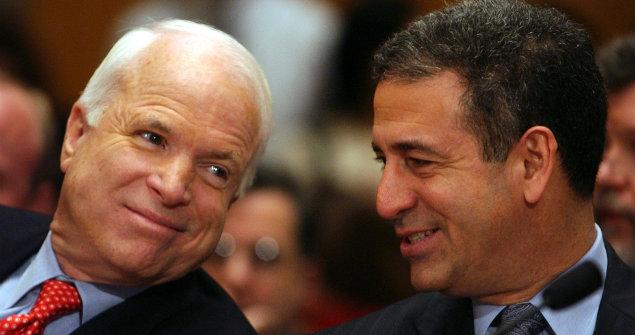
John McCain’s passing poses more questions than answers

McCain Feingold

I am not usually interested in talking about “current events” but the death of John McCain is worthy of consideration in terms of all the questions it poses for the long trajectory of politics in the US and elsewhere.

First, cards on the table: I was for many years a card-carrying member of the McCain fan club. I met the man twice, once when I was interning on the Hill in 2001 when he and Joe Leiberman were the Statler and Waldorf of American politics, and again three years later when he came to the Oxford Union; somewhere in the back of my desk drawer is a grainy first-generation camera phone video of the standing ovation he received from all as he left that hall. To my mind, in his 2000 incarnation he was perhaps the greatest President the US never had, combining nobility and grace with a far-reaching sense of mission and destiny for his country. On top of this, he was a patriot and in his own way, had a strong sense of America’s purpose in the world. His defeat at the hands of Karl Rove’s borderline racist campaign in the 2000 Republican primaries was a tragedy all round.

McCain sponsored the only substantial campaign finance reform bill of recent years, and was one of the few sources of bipartisanship in an era of increasing polarisation. He also attempted, being a Western conservative rather than a Southern one, to find a way to reform immigration in such a way that America could still be sensitively preserved before the difficulties set in. He failed, but not before dragging Bush along with him and not before cementing that alternative Republican approach towards success in states that were not whiter than white – including Arizona and Texas. In party terms it might be said that he was the future, once.

Yet by 2008, McCain was a sad shadow of his former self. For the previous few years he had begun to cravenly solicit the support of the GOP machinery by supporting an extension of the Bush tax cuts and in the end turning to Karl Rove, of all people, for advice in the Presidential campaign. For my own part, I struggled to support McCain during that election and only did so in the end as a counter to the vapidity that would prove to characterise Barack Obama; in fact my preferred candidate in early 2008 was Hillary Clinton. Where in 2000 I was so deeply upset at McCain’s failure, by 2008 I could only shrug as his team decided to invite Sarah Palin onto his ticket.

This stark decline was not just a measure of his political choices; it was indicative of the declining relevance of McCain and his whole faction, well-meaning but ultimately anachronistic as they were. For a start, his ideological hawkishness over Iraq showed an antiquated notion of how to manage international relations. Elsewhere, I have written about the idea that greatness can only be achieved through a judicious mixture of both nobility and ruthlessness, not through ideological optimism alone. For a country like the US, some countries may be won over, but others need to be kept down with all the skullduggery in one’s arsenal. McCain was blindly wedded only to the former; his worldview was effectively one of nobility alone – the idea that sheer “rightness” would be enough to win America’s conflicts.

McCain, even in 2000, embodied all too much that post-Cold War complacency which first failed to foresee the emerging threat of militant Islam and then also dealt with it so clumsily and inconclusively. Leaving aside Iraq, it is also difficult to imagine what McCain’s reaction to China would have been in recent decades. The likelihood is that in dealing with what has become the single largest threat to American hegemony, he would have undertaken the same combination of sabre-rattling and indecision which was to inform the Bush and Obama administrations. McCain would also have had nothing to say on China’s post-WTO gamesmanship, because trade, commerce and business were not his strength. He would have been just as distracted by pointless sideshows against Russia and just as obtuse, I am sad to say, about the key issues of wage growth and trade.

McCain young

It is incredibly sad to think of how irrelevant many of the things we put McCain on a pedestal for ten years ago, are today. Yet he does bequeath some traits which remain important, of bipartisanship, integrity and patriotism which are so obviously lacking throughout the ranks of both political parties today. McCain would have taken us into perhaps ten wars and back; but he would always have done so on first principles. Nonetheless his passing closes the chapter on an era when America could still afford to think in clean cut terms about its role in the world; and highlights the fact that his naivety on occasionally doing the cynical thing, is also passed. For McCain, I believe the world was always the world of 2000. I adored the man, but it is time to move onto a new reality.

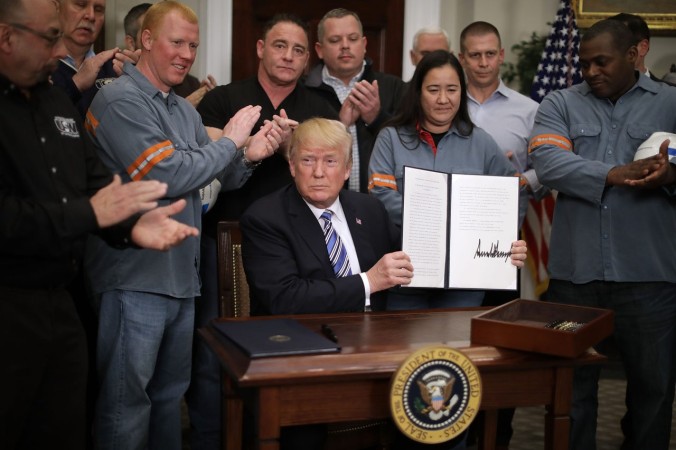
Donald Trump and the right side of history

Trump TPP

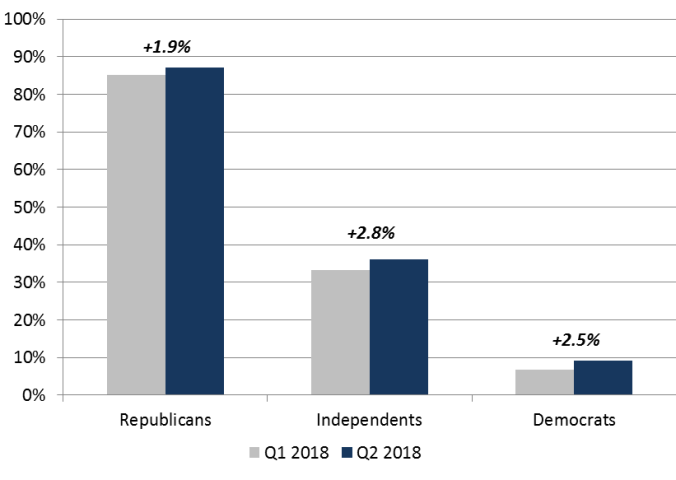
The Guardian recently caused a splash by publishing a piece discussing Donald Trump’s remarkable resilience in the polls despite the near universal opprobrium being heaped on him by the media. It had some sage words for why media hostility was actually hardening Trump support, as well as pointing out that ultimately, Trump is giving most Republicans what they want. Both are true, but the piece also omits one major explanation for the stubbornness of the numbers; after all, 87% of Republicans support Trump, but that is far too little to explain 43% approval numbers. Instead, it is the support of 36% of “Independents” and even more surprising 9% of Democrats which he continues to command (both numbers which have increased markedly during the first half of 2018), which make up the difference:

Presidential Approval Ratings between Q1 and Q2 of 2018

Trump polling

Source: Gallup

In the climate of public discourse, his avowed critics find it incomprehensible to imagine who these non-Republicans might be. But yet it is these independents and Democrats who make up the group supposedly so “racist” that they voted twice for Obama before voting for Trump. Why, as the Economist asks, will the Democrats “struggle to win back Obama-Trump voters”?

The biggest problem for Trump’s detractors is the fact that he is, on some level, on “the right side of history” at a moment when hardly anyone else in public life is. By this, I mean that on some of the largest issues weighing on the public today such as trade, immigration and even international institutions, it is Trump who is pushing at an open door, not his opponents. We can be pretty certain for instance that whoever wins the next few elections will not be doing so on a wave of championing more free trade, more open immigration or more faith in organisations such as the UN, NATO, the IMF or the WTO. Instead, the winners are likely to be those who are talking Trump’s language, even if they are not using his vocabulary.

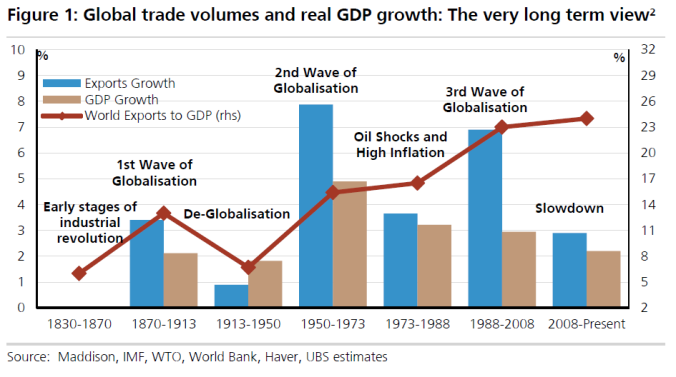
No doubt this idea will cause outcry amongst my liberal friends, but let us consider the evidence. The first such exhibits are the underlying macro themes. For instance, UBS released a note in 2016 charting the recent decline of globalization as a very natural part of the development cycle, and why also there are structural tensions being created in the current situation:

UBS - globalisation

The globalization cycle typically sees high growth in trade matching high levels of growth, followed by periods when trade and growth decline. These are the moments when societies spend a moment to draw their breath and “catch up” to the excessive changes that have been wrought. In an earlier blog I noted the limitations of explaining away trade deficits with capital surpluses for instance, as some commentators quite unashamedly continue to do. The reality is that those who gain from the latter are not the same who lose out from the former, resulting in a political and social tension unaccounted for in scholarship which is postgrad IQ but high school EQ.

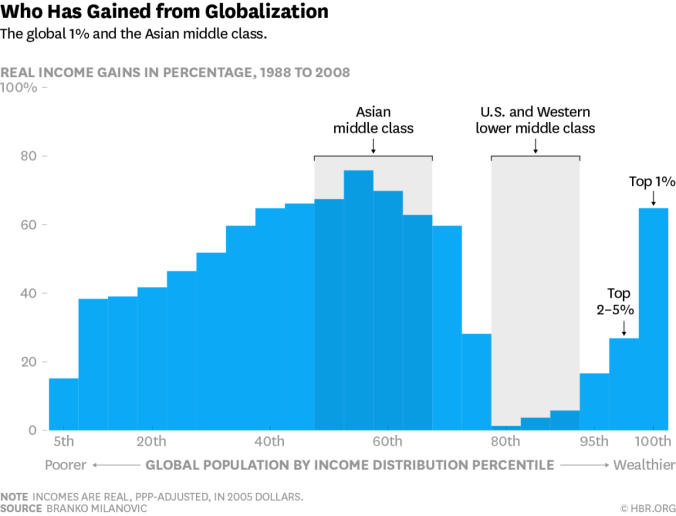
Additionally, there is the element of inequality over growth distribution. In the UBS analysis, we can see that despite a substantial slowdown in growth, exports remain at an unrelentingly high percentage of GDP resulting in limited social recalibration. Furthermore, the growth even during the previous wave of globalisation mainly benefited the non-West as this recent HBR study shows:

HBR - gloablisation

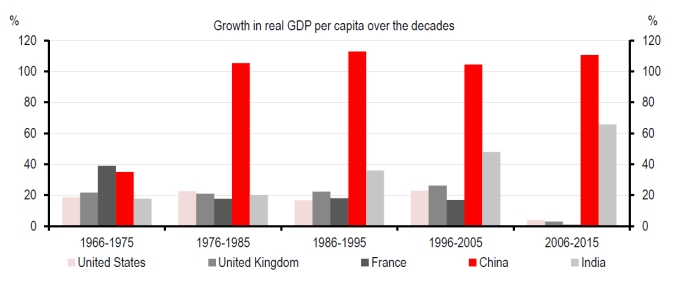
This is supported from a different angle by HSBC’s analysis of which countries have gained in which era of the recent past:

HSBC - globalisation

Source: HSBC presentation, January 2017 (not available online)

In broad terms therefore, there is such a thing as “too much trade” and its corollary “too much freedom of movement” (aka immigration). For all these reasons, from the perspective of the American voter, the “right side of history” is the side which will make these changes.

The second piece of evidence for Trump being on the “right side of history” is the surprising consensus for change in these areas. The China “trade war” – an irresponsibly used term if ever there were one – has seen much fear and anguish in the media (very few of whom understand even the basics of trade economics) but actually commands widespread bipartisan support in Congress and has done for some time. The same applies to pulling the plug on TPP and questioning NAFTA – both positions that have long animated the party that produced Bernie Sanders, Dennis Kucinich and Howard Dean. Some determined anti-Trumpers of the Left have now painted themselves into the absurd position of defending the free trade of the WTO, when just a few years ago they were its greatest opponents. On this, they have a credibility problem if nothing else.

But it is not just trade. On immigration, the Democrats are caught between arguing against Trump’s policies even whilst occasionally defending the fact that Obama deported more illegal immigrants than any other president. The reason he did this was popular support for the general principle that borders mean borders. And even with regards international institutions, it has long been understood that many are not working for the US. Obama called his NATO allies “free riders” as recently as 2016, and abandoned the Quadrilateral and G7 to try and reach an agreement in Copenhagen in 2010 much to their anger; meanwhile George W Bush spent the best part of two terms criticizing the WTO and finally abandoned the Doha Round. Clearly, no-one thought these institutions were working well or serving best American interests.

Yet strangely the Democrats have done almost nothing about this, and have found no real successor to Sanders, the only candidate from their side who talked about this. Sanders’ various successors – whether Liz Warren or the newly crowned Alexandria Ocasio-Cortez, have surprisingly little to say on any of these themes other than wanting to abolish ICE. Instead they have left the field to Trump who therefore feels (to the average voter) more like someone who is looking forwards, not backwards, about the world we live in. Where a politician stands on that nexus of trade, immigration and institutions has become a defining and almost apolitical issue; once you strip that away, you are only left with the usual rancorous debates on gun control and whether to install transgender toilets. Those arguments though, pale into insignificance against the background of how to remedy (rightly or wrongly) median wage stagnation. Democrats and Republicans are navel-gazing whilst Trump is allowed to speak unhindered to large swathes of the nation that voted for him in 2016. At the moment, he owns that space even if his methods seem clumsy – as former Australian Prime Minister Kevin Rudd recently said, Trump has been “strategically comforting but tactically terrifying”.

(As an aside, I would point out that the liberal desire to cast Trump as some sort of “reactionary” does not ring true either. I do not believe most of the public actually see him as being particularly anti-gay or anti-abortion for instance. Instead, one of his defining moments on the campaign trail was the highly pragmatic response to the transgender toilets issue, saying they should use whichever one they wanted but business could not pay for new facilities. Mostly, he just does not care. Sure, he is not actively helpful to liberal causes but he is hardly aiming to contain them. Remember, too, that in the Republican primaries almost every sort of more extreme candidate ran: states’ rights fundamentalists, religious fanatics, neo-conservatives and Koch-ite free traders. Trump was none of these things and triangulated quite effectively between them all.)

Of course much of the support for Trump remains cultural, and on what is sustaining this one need look no further than the exceptional piece written by Joan C Williams in the days immediately following the 2016 election. It remains the best depiction of that amalgam of economic, cultural and social thought which passes for “what’s best for my family” in many voters’ minds:

One little-known element of that gap is that the white working class (WWC) resents professionals but admires the rich. Class migrants (white-collar professionals born to blue-collar families) report that “professional people were generally suspect” and that managers are college kids “who don’t know shit about how to do anything but are full of ideas about how I have to do my job,” said Alfred Lubrano in Limbo. Barbara Ehrenreich recalled in 1990 that her blue-collar dad “could not say the word doctor without the virtual prefix quack. Lawyers were shysters…and professors were without exception phonies.” Annette Lareau found tremendous resentment against teachers, who were perceived as condescending and unhelpful.

Michèle Lamont, in The Dignity of Working Men, also found resentment of professionals — but not of the rich. “[I] can’t knock anyone for succeeding,” a laborer told her. “There’s a lot of people out there who are wealthy and I’m sure they worked darned hard for every cent they have,” chimed in a receiving clerk. Why the difference? For one thing, most blue-collar workers have little direct contact with the rich outside of Lifestyles of the Rich and Famous. But professionals order them around every day. The dream is not to become upper-middle-class, with its different food, family, and friendship patterns; the dream is to live in your own class milieu, where you feel comfortable — just with more money. “The main thing is to be independent and give your own orders and not have to take them from anybody else,” a machine operator told Lamont. Owning one’s own business — that’s the goal. That’s another part of Trump’s appeal.

Hillary Clinton, by contrast, epitomizes the dorky arrogance and smugness of the professional elite.

This is a major part of the real world, and Trump has no competitors here. It has led, as the Economist lamented well before Trump arrived on the scene, to “the return of history”. Skillful as Trump is, he did not create these issues or the popular sentiment driving the polls; years of poor governance did.

The fact is that none of these things – free trade, more multiculturalism, faith in institutions – are going to be more popular in five years time than today. In the areas of policy most commonly associated with Trump, there is a near consensus amongst the population but yet he alone is telling the story. The Democrats are therefore reduced to hoping for a candidate to come along that will articulate Trump’s message better than Trump. That may happen; but it’s an audacious hope. In the meantime, whisper it: whilst the Democrats and Republicans are wrangling over tax cuts and repealing Obamacare, it is Trump who is on the right side of history. For now, anyway.

Guns don’t kill people. Americans kill people.

Time to target the real cause of America’s non-criminal gun violence problem: Americans

Gun family

The perennial scene of a US school shooting brings a timely reminder of American exceptionalism. Typically, this is the time when both sides of the gun control debate rehearse their equally absurd statistics defending their position. So why should I be left out!

There are some unfortunate issues with the gun control lobby. The first is that they often roll out data which talks about total gun deaths and its correlation with gun ownership. The problem with this is, that total gun deaths includes suicides – and in fact, the vast majority of gun deaths are suicides. Arguably, this is also a problem but the gun control debate clearly is not one about regulating how people choose their own way to die. Secondly, and unhelpfully for domestic discourse, many also bring up comparisons with abroad – something which will surely cause more provocation than it solves given the NRA lobby’s notorious rejection of taking signals from foreigners. Two examples of data which commonly does the rounds are below:

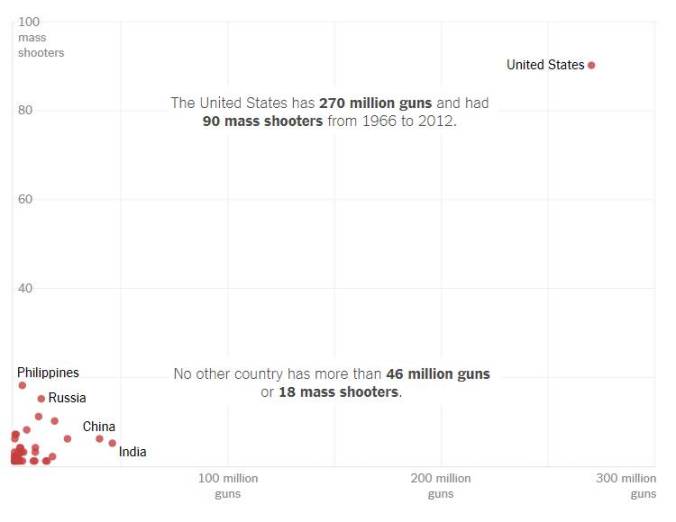
But let us look at this in a bit more detail nonetheless, because the comparison with other countries is actually more nuanced than it seems. The US of course has by far the OECD’s highest gun-ownership per capita – but it is not way off the scale. At about 89 guns per 100 people, this is “only” about twice as much as some other perfectly peaceful countries such as Switzerland and Finland, which both have over 40 per 100 people:

Guns per capita

There are all huge numbers compared to countries such as the UK. But the US also has far higher than twice the number of gun deaths and, as per this astute chart from the New York Times, has vastly higher numbers of mass shootings in particular:

NY Times gun mass shootings

Even stripping aside some of the obvious issues with this comparison, such as the facts that gun ownership has actually been much more mature in the US than several other of these countries (the chart looks at mass shootings since 1966) and that gun ownership in some countries is a function of national service (with commensurate training), this tells us something quite important: it is it not actually gun ownership that leads to lots of deaths, it is specifically gun-owning Americans.

This leads to a broader point about national character, of which I have written before in talking about the uniquely brash and ruthless personality of the Anglosphere. The fact is, gun control is not so much a universal human issue so much as one linked specifically to the perfect storm of mass gun ownership and American culture which currently exists. Intuitively, what would apply to the US, UK and Australia may not be true of Switzerland, Germany and Austria, where social discipline is that much stronger. I would be much more sanguine about the need for restricting guns in Japan, for instance, than I would in China, simply based on the type of people there.

This is not to say that other countries do not have problems – Switzerland has certainly not been immune to mass shootings. And it would be churlish to deny the obvious basic rational linkage between possessing guns and using them. But there is clearly something deeper about the American psyche that makes gun control a more poignant issue there than elsewhere.

For the record, I am in favour of gun control. I believe that since guns are actually designed for the purpose of inflicting damage – unlike cars or any other tools that cause harm as a side effect – society through its government ought to minimize its presence. There can be some leeway for practical or recreational use of course, but these should be restricted in both type and regulation. If a farmer needs a gun just as he needs a car, he should get a license for one.

I acknowledge that restricting legal gun ownership will not impact the larger issue of gun violence in the US. In fact it would be marginal. However, there is no evidence that legal gun ownership helps in preventing crime either; and the reality is that the few instances of legal gun-related disaster such as almost every school shooting, are much more high profile and in their way, rather more tragic than mere gang shootings in inner cities. They affect middle class suburbia and are preventable. This alone justifies action by the government.

But let us not assume that taking guns away from Americans is descriptive of the human condition; it is not. Instead it is descriptive of the American condition. “Guns don’t kill people.” Well, people don’t kill people, either. It is Americans that kill people. Time, therefore, to restrict Americans from owning guns …

Why the Tottenham penalties were correct – and why Liverpool fans are whingers

Kane Klopp

Liverpool fans have always been rather an irritating lot. The combination of hubris and inconsistency, as well as constant bleating about “heritage” and history as though somehow this renders the modern success of rivals such as the Manchester clubs less worthy, lead to popular conceptions of this group as probably the fan base other fans most love to hate – “football supporters think you are either tiresome, cringeworthy or both.

So it has been particularly enjoyable not only to watch the draw that Spurs battled to in front of the Kop last weekend, but also the whingeing that poured through social media in its aftermath from fans, players and manager alike. Other than maybe Barcelona, few football supporters come at things from such a moral high horse and, as with Barcelona it is great to see them get their comeuppance once in a while. Come to think of it, maybe that’s why all their players end up moving there.

Therefore let us examine forensically the two controversial incidents from the match, through some of the most common refrained heard from excitable Liverpool fans in the few days since.

1. “Kane was offside the moment Dele passed the ball”

The implication of this is that the moment the ball left Dele’s foot, the referee should have blown for an offside against Tottenham. This is simply factually wrong and demonstrates a lack of understanding about the offside rule and even Klopp was guilty of this mischief in his post-match press conference where he said:

… there is a new rule, I don’t know exactly? I don’t know who played the pass but in the moment the ball left the foot of the Tottenham player, Harry Kane is offside.

It is true that Kane was in an offside position when the ball was passed, but this is not the same as actually being offside. For the latter to be the case, Kane actually has to play the ball – in other words, had the ball not come off a Liverpool player, Kane would only be offside at the point when he received the pass and played. There is absolutely no requirement of the referee to call an offside before this point and it would be wrong to do so – players are constantly in offside positions through the match, which is why the rule was clarified to only include situations where a player in an offside position is “interfering with play”, and why today players who are in an offside position but not anywhere near the ball are not called for offside.

Kane offside

(Incidentally Klopp should know better and actually gets away with murder in a lot of his post-match comments, but let’s leave that for another day.)

Case for Liverpool: 1/10

2. “Kane was interfering with play at the point when the pass was made”

This charge has slightly more legs, but only slightly. Clearly, Kane is in an offside position but the referee deemed him not interfering with play. These are the situations which come down to referee’s opinions and it seems questionable to assume that Lovren necessarily struck the ball because of an awareness of Kane being behind his shoulder. If you look at the replay, Lovren seems to be all over the place and there is more than enough space for the referee’s opinion to be that Lovren played the ball purely because that was his instinct, not because of any perceived goal-side threat. In such situations one assumes that a seasoned referee’s opinion and read is as good as anyone’s – certainly VAR would not have resolved this question one way or another.

Case for Liverpool: 4/10

3. “Lovren was not playing the ball on purpose”

 At this point we have to accept that after the pass commenced from Dele, it ended up being (mis)played by Lovren and quite possibly by another Liverpool player also, first. Therefore the question is whether Lovren played the ball on purpose as per the official rules on exemptions for offside, which state:

A player in an offside position receiving the ball from an opponent who deliberately plays the ball (except from a deliberate save by an opponent) is not considered to have gained an advantage.

First, let us be clear that the purpose of this wording is designed to make sure that this exemption does not apply to completely accidental deflections and rebounds, the kinds of things where a ball hits the back of someone’s head inadvertently and so on. It is not supposed to cause a nuanced consideration of how professional footballers at the top level play.

In this situation Lovren clearly went to strike the ball and, due to being a simply terrible footballer (as we saw at Wembley earlier in the season), mis-kicked it. It was not an inadvertent deflection, just a crap piece of play. As such, it takes quite contorted logic to try and make the case that the exemption does not apply. Yes, it does not fall under the initially intended rule designed to exempt offsides from back-passes, but yes it falls under the strict laws of the game – the ball did not continue towards the Liverpool goal due to an accident.

Leaving this to the Professional Game Match Officials Limited (PGMOL) in their official statement, it seems pretty clear:

The interpretation of “deliberately” kicking a ball considers whether a player has intentionally tried to kick a ball – it does not consider whether the ball ends up where a player may have wanted to kick it.

Case for Liverpool: 3/10

 4. “Kane dived for the penalty”

Now onto the meat and drink of the incidents. Subsequent to the event, Kane has both admitted that he drew the contact, whilst Karius – and this is quite important – admitted that contact was made. In these circumstances, under the current refereeing environment, any challenge which a goalkeeper makes where they fail to get the ball is a poor challenge. To be clear, any time where a goalkeeper comes for a ball and fails to do so properly, leaves them exposed by definition to having committed a bad challenge – the very definition of a foul.

As that well-known Tottenham fan Jamie Carragher said on Monday Night Football (focusing principally on a similar incident involving Delafeu and Courtois):

When goalkeepers come out like a train, like he has – like Karius has – I’ve got no sympathy whatsoever. If he’s complaining about it, don’t come out like a lunatic … It was a poor decision to come out; Karius’ was as well. If there is a problem with attackers leaving their legs in there, then goalkeepers need to do something different.

My mind harks back to last season’s FA Cup semi-final between Tottenham and Chelsea, when Son’s mistimed sliding tackle gave away a penalty in much the same situation. A goalkeeper who, in missing the ball when coming out for it, makes contact with an attacking player, has committed a foul as per the rules. End of.

Case for Liverpool: 2/10

5. “Jon Moss was not sure about the decision”

This charge is linked in part to the slightly bizarre moment when the referee appeared to ask the fourth official for extra information, then did not bother to pursue this line of enquiry. The BBC’s transcript of the conversation with the linesman did seem to indicate some confusion, but the PGMOL statement also seems to put this to rest, noting that the conversation over whether Lovren had touched the ball was misrepresented:

Eddie Smart, having identified that Kane was in an offside position, correctly sought clarification on whether Dejan Lovren had deliberately played the ball. His question created some momentary confusion when Eddie asked if ‘Lovren’ had touched the ball. Moss knew a Liverpool player had touched the ball but not that it was Lovren.

There was also some manufactured controversy over why Moss had asked the fourth official for anything when he was not entitled to do so since VAR was not in action, but this is quite a sideshow which Moss has in any case admitted was “misguided”. Importantly though, he followed through on his own original opinion, as he is supposed to do.

I hate to break the news to Liverpool fans but the vast majority of refereeing decisions in a match are matters of opinion. They are not only entitled to act on such opinions but are indeed paid to do so. It is perfectly obvious that in complicated situations, referees are not going to be 100% sure of what happened but their job is to go with their instinct and the point of a seasoned professional referee is that they get these things right most of the time – as they did in this case.

Case for Liverpool: does not even justify a response

6. “Lamela dived for the penalty”

More meat and drink. To be honest this incident has barely been even controversial amongst the commentariat and much of the initial reaction seemed to be due to poor camera angles about what had happened, possibly informed by lingering bias against “latin players” and their record in this. But a closer inspection, as was done on the BBC’s MOTD2, shows it was actually a pretty hefty kick up the backside by Van Dijk on Lamela, and as Mark Lawrenson (another well-known Tottenham fan) put it clearly there:

Don’t get me wrong, Erik Lamela does extremely well and he’s very very clever. He just gets himself into a position where as Van Dijk is going to kick the ball he kicks the back of his leg, and yes that’s a penalty. Is that not a foul anywhere else on the pitch? So it’s a pen.

The threshold Lawrenson describes is of course important: the rules a are specific in saying that there should be no higher or lower threshold for what constitutes a foul within the penalty box as outwith. Again, however clever Lamela has been in positioning, if Van Dijk had undertaken such a piece of contact on the half way line, it would have been given as a foul and a free kick. A poor challenge is a poor challenge anywhere. Not being intentional is not an excuse; nor is the fact that Lamela appeared to go down heavily (although again from certain angles the kick seems more substantial that it did at first anyway).

Frankly, if the first penalty had not caused so much furore it is doubtful that the second incident would really cause any controversy whatsoever. ESPN’s Ali Moreno was one of many commentators who felt it was bizarre that it was even being talked about; whilst on The Football Ramble’s Luke Moore noted that:

… if Liverpool fans want to complain about that, I suggest they complain as well in turn about the VAR penalty they were awarded when Salah hit the ground like a ton of bricks with minimal contact, and that was overturned and awarded as a penalty.

I am not fan of whataboutery, but glasshouses and stones comes to mind. The foul component of the kick on Lamela is pretty indisputable.

Case for Liverpool: 2/10

7. “Lamela was offside when Llorente played the ball”

Now we get to the least discussed point of the whole episode, but ironically the one with the most grounds for questioning. Looking at the evidence, Lamela is probably offside by the width of a human foot, so I will not argue otherwise. However in the overall scheme of things, this kind of decision is well within the typical margin of error in football matches at the highest level and the very fact that people have barely mentioned it speaks in part to an acceptance that small errors like this are not abnormal and typically even themselves out over the course of a season. If Liverpool fans really want to moan though, this is the part they have most grounds to.

Lamela offside

 Case for Liverpool: 5/10

******************

So much for the technical analysis. Now, far be it for me to let popular support influence how one views decisions, but it is worth looking at the professional commentators and punters, and their opinions of what went on. Clearly, the PGMOL has given its own opinion that Jon Moss was correct – although Liverpool fans have been heard to allege that “of course they will protect their own!”, cue much eye-rolling. But Dermott Gallagher, seasoned referee and watching in the Sky TV studios, said the same thing:

In the debrief after the game, they’ll be told that they made the big, match-changing decisions correct on the day.

I will be fair and note that Mark Clattenburg, another pundit through his column, disagreed. Let’s see what everyone else thinks – the “court of public opinion” as Harriet Harman would call it:

Picture1

Note: “LOTG” refers to the opinion that the decision was technically correct as per the laws of the game, but that the strict application of the laws in this case made a mockery of the spirit of the rules.

Overall, a case of all is fair in love and war …