Tottenham have spent £1 billion less than their peers in the last decade, and this summer hardly changes that

Spurs may have splashed the cash this transfer window – but they have barely made a dent in their long-term spending deficit
Reaching into their pockets

It has been commonly understood that Tottenham have spent a great deal of money on transfers this window, much to the consternation of rival fans and Real Football Men™. After all, the club has added headline players such as Tonali, Fernandes, Van Hecke and now Savinho and Marmoush. And, after an inevitable opening day defeat at Brentford, trolls are asking if this supposedly ‘astronomical outlay’ will have any benefits.

Furthermore, much of the media such as Simon Jordan continue to claim that Tottenham have “always spent big”, making this summer’s splurge seem even more egregious. The ‘net spend’ figures which are frequently bandied about seem to support this – the Spurs figure of £728m compares comfortably with the average of £894m averaged by the other five clubs.

Big Six ‘net spend’ since 2015 – 2025
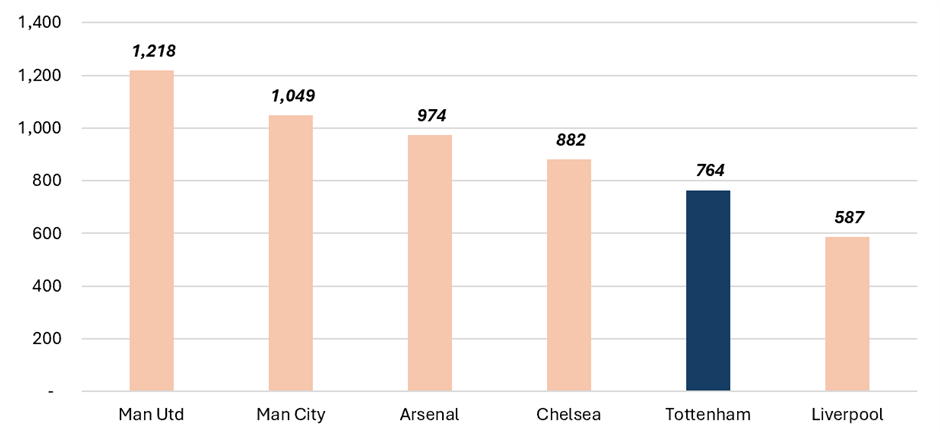
Source: Transfermarkt

The reality though, is that Tottenham even now are still trying to make up for the underspend of the last decade or more. To understand exactly how much – and to gauge how much more reasonably needs to be spent, we need to peel back the layers of the figures. For these, I will stick to just the four clubs that are run properly: Arsenal, Liverpool and Man Utd as well as Tottenham (Man City and Chelsea have an entirely different business model and financial base, rendering comparisons pointless).

There are three methodological concepts needed to establish a good comparison between these clubs and I will go through each of them step by step.

Gross spend, not net spend

First, let us deal with the frequently cited concept of ‘net spend’. The reason this idea comes up is that it reflects the financial model used in computer games like Football Manager (or, if you are older, Championship Manager). In this, player purchases and sales are hard numbers coming out of a bank account, the same way that you might spend your pocket money.

However, this is not how football transfers work from a financial perspective: fees are deferred over a period of months and even years; much of it is shuffled off into working capital rather than coming out of cash (which can be funded by debt facilities); and it actually excludes cash costs such as agent fees and signing bonuses which can be substantial. More importantly, net spend is netted off against player sales, which are an entirely different business requiring different skills.

‘Net spend’ (like real GDP) is a terrible metric which has taken over as a short hand for investment. Instead, a club’s ambitions in the transfer market are really to be measured by its outgoings only (‘gross spend’) since it has far less agency over its incomings. Yes, clubs wait to offload players before signing others – but this is mainly a question of managing salaries, less about transfer fees.

Big Six gross spend since 2015-2025
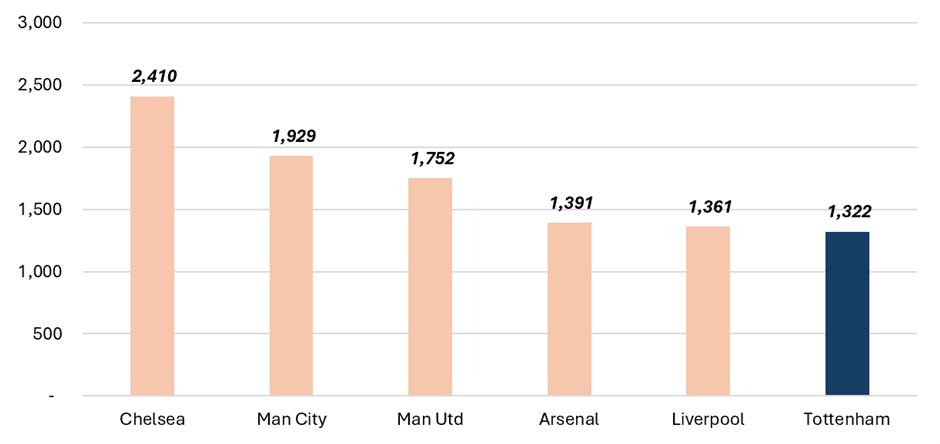
Source: Transfermarkt

Judged just on this measure, Tottenham are more clearly at the back of the pack, albeit not far behind Arsenal and Liverpool. But this is only the start of the story.

‘Big player’ spend, not overall spend

Secondly, not all player signings are the same. While from a financial perspective, a £50m player has ‘cost’ almost twice as much as two £30m players, this is not the footballing reality. Most fans will understand that the £50m player will be far more likely to important than the two £30m players combined, at least in the near term. The market suggests that they are better, they are more likely to be going straight into the first team, and they are also likely to be paid much more. Player value to the team increases exponentially as fees go up, so one simple way of looking at it is to square the transfer fee to calculate relative value: the square of two £30m is about 72% of the value of the square of one £50m player. We are into the realms of pure vibes here, but most observers would feel that this is about right. This quadratic application, re-based to a £100m transfer fee, might look like this:

The likely ‘true value’ of transfer fees
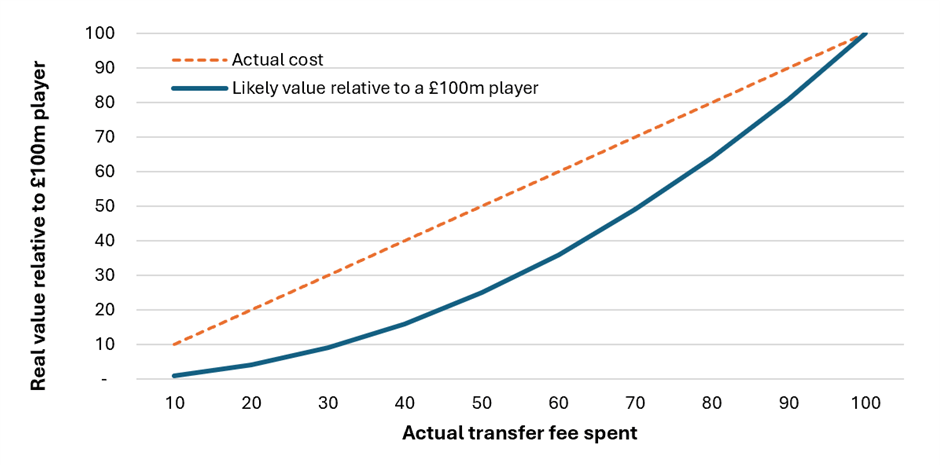
Notes: illustrative value curve assuming that £100m transfer fee = 1, ie that you get what you pay for, and therefore all other priced players are calculated relative to that – however one could choose any starting number

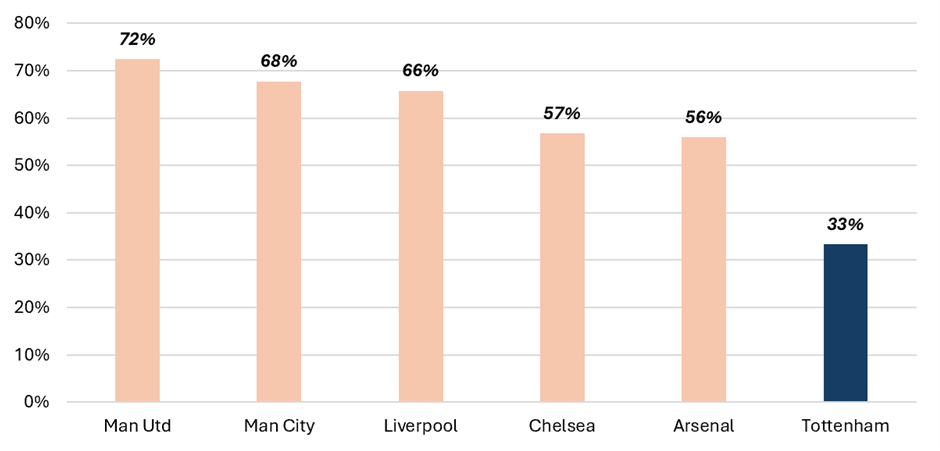
Therefore looking at spending on all players is less important than looking at spending on ‘big’, needle-moving players. One can debate what that cut-off means, but a reasonable rule of thumb is that players commanding fees of £50m or more, are generally the ones expected to play immediately and improve the first team, not just the squad. Additionally, the ‘big player’ threshold is a useful if imperfect proxy for how much a club is paying them, too.

Percentage of gross spend used on transfer fees of £50m or more, 2015-2025
Source: Transfermarkt

The problem is clear: while Tottenham have spent a fair amount of money on transfers, its spending on ‘big players’ has been severely lacking. Instead Spurs have brought in dozens of at best squad-level players (and many probably not even that). Of all the Big Six teams, Tottenham’s portion of £50m is the most off-kilter, showing a real problem of ambition.

Today’s money

Next is the matter of football inflation, which I have dealt with previously. If we look back at, say, a decade of spending by Tottenham, we cannot treat every year the same since player prices have gone up. Tottenham did up their spending in recent years, but by then the money did not mean the same. Xavi Simons cost £52m in the summer of 2025, but the same amount spent on Aymeric Laporte by Man City in 2017 was clearly a lot more in real terms. In order to compare apples to apples, we therefore need to adjust fees for inflation.

Taking into account the £50m number as the needle-moving transfer fee, and looking back, this number reduces over the course of the last decade such as £50m in 2026 is about £41m in 2021 and £36m in 2016. Therefore, to compare real spending, we have to look at ‘big players’ in today’s money.

What £50m looked like in money of the day, since 1992
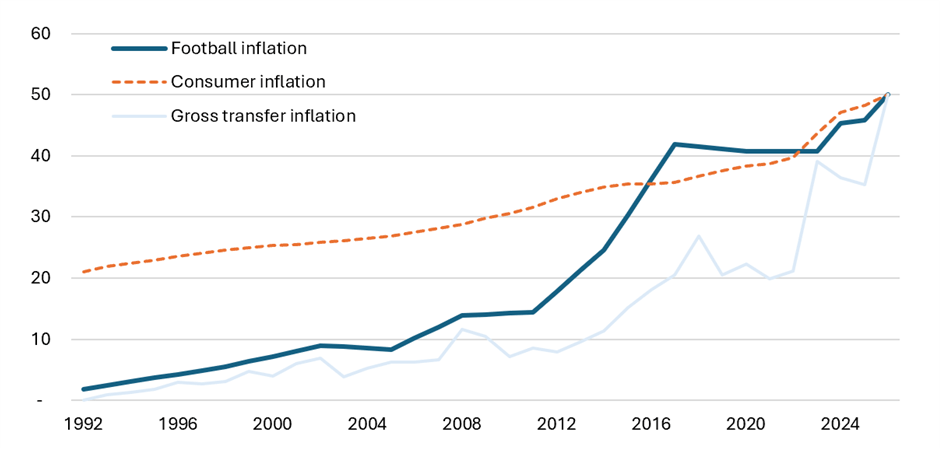
Notes: Football inflation calculated based on value of TV rights as per previous blog. For completeness, the implied inflation based on total Premier League actual gross spend annually since 1992 is also included, which has a 0.92 correlation with TV rights inflation but is more volatile and I feel less indicative of club management forward views affecting player prices. CPI from ONS.

Tottenham’s spending deficit

Until this summer, then, and even with the wallet being unleashed a little under Levy’s last window in charge, Tottenham over the last decade has underspent the rest of the Big Six by some £850m on average. To even catch up with the nearest spending rival, Arsenal, Spurs needed to spend more than £400m; but to catch up to, say, Manchester City, they needed not much over £1.1bn of new players. (I leave Chelsea out of this conversation for now simply because their business model under the current ownership is not the same.)

Big Six gross spend on players worth £50+ in today’s money 2015-2025 (£m)
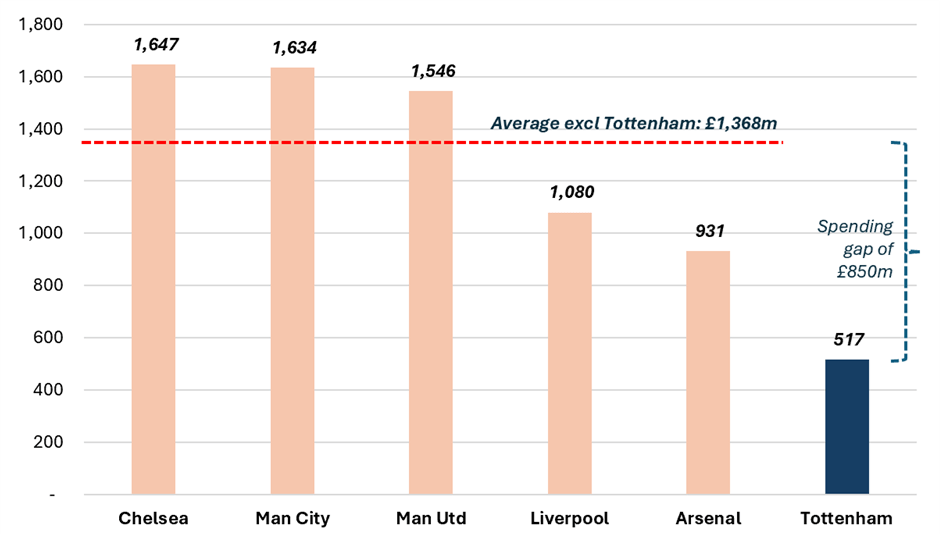
Source: Transfermarkt with inflation adjustments, full numbers below

To do this is tricky. First, it is impossible to spend so much in one transfer window at all, let alone do so without creating artificial price inflation because everyone knows you are doing so. Secondly, the figure shifts since the other teams are themselves spending more – Tottenham’s catch up spending needs to be net of new spending from the other clubs this summer. Lastly there is the softer elements, for instance how well Tottenham’s scouting and player assessment is compared to clubs which have been better run for so much longer, and whose infrastructure has been maturing for a decade. Tottenham struggle with both value and quality in trying to make up for lost time, as any club would under these circumstances.
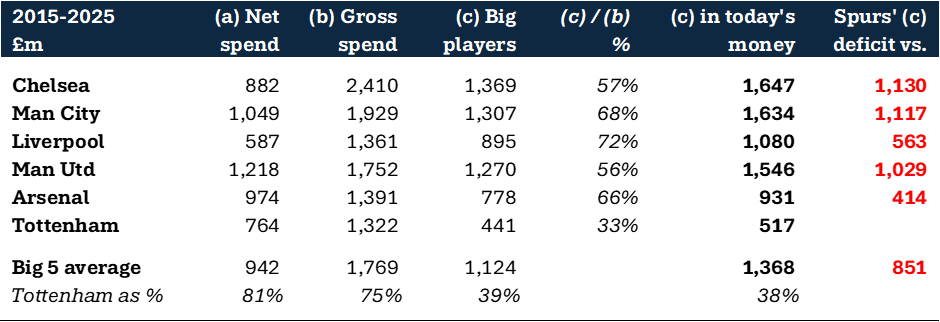
So yes, Tottenham are taking the requisite steps to make up for a lost decade of transfer activity. While we would all love to believe that success on the field could come from elsewhere, it is impossible to maintain a ‘Top Six’ status without spending being broadly in-line with the others. And while we can be very excited about the £300m+ invested this summer, this does not even put us top of the Big Six (Chelsea’s gross spend is almost £400m). There is still a long, long road ahead before we make up for the lost time relying on a few over-performers such as Kane and Son. Whether the Lewis family can maintain the appetite for this, is anybody’s guess.

Are transfer fees really more expensive? Not really.

While nominal spending is getting higher and higher, clubs are actually getting players cheaper than ever

The voice of sanity

“Transfer fees have gone crazy”, according to those eternal barometers of sanity, TalkSport listeners, as they react to the transfers this summer of Morgan Rogers (£117m to Chelsea), Elliot Anderson (£116m to Man City) and even Sandro Tonali (up to £100m to Tottenham), not to mention Izak and Wirtz to Liverpool last summer. And in a sense, fees do seem to have picked up, given that the record was not broken for 7 seasons between the signing of Paul Pogba by Man Utd in 2016, and the arrival of Enzo Fernandez to Chelsea in 2023. Since then, transfer fees of over £100m have come thick and fast, leading to charges of inflation and insanity.

However people should remember that transfer fee inflation has been a fact of life since the beginning of football. Moreover, football inflation is not the same as CPI, ie the price of a pint of milk; rather it reflects the increasing amount of money coming into the game. To that end, I am updating my proprietary transfer fee inflator index, last written about almost a decade ago. As the data demonstrates, transfer fees today still pale in comparison to some of the biggest deals signed in the past.

There are a few other calculators floating around – for instance here, here and here – but none of them are satisfactory for me. For a start most do not seem to start earlier than 2000, which leaves out a lot of Premier League inflation. Secondly the Kieran Maguire index, which seems to produce reasonable results, rebases to 2019 cost of money and also there are no details that I can find on the calculation.

A recap on my methodology: since inflation is a function of supply and demand, I have based my inflator on the total Premier League TV rights money each year. The biggest change since my last post on this subject is the inclusion of overseas rights into the calculation, the value of which overtook UK domestic rights for the first time in 2023 (for those sad enough to be interested, I include a complete set of data in the appendices). Using the growth of the TV rights money as base line inflation, I then adjust transfer fees accordingly to reflect what their true cost was compared to TV income of the day. It is not perfect, but it is as good a proxy as I can think of to find a measure of ‘football inflation’ rather than normal consumer inflation.

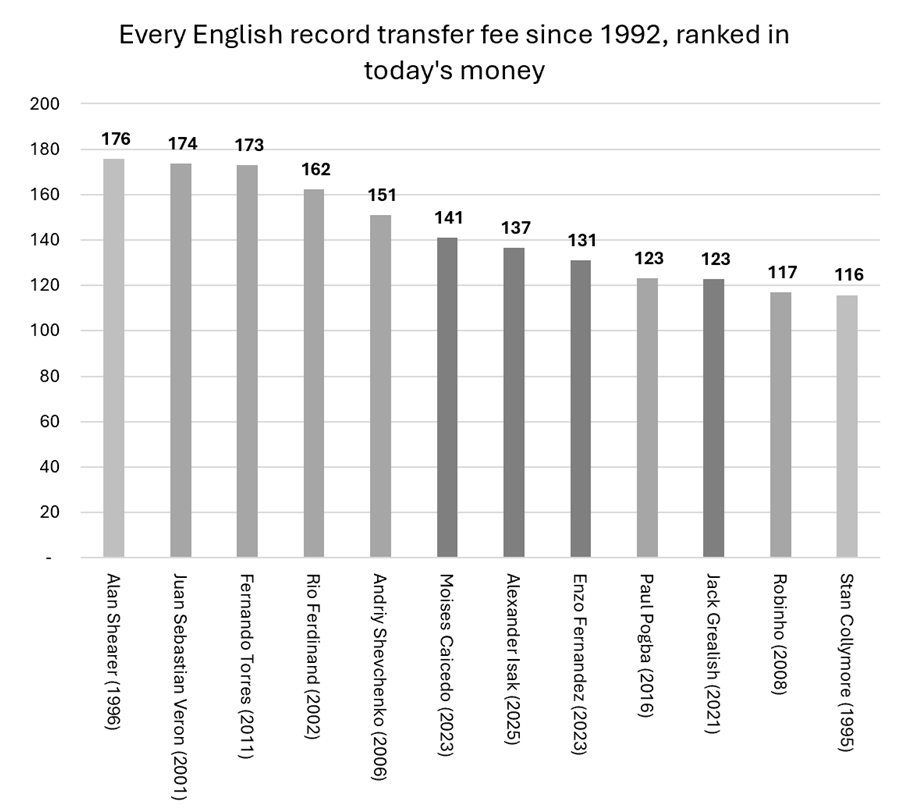
Note: Shading reflects recency

The results speak for themselves. The most expensive transfers in Premier League history, have far outstripped recent deals in ‘today’s money’. Alan Shearer’s £15m transfer to Newcastle in 1995 is about £176m in modern terms, substantially higher than any of the sums being paid this year. Likewise the transfers of Veron in 2001 and most amusingly, Fernando Torres in 2011, which come in close behind. Incidentally Alan Shearer’s first transfer, from Southampton to Blackburn in 1992, falls just out of scope but probably comes in at around the £100m mark too. At these prices, Elliott Anderson or Tonali look cheap as chips by historical standards.

Furthermore, the reverse is also true. The £100m player of today is actually the £25m player of 2010, or the £10m player of 1998, the dates between which I suspect the formative views on transfer fees for many readers (and TalkSport listeners) was set. Certainly these historical numbers account for the reluctance of Daniel Levy or Arsène Wenger, and other ‘old men’ of football, to reject the pricing they saw in the market later on in their careers. They had become antiquated, with the only response that the market was “madness”.

How then, one might ask, do English clubs compare to their European counterparts? It is difficult to make an apples-to-apples comparison, since European TV money has not matched that of the Premier League for a couple of decades now; additionally their earning streams (particularly for Real Madrid and Barcelona) are not structured in the same way as English clubs. For the sake of a completeness, I have calculated what European transfer fees look like in today’s money based on English football inflation, in the appendix. However I do not believe this is an accurate way of looking at it.

A better way to understand what top European transfer fees have been is simply to compare transfer records in Europe vs England to the closest possible point in time. Using this method, we can see that in general, European clubs have committed to much higher headline prices than English clubs typically have – albeit these are driven by only a few clubs.

Note: Euro-sterling exchange rate using average of June-July in each relevant year; where possible, same year transfers have been used but where not, the English transfer used is one year preceding

Gianluigi Lentini’s move from Torino to Capello’s AC Milan in 1992, for instance, was truly a shock to the world in 1992, at almost £13m. It was 3.6 times the highest amount paid in England at that time, which was Alan Shearer’s transfer to Blackburn. Shearer’s next move, to Newcastle, was the closest England has had to a record, benchmarking close to Ronaldo’s record jump from Barcelona to Inter a year later. By the time the next headline was being made in England, with Veron’s purchase by Man Utd in 2002, Zidane was shuffling over to Real for close on twice the amount of money – indeed the Veron fee weighed in at less than that of Figo the year before (£38m), and Christian Vieri three years earlier (£32m).

Since that time, English clubs have actually spent conspicuously less at the top end of fees, even as they have powered to more overall spending. Nobody has come close to matching Neymar’s almost £200m move to PSG for instance, way back from the pre-Covid years. It seems unlikely they will do so any time soon. As a side note, the history of transfer records stands as a real testimony to the shifting fortunes of financial leadership in European football. In the 1990s, records were all set by Serie A; by the 2000s, this was now being set by the two Spanish giants; and in the years before Covid, PSG alone set records – not only the €222m for Neymar but also the €180m spent on Mbappe.

Note: exchange rate same as above; all transfer records have been included

In summary, while headline numbers continue to increase, in the context of club TV money the transfer fees of today are actually quite modest. £100m is the new normal for key players and this is less than was paid for many stars in the last three decades – fees are higher but they aren’t more expensive. English clubs have still never hit the astronomical heights that European counterparts have, either. So lament crazy prices by all means – but we have not really seen anything crazy, unless you want to make the case that Elliot Anderson is not as good a midfielder as Juan Sebastian Veron.

Appendices

1. Comprehensive transfer fee inflation model

Note: multiple and discount factor are derived from each new TV deal, announced in nominal terms, interpolated between the relevant years; Premier League domestic TV money peaked with the 2017-2020 deal, but still grew factoring in foreign rights. To use the table, take any historical transfer fee and its year, and multiply it in order to see the price in today’s money. Or in reverse, take a transfer fee of today, to see what its equivalent number was back when you were young.

2. Evolution of the European transfer record since 1992 (nominal top, re-based to Premier League inflation bottom)

Spain leads football innovation off the field, not just on it

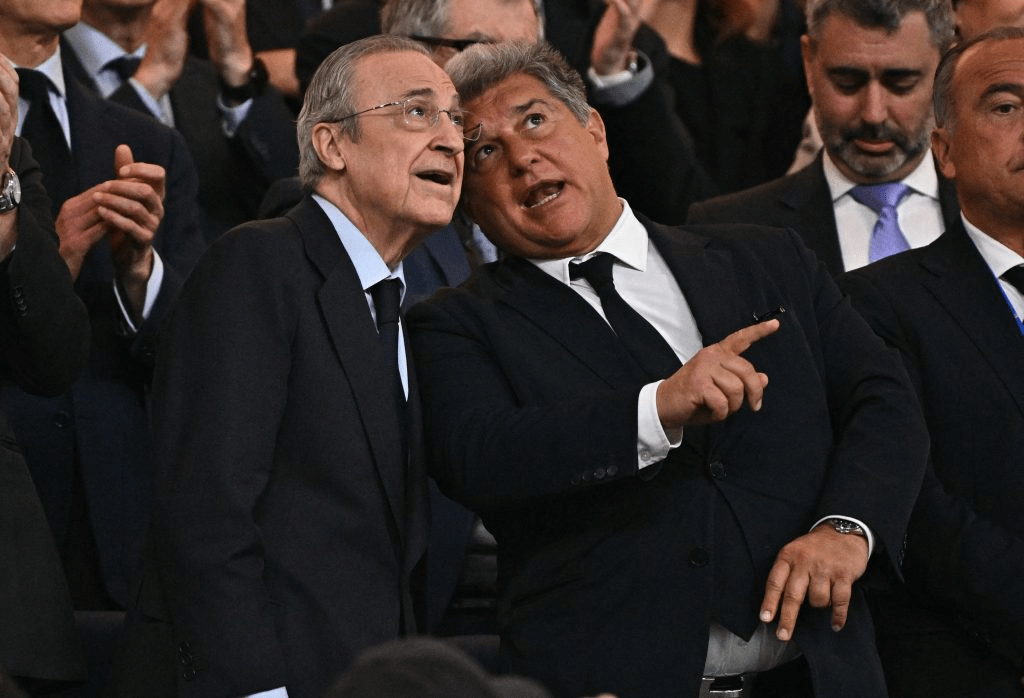
Given the dominance of Real Madrid and Barcelona on La Liga, and the importance of men like Florentino Perez in European football discourse, the outside observer would be forgiven for overlooking the role of the governing bodies. After all, surely the biggest clubs – which vastly overshadow their domestic peers in a way that does not happen in the Premier League – call the shots?

But surprisingly, the Spanish football federation has not only frequently come out on top against their biggest club members, but has also been a historical pioneer in football governance in a way which has set the agenda across the continent.

Transfer windows

In 1995, La Liga instituted the first modern restrictions on player trading, allowing changes of club only during a long summer break and a shorter winter slot. Strange to think, that across Europe until then, all major leagues allowed unlimited transfers until each of their deadline days – end of January for Italy, February in Germany and France and absurdly the 31 March in England, mere weeks before the season ended. At the time, transfer windows were designed to protect smaller clubs by not allowing Real or Barca to take their rivals’ best players mid-campaign, and Spain even prevented mid-season moves if a player had already played 5 matches for their club. FIFA then went on to adopt this system wholesale, bringing cross-border alignment to all leagues by 2002 to the system we know today.

If no Spain, then no Harry Redknapp hanging out of his car window on transfer deadline days

Buyout clauses

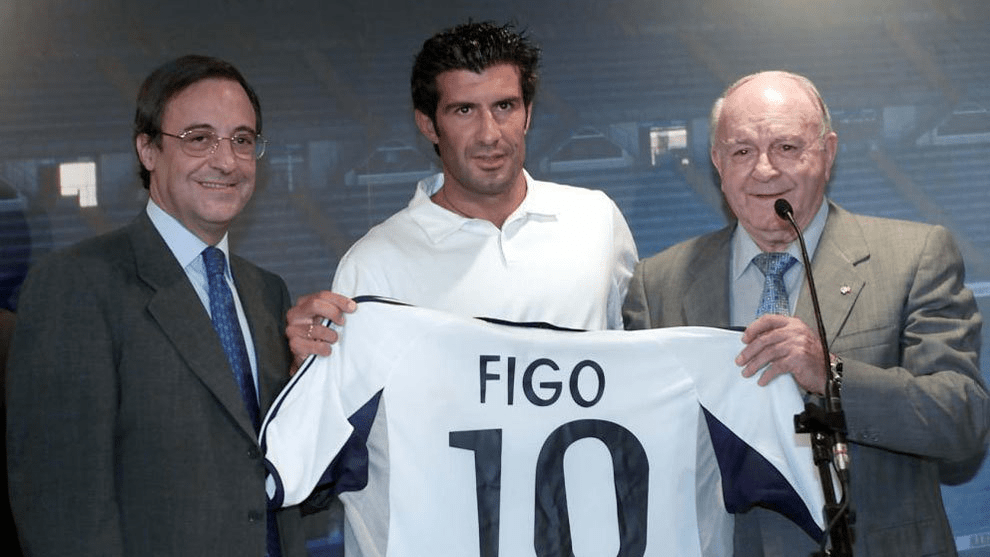
By the time of the Bosman ruling in 1995, Spain already had a system of buyout clauses described by World Soccer magazine, amongst others, as “positively futuristic”. In fact though, Spain had laid the groundwork for this a decade earlier when they actually had their own version of Bosman, leading to the Royal Decree 1006 which freed players to break contracts with their clubs. Clubs in turn responded by introducing the buyout clause – the difference with today being that the buying club actually gave the transfer value to the players themselves, who in turn paid their employer out and became a free agent. The most (in)famous example of this in action was Figo’s transfer from Barcelona to Real Madrid in 2000 for an astronomical €61m. Since that time, clubs around Europe began to normalise such clauses such that they are now commonplace.

Figo celebrating a victory for players’ rights

Image rights

In response to a change in the taxation rules in 1996, Spanish clubs began to split player compensation into two parts: salary and the use of image rights. This was revolutionary in two ways: first, it helped create a new world of tax avoidance which spread to most other leagues; secondly, it focused marketing attention on the image rights portion of football. Marketing agencies began to specialise in this segment which in turn changed the way the advertising industry used football. Image rights became a major political issue under Florentino Perez’s first Galacticos stint, but by then the Premier League and others had already taken up the baton. The reductio ad absurdum of this arrived through incidents such as Paulo Dybala’s transfer to England falling through in 2019 due to his image rights being sold and owned to third parties. At a club level, Barcelona’s rescue package in 2023, where they sold 25% of their future TV rights, is in some ways a continuation of this.

Salary caps

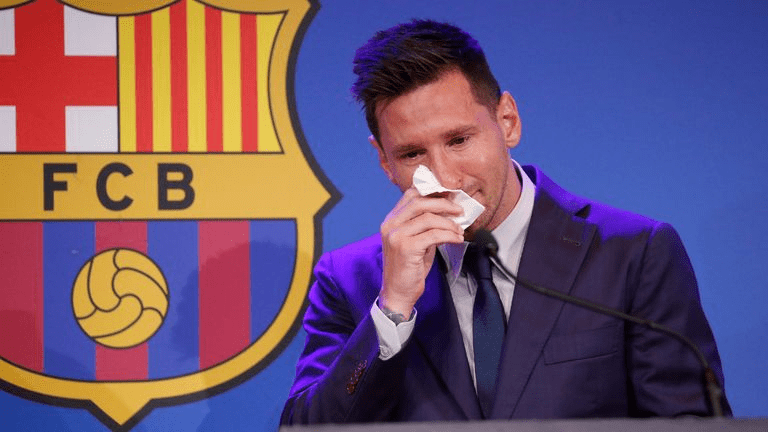
Before the coming of FFP in Europe, and then PSR and now SCR in England, Spain already developed a (seemingly quite heavy-handed) scheme for cost controls. Taking inspiration from US sports franchising, La Liga implemented a total squad salary cap from 2013 onwards, after several years where smaller clubs had come a cropper in the 2000s trying to chase down Real Madrid’s Galactico model. Many of them, moreover, were incurring ever greater debts to still buy players, while owing money on transfers and even wages to the current squad. In order to protect socio-owned clubs from themselves, La Liga actively calculated budgets and prevented new signings from being registered, a personal project from autocratic president Javier Tebas. The most high profile outcome of this was Barcelona’s inability to re-sign Lionel Messi – who was actually still at the club – on to a new contract in the summer of 2021 and hence pushing him out to PSG. Certainly not a case of the big clubs holding the system to ransom.

Messi lamenting the financial austerity only La Liga understood

Neutral venue matches

To be fair, in this area the Premier League did technically start earlier through its “39th Week” proposal in 2008, where the idea was to create an entire new round of fixtures to be played in various venues worldwide. However they backed down on it fairly quickly, where ten years later in 2018 Tebas (yes, it be he again) not only signed a new sports rights deal with Relevant Sports but went as far as to organise the Girona vs Barcelona fixture in Miami, scheduled for January 2019. While both clubs agreed to it, pressure from RFEF, UEFA and FIFA caused Tebas to back down – only for Relevant Sports to bring the lawsuits which forced UEFA itself to finally capitulate in 2025. Matches abroad are now permissible, all thanks to Spain.

Not only that, but Spain has been proactive in wanting to host others. The best example was Spain jumping at the chance to own the 2018 Libertadores Cup replay in Madrid between Boca Juniors and River Plate, after violence prevented the original fixture. However even further back, Spain offered to host everyone from Yugoslavian refugees Red Star Belgrade during their civil war, through to a number of Champions League matches during the height of Covid (not the final mini tournament, but several quarter-finals when logistics were much less sure).

Creation of a breakaway big money league

The most historical example of Spanish innovation is the creation of a more commercially orientated league setup, in anticpation of forthcoming revenues such as television rights. Spanish clubs broke away from the RFEF to form La Liga all the way back in 1984, a decade earlier than the Premier League. While in some respects, this act was as reminiscent of the Football League creation in 1888 as anything else, the similarities with more recent examples is the focus on commercialisation (the FA / Football League split was a contest over professionalisation vs amateurism as much as anything). La Liga was followed not only by the Premier League in 1992, but also the Bundesliga (2001), Serie A (2010) and the Ligue 1 (2022).

A side spur of this is the whole Superleague question. La Liga and the RFEF of course vociferously fought the idea of the Superleague, but ironically the culture of La Liga is what first set Real Madrid and Barcelona off on that direction alongside Juventus. And strange though it sounds to English or German ears, the idea of the Superleague is nowhere near as unpopular in Spain as it has been elsewhere, because the long-term culture to try new things has been cultivated over decades.

Championing employees and fans

*******

There are numerous reasons why Spain has always been so innovative in football governance. Some of this is deeplying in the legal and corporate culture of the country, including the focus on labour law post the Franco regime and the relatively litigious nature of the economy. Some of it has been driven by individuals such as Tebas or Perez. Above all though, Spanish football has always kept a weary eye on its place in the competitive landscape, particularly with regards Italy in the 1990s and then England since the 2000s. The authorites recognise the marketing strength of the big clubs, but also know that the whole product has to be sustainable in order to leverage that reach.

UEFA has headed off the Superleague for now, but the instincts which that proposal embodied – the innovative, the commercial, the litigious – had its roots mainly in Spain. And while the Premier League leads in revenues and sponsorship deals, it seems very likely that the next wave of innovations around governance will come once again from Spain. Ex Hispania semper aliquid novi, as Pliny might have said.

Postecoglou really does have a philosophy – you just don’t understand it

And you might not actually like it if you did

One of the most curious things about Postecoglou’s tenure at Spurs is how little observers seem to actually comprehend what he is saying. In turn, this leads to not really understanding what he is doing, either. This blog should not come across as just trying to defend Ange against the grain of results like this last weekend at Newcastle; but I think it is worth trying to at least understand what he says, in order to either agree or disagree with it.

So let us start with the background of recent comments Ange made about fourth place. He has, of course, made comments allowing us to interpret all sorts of things, such as “let them dream” and “if I’m not mistaken, we are three points off the top”. With regards to the Champions League places, his exact words were as follows:

“I don’t see fourth as the prize. I don’t want to finish fourth if we haven’t grown and developed as a team. Part of the narrative is to push you in these kinds of positions where you think that fourth is some kind of achievement that gives you something for next year.”

“Fourth would be great if I feel like we’re growing as a team, and we’re creating something that is going to bring us success next year. But fourth is not our goal… If we finish fifth, and if I think we’ve got a team to challenge next year, then I won’t be disappointed.”

MSN et al

As mentioned, this led to bemusement and incredulity at both ends of the spectrum, oddly enough. Critics inferred that by saying this, he was releasing himself from any accountability over finishing fourth and getting the club into the Champions League. Proponents went the other way, telling us that he was saying that fourth is no ceiling, and we should be aiming higher than that (Maddison unhelpfully made similar comments this week).

Maybe this confusion reflects the intellect of the average commentator, but the likes of Dan Kilpatrick and Jack Pitt-Brooke need to be told that Ange is saying neither of these two things. He was alluding to some very some basic points:

  1. There is no prize in football other than winning. Any place below 1st is still a failure and trying to moderate how much of a failure you are by distinguishing between 2nd, 4th or 5th is sophistry designed to make supporters feel better.
  2. The nuance of exactly where you finish, especially when it is below first, do not tell the story he is bothered with. Excluding the exogenous factor of Champions League financial income, there is little which indicates that the team in fourth is somehow better, or on a more positive trajectory, than the team in fifth.

It is not so much that the league table lies, it is that for a ‘project manager’ the table is irrelevant as a measure of progress. The only measure of progress is … progress. And progress is not defined by the noise of individual performances (like yesterday), or where you are in the table. It is about what you see and feel when you watch the team play every week. “Are we a better team than before? Yes, or no?”

And this brings us to the broader issue of Angeball philosophy**. This way of thinking, much more than the tactical use of inverted fullbacks, that Postecoglou is similar to Guardiola and Bielsa and some others. Because like it or not, the idea is that games aren’t a managed period of 100 minutes with beginning, middle and end; they should be a steady and constant stream of football. The blowing of the whistle signalling the end of one match or the beginning of another are merely inconveniently imposed breaks in an ongoing flow of action and implementation of the manager’s tactics and ‘plays’.

This was most clearly expressed when he noted that he didn’t want his teams being dictated to by the minutes on the clock or the score line. You don’t try and win things during certain parts of the game and sit back for others. You don’t react to ‘game state’. Every minute is just another minute of Angeball, trying to score goals, and it doesn’t matter who your opponent is or what the score is. It doesn’t even matter who you have on the pitch.

And this brings us to the increasing clamour regarding a need for a ‘Plan B’. Advocates of this are truly not understanding Ange, particularly when they start sentences with “I get what he’s trying to do, but … “. As far as Ange is concerned, the whole of this season is one long practice session. Changing things up tactically to win individual matches is all well and good, but is more or less just a waste of valuable match minutes where they should be practicing Plan A against real opposition. A match won through tactical changes is a match wasted. There is no Plan B – at least, not until every member of the squad has so internalised Angeball that he can finally look beyond it.

Guardiola pioneered this rather robotic nature of football, and with the likes of Messi in his team he was able to win La Liga titles and the occasional Champions League (though of course it was often noted that he ‘underperformed’ in the latter and “should have won more”). But the point was that every minute of a Guardiola team is another clean slate of Guardiola football, not an emotive reaction to events on the field. The end of a game against Burnley should be seamless with the beginning of the next match against Bayern. Details are mere noise.

This all being true, Spurs fans are arguably even more entitled to be more concerned about things currently, not less. As I said, I am not writing to defend Ange per se. The real question is whether Tottenham will ever invest in the squad to such an extent that they can reach a zen state of high quality football, inhuman and unsentimental. I have noted more than a few times that our squad is way, way off that level, and in the meantime the disparity between philosopher and the pragmatist is starker than ever.

Fans want to take every game as it comes. Fans see some games as more important to win than others. I’m sorry to tell you, that Ange Postecoglou – and for that Guardiola – just doesn’t agree with you.

** A previous post discussed football managers in the context of empiricism vs rationalism. Postecoglou is undoubtedly a rationalist, in the vein of great project managers such as Guardiola and even Pochettino. In philosophical terms, he is perhaps the Parmenides battling, in the current landscape, against the Heraclitus of Unai Emery. Arguably, to reach the top he will end up needing to reconcile both and eventually become the Democritus of English football.

Why the Tottenham penalties were correct – and why Liverpool fans are whingers

Kane Klopp

Liverpool fans have always been rather an irritating lot. The combination of hubris and inconsistency, as well as constant bleating about “heritage” and history as though somehow this renders the modern success of rivals such as the Manchester clubs less worthy, lead to popular conceptions of this group as probably the fan base other fans most love to hate – “football supporters think you are either tiresome, cringeworthy or both.”

So it has been particularly enjoyable not only to watch the draw that Spurs battled to in front of the Kop last weekend, but also the whingeing that poured through social media in its aftermath from fans, players and manager alike. Other than maybe Barcelona, few football supporters come at things from such a moral high horse and, as with Barcelona it is great to see them get their comeuppance once in a while. Come to think of it, maybe that’s why all their players end up moving there.

Therefore let us examine forensically the two controversial incidents from the match, through some of the most common refrained heard from excitable Liverpool fans in the few days since.

1. “Kane was offside the moment Dele passed the ball”

The implication of this is that the moment the ball left Dele’s foot, the referee should have blown for an offside against Tottenham. This is simply factually wrong and demonstrates a lack of understanding about the offside rule and even Klopp was guilty of this mischief in his post-match press conference where he said:

“… there is a new rule, I don’t know exactly? I don’t know who played the pass but in the moment the ball left the foot of the Tottenham player, Harry Kane is offside.”

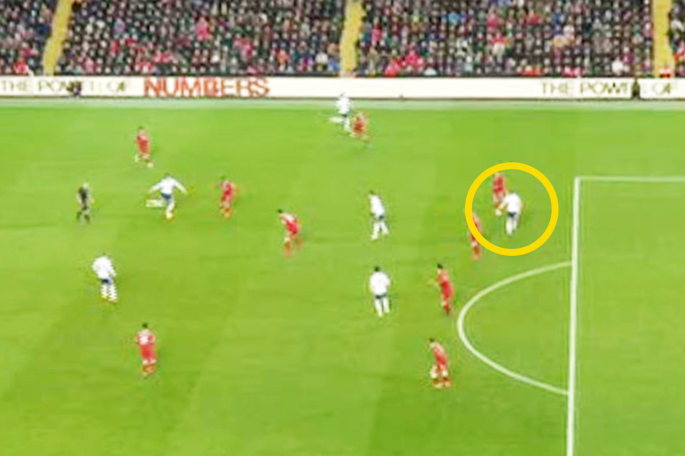
It is true that Kane was in an offside position when the ball was passed, but this is not the same as actually being offside. For the latter to be the case, Kane actually has to play the ball – in other words, had the ball not come off a Liverpool player, Kane would only be offside at the point when he received the pass and played. There is absolutely no requirement of the referee to call an offside before this point and it would be wrong to do so – players are constantly in offside positions through the match, which is why the rule was clarified to only include situations where a player in an offside position is “interfering with play”, and why today players who are in an offside position but not anywhere near the ball are not called for offside.

Kane offside

(Incidentally Klopp should know better and actually gets away with murder in a lot of his post-match comments, but let’s leave that for another day.)

Case for Liverpool: 1/10

2. “Kane was interfering with play at the point when the pass was made”

This charge has slightly more legs, but only slightly. Clearly, Kane is in an offside position but the referee deemed him not interfering with play. These are the situations which come down to referee’s opinions and it seems questionable to assume that Lovren necessarily struck the ball because of an awareness of Kane being behind his shoulder. If you look at the replay, Lovren seems to be all over the place and there is more than enough space for the referee’s opinion to be that Lovren played the ball purely because that was his instinct, not because of any perceived goal-side threat. In such situations one assumes that a seasoned referee’s opinion and read is as good as anyone’s – certainly VAR would not have resolved this question one way or another.

Case for Liverpool: 4/10

3. “Lovren was not playing the ball on purpose”

 At this point we have to accept that after the pass commenced from Dele, it ended up being (mis)played by Lovren and quite possibly by another Liverpool player also, first. Therefore the question is whether Lovren played the ball on purpose as per the official rules on exemptions for offside, which state:

“A player in an offside position receiving the ball from an opponent who deliberately plays the ball (except from a deliberate save by an opponent) is not considered to have gained an advantage.”

First, let us be clear that the purpose of this wording is designed to make sure that this exemption does not apply to completely accidental deflections and rebounds, the kinds of things where a ball hits the back of someone’s head inadvertently and so on. It is not supposed to cause a nuanced consideration of how professional footballers at the top level play.

In this situation Lovren clearly went to strike the ball and, due to being a simply terrible footballer (as we saw at Wembley earlier in the season), mis-kicked it. It was not an inadvertent deflection, just a crap piece of play. As such, it takes quite contorted logic to try and make the case that the exemption does not apply. Yes, it does not fall under the initially intended rule designed to exempt offsides from back-passes, but yes it falls under the strict laws of the game – the ball did not continue towards the Liverpool goal due to an accident.

Leaving this to the Professional Game Match Officials Limited (PGMOL) in their official statement, it seems pretty clear:

“The interpretation of “deliberately” kicking a ball considers whether a player has intentionally tried to kick a ball – it does not consider whether the ball ends up where a player may have wanted to kick it.”

Case for Liverpool: 3/10

 4. “Kane dived for the penalty”

Now onto the meat and drink of the incidents. Subsequent to the event, Kane has both admitted that he drew the contact, whilst Karius – and this is quite important – admitted that contact was made. In these circumstances, under the current refereeing environment, any challenge which a goalkeeper makes where they fail to get the ball is a poor challenge. To be clear, any time where a goalkeeper comes for a ball and fails to do so properly, leaves them exposed by definition to having committed a bad challenge – the very definition of a foul.

As that well-known Tottenham fan Jamie Carragher said on Monday Night Football (focusing principally on a similar incident involving Delafeu and Courtois):

“When goalkeepers come out like a train, like he has – like Karius has – I’ve got no sympathy whatsoever. If he’s complaining about it, don’t come out like a lunatic … It was a poor decision to come out; Karius’ was as well. If there is a problem with attackers leaving their legs in there, then goalkeepers need to do something different.”

My mind harks back to last season’s FA Cup semi-final between Tottenham and Chelsea, when Son’s mistimed sliding tackle gave away a penalty in much the same situation. A goalkeeper who, in missing the ball when coming out for it, makes contact with an attacking player, has committed a foul as per the rules. End of.

Case for Liverpool: 2/10

5. “Jon Moss was not sure about the decision”

This charge is linked in part to the slightly bizarre moment when the referee appeared to ask the fourth official for extra information, then did not bother to pursue this line of enquiry. The BBC’s transcript of the conversation with the linesman did seem to indicate some confusion, but the PGMOL statement also seems to put this to rest, noting that the conversation over whether Lovren had touched the ball was misrepresented:

“Eddie Smart, having identified that Kane was in an offside position, correctly sought clarification on whether Dejan Lovren had deliberately played the ball. His question created some momentary confusion when Eddie asked if ‘Lovren’ had touched the ball. Moss knew a Liverpool player had touched the ball but not that it was Lovren.”

There was also some manufactured controversy over why Moss had asked the fourth official for anything when he was not entitled to do so since VAR was not in action, but this is quite a sideshow which Moss has in any case admitted was “misguided”. Importantly though, he followed through on his own original opinion, as he is supposed to do.

I hate to break the news to Liverpool fans but the vast majority of refereeing decisions in a match are matters of opinion. They are not only entitled to act on such opinions but are indeed paid to do so. It is perfectly obvious that in complicated situations, referees are not going to be 100% sure of what happened but their job is to go with their instinct and the point of a seasoned professional referee is that they get these things right most of the time – as they did in this case.

Case for Liverpool: does not even justify a response

6. “Lamela dived for the penalty”

More meat and drink. To be honest this incident has barely been even controversial amongst the commentariat and much of the initial reaction seemed to be due to poor camera angles about what had happened, possibly informed by lingering bias against “latin players” and their record in this. But a closer inspection, as was done on the BBC’s MOTD2, shows it was actually a pretty hefty kick up the backside by Van Dijk on Lamela, and as Mark Lawrenson (another well-known Tottenham fan) put it clearly there:

“Don’t get me wrong, Erik Lamela does extremely well and he’s very very clever. He just gets himself into a position where as Van Dijk is going to kick the ball he kicks the back of his leg, and yes that’s a penalty. Is that not a foul anywhere else on the pitch? So it’s a pen.”

The threshold Lawrenson describes is of course important: the rules a are specific in saying that there should be no higher or lower threshold for what constitutes a foul within the penalty box as outwith. Again, however clever Lamela has been in positioning, if Van Dijk had undertaken such a piece of contact on the half way line, it would have been given as a foul and a free kick. A poor challenge is a poor challenge anywhere. Not being intentional is not an excuse; nor is the fact that Lamela appeared to go down heavily (although again from certain angles the kick seems more substantial that it did at first anyway).

Frankly, if the first penalty had not caused so much furore it is doubtful that the second incident would really cause any controversy whatsoever. ESPN’s Ali Moreno was one of many commentators who felt it was bizarre that it was even being talked about; whilst on The Football Ramble’s Luke Moore noted that:

“… if Liverpool fans want to complain about that, I suggest they complain as well in turn about the VAR penalty they were awarded when Salah hit the ground like a ton of bricks with minimal contact, and that was overturned and awarded as a penalty.”

I am not fan of whataboutery, but glasshouses and stones comes to mind. The foul component of the kick on Lamela is pretty indisputable.

Case for Liverpool: 2/10

7. “Lamela was offside when Llorente played the ball”

Now we get to the least discussed point of the whole episode, but ironically the one with the most grounds for questioning. Looking at the evidence, Lamela is probably offside by the width of a human foot, so I will not argue otherwise. However in the overall scheme of things, this kind of decision is well within the typical margin of error in football matches at the highest level and the very fact that people have barely mentioned it speaks in part to an acceptance that small errors like this are not abnormal and typically even themselves out over the course of a season. If Liverpool fans really want to moan though, this is the part they have most grounds to.

Lamela offside

 Case for Liverpool: 5/10

******************

So much for the technical analysis. Now, far be it for me to let popular support influence how one views decisions, but it is worth looking at the professional commentators and punters, and their opinions of what went on. Clearly, the PGMOL has given its own opinion that Jon Moss was correct – although Liverpool fans have been heard to allege that “of course they will protect their own!”, cue much eye-rolling. But Dermott Gallagher, seasoned referee and watching in the Sky TV studios, said the same thing:

“In the debrief after the game, they’ll be told that they made the big, match-changing decisions correct on the day.”

I will be fair and note that Mark Clattenburg, another pundit through his column, disagreed. Let’s see what everyone else thinks – the “court of public opinion” as Harriet Harman would call it:

Picture1

Note: “LOTG” refers to the opinion that the decision was technically correct as per the laws of the game, but that the strict application of the laws in this case made a mockery of the spirit of the rules.

Overall, a case of all is fair in love and war …

Why Barcelona are still not learning their lesson

Messi sad

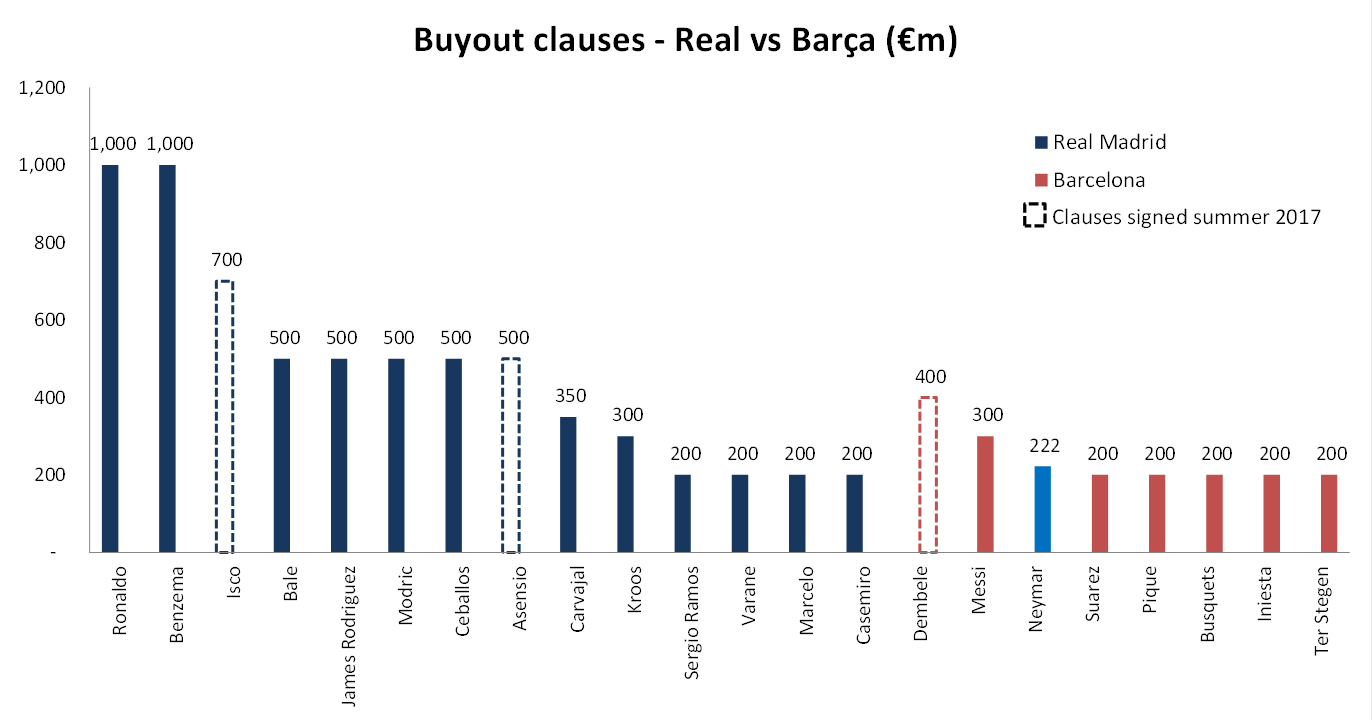
Ousmane Dembele has just arrived at Barcelona for a “club record fee” of €105m plus add-ons which could take the total paid to around €140m, far eclipsing even the official updated €86m paid for Neymar that the club had to admit to two years afterwards (although the real cost may still be somewhat higher, and we may never know). Whether Dembele can emulate his predecessor in footballing terms is anyone’s guess; but more intriguing is the fact that he may emulate the superstar as a future exit – curiously, Barcelona seem not to have learned their lesson and set a buyout clause of only €400m.

€400m may seem a lot, but this summer has shown that numbers we could barely believe have a habit of becoming reality; if TV revenues increase, the figure will not seem excessive. But in any case, and more importantly, it is already not very high in the world of preventative buyout clauses. If any proof be needed that Real Madrid are better run than Barça at the moment, it can be seen in the buyout clauses currently in place. Not only is Dembele’s price, their newest signing, still way below the sums set by their arch-rivals, but so are all the rest of the squad – by some distance, too. Eight of Real’s stars have clauses higher than Lionel Messi, the best player in the world. Suarez and Busquets look at snip at just €200m.

Real Barca transfers

Source: Gab Marcotti via ESPNFC.com, updated for Asensio, Isco and Dembele

Why have Barça been so remiss and what explains this imbalance? Well first, to be fair, the Barça squad is just that much worse than Real’s. Other than the MSN, most of the others have passed their Pique (lol) and their clauses were signed in another era. Having said that, Cristiano Ronaldo’s €1bn clause was set as long ago as 2015, a full year before Neymar (Barcelona’s youngest and most marketable star) was set at only €200m rising to €250m over three years. Is it perhaps that Barcelona do not have the pull to get players to agree to prohibitive buyout numbers? Or is the board still arrogant enough to believe that players go to Barcelona for its “philosophy”? Either way, it is a failing of their fiduciary duties which would be prosecutable under UK company law.

Furthermore, Barcelona really have encountered a perfect storm. The inflation in this year’s transfer window has hit them just as an irreplaceable star has gone. To be clear, buyout clauses work very differently from normal transfer fees in terms of distorting the market. This is because a normal fee is, these days, usually paid out over a number of years; so that a transfer fee of €222m might only be about €55m per year. The rest of the market (though not the idiot fans) will “know” that the extra money available to the club who has just sold their star asset is only €55m at that point. But with a buyout, the money arrives instantly, meaning that the market is aware of both an entire €222m overhang, as well as the necessity to frantically spend most of it on a replacement. Furthermore, buyout clauses are by their very nature “supernormal”, higher than market valuations. This means that in turn they are causing inflation above normal market values when the money is spent in turn. In other words, it is not just usual “football inflation” (see my previous) but a buyout-driven super inflation. Barcelona this summer have become a footballing version of Mansa Musa I.

Of course in today’s world, only a few clubs are true “buyers”: Real Madrid, who do so from their own resources, and then PSG and Man City, who do not. Barcelona have ultimately been left on the heap as just another “selling club”, the dreadful epithet that even Man Utd had to understand when they lost Ronaldo to Real all those years ago. Barça just have not learned their lesson.

Are transfer fees really exploding?

camp_nou_coreografia_mes_que_un_club

With Neymar’s transfer to PSG, the football media has moved from just excitable to the swooning and fainting associated with young Victorian debutantes laying eyes on returning officers of the Household Cavalry. The “world record” (we will get to this in a moment) has seen the football experts go into overdrive in trying to explain how it is that so much has been paid, and how it can be justified.

Among the more interesting commentators were the crew on last week’s Guardian Football podcast, specifically award-winning Jonathan Wilson who made a couple of insightful points. The first was the likening of the football transfer market not to the clichéd and overused Dutch tulipmania of the 17th century, but to a more subtle historical event that I had not heard of before, the Indian horse market of the same period. Although Wilson does not spell it out, the point here is not that best-in-class assets become expensive (Neymar for €222m is comprehensible); it is rather what Mourinho has been warning about, that mediocre asset prices get dragged up too and that is where things become unsustainable. In other words, the Man Utd’s of this world will always spend top dollar; the real danger is when Middlesbrough are doing the same.

The second intriguing point surrounds the role of Qatar in the Neymar move. Barcelona have for many years irritated a majority of neutral fans with their holier-than-thou attitude about all matters football. It does not take a hard-core royalist like myself to be sickened by the constant nonsense about being “mes que un club”, or the self-indulgent refusal to have a shirt sponsor for so many years. But recently, the club have taken to criticizing Qatar over the forthcoming World Cup – the very people they finally took their blood money from when the caved into for money. Was this criticism a result of failing to agree a new sponsorship deal? Was PSG’s bid for Neymar driven by a Qatari government keen to demonstrate they still had retaliatory power? Both, it seems, may be a firm “yes”. Well, it couldn’t have happened to nicer people …

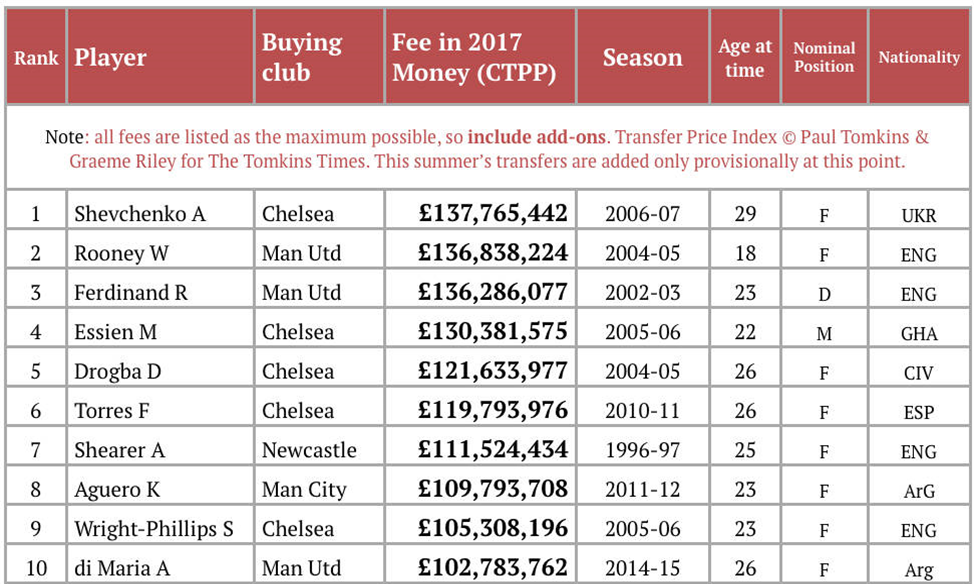
But really, how big a transfer fee is Neymar, anyway? Clearly a direct comparison of nominal fees is useless; so is a basic use of inflation to recalculate them. Only one analysis I have seen attempts to bring fees into historical perspective, the excellent Paul Tomkins’ blog. For the purposes of analyzing which transfers have had what impact, Tomkins and his team have used a form of “football inflation” based on average transfer prices from year to year, and inflating the nominal figures this way. Since football inflation has far outstripped CPI, this produces a top ten looking something like this:

Tomkins table

Source: https://tomkinstimes.com/2017/07/shock-transfers-now-cost-more-plus-top-100-signings-after-inflation/

Now, I like this approach. It has much to recommend it. However I believe it understates the impact of TV money on the psyche of football clubs – Tomkins’ analysis looks at correlation between the two but does not integrate them. I believe that – for the Premier League at least – another interesting way of looking at transfer prices is rebasing nominal transfer fees against the growth in TV deals. In my model, “inflation” is based entirely on the growth of TV deals struck over time (which have grown at an impressive 17.2% CAGR since 1992). In particular, I think this better reflects the thinking behind those headline-grabbing, record transfer deals as opposed to the median ones. The thesis being, that record transfers experience inflation different to normal transfers.

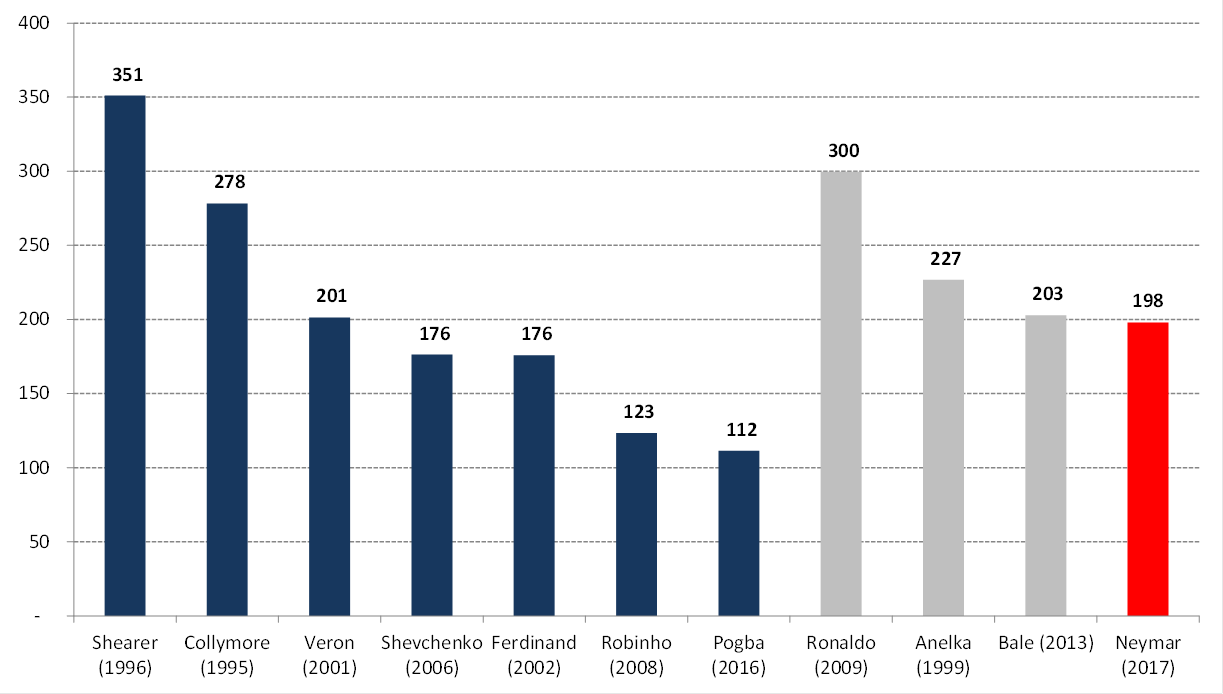
When this principle is applied – the Pang Index – the following numbers are generated:

Transfer records re-based to Premier League TV deal sizes

Football transfers

The blue bars represent record transfer fees paid by English clubs since the Premier League came into effect in today’s money. The grey bars were record transfers out of England (as it happens, all to Real Madrid). In this context, I have thrown in the Neymar transfer for fun. Of course this is not a perfect comparison – European clubs have very different TV deal structures and have not earned as much as English clubs have anyway; moreover the likes of PSG are barely “commercial” clubs at all these days, throwing the numbers out. Nonetheless, it makes some sense: Neymar’s fee is probably the same as a proportion of the kinds of TV money sloshing around as Veron’s transfer to Man Utd was all those years ago. No-one old enough to remember, can really be in doubt that Shearer’s £15m fee shocked us rather more than Neymar’s (let’s perhaps forget Stan Collymore for a moment).

The basic lesson is: money is here to stay; it is growing at a pace; but it makes surprises more and more difficult. Already this summer, there have been several moves rumoured to be in the same ballpark (£131m for a 31-year old Ronaldo, for instance). Actually, for the bigger clubs, it seems superstars are getting cheaper, not more expensive.

A squad of two halves – the drag from Tottenham’s wage structure

Tottenham NY Post

Frustrations are beginning to appear around my beloved Tottenham Hotspur. Obviously, we have yet to make any new signings, even as all around us in the top six have done so – including from us with Kyle Walker’s move to Man City. It is well known that we have a shortage of money compared with our rivals – the subject of a neat video produced by Joe Devine last year. But, there has also been much commentary about how Tottenham are struggling to find the right kind of players to fit into the squad – especially as “understudies” to key players like Harry Kane and Dele.

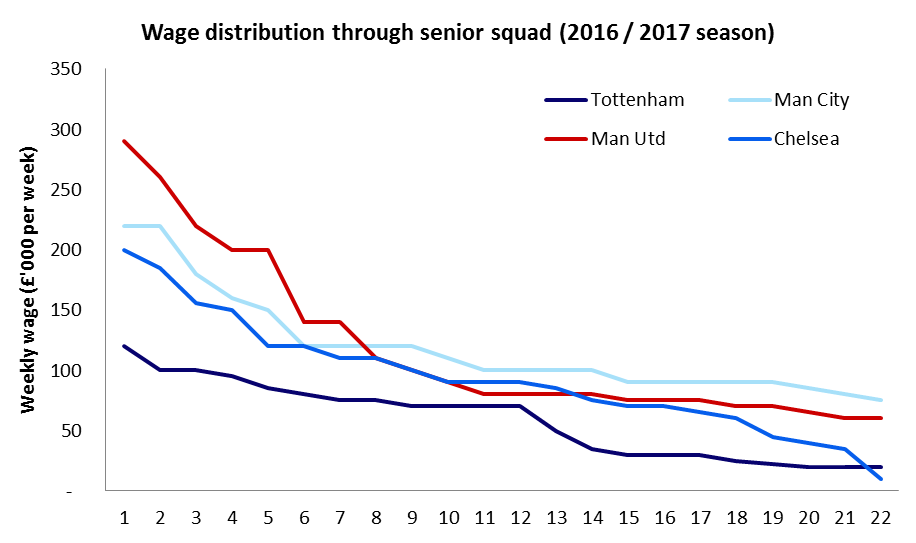
The reality is that Tottenham faces structural problems of its own making. First, the wage cap in place is enforcing a concept of a First XI vs secondary players. Most clubs have some sort of wage structure in place, of course, but rarely at the top level is such a fuss made about it or is it so well known. A look at the figures as last season commenced (below) demonstrate this clearly: Lloris and Kane were the top earners but the whole first team plateau out before a sudden drop off as one reaches Trippier and Davies (both now ironically effectively first team players).

Tottenham wages

Source: sillyseason.com (http://sillyseason.com/salary/tottenham-hotspur-players-salaries-69471/)

Compare this with the three biggest paying clubs in the Premier League and the contrast is stark. It is not just the absolute amounts that are different; it is the distribution, and with it an entire philosophy of creating star players with a large pool of players below them. A new arrival at Spurs would question how inelastic the first team appears to be; a new arrival at Man Utd may know he won’t oust Paul Pogba, but the rest is up for grabs. Tottenham have allowed themselves to create too rigid a playing structure.

This leads onto the second structural point: no other team has quite such a disparity between the quality of our First XI and the bench. Title winning teams do not have a set first team; asking “who is willing to sit on the bench?” is to ask the wrong question altogether. The real measure is the quality of the first team squad – the 18 or so players who should be interchangeable in quality terms. This is more difficult for the striker position, since there is only one match day position available. But for the attacking midfield positions, where we play at least two (in the 3-4-2-1 formation) or three (in the 4-2-3-1), we should have at least n + 2 players of comparable quality competing.

So what is the answer? Well, one or two rumours have emerged which are of real interest: Iheanacho from Man City for instance, or Kovacic from Real Madrid (incidentally Ross Barkley is not the answer). But it seems like under the financial constraints we have, and under the wage structure we enforce, Pochettino is going to have to further rely on coaching youth players. It’s not a bad way to do it – Josh Onomah has had an excellent summer with the England U-20s, as has Kyle Walker-Peters; Harry Winks and Cameron Carter-Vickers already made their appearances last season too. I also believe that some players can be reinvented – Moussa Sissoko into a deep-lying central midfielder for instance.

Ultimately though, Spurs are going to have to rejig the way they pay their team even if they do not raise the total amounts being spent, and even to keep existing squad members happy. The current system reflects something static, sacrificing flexibility on the altar of stability. It might serve for another season, but what happens when our ambitions expand?