Can we actually cut the trade deficit? Yes, we can.

Economists turn out to be as stupid as journalists are lazy
Except, er, they have …

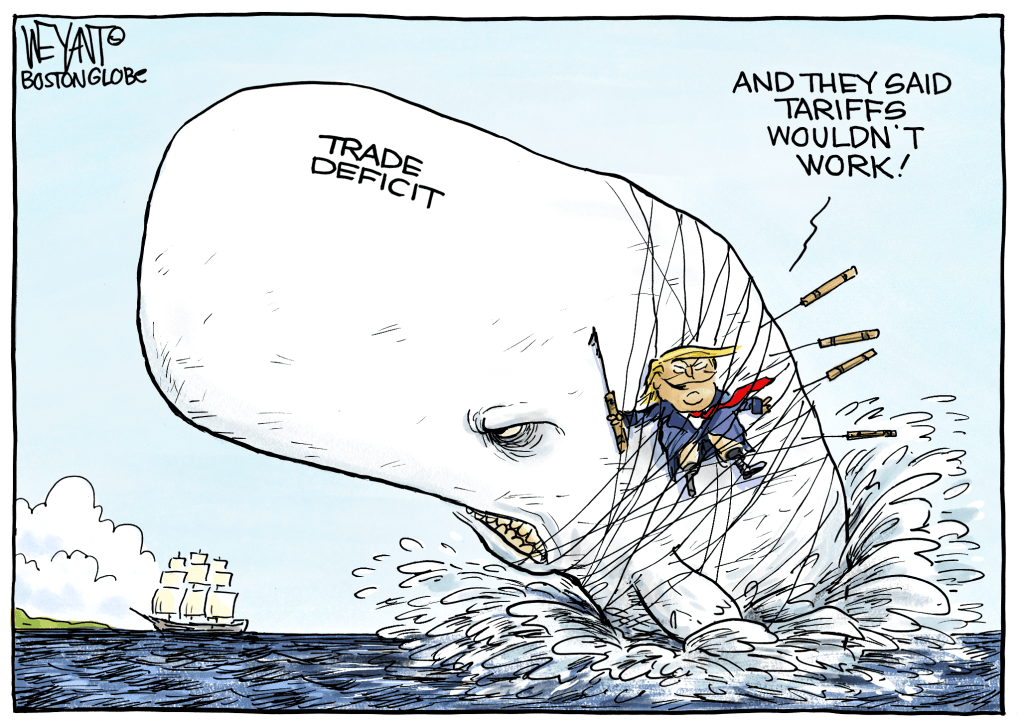
It will never work anyway!”, comes the common refrain thrown at almost all disruption attempts in the last decade in response to the broadly technocratic and deterministic policies of the last half a century since the oil shock. Trump’s implementation of trade tariffs is a prime example of this. Critics of the policy broadly fell into two buckets. On the one hand, were those who predicted major and immediate crises of various sorts – an economic slump in the US, an inflation crisis, a currency collapse, an escalating trade war with no winners and no end. On the other hand, smug ‘super administrators’ focused with glee on the idea that the policy would never even achieve its stated objective of cutting the much discussed trade deficit.

The Cassandra-like forecasts of the first bucket would appear somewhat challenging after the fact. In the year since tariffs were implemented seriously, the US economy has been robust and by far the standout performer among OECD economies, while continuing to attract more outside investment than China or India (and by the way, the stock market is not doing poorly either). Inflation has stabilized from its Biden-era highs, and even the Fed agrees that tariffs have added at most 0.2%-0.4% to prices – never ideal but hardly the stuff of calamity. In the meantime, there has been no ‘trade war’, with the universal 10% levy imposed with almost no resistance and in the singular matter of China, as I have written about previously, the US has managed to achieve a positive tariff differential for the first time since the 1990s, and China has had to suck it up.

But it is the second charge – that the trade deficit cannot be brought down – that is currently doing the rounds. Journalists in particular react to monthly numbers a bit like football fans judge their manager by their last result. Economists are even worse, driven by a form of theoretical blindness. However it has now been a year since tariffs were brought in, and well worth examining what has occurred as a whole.

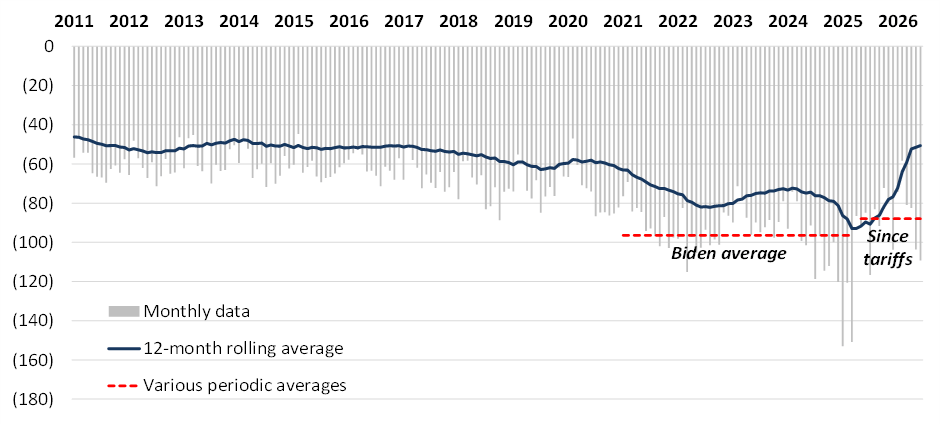
Notional trade deficit over last 15 years (monthly vs 12 month rolling average)
Source: US International Trade Commission database

Even taking the critics at face value, using unadjusted monthly numbers, the deficit has fallen from an average of US$96bn per month in the four and a half years from Biden through to Liberation Day, to an average of US$88bn per month since, almost a -10% reduction. Using a simple mathematical concept like a rolling 12-month average (as shown above and something beyond the ken of most reporters, it seems) highlights this direction much more clearly. So far, so simple: the deficit is down and falling.

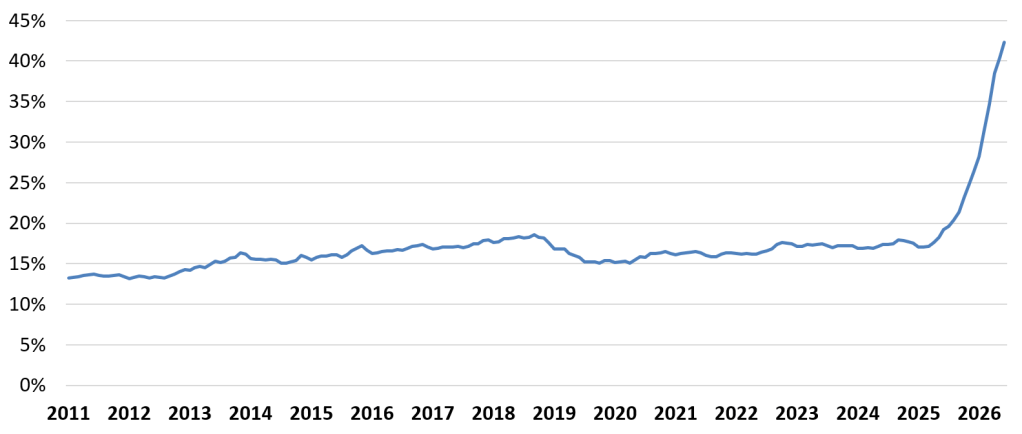
However this is not the end of the story. When assessing the impact of the tariffs on the trade deficit, the focus should really be on the industries being protected, rather than the whole economy, for obvious reasons. Major exemptions were instituted for strategic necessity – tariffs were not implemented clumsily and without thought. In particular, in the last few years we have entered a once-in-a-generation industrialization race regarding AI, which has led to huge distortions in the trade imbalance. Over the same period as above, imports under Harmonized Tariff Schedule (HTS) codes for semiconductor products (key categories 8541, 8542, 8471, 8473 and 8517) have jumped enormously and on purpose as America seeks to get ahead of the game in data centres and compute power.

Semiconductor (aka AI spend) as % of total trade deficit
Source: US International Trade Commission database

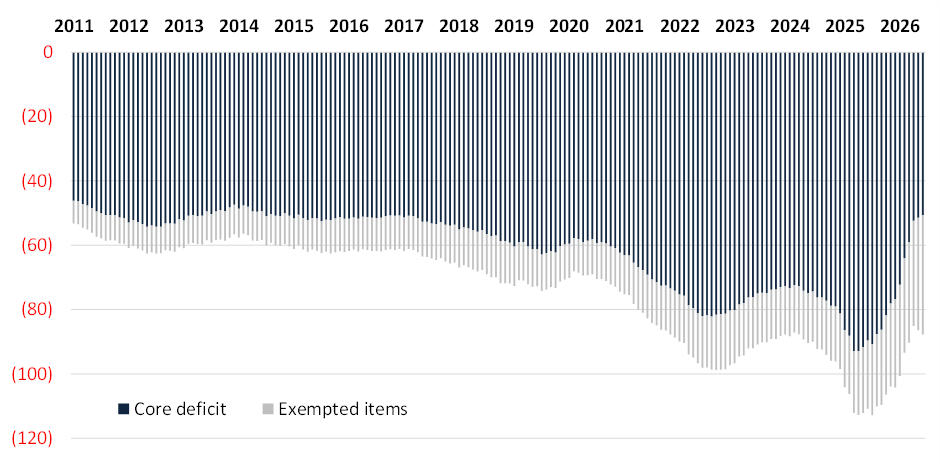
This has little to do with the aims and objectives of the so-called ‘trade war’, and does not take away from Rust Belt jobs. The success of tariffs from even the narrow perspective of the trade deficit, can only be understood through its impact on the industries being targeted, or their substitutes. On an intuitive basis (and despite what economists love to think) the importer of, say, cars is not going to substitute their purchasing power into less taxed segments such as semiconductors – there is no fungibility of capital occurring across unrelated segments. So there is a distinction to be made between the ‘core deficit’ and the exempted items, making the effects of tariffs even clearer.

US trade deficit over last 15 years (12 month rolling average)
Source: US International Trade Commission database

On a nominal basis, the trade deficit in the truly relevant industries has actually declined precipitously to levels not seen since the Obama administration. It has been reduced by more than a third from the highs of the Biden era – indeed the average ‘core deficit’ since Liberation Day is -13.4% lower than the entire 15 years preceding it. It has fallen to record lows as a result of tariffs.

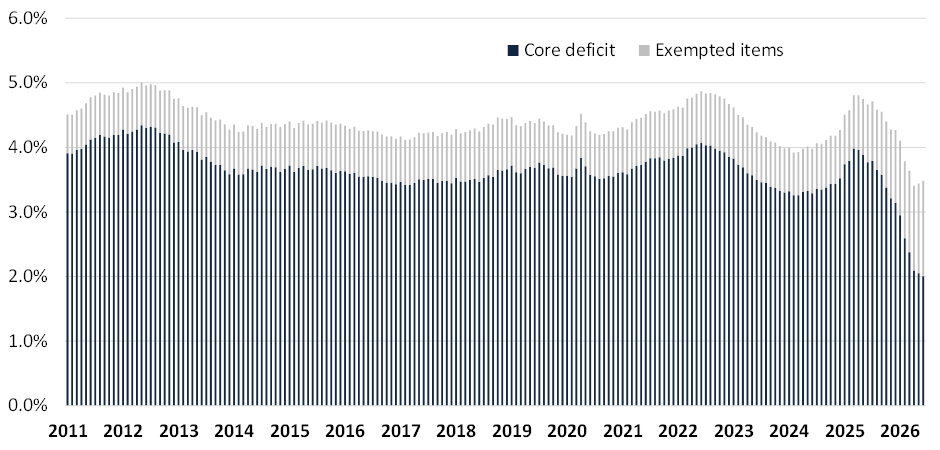
Yet even this is not the whole story. In today’s money, the current total deficit is $88bn, while the ‘core deficit’ number stands at $51bn. You may choose to look at whichever number you like, but one must also factor in the time value of money. The US$88bn total deficit was last this low in Q4 2021, but US$88bn today is not the same as US$88bn five years ago. Likewise the last time the ‘core deficit’ was this low was way back in Q1 2017, a totally different world. The key metric to measure against is GDP of the day, basically allowing deficits to be benchmarked against a form of ‘inflation’. When examined in this light, the true and remarkable scale of the deficit reduction becomes apparent.

US trade deficit over last 15 years as % of GDP
Source: US International Trade Commission database, US Federal Reserve database

In short, the US trade deficit has fallen to levels not seen for decades – exactly as would be foretold if analysts did not keep needing to overthink it. And it has fallen against a backdrop of a strengthening economy which is seemingly more strongly positioned against its competitors than ever, a fact underlined by FDI being maintained at by far and away No 1 (with the US at US$277bn in 2025), a far cry from the 2000s and 2010s when China led on this metric.

There is plenty to dissect in this, and these statistics do not in themselves prove that tariffs are good for the economy, or even that reshoring is happening. Nonetheless there are only a few explanations as to why GDP can continue to grow even as the deficit reduces, and the likelihood is that these reasons are ‘good growth’. A major component of it has been the US ability to increase productivity and replace imports effectively, most of which helps with job growth – another area which has “surprised” economists on the upside. While there are other potential reasons – currency effects and exogenous slowdown – these will not account for the bulk of what is happening.

Ultimately the debate over tariffs should always have been a long-term one, over whether free trade or whether selective trade benefits an economy and a society more. The scaremongering over near-term effects is always counterproductive to the critique and often wrong, as has been demonstrated here. Above all though, critics need to learn what I first noted a decade ago: that trying to tell people that changes “will not work” makes them increasingly angry over the lack of agency politicians represent. Argue that it is bad, by all means, but there is no point implying that the great system of global economy and relations makes independent national policies redundant. Nobody is here to listen to that and even bad independence will be rewarded over good dependence. In the end the answer has to be, “yes, we can”.
It’s the net tariff differential, stupid

Free trade was never supposed to be the end-game

With the dust settling on tariffs, it is opportune to take a moment to consider the sheer scale of change ushered in by Trump on global trade since 2016, and especially with recent events. Trump’s policy is often confused by a vast amount of ‘noise’, which tends to undermine even his own news cycle (see the recent Iran nuclear facility bombing, for instance). Which is a shame, because he has almost entirely remade the landscape, and whether one supports or opposes the theory behind it, it seems irrevocable.

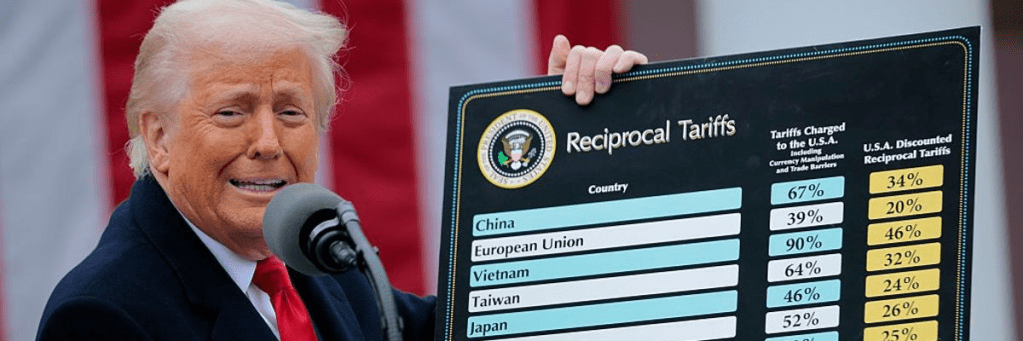
There have been two major components of this earthquake. First, Trump has instated and effectively normalised a global 10% tariff on all US imports, regardless of origin. As noted elsewhere, a ‘universal’ tool like this is by far the most efficient mechanism to charge the world a cost of doing business with America (a concept the youth of today will more easily liken to “gas fees” paid in the world of crypto). It has also raises the policy ‘baseline’ to a figure greater than zero, which I discuss below.

This baseline 10% has both more or less been accepted without reciprocation, by every major trading partner including the EU and China, regardless of vehement struggles over additional duties on top. Whether this 10% is the only tariff, like Britain, or whether it is just the minimum, like Japan and Korea who currently have 25%, the standard has been set and moreover will be very likely here to stay – any future US administration may renegotiate on specifics, but will almost certainly leave the baseline in place. It is now quite simply a fact of commercial life.

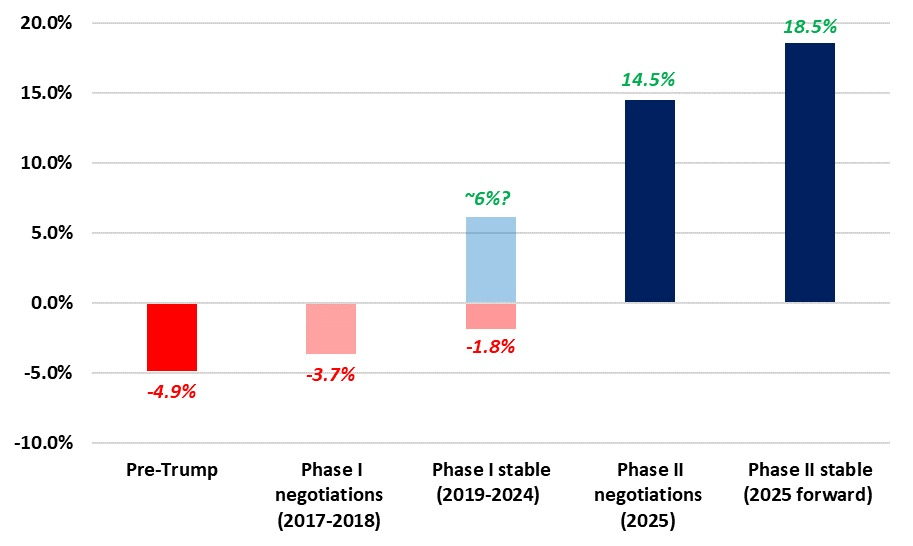
Secondly, there is China. Amidst all the turmoil (which may be part of a grand plan, but frankly who knows), Trump has continued his decade long trade strategy of increasing tariffs and daring China to fight back and contest who holds the most leverage. This bluff has been called several times, and has resulted in the US turning the net tariff differential (the principal measure of ‘success’ in any tariff strategy) in its favour for the first time in living memory.

US net tariff differential with China, 2016-2025


Sources: PIIE, underlying sources
Notes: 1. Trade-weighted tariff rates in 2016 were 8.0% on US exports to China vs 3.9%  on imports; 2. While the notional differential achieved in Phase I was -1.8%, in reality China unofficially suspended many import duties leading to a positive differential under Trump’s first administration; 3. 2025 forward numbers based on latest round of negotiations ending May 2025.

When Trump first emerged on the scene, the institutional trade nexus between the US and China, comprising both WTO and bilateral arrangements, was such that China imposed about 5% more duty on the US than vice versa. Liberal economists contended rather tritely that this was a price worth paying. Yet over the course of both the 2016-2020 presidency and now in his second term, this negative differential was first reduced and now into a major surplus. China, despite raising tariffs of its own, has acquiesced to the new normal that it must pay the US more than the US pays it, for trade. If anything can be considered a ‘win’, this is what it looks like.

In the meantime, we have seen no sign of the supposed economic slowdown as a consequence of the “trade wars” [sic]; there have been plenty of anecdotal examples of exporters eating the additional cost into their bottom lines; and after the initial volatility, the markets have settled down into a rally. Personally, I regard none of these as important for long term strategic reorientation, but among the breathless commentariat fainting at news from the bond markets, it seems to matter.

And what is the point of all this, might you ask? For me, on the subject of tariffs themselves, this policy has been a triumph of common sense. I have argued for years that the US and others needed to ramp up tariffs for several reasons.

One main consideration is that today’s global economy is no longer that of Ricardo’s. The applicability to free trade theory to a landscape of non-tariff barriers, unfungible services, and complexities of cross-border supply chains are extremely limited. Furthermore Ricardo assumed (as all economists tend to) agnostic counterparties motivated and constrained by economic incentives including public wealth and living standards; he did not factor in malevolent strategic actors who would happily pay a cost to bend a supposedly neutral system to their own agenda. Let us be in no doubt: if Ricardo were alive today, he would be pushing for trade tariffs.

Another outcome is the pushing back on the idiot savancy© which has led the technocratic classes to glorify “zero” targets – tariffs, interest rates, inflation, exchange volatility, even carbon emissions (though strangely not taxes or immigration). In most areas of public policy, however, zero is convenient for bureaucracy but wrong for the public. Low rates can occasionally be enjoyed as an output, not an input, but freedom to raise them are the safety valves required for cyclical management of the economy – sometimes you want inflation; sometimes you need currency devaluation. Tariffs, too, are a tool whose starting point (the ‘baseline’) needs room for manoeuvre both up and down – as a decade of near-zero interest rates have demonstrated, autistic ambitions hamstring policy tools needed to meet new challenges (I will write separately about this whole topic). So 10% or so suits the US quite nicely.

How tariffs will end up functioning is an unknown, due in part to how long OECD governments have allowed their muscles to atrophy in recent decades. And nothing scares technocrats more than the unknown. Yet beyond the anecdotal evidence of implementation, we also now know that the first round of Trump’s changes in 2018 led to substantial fiscal outcomes, with customs revenue doubling from US$35bn per year to US$70bn and well beyond.

Source: Bloomberg

This income is forecast to continue rising unless the economy tanks, but little sign of this. How the US government chooses to use this windfall is a separate matter, but the income certainly exists and one reason Biden chose to continue Trump’s tariff policy was that nobody wanted to look this gift horse in the mouth. While revenue raised is not central to the justification for tariffs, they offer an important lesson in how erroneous predictions on effects can be.

Most importantly of all, regardless of whether one supports increased trade protectionism or not (and I accept there are plenty of arguments to be had on either side), Trump continues to challenge the orthodoxy that such sharp directional changes are not even possible. Because for every protagonist arguing against the economics of tariffs, several more are usually hiding behind the sophistry that “he will never be able to do it, anyway”. These are the people cheering on the bond market turmoil or China’s retaliatory duties, unwilling to admit out loud that if it could be done, it might actually make sense for people, even at the cost of being vastly more inconvenient for the beneficiaries of globalisation.

As with defence or immigration, Trump has shown that none of these shibboleths are untouchable. The governing classes, while self-interested in keeping the policies of the last fifty years in place, has been surprisingly ineffective at stopping Trump from turning 180 degrees on tariffs or NATO or Iran, despite loudly arguing that it could “never be achieved”. So it turns out that the system, for better or worse, can be changed. Perhaps after all it is actually Trump who is living Obama’s best life, as he surveys the world around him and tells voters “yes, we can”.

American poverty is neither urban nor rural – it’s small, mostly white towns

A vacant, boarded up house is seen in the once thriving Brush Park neighborhood with the downtown Detroit skyline behind it in Detroit,

It has been a year since Trump entered the White House, and eighteen months since the Brexit vote. Yet the media still display an astonishing lack of understanding about several aspects both of US wage stagnation, as well as how it interacted with voting.

The Brookings Institute came out with an important piece recently which has not received the attention it deserved. They produced five maps, showing the winners and losers in median wage change across the US between 1999 and 2016. Some of the results are obvious: the first map, of “winners”, shows that wages in the tech hubs and in government subsidised DC have done rather well; the last map, showing where wages have done the worst – step forward Detroit amongst others – is also a well-worn narrative.

But it is the penultimate map which should be most concerning. I have long argued that American liberals take far too narrow a view of poverty, and see the role of government as essentially providing urban answers to urban problems, which are the most visually obvious to those inside the Beltway. This ends up focusing on helping ethnic and other minorities, albeit usually in a less-than-constructive method. Altogether ignored is where much of the real poverty lies – as this map shows:

metro_20171012_alan-berube_fig4-struggling-v3

It repays some close study. The problem areas are not Detroit or Flint or Cleveland. The problems are that 10 urban areas of over 1 million inhabitants – and another 59 towns of between 100,000 and 1 million – have experienced median wage declines of 10% – 15% over the period. On the basis of this study, that’s 50 million people constituting the single largest group, and are not all names you would expect:

While the group contains a handful of large Sunbelt metro areas still laboring to rebound from the late 2000s housing crash (e.g., Miami, Orlando, Phoenix, Tucson) and a few major industrial centers in the Midwest (e.g., Chicago, Indianapolis, Milwaukee), small- to mid-sized urban areas predominate in this category. Most are manufacturing centers that lost significant numbers of middle-income jobs in the 2000s that have not been replaced, including 10 urban areas in Wisconsin, six each in Michigan and Ohio, and five each in Georgia and Indiana. A few have shown some green shoots in the 2010s after a rough decade, including Ann Arbor and Kalamazoo in Michigan, and Oshkosh in Wisconsin. Others, however, have slipped considerably since 2009, such as Charleston, W.Va., Davenport, Iowa, and Springfield, Ill.

This reinforces two lessons. The first is that the often quoted cliché about urban vs rural voters is a false one; neither America (nor Britain) are about large urban centres. By my last count, well fewer than half (43%) of Americans lived in conurbations of over a million people. Fewer again (33%) lived in cities of over two million. The genuinely rural population is also small (15%). Instead, real American life is about small market and post-industrial towns.

Politics focused on what happens in New York or LA, and contrasted perniciously against what happens “out on the ranch”, is not helpful to anyone. Reporters and politicians know all about the urban indigent, even if they do not do much about it; but they seem to know nothing of the small-town working poor. That is what Trump and Sanders were all about. It is also the case with Britain, as was identified in an excellent piece in 2007 by Blair Freebairn.

The obsession with reporting on urban areas is one I have discussed before in relation to media misinformation about street protests in the developing world.

Neatly compact urban street protests are highly photogenic and easily captured on camera. Crowds sell news … It is difficult for outside observers to empathize with anyone other than those who are so passionately occupying the capital. It also involves much greater effort and investment in time – time which is not afforded by the twenty-four hour news cycle.

The great tragedy is that the same misguided focus is applicable at home, where we discovered last year that journalists who should know better, did not.

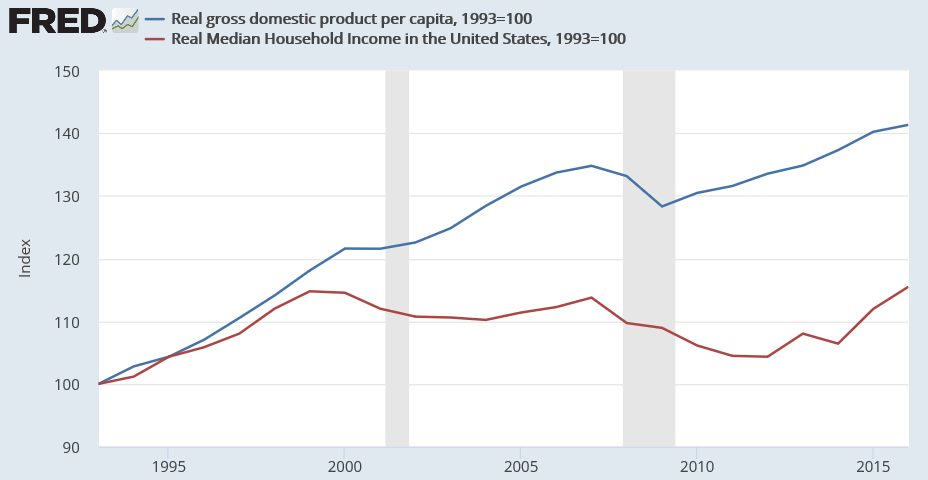
The second lesson is the danger of economists and economic commentators continue to fall victim to the intellectual Tyranny of the Mean, whereby average numbers still form the focus at the expense of median data. What I should hope is by now a very commonly seen chart shows the disparity which still leads to the incredulous question: “who are all these poor white people?”

US_GDP_per_capita_vs_median_household_income

There is little sense in technocrats informing voters that their economy has been growing, or that living standards have been rising, when no-one recognizes it as such. The disparity shown here is not only obvious as a chart, but more importantly in how voters feel about the economy. Median calculations are not perfect, but a good starting point would be for all economists to rethink along median lines each and every time they put out a statistic or indicator.

All said and done, it seems to me most liberals have still not grasped the underlying lessons of the last few years. Obama, of course, had precisely zero to say on the issues that would come to dominate 2016 – he barely seemed curious about such trends, for someone so supposedly intellectual. Fighting the urban-rural battle is to continue the last war. Small white towns are where it’s at right now, and telling them they’ve been doing okay is not going to win any votes.