Forgotten Fantasisti: Domenico Morfeo

Part of an occasional series translating some of the most interesting foreign language football writing

“I could, but I don’t want to”

Football observers, who are often amateur anthropologists, have long held that Latin American players carry their varied ancestry from the Old World with them; in particular, that those of Argentina often demonstrate their Italian roots. Domenico Morfeo, on the other hand, despite being born in Pescina in 1976 and having never left for foreign shores, could easily have been mistaken for such an emigrant. The delicate left foot, the innate confidence, the prosaic facial expression contrasted with the dynamic sense and touch of the ball, might all have been found on the streets of Buenos Aires or Montevideo. Yet destiny was to take him on a long, winding road of turns and dead-ends until he finally returned home, in a series of migrations that were little more than local.

A subtle left winger with great dribbling ability, vision of the game, the ability to provide pinpoint and balletic poise, close control and shooting precision made him a complete fantasista. Set against this was his diminutive size and delicate physique. Laziness and obstinacy of character round out the picture, the cracks through which his natural talents eventually slipped away. Trained at the academy of Atalanta Bergamo, he stood out while playing for their Primavera team such that at national youth level, one would often see Morfeo on the pitch while a certain Francesco Totti was left on the bench.

He made his debut at Atalanta at the age of 17, registering 3 goals in 9 appearances in the initial season. He went on to complete his apprenticeship by playing the following full season in Serie B and then two campaigns in Serie A, until at just 22 he had chalked up 83 appearances and scored 22 goals. Over those same years, Morfeo participated in the European Under-21 Championships with gli Azzurri, winning a gold medal in Spain I May 1996 in Spain, triumphing on penalties against the hosts. He was the final penalty-taker, capitalising on a mistake from Raul; this was the Italy of Cannavaro and Nesta, of Panucci, Tommasi and Totti – all coached by Cesare Maldini.

Morfeo found his way back to the motherland of Atalanta many times

The first spur for Morfeo’s career came with the move to Cecchi Gori’s ambitious Fiorentina. But here also emerged the early signs of his character limitations, in a side containing giants of the game such as Batistuta and Rui Costa, as well as the excellent Oliveira. 5 goals in 28 appearances in his first season was a modest if respectable haul, but lower than might be expected. The following season, Fiorentina signed another forward, Edmundo (‘O Animal’), another competitor in terms of talent and on-field personality potentially pushing Morfeo down the pecking order.

The new role designed for him by Trappatoni did not help, either, relegating him to the wing where Morfeo did not have the physicality and pace to express himself. Approaching a critical phase for his development, he found himself loaned out first to Milan (where he did in fact win a Serie A championship, albeit as a non-playing protagonist) and the to Cagliari. The instability doubtless watered down his performances.

Domenico finally seemed to find his true self in Verona, at the court of another ‘Ceasar’ just starting to make his mark in Serie A. This one, Prandelli, was familiar with Morfeo’s talent through Atalanta’s Primavera, who he had coached to victory in the Viareggio Tournament in 1992. Arriving during the winter transfer window while the team appeared on the verge of relegation, Morfeo finally demonstrated the full repertoire of ability that everyone had suspected for years. With 5 goals and countless contributions in 10 games, he dragged the gialloblu to safety.

Morfeo now returned to Florence, full of expectations, yet things would still not go his way: after just half a season he departed on another tour, this time to his motherland of Atalanta. After this, at his athletic peak of 26-27 years old, he strung together a couple of modest seasons first at Fiorentina itself (18 appearance and 2 goals), and then at Moratti’s Inter where he reunited with former teammates Toldo and Batistuta (17 appearances and a single goal).

One of Morfeo’s 17 appearances in the Champions League, where he scored 3 and assisted 1

It was to be once again Prandelli who would bring Morfeo back to an environment more suited to his ability to express himself. Prandelli wanted Morfeo with him at Parma, where the team needed to find itself again after the glory years of the Tanzi era. Here, finally, Domenico was able to play with reasonable continuity for four seasons, being selected for around two-thirds of the club’s fixtures and scoring a few goals here and there – the high point being 8 goals in the 2004-5 season. Moreover his contributions were often decisive, particularly in providing assists to the front men in a notable pairing with Gilardino. Long and short passing, backheels and placed shots, it was finally magic again for Morfeo.

The fifth and final season at Parma marked the bitter end of the relationship. Then at 32, Morfeo appeared to be on the verge of dropping down to Serie A to join Brescia; but, even with the paperwork signed, the now worn-out talent from Abruzzo reneged on his contract having only taken to the field for a single Coppa Italia match. In 2009, another of his former mentors from Atalanta, Emiliano Mondonico, summoned him to Cremona, but even this was not a success: 4 miserable appearances marked the end of this career as a professional.

What remains to us of Domenico Morfeo is at the same time both too highly acclaimed to be forgotten, but also clouded in disappointment; a sense of “I could, but I don’t want to” which is difficult to comprehend. He possessed great class and ended with some reasonable numbers (54 goals and 51 assists in 282 games in Serie A, during that league’s golden age), but fans are hard-pressed to remember them unless they happened to be there in the ground during a moment of magic. Ultimately this is probably Morfeo’s greatest enigma – the King of the Lesser Tens.

**********************

Preface to the original article, from the Mondo Sportivo column ‘The Children of Lesser Gods”, authored by Paolo Chicherchia:

This is the first instalment of a new column dedicated to all those fantasisti which have intermittently shone, like actors on suburban amateur dramatic stages, without ever making that final step up to true quality: provincial playmakers, directors caged within their own limitations, clear talents lumbered with pub physiques, deft-footed hot-heads, wasteful artists, unlucky stars and fragile champions, often considered “the next big thing”. All of them have floated outside the ranks of the greats of the game, but all of them have created magic in that No 10 shirt so beloved by football fans.

Postecoglou really does have a philosophy – you just don’t understand it

And you might not actually like it if you did

One of the most curious things about Postecoglou’s tenure at Spurs is how little observers seem to actually comprehend what he is saying. In turn, this leads to not really understanding what he is doing, either. This blog should not come across as just trying to defend Ange against the grain of results like this last weekend at Newcastle; but I think it is worth trying to at least understand what he says, in order to either agree or disagree with it.

So let us start with the background of recent comments Ange made about fourth place. He has, of course, made comments allowing us to interpret all sorts of things, such as “let them dream” and “if I’m not mistaken, we are three points off the top”. With regards to the Champions League places, his exact words were as follows:

“I don’t see fourth as the prize. I don’t want to finish fourth if we haven’t grown and developed as a team. Part of the narrative is to push you in these kinds of positions where you think that fourth is some kind of achievement that gives you something for next year.”

“Fourth would be great if I feel like we’re growing as a team, and we’re creating something that is going to bring us success next year. But fourth is not our goal… If we finish fifth, and if I think we’ve got a team to challenge next year, then I won’t be disappointed.”

MSN et al

As mentioned, this led to bemusement and incredulity at both ends of the spectrum, oddly enough. Critics inferred that by saying this, he was releasing himself from any accountability over finishing fourth and getting the club into the Champions League. Proponents went the other way, telling us that he was saying that fourth is no ceiling, and we should be aiming higher than that (Maddison unhelpfully made similar comments this week).

Maybe this confusion reflects the intellect of the average commentator, but the likes of Dan Kilpatrick and Jack Pitt-Brooke need to be told that Ange is saying neither of these two things. He was alluding to some very some basic points:

  1. There is no prize in football other than winning. Any place below 1st is still a failure and trying to moderate how much of a failure you are by distinguishing between 2nd, 4th or 5th is sophistry designed to make supporters feel better.
  2. The nuance of exactly where you finish, especially when it is below first, do not tell the story he is bothered with. Excluding the exogenous factor of Champions League financial income, there is little which indicates that the team in fourth is somehow better, or on a more positive trajectory, than the team in fifth.

It is not so much that the league table lies, it is that for a ‘project manager’ the table is irrelevant as a measure of progress. The only measure of progress is … progress. And progress is not defined by the noise of individual performances (like yesterday), or where you are in the table. It is about what you see and feel when you watch the team play every week. “Are we a better team than before? Yes, or no?

And this brings us to the broader issue of Angeball philosophy**. This way of thinking, much more than the tactical use of inverted fullbacks, that Postecoglou is similar to Guardiola and Bielsa and some others. Because like it or not, the idea is that games aren’t a managed period of 100 minutes with beginning, middle and end; they should be a steady and constant stream of football. The blowing of the whistle signalling the end of one match or the beginning of another are merely inconveniently imposed breaks in an ongoing flow of action and implementation of the manager’s tactics and ‘plays’.

This was most clearly expressed when he noted that he didn’t want his teams being dictated to by the minutes on the clock or the score line. You don’t try and win things during certain parts of the game and sit back for others. You don’t react to ‘game state’. Every minute is just another minute of Angeball, trying to score goals, and it doesn’t matter who your opponent is or what the score is. It doesn’t even matter who you have on the pitch.

And this brings us to the increasing clamour regarding a need for a ‘Plan B’. Advocates of this are truly not understanding Ange, particularly when they start sentences with “I get what he’s trying to do, but … “. As far as Ange is concerned, the whole of this season is one long practice session. Changing things up tactically to win individual matches is all well and good, but is more or less just a waste of valuable match minutes where they should be practicing Plan A against real opposition. A match won through tactical changes is a match wasted. There is no Plan B – at least, not until every member of the squad has so internalised Angeball that he can finally look beyond it.

Guardiola pioneered this rather robotic nature of football, and with the likes of Messi in his team he was able to win La Liga titles and the occasional Champions League (though of course it was often noted that he ‘underperformed’ in the latter and “should have won more”). But the point was that every minute of a Guardiola team is another clean slate of Guardiola football, not an emotive reaction to events on the field. The end of a game against Burnley should be seamless with the beginning of the next match against Bayern. Details are mere noise.

This all being true, Spurs fans are arguably even more entitled to be more concerned about things currently, not less. As I said, I am not writing to defend Ange per se. The real question is whether Tottenham will ever invest in the squad to such an extent that they can reach a zen state of high quality football, inhuman and unsentimental. I have noted more than a few times that our squad is way, way off that level, and in the meantime the disparity between philosopher and the pragmatist is starker than ever.

Fans want to take every game as it comes. Fans see some games as more important to win than others. I’m sorry to tell you, that Ange Postecoglou – and for that Guardiola – just doesn’t agree with you.

** A previous post discussed football managers in the context of empiricism vs rationalism. Postecoglou is undoubtedly a rationalist, in the vein of great project managers such as Guardiola and even Pochettino. In philosophical terms, he is perhaps the Parmenides battling, in the current landscape, against the Heraclitus of Unai Emery. Arguably, to reach the top he will end up needing to reconcile both and eventually become the Democritus of English football.

True GOATs are strategic, not tactical

With the ascent of Jude Bellingham, we are finally marking the passing from one generation of Real Madrid to another. The outgoing vintage, though, was perhaps one of the most remarkable club side midfields we have ever witnessed: the pairing of Luka Modric and Tony Kroos, with the contribution of Casemiro, was the backbone of the Madridistas’ four European Cups between 2016-2021 (Modric won an additional one earlier in 2014). Arguably as impressive is their three La Liga titles over the same period, a competition which they have generally struggled to win compared to Barcelona.

Over the years, Madrid had plenty of other stars of course. Ronaldo and Bale at the Galactico level; Benzema, Marcelo and Sergio Ramos occupying ‘stalwart’ status, which probably underplays their importance; and the rise and fall of starlets like Isco and Asensio. But for all the debates about Ronaldo vs Messi (vs Bale if we want to be British about it, rather like considering Andy Murray part of a tennis ‘big four’), Modric and Kroos will in many managers’ eyes be the most imperative piece of the team.

Both are supremely talented and creative, which as deep-lying No 8s is their obvious role. Both are also superlative set-piece takers, too – Kroos’ last minute free-kick for Germany against Sweden in 2018 has been all-but-forgotten, but is surely one of the greatest ever in a World Cup. Likewise their ability to win, hold and carry the ball is also well-known. The phrase “press-resistant”, a favourite of contemporary analysts, is nowhere better characterised than by these two.

But it is really where these two skills – creative passing and escaping the press – combine that we see where true greatness lies. Because these two also have a side to them which few other ballon d’or candidates have: the desire to chase lost causes, to not give up, and to go the extra mile. And this is why the coaches’ opinions of the GOAT debate vary from many fans.

Below are two small (!) examples of what each of these do to give their team the edge, and it is on such actions that titles are built. Each example demonstrates specifically what Modric and Kroos – who are different players in many ways – contribute, and moreover do so on the biggest stage, in Clasicos and in European finals.

The first is from the 2022 Champions League final against Liverpool. With the game delicately poised at 0-0 and with Liverpool having arguably had the edge until that moment, Modric is fed something of a hospital pass from Casemiro of all people and, confronted by a three man Liverpool press, has to carry the ball right back to his own defence.

Real Madrid’s Decimaquarta

Yet he does not give it up or pass back to the keeper, or play for a foul. Instead, with a single swivel, Modric sends the ball through all three opponents to Carvajal and sets off the movement which sees Vinicius ultimately score the only goal of the match. Commentators did not really think of the goal coming as “out of nothing” since by the end of the move, it was a full Madrid attack. But in fact, looking at the provenance of it, it was pretty much something from nothing. Modric won that match with his indefatigability.

A few months later, Madrid are playing in a rather celebratory Clasico, which Los Blancos go on to ultimately win against Xavi’s early Barcelona side. The 3-1 scoreline, though, belies the fact that such matches are always tough, and always rely on moments; no moment is more important than the first goal.

Ancelotti vs Xavi

Up steps Tony Kroos on 11 minutes to harry through from defence to midfield and, as he is being physically bundled over by Busquets – indeed even as he is falling down on to the turf – sends a through-ball to Vinicius. This in turn leads to Benzema’s goal. Again, no official assist was racked up by Kroos for his effort, but his dogged pursuit of the best option overall (to send the pass), rather than the quickest option (to claim a foul) marks him out. He instinctively makes a long-term choice rather than a short-term one, and whilst Madrid went on to win handsomely, this opener set the tone.

Bear in mind that Modric and Kroos are already 36 and 31 years old respectively during the two highlights above. The reality is that both players show how the very best are strategic rather than tactical. Those who we believe see the ‘bigger picture’ around the pitch are those which will always be valued most by coaches. By comparison, Ronaldo for all his skills, could only ever be a tactical player rather than a strategic one; Messi’s slight edge in strategy is one of the reasons he is the better player in football history.

Madrid have the beginnings of a new platform now, and one which may see much success. But it will be a while before they can recreate a midfield of this quality, and in turn it will be a while before they, or anyone else, can come to dominate a competition like the European Cup the way they did. Players like Ronaldo and Bale still come up from time to time, as Bellingham shows; but players like Modric and Kroos are a much rarer breed.

However much you think Spurs need to spend, double it

We think Todd Boehly is an idiot, but it may be he alone knows how much investing in a new squad really costs, whilst we continue to underestimate it

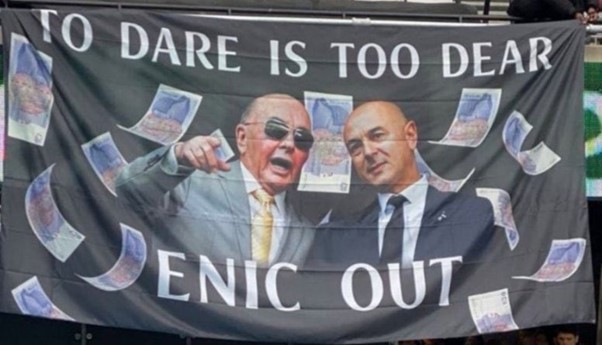
The “ENIC Out” movement, which is seemingly gaining traction, has a number of complaints: the pace and scale of commercialisation, the prices of ticketing and matchday experiences, the incoherence of managerial appointments to name a few. But more than anything, there is a sense that Spurs just will not spend what is necessary to take the squad to the next level. The recent overreaction to the momentary news that Pedro Porro might not sign was a case in point.

I have previously written about how poor Tottenham really are and why the fans are somewhat wide of the mark in their financial expectations – particularly when unhelpful and misleading news comes out about “record profits” or our wealth rankings. But here I want to consider how misleading the headline numbers are about what is needed or how much a certain amount buys you, since we supposedly know what the gaps we need plugging are. A central defender and an attacking midfielder, for instance, will likely cost us some £125m between them. Factoring in another young talent and we can round that up to maybe £150m – the amount, incidentally, that ENIC put into the club back in the summer.

But the problem is this: that £150m will get you two players that you need, in theory only. The reality is that one of them will be a dud, and possibly both. We may need at least one more player, if not two more, just to bring us the likelihood of two decent players who fulfil our potential. This is a leads us to a risk-adjusted spending of more like £250m-£300m.

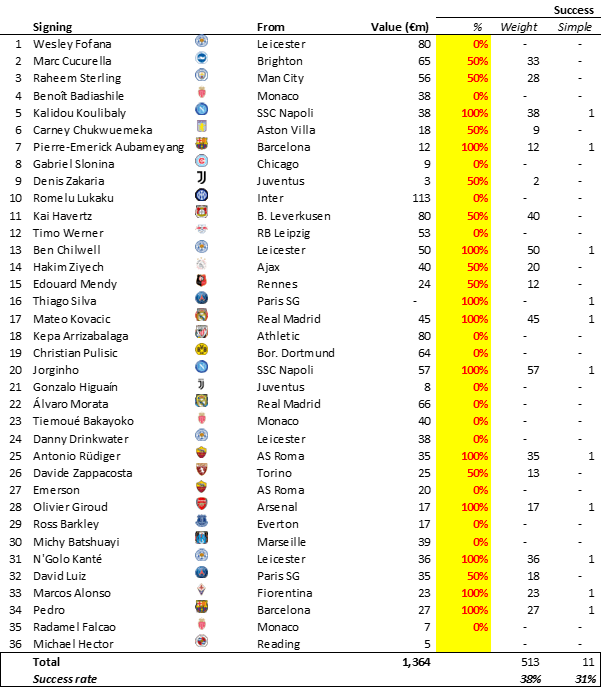
To think about how much we need to risk-adjust, I have gone back to every transfer Tottenham have done since the summer of 2015, and assessed broadly how successful they were for us. Why 2015? Well, it was the summer after the new 2016 Premier League TV rights package was announced in Feb 2015, leading to clubs spending more money in anticipation (the TV rights have stayed static since then). As an example, it was the summer of Anthony Martial’s £36m-rising-to-£58m transfer to Man Utd, a symbol, if ever one were needed, of the new age of spending.

Source: Sports Business Institute

Looking at these transfers, we then need to think about what the “hit rate” has been. For instance, if one in two signings have been successful, this would be a 50% hit rate and based on this, the amount we need to spend to get £150m of value is £300m. If only one in three signings have been a success, we would have to triple our spend, with £150m becoming more like £450m of real spending required.

There are two ways of looking at our hit rate: simple numeric (did a given player succeed?) or weight-adjusted (how much of his transfer fee as he worth?). Neither is perfect. The weight-adjusted number makes it difficult to account for free signings such as Perisic or Lenglet. The simple numeric figure treats players as more or less equal. I lean towards the simple numeric however, because for me the transfer fee is a function of the market you cannot control. Much as players supposedly try to ignore their own transfer fee in terms of the weight of expectation, the reality is that if we need a player for that position, we need him whether he costs £100m or is free.

Based on this, I have had a go at allocating Tottenham’s hit rate over time since 2015:

Source: Transfermarkt
Note: only total final fees are included (eg Lo Celso, Bentancur); exclludes players who are too early to tell

From this analysis, in turns out that indeed our hit rate on weight-adjusted transfers is about one in two, and on the simple numeric basis it is even worse, one in three.  We can argue all day about whether the success allocations I have given are right or wrong, but in the end this will not affect the final percentages much. I think it conveys a sense of, did a given player fulfil the expectations we would have had of them, particularly in making regular first team appearances, whilst he was there?

Taking these numbers therefore, to get the aforementioned £150m of necessary talent through the door, would actually cost ENIC between £300m and £450m of spending, given our track record. Is that a lot of money? Yes – but it also puts into perspective why the other clubs have been spending so much. If they are splashing out £1bn in transfer fees, the likelihood is they are only getting £300m – £500m in actual talent. The headlines are distorted.

So then the question arises, are we better or worse than the others? I have gone into a single other example below, that of Chelsea, due to their recent big spending. Comprehensively analysing other clubs is not only time-consuming, but I also do not know their players well enough. The assessment of Chelsea really is based on a mixture of comments from Match of the Day, Gary Neville and Twitter. I think it’s a reasonable reflection, but stand to be corrected.

It makes interesting reading though:

Chelsea have, if anything, been even worse than us over this period. And this makes intuitive sense of course, since for every N’Dombele they have had a Lukaku and a Pulisic thrown in for good measure. If anything, our possibly better hit rate on a weighted basis means we are more careful with our money, and do better with more expensive signings. Unsurprisingly.

To round this off, I would add one additional measure, which is that Chelsea do of course have a much better academy than us. Against our Harry Kane and, to an extent, Harry Winks, Chelsea’s free production list includes:

We can reasonably say that this has not only produced sellable talent, but has over time strengthened their squad significantly for a period. On this score, we could improve. Are any other clubs materially better than us? Off the top of my head, only Man City feel like they hit the target more frequently than others, and this may be poignant.

To bring this to its conclusion, when we think about our transfer needs, we should be realistic. If we feel we need, say, £150m of talent, double it (or more). If we have £150m to spend, halve it (or less). And do not be distracted by the headline spend of others – whilst they are buying more talent, they are not quite pulling as far ahead of us as we fear. What we need is to either improve our hit rate considerably (the role of Paratici et al), improve our academy, or find a backer who will spend not only what they need, but twice as much as that, just for us to make even a small improvement. Because the absolute money numbers associated with life in the Premier League will continue to astonish us – and Todd Boehly may well be ahead of the game on this.

Fiorentina, not Napoli, are the Tottenham of Serie A

Always attacking football; always some of the best players; always a few steps short – this is what unites two top table outsiders

Regular readers of this blog will know of my affinity for Spurs. So deep is it, in fact, that I actually enjoy periods like the current one, where hope and expectation collide with the reality that is, and has for my entire life been, Tottenham.

The side that I first came to support was that of Gary Lineker and Paul Gascoigne; fresh from my footballing consciousness having been waken by Italia ’90, and having just moved to the UK that summer, it was natural that as I cast around London clubs, Spurs were one of the obvious choices. Then came the highs – the FA Cup in 1991 , the arrival of Jurgen Klinsmann, the dazzling play of David Ginola – and the lows. The FA Cup in 1992; the 1995 FA Cup semi-final against Everton and Klinsmann’s departure; eventually the slow, excruciating 2000s. Cutting one’s football teeth on the Spurs of the 1990s was … interesting.

But another thing happened in that decade: my first ever live football match which was an astonishing 7-1 victory that Fiorentina chalked up against lowly Ancona during the 1992-93 season of Serie A, and it is a match worth revisiting for a number of reasons:

Because in a season when Tottenham, with Lineker and Gascoigne gone, were the team of Dean Austin and Vinny Samways, Fiorentina were a world apart. I knew none of these names at that age, but I was watching Gabriel Batistuta, Stefan Effenberg and Brian Laudrup. The season was worth noting too, for Fiorentina were second in Serie A at Christmas that year, only to suffer the ignominy of relegation five months later. Batistuta, some may know, heroically stayed on in Serie B.

And for all the discussion that circulates occasionally about which team is the Spurs of Serie A – and in recent years, that has been Inter and more recently Napoli – I believe Fiorentina offer the best parallel. Not just because I happen to support both, of course, but because of the very real historical similarities which lead, in many ways, to fans with the same mindset. Below are a few reasons why.

Chronology

The first is the alarmingly similar timelines between the two clubs. To put it bluntly, despite always being amongst it, both saw their glory days in the 1950s and 1960s. Fiorentina won their two Scudetti in 1956 and 1969; in between they reached a European Cup final in 1957, losing to the great Real Madrid side, before winning the Cup Winners’ Cup in 1961. Spurs, meanwhile, managed the first ever Double in 1961, and two years later also won the Cup Winners’ Cup. Both teams also made something of a habit of winning their domestic cups, two for Fiorentina and three (including that Double) for Spurs.

Fiorentina’s Cup Winners’ Cup final in 1961 (left) and Tottenham’s winners two years later (right)

Both clubs then had unremarkable 1970s, before making staggered comebacks in the 1980s for Spurs and 1990s for Fiorentina. But it cannot mask the most basic point that both clubs saw their glory days, in absolute terms, many eons ago. To an extent therefore, both clubs’ fan bases live disproportionately off the hero figures of a very different era, the Blanchflowers and Hamrins, the Greavesies and Antognonis – the curse of being a club with long traditions.

Top table

Secondly, despite meaningful success being rather long ago, both clubs frequently occupy a status that is considered at or around the top group within their league. Serie A aficionados will remember the era, in the 1990s, of the so-called ‘Seven Sisters‘, when Fiorentina ranked alongside Juventus, the Milan and Rome teams and agricultural powerhouse Parma in being considered perennial challengers for lo Scudetto.

Tottenham have for some years now been considered part of a Premier League Big Six of course; but the inception of the competition in 1992 is perhaps more telling. Spurs were part of a ‘Big Five’ then, large enough in terms of support and brand to be founders of the Premier League itself, alongside Liverpool, Manchester United, Arsenal and Everton. This confluence of long-running status with mixed recent success is a particularly curious one, and both clubs are to an extent, disliked for it.

Supposed ‘Spursiness’

Thirdly, a feature of both clubs’ mixed success is the perennially favourite issue of what others often referred to as “Spursiness”, the inability to get across the line despite fairly regular progress in competitions. This needs definition, of course, but it basically means failing at the final hurdle or losing matches we really should not, and often based on random things outside of our control. Lasagna-gate and Sissoko’s hand-ball after 22 seconds of the 2019 Champions League Final are marks of this for Spurs, or in my mind, losing the FA Cup semi-final against Manchester United in 2018.

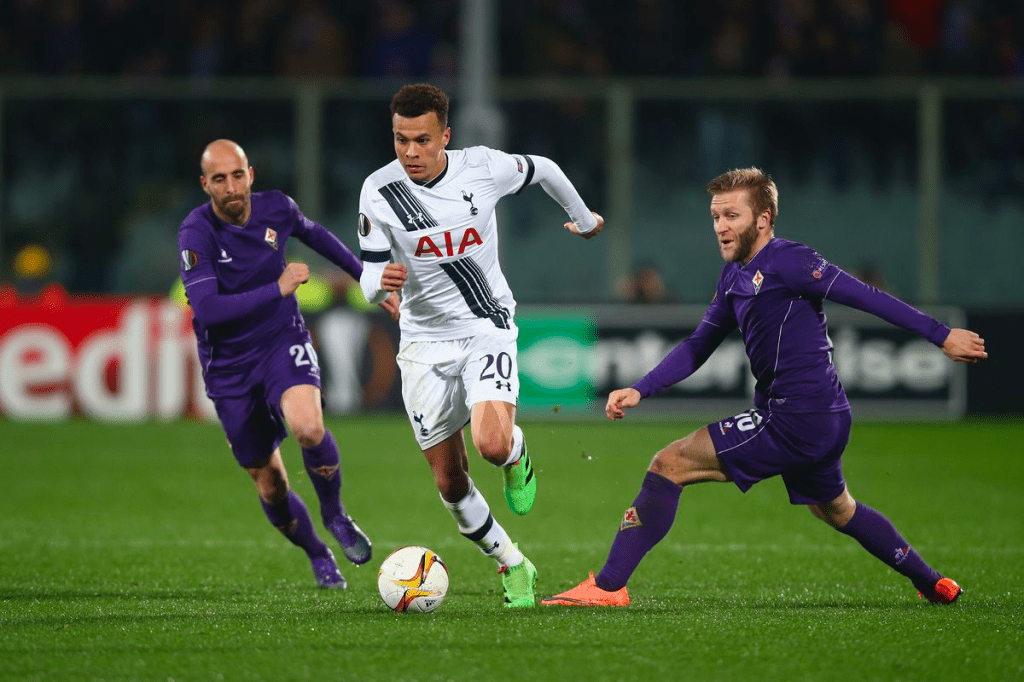
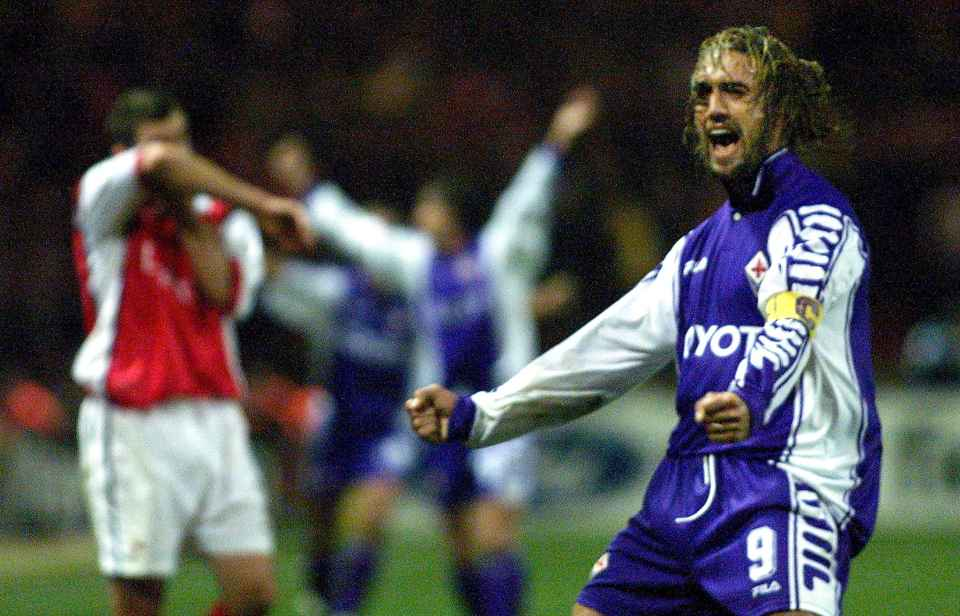
Fiorentina have also lost a European Cup Final, but greater similarities lie in the failure of the side in the 1990s to capitalise on a once-in-a-generation squad to do better. Taking the Champions League by storm once or twice is all very well, but the side of Batistuta and Rui Costa always found themselves against Juventus and Milan who had a touch more, reminiscent of Tottenham’s 2015-2017 period where Kane and Dele consistently came second to Leicester and Chelsea.

Gabriel Batistuta and Manuel Rui Costa in 1998 (left) and Harry Kane and Dele Alli in 2018 (right)

Batistuta had to leave Fiorentina to fulfil his ambition of finally winning Serie A, with Roma in 2001. Hopefully not a portend of things to come with Kane.

Real “Spursiness”

This leads us nicely to the last point: players and style. Because more than anything, what unites Fiorentina and Tottenham is that regardless of how well we are performing, we often have some of the absolute star talents of the age, punching well above our station. Fiorentina are, above all, famous for a line of fantasisti including Giancarlo Antognoni, Roberto Baggio and Manuel Rui Costa. It is difficult to identify three greater creative talents, certainly in the history of Serie A. Even when Fiorentina were not winning trophies, they were still had game-changers.

Tottenham share this heritage too, since like Fiorentina, the club is known for a style of attacking football and the fans demand authentic entertainment even at the expense of winning (the Spurs side of this is well known, but it takes a lot to maintain this mentality in Italy.). Over a similar period, Spurs was the platform for talents like Glenn Hoddle and Paul Gascoigne – both arguably the last examples of game-changing creative talents in English football. Certainly the England team have not seen their like since.

This is not just a cheap point about both teams having good players from time to time. It is about consistently showcasing players who are amongst the very best in the world, in a system that shows them at their best, even when we are not commensurately successful. ‘Spursiness’ disparagingly refers to the lack of success, but surely the most notable thing is that even when we are not winning, we still have great, memorable players that everyone else wish they had.

*****

What’s the point of all this? Well mainly, it’s to satisfy myself that there is some poetic link between the two teams in my heart. But were I to be more pretentious, I would say that the two fan bases are similar and should consider themselves so because of being united in the greatest frustrations, and greatest beauty, of the game. Both clubs’ fans are committed to a side that does it ‘right’, and that does not sacrifice style for the heartless wins. Does it mean we have a weak mentality? Perhaps. But it also means we can continue with a sort of righteousness which, if nothing else, drives other fans up the wall. That is worth celebrating.

Batistuta uniting Tottenham and Fiorentina against the Scum in 1999

The Five Blogs of Christmas III – Battles of the Spurs

Missed a couple of days, but the Muse is now thinking about football …

********************

Hard-battling, controversial 2-2 draws have become a hallmark of Tottenham in recent years, with the recent game against Liverpool a case in point. Whilst many fans will remember other specific moments such as Ajax away in 2019, this series of draws symbolized life under Pochettino and will, perhaps, do so under Conte. I think the thing about them is not only their indication of our resilience when the team is at its best, but also that scoring goals was the mainstay of our key contests against the bigger clubs, not just defensive stability – something we all hope remains true.

Below, then, is a potted history of Tottenham as told through these glorious matches.

March 2016: Tottenham 2-2 Arsenal

This really kicks off the Pochettino and arguably the Kane era, since the most important part of it was that goal to give us the lead. The Arsenal of 2016 was still at the tail end of Wenger 2.0, the less successful but still fluid attacking side containing Özil and Sanchez at their peak, and a Hector Bellerin understood to be going on to great things at Barcelona.

Interesting to note that Kevin Wimmer was still in and out of our back line at that point (his £18m sale to Stoke must surely rank as one of Levy’s financial masterpieces), and Lamela playing his part, but the core of the great team, including a Dembele and Dier midfield, was in-place. We would have been happy with the result overall, but with Coquelin having been sent off in the 55th minute, it could have been more. The dropped points would start to count.

May 2016: Chelsea 2-2 Tottenham (aka “The Battle of Stamford Bridge”)

This remains perhaps one of my favourite displays from any Tottenham side, ever. The sheer determination of our boys to play the man, not the ball, is satisfying every time I rewatch it. It was a testament to the fact that for all the good football that Pochettino had started to instill in this young squad, there was also steel in them, a guttural identification with the club and the fans. Every poke, kick and punch was being unleashed on behalf of us, the supporters, and we loved every moment of it.

There are a lot of heroes here:

  • Dembele majestically exerting his power like a coiled big cat ready to pounce, including poking Diego Costa in the eye at the margins of a melee
  • Vertonghen pulling Diego Costa’s shirt and then feigning an Oscar-winning “who, me?” performance.
  • Lamela stamping on Fabregas’s hand
  • Rose lunging in on Willian and getting himself and his adversary booked
  • Kyle Walker throwing bodily fluids at Diego Costa
  • Dier chopping down Hazard like a lumberjack and then calmly walking away
  • Kane constantly pretending to be a voice of reason, mostly by pulling Diego Costa away from the fray (yes Costa was a major focus of our attentions)
  • Ryan Mason hauling down Hazard for no good reason other than he does not want to miss out in the story
  • Pochettino trying to calm it all down like a gangster patriarch who ultimately is more pleased to see blood than no blood

None of this conveys the full emotion of it all though. It is all the other moments, when Chelsea players are attacked by not one but two Spurs players in quick succession; or when a hard tackle against us (and there were plenty) was immediate answered by a comrade putting one through the offender. The players were playing for each other; there was joy; this was only the beginning, they would have thought.

One thing is for sure – this match would never have survived VAR, and that is a crying shame because this is what football is all about.

Jan 2017: Man City 2-2 Tottenham

In a foreshadowing of what would come a couple of years later, Pochettino’s team took it to Guardiola in his first season at the Etihad, fighting back from 2-0 down to pull level. Spurs have had a strangely strong record against City ever since Pep arrived, and this was one of the undeserved results we pulled off.

City still had a back line of Zabaleta, Otamendi, Kolorov and Clichy which explains some of this, but their attack was already potent. Sané and De Bruyne scored in quick succession in the second half, but Dele and Son (coming on for Wimmer) responded. But the real controversy was Kyle Walker’s clear push on Sterling which went unpunished, leaving Man City enraged much to the amusement of all. Both of our goals were also fairly spectacular, Dele with a trademark late run into the box for the first, whilst intricate interplay including a penalty box backheel from Kane set up the second. This was some of our best football.

Feb 2018: Liverpool 2-2 Tottenham

This match was so full of controversy that I even wrote a whole separate blog about it. Liverpool, of course, are poor losers at the best of times, and even worse winners; there is nothing quite as satisfying as seeing them upset. This topsy-turvy match (just as VAR was being introduced and finding its feet) saw a Liverpool side which already had almost all their pieces in place, including three of the current back four, and the famous front three. However they did have Lovren alongside Van Dijk and, perhaps worse, Karius in goal.

There was reams of column inches written after this match, but the highlights included a Wanyama goal which is probably the peak moment of his entire career. Kane uncharacteristically missed a penalty in the second half, but manned up to take and score a second one five minutes into injury time to draw us level again – and hush Anfield up. But it was the nature of the penalties – Kane’s supposed dive for the first, and Lamela (yes, him again) winding up Van Dijk for the second – which really stand out. We should not underestimate the benefits of gamesmanship that Lamela brought to this team.

Feb 2018: Juventus 2-2 Tottenham

Thus far we have only referred to Premier League matches. Tucked in between them though, was the footnote of our battle against Juventus in Pochettino’s slow season-by-season progress in the Champions League. Ultimately we lost the tie, with Juve coming to Wembley and giving a masterclass at match control, we being haunted by the words of Giorgio Chiellini.

But in this first leg at the Allianz Stadium, we actually fell behind to two Higuain goals in the first 9 minutes, demonstrating a certain immaturity, before heroically making a come back. Kane and Dele combined before half time, and while Higuain then hit the crossbar, Eriksen finally scored a free kick – albeit not a pretty one – to leave Juventus irritated at our resilience. As with the 2019 matches against City and Ajax, not eventually winning does not mean we do not have these memories in the bank; and what is more, we clearly learned from all this in order to go further the next time round. All part of growing up.

Aug 2019: Man City 2-2 Tottenham

It is easy to forget that despite Pochettino being sacked in November, the 2019-2020 season had actually started pretty well with a 3-1 home victory against Aston Villa, with new signing N’Dombele scoring, followed by this dazzling draw against Guardiola’s 98-point previous season champions. Bear in mind also that this came after perhaps our most controversial ever VAR match, against City in the Champions League quarter-final just months earlier, where a 94th minute Sterling “goal” was disallowed.

Somehow, VAR managed to disallow yet another goal, this time in the 93rd minute from Gabriel Jesus. So despite City chalking up 30 shots against us (10 on target) compared to our 3 (2 on target, 2 scored), we walked away points shared after first Lamela and then Lucas equalized – the latter just 19 seconds after being on the pitch. Frankly, even Poch and Guardiola had to laugh. Little did we know what was still to come.

“What just happened?”

Sep 2019: Arsenal 2-2 Tottenham

Just two games later, a bit of a different story. Arsenal (now managed by the short-lived Unai Emery) were looking pretty vulnerable, and had entered their phase of having little in the way of a recognized defence. It was hard to take seriously a back line comprising names such as Sokratis, Kolašinac and an ageing David Luiz; having said that, Aubameyang and Lacazette will always be able to sting – as they did here.

For once this was a tale that went against us, possibly indicating what was to come. Taking a 2-0 lead to the cusp of half time through Eriksen and then a Kane penalty, we still looked every inch the top four challengers we had been over the previous three seasons. But Lacazette’s strike just before half time changed the shape of things and it was Arsenal who would end up celebrating being able to battle back for a draw. The only thing to raise a smile for us was that yet again, VAR ruled a goal off against us as an 80th minute effort from Sokratis was deemed to have been offside in the build-up – from Kolašinac. What a great team that Arsenal side was.

Dec 2021: Tottenham 2-2 Liverpool

Which brings us to the present day. Fresh in the minds, we had Kane scoring his first proper goal of the season, his almost celebratory near-sending off moments later, and the corresponding red card handed to Andy Robertson instead (after – guess what – VAR again!). In the meantime Liverpool, who until that point were arguably the best team in the country and maybe in Europe (this has changed a little since), came back to equalize and then lead, before Son brought us back again.

Ironically, in this list of historic matches, this last one may be the least controversial, though it may not be the least significant. Conte finally tried a 3-5-2, and gave lifelines to Winks and Dele for the first time since he arrived. If things progress well, there is every likelihood that we look back on this game as the moment which came to define his change at the club.

More than anything though, this last 2-2 draw really harks back to all those previous 2-2 games, where Spurs really had the heart and soul to battle against the odds (with a little help from VAR at times, one would have to admit) and attain decent results against decent teams. And it is notable that so many of those results were away from home, meaning that at our best we were really taking the game to the opposition. This is the most heartening aspect of that period; we can only hope that better yet is to come.

Just how rich is Tottenham Hotspur, really? Not very.

Daniel Levy

With the virus having suspended football, this seems like a good moment to finally sit down and look at exactly how “rich” Tottenham Hotspur is as a football club, and therefore think about the question of how much we can afford to spend.

The Swiss Ramble recently performed its annual analysis of Spurs’ finances, and it is an exercise I like and admire very much since it attempts to put into perspective the club’s performance and context amongst the elite. Yet it has a major limitation, which is that it focuses almost exclusively on “profitability”, as this excerpt shows:

Swiss Ramble

Source: Swiss Ramble twitter account

The problem, of course, is that profitability tells us very little about cash available, since the items on the P&L (including the profits after taxes) are mostly not real cash items. Instead they are filled with such concepts as depreciation and the gains recognized on the sale of players as assets. Essentially, these are accounting items. And I find it a dangerous way to look at a football club because it raises false expectations about how “rich” we are and therefore how much we should be able to pay for transfers.

I prefer to apply a financial perspective by looking at football clubs as one would any other business, through the company’s balance sheet and cashflow statements. The balance sheet gives us a sense of how indebted the company might be. But more importantly I like to look at the cashflow statement for a few reasons:

  1. Real cash items – the cashflow statement gets rid of non-cash items such as depreciation and replaces it with real cash such as capex
  2. Transfers – it more accurately captures the actual money going in and out on transfers including all hidden costs as well as payments spread over time – a £60m fee paid over three years should be seen as such and not lumped into one number
  3. Stadium investment – it captures all hidden costs but also allows for financing raised against the project, ending the “the stadium pays for itself” speculation.

Helpfully most financial accounts break down transfer spending in quite some detail, which in turn allows for me to get to my core concept: the pre-transfer free cashflow (“PTFCF”). For this I take the net cash inflow / outflow, and add back transfer spending which I assume to be discretionary. This brings us to a calculation which tells us how much “spare” money we would have available to spend in a given year, if we had wanted to.

Taking the June 2019 figures, this metric then allows us to judge – somewhat – our performance in the transfer window.

Pre-Transfer Free Cashflow by club for year ended June 2019 (£m)

PTFCF 2019

We can see from this analysis that Tottenham came a fair way off Man Utd, Chelsea and Liverpool (and one assumes Man City, who do not publish a cashflow statement or give any notes to their Intangible Fixed Asset investments). Arsenal were the big losers of last year given their Europa League participation, and Chelsea show themselves as doing well despite not qualifying for the Champions’ League. To be clear, generating a negative cashflow (just like generating a loss) does not mean you have no money to spend; only that you must do so unsustainably out of your “savings”, which will show up on the net debt (which we will get to).

If we look at the year prior, this becomes even more stark, and highlights the fact that Tottenham, contrary to some assertions, was under real financial pressure during the stadium building process starting in 2017.

Pre-Transfer Free Cashflow by club for year ended June 2018 vs net transfer investment for the following year (£m)

PTFCF 2018

Note: Since transfer spending runs July-June and mostly occurs during the summer transfer window, a June 2018 year ending is best contrasted with the June 2019 transfer spending.

At this point, Spurs were actually incurring a substantial negative PTFCF due to stadium costs, not least since much expenditure for large capital projects is paid up-front, for land acquisition and so on. Man Utd and Chelsea spent far more than they were generating – one might say generously, “investing for the future”; Liverpool were spending about as much as they might expect; and only Arsenal were spending significantly below their capacity, buoyed no doubt by the knowledge that they were not in the Champions’ League. Indeed Tottenham’s tiny net expenditure of ~£3m was quite flattering under the circumstances.

In fact, if we look at how Tottenham have performed on average against the rest of the Top Six (excluding Man City), we have had a tenuous few years.

Three-year rolling average Pre-Transfer Free Cashflow (£m)

PTFCF 2015-2019

On a rolling three-year average, the other clubs have managed a PTFCF of around £80m per year over the last five years, whereas Tottenham, having clawed our way into contention by 2016, have actually seen the gap widen again in the subsequent years. In other words, we really are not that well-off, are some way behind the other Big Six teams, and cannot spend the money on transfers that some fans seem to believe we now should. The stadium remains a massive gamble and has to succeed as a standalone business for us to begin making up the difference with the other clubs.

To cap things off, let us just look at the “savings”. A net debt position is typical of most companies and football clubs are no exception. Furthermore, the ratio of that debt to net assets or ‘shareholders’ funds” shows the relative indebtedness of a business.

Top Six clubs net debt (£m) and gearing for year ended June 2019

Gearing and net debt

On both measures, Tottenham are more precarious than our peers. Not only is net debt larger in absolute terms, carrying with it the funding for the stadium; but alone amongst the Big Six, our gearing is at more than 100%. No doubt much of the stadium borrowing is ring-fenced to a degree, and probably operates on a project finance basis; nonetheless the cost of the debt will weigh Spurs down through interest payments for some time – and the analysis gives a sense of how much better off Man Utd really are than us, for instance. Daniel Levy, who is no stranger to this situation, will clearly not be minded to let spending get out of hand.

Some of this will be well-known and obvious to observers. The reason I raise it is the danger of football fans demanding spending beyond what is possible – and Spurs have been particularly under the microscope for this. The Swiss Ramble’s analysis – whilst perfectly legitimate and technically correct – conveys a very misleading impression over our financial clout. Headlines about record revenues and profits on the P&L, lead to questions (from those who should know better) of “where has all that money gone?”. In the end, Spurs just are not yet that big a club, and whilst I am confident that we will reach our goals, it will still take some time before we can splash out.


**************************************

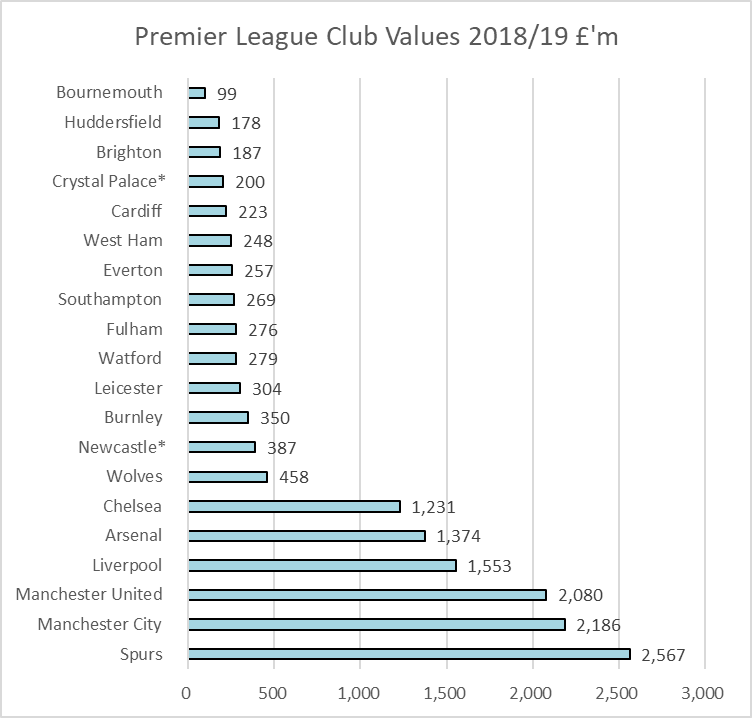
Browsing the internet after posting, I came across the University of Liverpool’s football finances website, which has recently just posted about Premier League club values for 2018-2019, which, whilst doing some equally interesting things,  has rather fallen rather into the same trap. Their proprietary “Markham Multivariate Model” is based on net profit adjusted for one-off items, but unadjusted for non-cash items. The formula is quite off-the-wall in other aspects too but I will let that lie for now.

Nonetheless it leads to what I think is just as unhelpful an output (below), saying:

Spurs overtook both Manchester clubs at the top of the table on the back of reaching the Champions League final, a fourth-place finish in the Premier League and a wage bill barely half that of Manchester United.

UoL club valuations

Even from the eyes of a purely financial investor, this cannot be true. Spurs’ true hidden value, if you want to see it this way, is the stadium value and its future earnings but as far as I can see this has not been captured by Markham. If you strip that out, however well managed our wage bill is, a DCF of Tottenham vs the other clubs would not come to this conclusion. My opinion: head in hands.

Pochettino, Rationalism and St John the Baptist

“There was a man sent from God, whose name was John. The same came for a witness, to bear witness of the Light, that all men through him might believe. He was not that Light, but was sent to bear witness of that Light. That was the true Light, which lighteth every man that cometh into the world.”

John 1:6-13

The news of Pochettino being “relieved of his duties” was one of those events which, while an enormous shock at the time, with every passing day become more and more comprehensible; such that having had a couple of weeks to digest, it now seems the most natural thing in the world. Then Mourinho arrived so quickly that, as the Taoist saying goes, “if you use a sharp enough knife, the cow does not even know it is dead”.

The reason that a certain section of the fans – the majority, I suspect – were so saddened at Poch’s departure was because of how much we had all bought into “the Project”. Almost five and a half years is a life time in football today, and for parts of that, it really did seem that he was the one who had come to lead us to the Promised Land: a new stature, a new stadium, and an end to the trophy drought. Yet it had been clear for a long time that Pochettino also had limitations – limitations which, frankly, may yet prevent him from really becoming a top class manager anywhere else, even if he were to have more resources.

First amongst them was that he never really displayed tactical nous, and was instead a system manager. He belonged, in his way, to a tradition which places the system above all else, a tradition which can be traced from Guardiola, Bielsa and Wenger, all the way through Poch down to the likes of Eddie Howe and Ralph Hasenhüttl. System managers – perhaps we can call them “Rationalists” – when they are right, are irrepressible: their teams play throughout the season as a single unbroken line, constantly possessing, attacking and scoring, not punctuated by the mere whistle of referees starting and ending matches. The end of one game and the beginning of the next is seamless. This is what makes them so resilient and machine-like – scoring against them does not really achieve anything more than insects hitting the windscreen of an onrushing car. When it works, individual moments of adversity make no impact on a team’s mentality or emotion.

Against these Rationalists are the Empiricists, the school of management which takes each match as it comes and deals with them one at a time, often with tailored tactics for specific parts of the pitch or even windows of time. In this tradition belongs Mourinho above all others, the man who makes double substitutions at half-time and who famously defeated Pep’s Barcelona in 2010 with ten men. But there are others: Ancelotti, Allegri and Conte for instance; Marco Silva and, I would guess, even Big Sam. Italy was always the home of tactical men such as Lippi and Trap, with little acceptance of outsider Rationalists such as Sacchi. With them, the moment and the match are everything: these teams win cup semi-finals and finals, derbies, and top-of-the-table clashes. By and large, a siege mentality is useful; but so, too, is the ability to discard players when needed. In a sense, it favours a little bit of the under-dog.

The problem for the Rationalists is that when trying to make the system work, there is a fine line. Success is magnified by compounded success; but loss is likewise exaggerated. There is no “middle”. For an Empiricist, your last game can prove you right; for the Rationalist, only success over a long period can justify the seemingly rigid adherence to the system. Poch did not make substitutions. He did not, until near the end, introduce formational changes. He remained loyal to players at all times. More than anything, he was not good at incorporating new players and needed the constancy of his core group, pressing them repeatedly to come up with the same goods, game after game, season after season.

And this would have been fine, if players had rotated. But the iron law is that either the players have to be freshened up … or the manager does. But there was a further dichotomy with Poch which was that he was so dogmatic that he struggled to bring in new players at all. I believe there is every truth to the claim that he rejected new signings during the summer of 2018, because he did not feel they would fit. Additionally, he did not have a great track record of new signings anyway after the departure of Paul Mitchell in 2016. His teams were always thrown by resets such as summer breaks and even normal international breaks – form was always randomised after such events like the dice in a game of Boggle. Yet at the same time he refused to introduce new talent, meaning the squad was tired out. It was intensity without any possibility to refresh.

Which brings us to what Pochettino should be seen as: not as the Saviour, but as St John the Baptist, crying out in the wilderness before the coming of the real thing. Poch understood that for a few seasons he had to ignore the noise of fans and media and demands for silverware, and just concentrate on stature. The rest would come. He was specifically the right man for bringing Tottenham out of being a probable-top-six club to a regular-top-four one – a role he may be destined to repeat, since if he were to join either Man Utd or Arsenal, they would rightly want this particular trick repeated. His five years at Spurs were a necessary time and place, and he leaves a platform ideal for the next step, whether that be under Mourinho or anyone else. He fit that stage of Levy’s development plan perfectly, and in retrospect, it was never likely to be anything more. Much like Bielsa, he may be destined to never achieve true greatness; and much like St John, he may not himself be the True Light, but rather be destined for undignified decapitation.

Pochettino

Nonetheless St John has his retinue of true followers and believers, and good luck to them. There are those who might want the Rationalist system despite the tactical rigidity and squad management. These are perhaps the purists, though they are destined to be as tangential as the Mandaeans. For myself, despite the initial shock, I am all for the man who may well turn out to be the True Light.

In nomine Domini, Amen

In defense of football managers

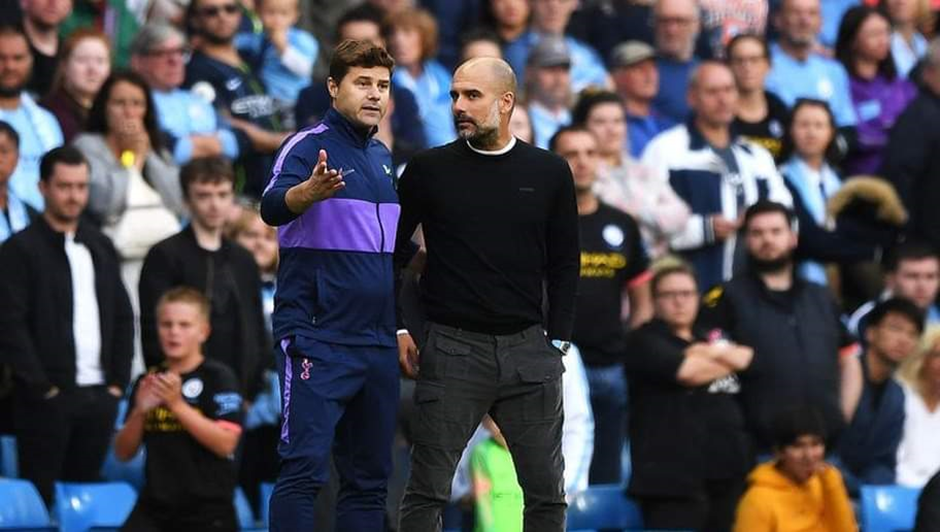
Mourinho Pochettino

Last night was one of those glorious Spurs nights which, under Pochettino’s reign, rank alongside last season’s win at Stamford Bridge in terms of “announcement”. Therefore I would love to dwell on it – but I will not. Instead I want to make a different point in support of Jose Mourinho, a manager I have not much liked over time but who I perceive to be somewhat victimized.

A lot is leveled against the Manchester United manager these days: bullying of his players, attention seeking, shortness with the media, finding excuses about the talent in his team and directing criticism onto the Board. Yet amongst all this analysis, I often find that there is a disjuncture between commentators and fans, with commentators – the typical “chattering classes” as it were – frequently focusing on the coach a lot more than supporters.

Take last night. I woke up to the news that Mourinho had walked over to the Stretford End stand in what appeared like a valedictory farewell with a few hardcore fans. This turned out to be fake news – as Gary Neville pointed out on Monday Night Football in listening to Mourinho’s post-match interview, one can tell he simply wanted to applaud some fans who had remained to the end. Of course, to media commentators, who have been aiming for Mourinho for some months now, it seemed obvious that the fans should be fed-up. After all, who else is there to blame, when the manager has spent more than £300 million net on transfers since his arrival? In their view, those in the stands must be onboard with the media agenda too, of laying the blame squarely at the feet of The Special One.

But football fans are much more likely to blame the players, who they sometimes see as not pulling their weight or trying hard enough to bleed for the team, and always see as overpaid; or direct their ire to the club ownership who they feel are not investing enough or only there for the profits. Yes, there are certain managers who get up the nose of their own support, such as the way Alan Pardew consistently did. Sometimes this is because of “playing style” such as during Sam Allardyce’s short-lived sojourn at Everton; other times there are much overt clashes such as Mick McCarthy’s fiery relationship with the terraces at Ipswich. But as witnessed with Arsenal fans for the last two seasons or with Moyes’ brief stint in charge of Man Utd, tolerance for managers is actually quite high. They are not paid as much as players usually, and are reckoned as having a bit of a tough job treading between preening athletes and cynical club executives.

So why this disjuncture? As usual, the blame lies in with the media being limited, insular and lazy. First, they rarely think outside the box – listening to Henry Winter, the much-lauded Times football correspondent (five times Football Journalist of the Year, no less) offering up his analysis was painful – “he has lost his touch” was the stumbling insight offered on Radio 5Live. Secondly, they are being played as part of a game they seem to have no idea about. These days few players and even fewer owners speak to the press freely. Post-match player interviews are generic and pointless, to the extent that even I have to laugh at the BBC’s Dead Ringers when the mimic my beloved Harry Kane. From an early age, professionals have been coached to say as little as the public announcements of a listed company. Meanwhile, getting words from clubs owners is rarer than seeing ketchup in canteen of a Premier League training facility – when David Sullivan gave an interview in 2017 on the back of poor results for West Ham, journalists did not seem to know what to make of it.

Managers, by contrast, are the only figures who are both obligated to speak to the outside world (Premier League post match press conferences are obligatory at the risk of fining), and often have something interesting to say. Therefore football commentators focus incessantly on the managers of clubs and to an extent allow managers to define club identities in a way that real fans do not see it. Media talking mainly about managers is nothing short of navel-gazing. For the outside observer, it is actually players who embody a club, and who have the agency to change a team’s fortunes. This may not actually be true in this age of advanced tactics and hyper preparation, but it is what is felt. Since journalists are lazy though, they rely on these moments of managerial interaction for almost every reading of the tea-leaves.

Consequently when the media, in their one-dimensional world, get the bit between their teeth about a manager, they are often surprised to see – and then usually ignore outright the fact – that fans do not follow suit. When Moyes was at his nadir, a banner flown from a plane was met with at best mixed reaction from fans, much to the media’s bemusement since they assumed all supporters must agree with them. Even Wenger for years had higher levels of support and trust from those in the ground than he did from outside, even until the bitter end.

Last night as the numbers at the Stretford End began to be revised upwards, it seems like maybe a couple of thousand Manchester United supporters stayed to the end to support and chant for Mourinho. The manager, in turn, recognized this. Supposedly, around the director’s box, a good sliding tackle from Spurs defender Toby Alderweireld in the first half caused fans around them to look up to Woodward and make the point that a lack of these signings were the cause of problems – in stark contrast to the coach. In the end, the planned (and once again inept) plane banner for next week is targeted at Woodward, not at Mourinho. When Mourinho failed in his second stint at Chelsea, the fans directed their anger at those perceived as not trying hard, such as Hazard, Diego Costa and Fabregas. The fans do not like prima donnas.

I would make the cheap and obvious political point here about how the chattering classes miss what people are really thinking and arrogantly assume that the view being disseminated are the ones which encapsulated public opinion. But with Tottenham having won a magnificent victory last night, no need for that at this point …

Why the Tottenham penalties were correct – and why Liverpool fans are whingers

Kane Klopp

Liverpool fans have always been rather an irritating lot. The combination of hubris and inconsistency, as well as constant bleating about “heritage” and history as though somehow this renders the modern success of rivals such as the Manchester clubs less worthy, lead to popular conceptions of this group as probably the fan base other fans most love to hate – “football supporters think you are either tiresome, cringeworthy or both.

So it has been particularly enjoyable not only to watch the draw that Spurs battled to in front of the Kop last weekend, but also the whingeing that poured through social media in its aftermath from fans, players and manager alike. Other than maybe Barcelona, few football supporters come at things from such a moral high horse and, as with Barcelona it is great to see them get their comeuppance once in a while. Come to think of it, maybe that’s why all their players end up moving there.

Therefore let us examine forensically the two controversial incidents from the match, through some of the most common refrained heard from excitable Liverpool fans in the few days since.

1. “Kane was offside the moment Dele passed the ball”

The implication of this is that the moment the ball left Dele’s foot, the referee should have blown for an offside against Tottenham. This is simply factually wrong and demonstrates a lack of understanding about the offside rule and even Klopp was guilty of this mischief in his post-match press conference where he said:

… there is a new rule, I don’t know exactly? I don’t know who played the pass but in the moment the ball left the foot of the Tottenham player, Harry Kane is offside.

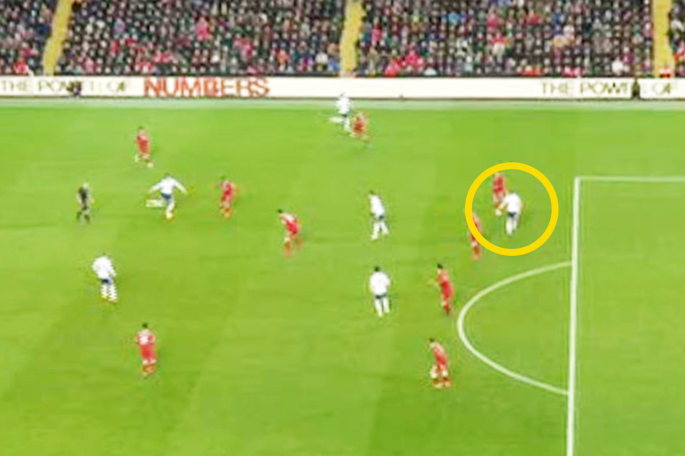
It is true that Kane was in an offside position when the ball was passed, but this is not the same as actually being offside. For the latter to be the case, Kane actually has to play the ball – in other words, had the ball not come off a Liverpool player, Kane would only be offside at the point when he received the pass and played. There is absolutely no requirement of the referee to call an offside before this point and it would be wrong to do so – players are constantly in offside positions through the match, which is why the rule was clarified to only include situations where a player in an offside position is “interfering with play”, and why today players who are in an offside position but not anywhere near the ball are not called for offside.

Kane offside

(Incidentally Klopp should know better and actually gets away with murder in a lot of his post-match comments, but let’s leave that for another day.)

Case for Liverpool: 1/10

2. “Kane was interfering with play at the point when the pass was made”

This charge has slightly more legs, but only slightly. Clearly, Kane is in an offside position but the referee deemed him not interfering with play. These are the situations which come down to referee’s opinions and it seems questionable to assume that Lovren necessarily struck the ball because of an awareness of Kane being behind his shoulder. If you look at the replay, Lovren seems to be all over the place and there is more than enough space for the referee’s opinion to be that Lovren played the ball purely because that was his instinct, not because of any perceived goal-side threat. In such situations one assumes that a seasoned referee’s opinion and read is as good as anyone’s – certainly VAR would not have resolved this question one way or another.

Case for Liverpool: 4/10

3. “Lovren was not playing the ball on purpose”

 At this point we have to accept that after the pass commenced from Dele, it ended up being (mis)played by Lovren and quite possibly by another Liverpool player also, first. Therefore the question is whether Lovren played the ball on purpose as per the official rules on exemptions for offside, which state:

A player in an offside position receiving the ball from an opponent who deliberately plays the ball (except from a deliberate save by an opponent) is not considered to have gained an advantage.

First, let us be clear that the purpose of this wording is designed to make sure that this exemption does not apply to completely accidental deflections and rebounds, the kinds of things where a ball hits the back of someone’s head inadvertently and so on. It is not supposed to cause a nuanced consideration of how professional footballers at the top level play.

In this situation Lovren clearly went to strike the ball and, due to being a simply terrible footballer (as we saw at Wembley earlier in the season), mis-kicked it. It was not an inadvertent deflection, just a crap piece of play. As such, it takes quite contorted logic to try and make the case that the exemption does not apply. Yes, it does not fall under the initially intended rule designed to exempt offsides from back-passes, but yes it falls under the strict laws of the game – the ball did not continue towards the Liverpool goal due to an accident.

Leaving this to the Professional Game Match Officials Limited (PGMOL) in their official statement, it seems pretty clear:

The interpretation of “deliberately” kicking a ball considers whether a player has intentionally tried to kick a ball – it does not consider whether the ball ends up where a player may have wanted to kick it.

Case for Liverpool: 3/10

 4. “Kane dived for the penalty”

Now onto the meat and drink of the incidents. Subsequent to the event, Kane has both admitted that he drew the contact, whilst Karius – and this is quite important – admitted that contact was made. In these circumstances, under the current refereeing environment, any challenge which a goalkeeper makes where they fail to get the ball is a poor challenge. To be clear, any time where a goalkeeper comes for a ball and fails to do so properly, leaves them exposed by definition to having committed a bad challenge – the very definition of a foul.

As that well-known Tottenham fan Jamie Carragher said on Monday Night Football (focusing principally on a similar incident involving Delafeu and Courtois):

When goalkeepers come out like a train, like he has – like Karius has – I’ve got no sympathy whatsoever. If he’s complaining about it, don’t come out like a lunatic … It was a poor decision to come out; Karius’ was as well. If there is a problem with attackers leaving their legs in there, then goalkeepers need to do something different.

My mind harks back to last season’s FA Cup semi-final between Tottenham and Chelsea, when Son’s mistimed sliding tackle gave away a penalty in much the same situation. A goalkeeper who, in missing the ball when coming out for it, makes contact with an attacking player, has committed a foul as per the rules. End of.

Case for Liverpool: 2/10

5. “Jon Moss was not sure about the decision”

This charge is linked in part to the slightly bizarre moment when the referee appeared to ask the fourth official for extra information, then did not bother to pursue this line of enquiry. The BBC’s transcript of the conversation with the linesman did seem to indicate some confusion, but the PGMOL statement also seems to put this to rest, noting that the conversation over whether Lovren had touched the ball was misrepresented:

Eddie Smart, having identified that Kane was in an offside position, correctly sought clarification on whether Dejan Lovren had deliberately played the ball. His question created some momentary confusion when Eddie asked if ‘Lovren’ had touched the ball. Moss knew a Liverpool player had touched the ball but not that it was Lovren.

There was also some manufactured controversy over why Moss had asked the fourth official for anything when he was not entitled to do so since VAR was not in action, but this is quite a sideshow which Moss has in any case admitted was “misguided”. Importantly though, he followed through on his own original opinion, as he is supposed to do.

I hate to break the news to Liverpool fans but the vast majority of refereeing decisions in a match are matters of opinion. They are not only entitled to act on such opinions but are indeed paid to do so. It is perfectly obvious that in complicated situations, referees are not going to be 100% sure of what happened but their job is to go with their instinct and the point of a seasoned professional referee is that they get these things right most of the time – as they did in this case.

Case for Liverpool: does not even justify a response

6. “Lamela dived for the penalty”

More meat and drink. To be honest this incident has barely been even controversial amongst the commentariat and much of the initial reaction seemed to be due to poor camera angles about what had happened, possibly informed by lingering bias against “latin players” and their record in this. But a closer inspection, as was done on the BBC’s MOTD2, shows it was actually a pretty hefty kick up the backside by Van Dijk on Lamela, and as Mark Lawrenson (another well-known Tottenham fan) put it clearly there:

Don’t get me wrong, Erik Lamela does extremely well and he’s very very clever. He just gets himself into a position where as Van Dijk is going to kick the ball he kicks the back of his leg, and yes that’s a penalty. Is that not a foul anywhere else on the pitch? So it’s a pen.

The threshold Lawrenson describes is of course important: the rules a are specific in saying that there should be no higher or lower threshold for what constitutes a foul within the penalty box as outwith. Again, however clever Lamela has been in positioning, if Van Dijk had undertaken such a piece of contact on the half way line, it would have been given as a foul and a free kick. A poor challenge is a poor challenge anywhere. Not being intentional is not an excuse; nor is the fact that Lamela appeared to go down heavily (although again from certain angles the kick seems more substantial that it did at first anyway).

Frankly, if the first penalty had not caused so much furore it is doubtful that the second incident would really cause any controversy whatsoever. ESPN’s Ali Moreno was one of many commentators who felt it was bizarre that it was even being talked about; whilst on The Football Ramble’s Luke Moore noted that:

… if Liverpool fans want to complain about that, I suggest they complain as well in turn about the VAR penalty they were awarded when Salah hit the ground like a ton of bricks with minimal contact, and that was overturned and awarded as a penalty.

I am not fan of whataboutery, but glasshouses and stones comes to mind. The foul component of the kick on Lamela is pretty indisputable.

Case for Liverpool: 2/10

7. “Lamela was offside when Llorente played the ball”

Now we get to the least discussed point of the whole episode, but ironically the one with the most grounds for questioning. Looking at the evidence, Lamela is probably offside by the width of a human foot, so I will not argue otherwise. However in the overall scheme of things, this kind of decision is well within the typical margin of error in football matches at the highest level and the very fact that people have barely mentioned it speaks in part to an acceptance that small errors like this are not abnormal and typically even themselves out over the course of a season. If Liverpool fans really want to moan though, this is the part they have most grounds to.

Lamela offside

 Case for Liverpool: 5/10

******************

So much for the technical analysis. Now, far be it for me to let popular support influence how one views decisions, but it is worth looking at the professional commentators and punters, and their opinions of what went on. Clearly, the PGMOL has given its own opinion that Jon Moss was correct – although Liverpool fans have been heard to allege that “of course they will protect their own!”, cue much eye-rolling. But Dermott Gallagher, seasoned referee and watching in the Sky TV studios, said the same thing:

In the debrief after the game, they’ll be told that they made the big, match-changing decisions correct on the day.

I will be fair and note that Mark Clattenburg, another pundit through his column, disagreed. Let’s see what everyone else thinks – the “court of public opinion” as Harriet Harman would call it:

Picture1

Note: “LOTG” refers to the opinion that the decision was technically correct as per the laws of the game, but that the strict application of the laws in this case made a mockery of the spirit of the rules.

Overall, a case of all is fair in love and war …