Why commentators like Martin Wolf are still firmly thinking inside the box on China

aging-population

China’s rise is not about following the conventional economic norms, and the reality is that an ageing population is probably better than a young one

China has always been a black box. For the whole of my professional life, companies (investment banks being amongst the worst) happily hire someone – anyone at all – who claims to know the Chinese market if they can make even a sliver of money. Consequently, these people are given free rein to build their own silos. For boards in London or New York, China remains “a faraway nation of whom we know nothing”. It is from this mysterious, exotic ignorance that reliably insightful commentators, from publications which should know better, produce some tired answers to tired questions. Sad to say, amongst them was a recent piece from Martin Wolf at the Financial Times titled The Future May Not Belong to China.

Now, the future may very well not belong to China. Much of what Wolf outlines from his Capital Economics report (rather too much from one source for my liking) is unarguably true: the over-investment, the under-consumption, the increasing corporate debt and reliance on exports. But they only change from fact to “problem” when seen through the same old prism of economic development. China though has been disrupting the whole framework through which one sees these issues, confounding a whole mini-industry of untiring China bears. Who can forget the inflation crisis of 2010 – 2011? The Chibor crisis in the summer of 2013? The stock market crisis in 2015? The capital outflow crisis over 2016 – 2017? In each of these and many others besides, China was to be “found out”; it never was, not because the facts were inaccurate but because the basis for observation by outsiders was so incomplete (although to be fair some of the facts were also inaccurate). The fact that the naysayers and doom-mongers have been consistently wrong may be a cheap point to make, but it is worth making nonetheless. The only laws of economics, it seems, are the ones amateur journalists derive from their undergraduate readings of Adam Smith, Ricardo and Keynes.

china bears

A non-exhaustive list of China bear headlines since 1990

However I would submit two additional unrelated and possibly more controversial theses. The first is that the way China encounters these perceived crises is actually a mark of its success in terms of being on a pathway to global power, rather than a failure. There is a reason why China encounters “difficulties” where Japan, during its own precipitous rise in the 1970s, did not: China is actively trying to change the world it is living in. These crises are the tremors generated by moving tectonic plates, as Chinese objectives grate against the rules and outcomes it is being measured against. Currency and capital flows, interest rates, debt and the banking system – these are all examples of Chinese policy that do not make macro-economic sense until you factor in that it wants to change the system and if it plays its cards right, it probably can. We are faced with the first occasion since the United States back in the 1840s, where the world may have to accommodate a new power, and accordingly the rules will change. For China, this friction is good.

japan china gdp

Source: The Economist (2010)

To run through just one example of this, let us look at capital outflows. The reason capital outflows seem like a “crisis” is that the Chinese government wants to control the currency rather than let it be determined by the market. To pay for this, it must use foreign exchange reserves to keep the exchange rate stable. This becomes a huge cost when the environment is weak – except that the reason China does this is to try and make the RMB a regionally accepted trade and reserve currency. This could be done through just trade alone, but in China’s case it will also be done through the crypto-imperialism of the Belt & Road and other initiatives. If it succeeds, it will both eat into America’s ability to project power through the dollar, as well as ultimately encourage greater consumption of Chinese-made goods which in turn once again brings capital flows back into balance. It is a risky and expensive, all-or-nothing gamble; but unlike merely acquiescing into the current world system, if it succeeds it will have changed the regional financial and trade landscape. A price, some would say, worth paying.

The second thesis focuses on the cliché that China may be facing the middle income trap – that it may “get old before it gets rich”. This is typically paired with the curiously British trait of enthusiasm for India as an alternative story. Yet I would argue that with the coming of automation, China is actually on the right side of history on this and that far from fearing age, the adage should be turned on its head: for many comparable countries it is youth, not age, which will be a great peril; and these countries may be too young to ever get rich.

We have for some decades been fed the neoliberal trope that a younger population is good for the economy, and that pursuit of youth, through birthrates or immigration, is a Good Thing. Yet we are fast approaching the point where this notion is being exposed, because automation is actually a process which will eat into youth employment rather than any other. China’s workforce is actually declining and has been for some years, just in time for robots to start taking over.

The process of classic industralisation is just one of various models for a country to develop. But in this particular model, families can contribute labour rather than capital in order to obtain greater earnings, and thereby over time accumulate household assets. For many countries though, this industrialisation may never now be possible. The Economist noted as much when opining that the pathway of development exhibited by the China + ASEAN axis is probably irreplicable by anyone else including markets in Africa and South America. Goods may be manufactured in some of these economies, but it will be robots that do most of it and young median households will never cross either the asset-owning or educational thresholds required to survive automation before it hits.

Now, it may be that these countries find other models to become rich, but I doubt it. Agriculture or resource extraction will be possible for only a precious few. The mercantile model is not stable or sustainable. Services, as we have seen, actually produce a lower return on labour than industrialization does since jobs are often of a lower quality. In any case one of the stark lessons of 2016 was the fact that in 29 out of 50 states in the US, trucking was the single most common form of employment – and this, more so than manufacturing, is where automation will first hit.

us job types

Source: NPR (2015)

The fact is that to weather automation, median family assets need to reach a critical mass enough to be “invested” into the economy such that they can be gainers from robot productivity rather than victims. The most obvious if questionable form of asset-ownership would be home-ownership, but in an ideal world it would take other forms. China’s urban population has just about caught this train (financial income growth has far outstripped wage growth in recent years), but younger populations in India or Vietnam may not make it. Young people inevitable have fewer assets having had less time to earn; if their family does not reach this critical automation-neutralising financial position, they face eternal unemployment. OECD economies mitigate this conundrum somewhat through welfare transfers, but welfare is another privilege of long term asset accumulation by Society – a privilege emerging markets do not have. It is a race against time and any country that fails to achieve this will be left without a chair when the music stops.

In this context, I have little time for those who argue, as Wolf does, that India is “the most interesting other economy” (Americans I have noticed, tend to use Vietnam as their preferred example). As one of my friends commented, “the human race will probably be extinct before India has an airport like Pudong”. Taken individually, each of these points (China’s extra-economic rise and youth being a greater concern than age) have huge implications about the rules and framework for emerging market development theory. Taken together however, they may represent a perfect storm which leading to an inflection point in global economic development. In this case, being wedded to the old ideas, commentators like Wolf are probably missing it.

Why Britain could demand asymmetric labour access to the EU – and why it might be best for both sides

Freedom of movement

The disputes over Brexit negotiations have mostly been premised on the idea of reciprocity – or rather, retaliation. If we do not give them rights, they will not give them to us. This has been particularly true when discussion freedom of movement, possibly the single most important driver of Brexit voting in 2016. On the face of it, there seems to be logic in the EU demanding that EU nationals be allowed to freedom of movement into the UK if the UK wants the same thing in return. However this may belie the reality, which is that asymmetric access is perfectly viable and indeed valid.

To give one example of where this makes sense, let us examine Chinese policy with regards Hong Kong. Here, Hong Kong residents have an almost unhindered access to the Mainland and its economy, not only in terms of movement and residency, but also asset ownership including real estate and businesses. Chinese Mainlanders on the other hand face extremely stringent rules on coming to Hong Kong and particularly for settling here. Work visas are required almost exactly as they are of any foreigners. Yet this is essentially just one country with ultimately one government. And yet it suits both sides.

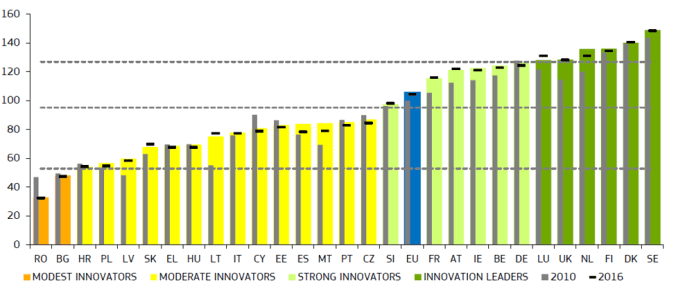
Why? Well there are two main reasons for allow one-way borders. The first is when one area needs skills the other has. This was historically true of Hong Kong and the services it provided to mainland China in terms of capital and skills, although today this is no longer so relevant. In the case of Britain and the EU, there are arguably skills which those across the channel, all things being equal, would prefer to have. Banking and finance might be part of this, but it seems unlikely. Much more relevant is that Britain is far more innovative than the rest of Europe and particularly so compared to the larger countries. In the European Commission’s innovation rankings for instance, Britain comes fifth but well ahead of Germany, as well as France, Italy and Spain. This is something the EU would surely rather not lose: startups and business ideas which could change the world but which need a large market to be tested and improved. For this reason, one-sided migration would be net positive.

European countries ranked by innovation

European innovation

Source: European Innovation Scoreboard 2018 (European Commission)

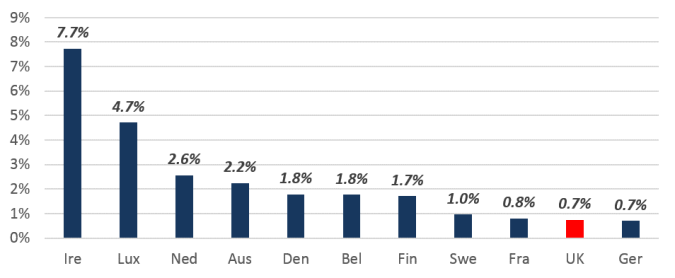
The second reason is the defensive one and relies on a resource Britain has an abundance of: parochialism. One of the reasons China has no particular fear of opening the border to Hong Kong is that there is very little chance that people will want to cross the border and stay there. Oddly enough, Britain is in the same boat, since Britons have historically been far less likely to move to another European country than many others, especially those of a working age. If we look at northern European migrants to other northern European destinations (in other words, intra-EU migration which strips out the retirement population) Britain figures as one of the least mobile populations behind even France. Only Germany is marginally behind and this is due to its outstanding export economy.

Total intra-Northern European emigrants as a percentage of total population

Intra-European migration

Source: People on the Move (Bruegel Jan 2018)

This reflects only “rich” Europe; if eastern and southern Europe were included the numbers would be even more stark. This peculiarly British parochialism can be seen in everything from the lack of language learning in British schools through to the reluctance of British footballers to move to European leagues which are better for their career. In other words, the British are much more disinclined to move and settle in the EU than the other way around, so that offering asymmetric access will only help business without causing any employment displacement.

This is a classic and enjoyable case of hidden asymmetry, the defining theme of this blog. The simple fact is that just because access is unequal does not mean that it is imbalanced or not beneficial to both sides. Reciprocity may seem “fair” on the face of it but may not actually be relevant – when there are cultural asymmetries as in this case, there is a good case to argue that reciprocity is not needed. Unless indeed retaliation is the core objective.

The hidden costs of parenting – why PPP could become PPPP

stress-cost-of-kids

Purchasing power parity or “PPP” has for many years been as good a proxy as any for allowing comparability between figures such as different countries’ GDP. China’s economy, for example, has a nominal GDP of just US$12 trillion, compared to America’s US$19.4 trillion. Yet when re-based on PPP, China’s GDP is actually US$23.2, making it the largest in the world. I for one accept that this is a useful indicator of economic strength, in the sense that China as a country is able to mobilise more economic resources than its nominal GDP would strictly suggest, since labour and capital there are cheaper. Likewise, a preferred measure of living standards is that of GDP per capita at PPP, or sometimes (better) average wages at PPP. In this way, some comparability may be afforded which accounts for street food in China appearing so much cheaper than in the West for instance.

Yet a friend of mine recently noted that in a sense, PPP-based comparisons of wages and living standards were very much geared towards the individual. A great leveler, he reckoned (as a relatively new parent complaining about the costs of the endeavor) was the arrival of children into his life. Because whilst in theory a basket of goods for PPP calculation includes items needed for raising children, in reality behavioral differences distort its reality. PPP, he felt, did not reflect the full costs of parenting and its effects seemed most intuitive to a single person. When considering where to live, PPP in his life could and perhaps should be re-adjusted to Parental PPP or “PPPP”.

There are three main buckets to consider in making any such adjustments:

1. Direct additional costs of education
2. Consumption choices
3. Real estate costs

The theory here is as follows: wherever you live in the world, the likelihood is that you will as a parent attempt to make up for the deficiencies of the world around you as best you can, in the interest of your children. This comes out of your own resources, and actually in many countries where life is “cheap”, when it comes to raising children those expenses shoot right up again. For instance, as a single person one may choose to drink tap water; as a parent one begins to invest in water cleansing machinery or bottled water (especially in Asia). Education is an important element too, since although many countries provide free universal education, parents recognize their limitations and will correspondingly pay for tuition and other aid. A surprisingly large selection of countries such China actually see parents effectively paying for education despite it being notionally free – and this is before getting to the issue of boarding schools paid for by expats. Lastly, real estate requirements are different and in some parts of the world rents / price counter-intuitively increase with the size of a property, commanding a premium due to restricted space.

So a comprehensive, scientific adjustment to PPP would require a sophisticated model which includes all these factors. To test it though, I instead looked at a simplistic account using only one factor that I could readily find, HSBC’s analysis of how much parents pay for their children’s education in several countries:

Cost of parenting
Source: HSBC – The Value of Education report 2017

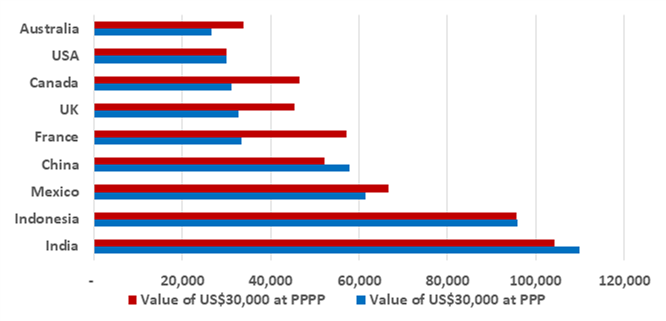
Using this data as a rough proxy for all-in childcare costs (imperfect, but it is all I have to hand) I then readjusted the standard PPP index as provided by the OECD. The assumption I have made is that one-third of a parent’s income is used on children, a figure broadly in-line with statistics also published by the OECD. Thus I left two-thirds of income adjusted on the official OECD PPP basis, whilst the remaining one-third I have adjusted using a new index created by comparing total childcare spend. The results look like this:

Value of 30000

Basic and clumsy though this analysis is, it shows some interesting trends. First, as my friend suspected, the “real” living costs for a parent in places like China and India may be in fact higher than initially assumed, due to a surprisingly high need for private spend. But even more notable is how much value is added by the welfare societies of France and the UK, where the median family does not spend anything like as much for education particularly at the tertiary level. Median wages go a lot further in Europe and Canada than in the US under this system – and indeed US$30,000 almost matches the value of US$30,000 in China. The same kind of logic no doubt applies to issues such as universal healthcare. Assuming my calculations are even remotely accurate, life is fundamentally as cheap in Europe as it is in China, whilst life in the US remains the most expensive.

This methodology is very preliminary, full of assumptions and no doubt lacking. I would be happy to hear opinions on how best to improve it. However the basic theory is strong, namely that PPP may have a simple underlying flaw due to not accounting for changes in life cycle; in some cases PPP probably needs to become PPPP to be meaningful for public policy and for investment purposes alike. Essentially, single life remains localised whilst parenthood is becoming globalised. Since parenting costs are only going to increase as we go forward, the issue becomes particularly prominent. PPPP could be the future.

**************

For those keen to see the underlying data, below is the table of calculations:

PPPP table

How all politics really works – in one simple chart

Introducing the General Theory of Government 

The events of 2016 were curious because of their dichotomy: on the one hand, they were such a shock to the political classes, on the other hand they were also entirely predictable. Yet the commentariat both then and since appeared to miss (or simply forget) the most basic and obvious premise of how all politics works: namely that the ruler has to offer the ruled a mixture of both material and psychological well-being. The desire for identity is as legitimate a concern as any amount of wealth, and any government that fails to provide one or the other over a long period of time will suffer the occasional revolt. Understanding this explains Brexit, Trump and any other examples one might care to mention.

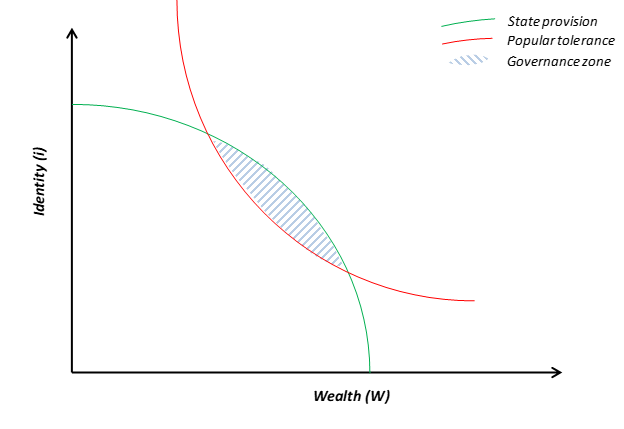
I do not claim this to be revolutionary, but given its lack of profile and given the impending elections in the US which will doubtless cause another round of soul-searching, I think it is useful to visualize this concept in a simple, easy to comprehend model. With no further ado therefore, all politics can be represented in this single chart:

General Theory - basic model

The Wealth-Identity Trade-off Model

It should be easy to see where I am going with this. Into the x-axis goes all those things which politicians want to focus on: taxes, welfare spending, the cost of living. Into the y-axis are all those things politicians seem not to think exist anymore such as ethnicity, religion and language. And, in a democracy at least, any government which consistently offers too little of one or other of these parameters, will find themselves cast out. We have for perhaps too long been living in a world where the governing classes have not only mistaken how to deliver W (Sanders, &c), but completely ignored i (Trump, Farage &c). Political parties across the spectrum have spent the last few decades obsessing over the x-axis whilst assuming that the y-axis will tend to itself. Rectifying this will be, as I have alluded to before, the dominant theme of the next two decades at least in the West.

I would hope this is all intuitive enough not to need vast amounts of explanation, but in a series of posts I intend to outline the basic premise of the General Theory and specifically its core idea, the Wealth-Identity Trade-off Model (WITM™). I will go on to examine how and when a society ceases to function properly; what a society really comprises within the model (“Median Man”, or “MM“); and lastly look at some applied examples in the world today and perhaps yesterday.

What I am proposing is not in itself, I think novel; however like all good things I believe this theory synthesizes simple, intuitive ideas which have at best not been expressed before in such a manner, or perhaps may not have been coherently identified. To anyone who disagrees with this, or who have contrary opinions, I look forward to hearing them. Additionally, since these are blog posts which may one day find their way into a book, I will not footnote everything in detail. However I trust that enough is articulated to allow the reader to comprehend what I intend.

The End of Entrepôts – why the future is big, not small

Lugard

Photo: Lord Lugard with the Legco in 1909

It is one of the most oft-repeated fallacies in modern politics that the future is destined to be ever smaller and fragmented. One only has observe the fetishization of breakaway movements such as Scotland or Catalonia and hear the accompanying, knowing murmurs telling us that in political terms at least, atomization is the way of the future – small is beautiful. Some still reach further back, summoning up the collapse of the Soviet Union as proof that all large entities must collapse.

This is completely at odds with reality, on a number of levels. First, recent history has, far from being driven by a narrative of devolution, instead been dominated by the rise of “big countries” which in turn are resurrecting their own brand of Great Power relations. The corresponding decline in relevance of smaller entities is pronounced – most noticeably in the shape of individual European nations which have seen their weight fall off considerably. The 2010 Copenhagen agreement, where Obama sidelined the Europeans to reach straight for emerging giants, was an early sign of this; the gradual extinction of the Quadrilateral in determining trade policy was another.

Indeed in my 2013 paper on China and multilateralism, I noted that the world is if anything heading towards a new “community of empires”, with both the foreign and domestic policies of China, Brazil and India joining the US and Russia in pursuing an unrelentingly imperial logic. In response, those outside of their orbit are banding together to form what are prima facie trade blocs, but which are in reality the beginnings of something much more. Whether the European Union, ASEAN or Mercosur, nation-states are ceding sovereignty slowly but surely for the express purpose of aggregating their power in the world beyond. Even in unexpected corners of functioning humanity such as East Africa, union is the name of the game. Status and size do not have a linear correlation; as one reaches critical mass, the relationship becomes exponential. A power ten times as large as its neighbours is far more than ten times as important.

At the heart of this is a simple thesis: in the long run, the power of any country will be determined by the size of its population (with a shared identity – more of that another time), somewhat adjusted for a country’s natural resource base. In the long run, all else is mere noise. Yes, certain countries or civilisations may exercise disproportionate power for a period of time, even centuries. This can have any number of causes but often it is because of temporary technological disparities – temporary because in the long run, all technology will permeate meaning that we arrive back at where we started: population. Any vision of a world where the largest population blocks are not the most important countries must be premised on a smaller, more nimble country actively and exploitatively keeping larger population blocks subject. This was a kernel of much of European colonialism of the 19th century (which should not be conflated with a general model of imperialism exercised in human history).

Now in the long run, as Keynes says, we are all dead. So does it matter? I would say yes it does, particularly for those living in and around the rising powers of Asia such as China, Indonesia and to a lesser extent, India. Because some of these changes are no longer concerns for the long term, but coming to maturity now.

One lesson is this: the age of entrepôts such as Hong Kong and Singapore is fast coming to an end. In the future, there will be no space for such outposts any longer, at least in their current form. This is because the very existence of such centres is a lingering post-colonial legacy, based on an economic system that is now no longer extant. City-states like Singapore thrive because they are a form of offshoring, and the offshoring they offer is reaching the end of its useful life.

We should be crystal clear that offshoring has two forms: there is offshoring for work a country does not want to do, and offshoring for work it cannot do. On the one hand, there is what we classically understand as “offshoring” where one jurisdiction offers a cheaper way of producing goods and services for a richer one – offshoring from below. Textiles in Bangladesh fall into this, as does the core of China’s economic rise during the 1990s and 2000s. The second form is what hubs such as Hong Kong, Singapore, Dubai and even London offer to an extent – offshoring  from above. They provide capabilities that other poorer, less developed countries cannot do themselves.

The problem is that much of the world is catching up. There is precious little that can be done in Hong Kong today that cannot be done in China; yet Hong Kong really only exists to serve the Chinese economy, much as some lament its progress to becoming “just another” Chinese port. Singapore is safer for the moment, but it is still implausible to imagine that Malaysia, much less Indonesia, will allow the island to remain an offshoring hub for high value-added industries such as finance. As with China, they will end up doing everything themselves. The post-colonial legacy of substantially inadequate skills and infrastructure will be bridged, if not today, then tomorrow. At that point, the city-states will have precious little left. This is a problem not faced by Bangladesh – but then no-one wants to be Bangladesh. There is a reason why entrepôts barely exist in the OECD and if they do, they service a tiny, marginal sliver of their neighbours’ economic life as Jersey or the British Virgin Islands do. It is because there is no room at the top.

Britain suffers from many of the same issues. Plenty have lauded the supposed rebirth of the British automotive industry, and in a few instances, this is well justified. But for every Aston Martin or Morgan, where real value-add and R&D is achieved in the UK, there is a far bigger presence of Nissan or Toyota. The latter however, are essentially a little Bangladesh model – investment into the UK occurs not because of any inherent capabilities, but because we are marginally cheaper and have fewer regulatory restrictions (unionization etc) than regional neighbours. This is not much of a national dream.

The other side of the UK is that of the entrepôt. Here I am referring to her services exports – but not the headline-grabbing financial services sector, which will be pretty easily replicable elsewhere, but rather industries such as advertising, publishing, design and architecture which are more genuinely unique. And one can tell that they are unique, since whereas the UK can barely export any financial services to the big empire economies of the US or China, it sells large quantities of stylish design. The problem is, this is nowhere near enough to support an independent UK – the idea of the UK becoming a “Singapore of Europe” is beyond fanciful, as I have noted before.

Singapore has been conspicuous in how strongly it clings to and pushes for ASEAN. And the reason is clear: if ASEAN does not succeed in binding the region together, Singapore will soon have nothing to offer its larger neighbours. Only a union of sorts will allow it to continue holding a position of import. Hong Kong’s commercial residents have long acquiesced to the fact that it will have to be another Chinese city, albeit one offering some special rules and playing a specific role. Hong Kong’s flagship airline’s troubles reflect the decline of hub-and-spoke trade in favour of point-to-point, and are a microcosm of how the whole economy is developing. Dubai will play off the inability of regional giants to pull their weight (Iran, Egypt and Turkey) but if and when they do, it too will face the same problems of reinvention.

But the old model of “Singapore” is a complacent and condescending anachronism – and those pushing the model for countries like Britain are living a sheer fantasy.

Explaining the Umbrella and Sunflower protests

As a brief follow-on from my previous piece on Taiwan, I have done a quick and dirty analysis on what is driving youth discontent in Greater China, and specifically what has arisen in Hong Kong and Taiwan in recent years.

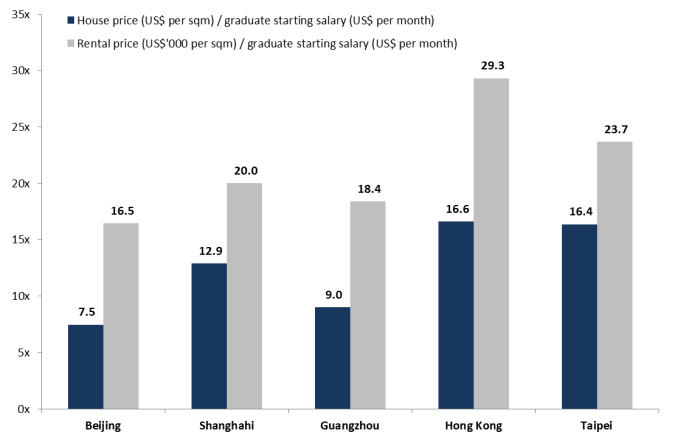
In this single chart, I believe I capture what I would call the “aspiration deficit” in being a young person in these two jurisdictions today. Here I have calculated the house pricing and rental in key cities as a multiple of graduate starting salaries.

Graduate salaries

Sources:

  1. Graduate salaries for PRC cities from Baidu News, as per 2017
  2. Graduate salary for Hong Kong from SCMP, as per 2016
  3. Graduate salary for Taiwan from Taipei Times, as per 2016
  4. House price and rental data from Knight Frank Greater China Property Market Report Q3 2017, based on Luxury Residential

The caveats: this is not designed to give any sort of rule of thumb about how long it takes to save for a flat, or how much is used up of income to pay for rent. I may even come up with a better methodology going forward – if the data allows. Instead, this exercise is simply a measure of what pressure there is on the dreams of those who newly come onto the job market, having been promised that their four years at university would lead them to a better life. This is why the luxury Residential market is I think an adequate metric on which to judge.

What is shows is quite how desperate prospects are for many of those in Hong Kong and Taiwan. Their earnings are stagnant, yet house pricing is going up. Welfare is better than in China, but the infrastructure is beginning to creak. The idea of looking after themselves – let alone looking after their parents – seems distant; and of course having children in this environment is ever less appetising. This is perhaps the single largest contributor to the upheavals experienced from students and other youth in the Umbrella and Sunflower movements – and it explains why so many young people see their future in China or elsewhere abroad.

To bring this back to politics, I wrote some time ago on the problems Beijing has had in relying on local tycoons to press their case in Hong Kong:

… less obvious has been how housing prices are preventing young local Hong Kong residents from starting lives properly, and in this as with much else the fault lies in a government that has existed to serve the tycoons – let us call them the Oligarchs – instead of the people. Beijing has been complicit in this since it decided to use the Oligarchs as a shortcut towards legitimacy after the handover. In colonial times, many tycoons were respected by locals as examples of being able to escape the unspoken racial glass ceiling, but since 1997 these Oligarchs have gone on to really take local people for a ride. Beijing is now paying the price for siding with the rich against the poor for so long. There is a limited amount of time that this can continue before Beijing must begin to change sides.

The same, in a sense, is true of Taiwan, where the big business lobby has been allowed to get rich off mainland China, repatriate their earnings and create asset bubbles in Taiwan that put home ownership increasingly beyond the reach of locally based graduates. It is a death spiral for aspiration – and it is this, much more than any real impact on living standards – which diminishes the legitimacy of any regime.

American poverty is neither urban nor rural – it’s small, mostly white towns

A vacant, boarded up house is seen in the once thriving Brush Park neighborhood with the downtown Detroit skyline behind it in Detroit,

It has been a year since Trump entered the White House, and eighteen months since the Brexit vote. Yet the media still display an astonishing lack of understanding about several aspects both of US wage stagnation, as well as how it interacted with voting.

The Brookings Institute came out with an important piece recently which has not received the attention it deserved. They produced five maps, showing the winners and losers in median wage change across the US between 1999 and 2016. Some of the results are obvious: the first map, of “winners”, shows that wages in the tech hubs and in government subsidised DC have done rather well; the last map, showing where wages have done the worst – step forward Detroit amongst others – is also a well-worn narrative.

But it is the penultimate map which should be most concerning. I have long argued that American liberals take far too narrow a view of poverty, and see the role of government as essentially providing urban answers to urban problems, which are the most visually obvious to those inside the Beltway. This ends up focusing on helping ethnic and other minorities, albeit usually in a less-than-constructive method. Altogether ignored is where much of the real poverty lies – as this map shows:

metro_20171012_alan-berube_fig4-struggling-v3

It repays some close study. The problem areas are not Detroit or Flint or Cleveland. The problems are that 10 urban areas of over 1 million inhabitants – and another 59 towns of between 100,000 and 1 million – have experienced median wage declines of 10% – 15% over the period. On the basis of this study, that’s 50 million people constituting the single largest group, and are not all names you would expect:

While the group contains a handful of large Sunbelt metro areas still laboring to rebound from the late 2000s housing crash (e.g., Miami, Orlando, Phoenix, Tucson) and a few major industrial centers in the Midwest (e.g., Chicago, Indianapolis, Milwaukee), small- to mid-sized urban areas predominate in this category. Most are manufacturing centers that lost significant numbers of middle-income jobs in the 2000s that have not been replaced, including 10 urban areas in Wisconsin, six each in Michigan and Ohio, and five each in Georgia and Indiana. A few have shown some green shoots in the 2010s after a rough decade, including Ann Arbor and Kalamazoo in Michigan, and Oshkosh in Wisconsin. Others, however, have slipped considerably since 2009, such as Charleston, W.Va., Davenport, Iowa, and Springfield, Ill.

This reinforces two lessons. The first is that the often quoted cliché about urban vs rural voters is a false one; neither America (nor Britain) are about large urban centres. By my last count, well fewer than half (43%) of Americans lived in conurbations of over a million people. Fewer again (33%) lived in cities of over two million. The genuinely rural population is also small (15%). Instead, real American life is about small market and post-industrial towns.

Politics focused on what happens in New York or LA, and contrasted perniciously against what happens “out on the ranch”, is not helpful to anyone. Reporters and politicians know all about the urban indigent, even if they do not do much about it; but they seem to know nothing of the small-town working poor. That is what Trump and Sanders were all about. It is also the case with Britain, as was identified in an excellent piece in 2007 by Blair Freebairn.

The obsession with reporting on urban areas is one I have discussed before in relation to media misinformation about street protests in the developing world.

Neatly compact urban street protests are highly photogenic and easily captured on camera. Crowds sell news … It is difficult for outside observers to empathize with anyone other than those who are so passionately occupying the capital. It also involves much greater effort and investment in time – time which is not afforded by the twenty-four hour news cycle.

The great tragedy is that the same misguided focus is applicable at home, where we discovered last year that journalists who should know better, did not.

The second lesson is the danger of economists and economic commentators continue to fall victim to the intellectual Tyranny of the Mean, whereby average numbers still form the focus at the expense of median data. What I should hope is by now a very commonly seen chart shows the disparity which still leads to the incredulous question: “who are all these poor white people?”

US_GDP_per_capita_vs_median_household_income

There is little sense in technocrats informing voters that their economy has been growing, or that living standards have been rising, when no-one recognizes it as such. The disparity shown here is not only obvious as a chart, but more importantly in how voters feel about the economy. Median calculations are not perfect, but a good starting point would be for all economists to rethink along median lines each and every time they put out a statistic or indicator.

All said and done, it seems to me most liberals have still not grasped the underlying lessons of the last few years. Obama, of course, had precisely zero to say on the issues that would come to dominate 2016 – he barely seemed curious about such trends, for someone so supposedly intellectual. Fighting the urban-rural battle is to continue the last war. Small white towns are where it’s at right now, and telling them they’ve been doing okay is not going to win any votes.

China is reinventing the equity markets – and Britain’s aspirations are shrinking

First, the exposition:

  1. Exuberance for equity as a class of investment reflects how confident a given society is in their future; preference for fixed income indicates the opposite
  2. China has been reinventing the equity markets for some time now, becoming the first country since the rise of the US to really have the risk appetite for it
  3. In doing so it is breaking the convention of maturing countries in the region (Japan, Korea, Taiwan) as well as ageing civilisations such as Europe
  4. As with so much else, China is the new America

The above can be seen in a number of ways. Consider this: despite the scare stories about rising Chinese debt, it is in fact equity (both institutional and private capital) which has mostly funded fixed asset investment in recent years – averaging 66% over the last decade versus just 52% over the decade before. Anecdotally too, we know that all around us in China new startups have no problems accessing micro-equity from friends and family for the most spurious of businesses.

Self-raised funding as a % of fixed asset investment in China, 1995 – 2016

Self-raised funds.png

Source: National Bureau of Statistics

Note: the NBS splits out five categories of funding for FAI, namely Government Budgetary Funds, Domestic Loans, Foreign Investment, Self-Raising Funds and Other Funds. It is reasonable to assume that Self-Raising Funds constitutes equity investment, and that a portion of Foreign Investment may also do.

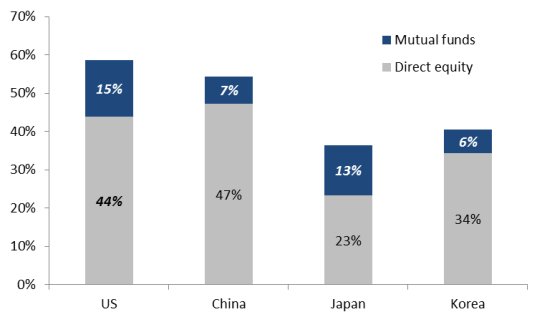
Likewise, institutional equity and equity linked investments account for a higher proportion of Chinese asset allocation than their East Asian peers – and are more reminiscent of the US in approaching 60% of allocations. Conservative Japan and Korea are the reverse. Small wonder then, that annual stock turnover in China is far higher than other markets (around 5.0x compared to c. 1.5x in the US, Korea and Japan) given the limited supply of listed equity.

Equity proportion of total non-cash household financial assets, 2016

China vs peers portfolio allocation.png

Source: Goldman Sachs Investment Research, 2016

Again, this reflects the fundamentals of not only an economy, but the society on which it sits. Buoyant equity markets reflect confidence not just in business, but in the system and the role of a country in the world. This is especially true when we think about equity provided by the retail markets, either through stock markets, or its proxies, or through earlier stage funding such as seed and venture funding where China is now the world’s second largest market. The basic principle is that when tomorrow seems like it will be better than today, people will gamble.

China still has a long way to go, of course. Its stock market capitalization per capita at c. US$6,000, still lags its peers and is just one thirteenth that of the US (and no, PPP is not appropriate here). Its private equity market, though already Asia’s largest, still has some way to catch up also at only one-third of North America. Nonetheless, China seems to be well placed to pick up the baton from the US of driving the whole culture of equity and all its attendant benefits.

And it matters. The point about equity is not just that it is one source of funding, but rather that it is a source of long-term funding and seeding for growth. A country that begins preferring fixed income to equity is giving up on its future, but also giving up on the idea of being a leader in innovation and technology. It is no coincidence that America has been the world’s great equity proponent for the last century and the cradle of  most technology; or that China is following in its footsteps. These are the hallmarks of “big countries” that make their own rules and are a force in the world.

On the other hand, a country like the UK should be very worried indeed: equity in portfolio allocations has declined alarmingly from well before the 2008 crisis. This reflects some ageing – but the ageing profile is less severe than many of its neighbours. Rather, I believe it reflects a psychological retreat from aspiration.

Changes in broad strategic asset allocation for UK plans, 2003 – 2017

UK asset allocations

Source: Mercer European Asset Allocation Survey 2017

This, much more than Brexit or the reduction of blue water navy capacity, indicates the decline of British aspirations. On a recent podcast, someone asked “but how close is China to really producing an Apple?”; the curt reply came, “how close is Britain?”, alluding to the even greater absurdity of such a prospect. If this continues, Britain will certainly no longer be a “big country”.

Private equity with Chinese characteristics

Elsewhere, I intend to reflect on my pet theme that China is reinventing – and indeed single-handedly resurrecting – equity as an asset class. In my opinion, this reflects an underlying self-confidence and correlates with the emergence of other equity cultures such as the Netherlands in the 18th century, England / Britain in the 19th and America in the 20th century, in contrast to the contemporary Japans, Koreas and Taiwans of this world.

In the meantime, developments in Chinese private equity are also worth noting. For a start, when we talk about private equity in Asia ex-Japan, we are effectively talking about just one country: the PE market in Greater China reached US$222bn in 2016, whereas SE Asia combined only managed US$37bn. The ASEAN region has not yet emerged as a market of material scale.

However the prevailing orthodoxies of PE in China are also showing that the market will not come to simply resemble OECD behavior. As many observers will know, Chinese funds operate in a grey area between classic private equity and venture capital, and sometimes throw in an element of special situations or even hedge funds to boot. This comes through in the types of deals that are done – whereas conventional buyouts still account for almost 80% of the N American market, in China this is just 20%. Instead, growth capital and PIPEs account for a much larger chunk, itself revealing that PE funds typically take smaller stakes in Chinese targets and rarely buy the whole company.

Asian private equity deals by type (2012 – 2016)

PE by type

Source: AVCJ and Prequin via Bain Asia Pacific Private Equity Report 2017

Why is this? There are a number of reasons which play a part:

  1. Stage of development – the simple point that in a high growth market, sellers may be younger and in any case desire to have a greater piece of the future upside that a company might yet deliver. It also means that there is less appetite for use of debt in the transaction.
  2. Exit liquidity – by far the biggest problem PE funds have had in emerging markets is a clear pathway to exit. Recent turmoil in the Chinese stock markets for instance cause a lower risk appetite for funds, who may find it easier to sell a stake than to shepherd the company to IPO.
  3. Control issues – perhaps the most important matter, PE funds do not always have the confidence to take a company over completely since they will be susceptible to the vagaries of China country risk. A partner of some sort often seems necessary to keep a company functioning the way it has been historically.
  4. LP involvement – this leads neatly to the preponderance of strategic investors who exist in the market, and who it is better to work with than against. LP involvement in deals stands at 29% in APAC and an enormous 57% of deals over US$1bn, compared to a global average of just 17%.

LP involvement in transactions

LP involvement

Source: Bain Asia Pacific Private Equity Report 2017

So where does all this leave us? In my mind, there are a range of different players in the Chinese PE market, and they fulfill a range of roles. On the one hand, there are the classic international players, but often these are not capable of realistically doing a deal on their own without some sort of local partner angle. On the other end of the scale, you have the very Chinese funds who retain many of the classic characteristics of Chinese business ambiguity in their dealings – at times almost seemingly linked to the state. In between you have the good stuff – the international firms who have really localized and look and smell like Chinese funds; and the few local funds who have really made an effort to westernize in their business practices, if not their focus.

Here, purely subjectively based on my own experience, is an overview of the landscape of funds in and around China:

Chinese PE.png

This will cause many an argument, I am sure. But I have tried think about ways of reflecting the degree of “localisation” too. The best I could come up with involving an excel spreadsheet was to analyse where these funds were keeping their staff – the more onshore, the more localised they might be supposed. The results were interesting if not conclusive:

PE by office.png

Source: company websites

Warburg Pincus and Blackstone represent good counterpoints. Warburg is by common consensus one of the most successful foreign funds in China, and its staffing reflects this since more than half of the Asia employees are based in Beijing and Shanghai. This reflects the 26 Greater China deals they have done against the 4 in ASEAN. Blackstone on the other hand, prefer to hub-and-spoke out of Hong Kong (a business model which has had its day, as I have written before). Their deal count is correspondingly lower. It need not be added that sheer numbers of staff can help, but only if they are the right staff in the right places.

The lesson of all this is simple: China will be a very large, profitable private equity market, but it will do so on its own terms. As with much else, assuming that China will develop along the lines of its OECD counterparts is a recipe for disaster. Whilst it has some of the framework for creating a functioning market, the behavior will be totally different. Foreign participants will have a role, but they will have to adapt. This will be, as Deng Xiaoping said, private equity “with Chinese characteristics”; but perhaps we can also add, it does not matter if it is a local cat or a foreign cat, as long as it catches deals?

Why Barcelona are still not learning their lesson

Messi sad

Ousmane Dembele has just arrived at Barcelona for a “club record fee” of €105m plus add-ons which could take the total paid to around €140m, far eclipsing even the official updated €86m paid for Neymar that the club had to admit to two years afterwards (although the real cost may still be somewhat higher, and we may never know). Whether Dembele can emulate his predecessor in footballing terms is anyone’s guess; but more intriguing is the fact that he may emulate the superstar as a future exit – curiously, Barcelona seem not to have learned their lesson and set a buyout clause of only €400m.

€400m may seem a lot, but this summer has shown that numbers we could barely believe have a habit of becoming reality; if TV revenues increase, the figure will not seem excessive. But in any case, and more importantly, it is already not very high in the world of preventative buyout clauses. If any proof be needed that Real Madrid are better run than Barça at the moment, it can be seen in the buyout clauses currently in place. Not only is Dembele’s price, their newest signing, still way below the sums set by their arch-rivals, but so are all the rest of the squad – by some distance, too. Eight of Real’s stars have clauses higher than Lionel Messi, the best player in the world. Suarez and Busquets look at snip at just €200m.

Real Barca transfers

Source: Gab Marcotti via ESPNFC.com, updated for Asensio, Isco and Dembele

Why have Barça been so remiss and what explains this imbalance? Well first, to be fair, the Barça squad is just that much worse than Real’s. Other than the MSN, most of the others have passed their Pique (lol) and their clauses were signed in another era. Having said that, Cristiano Ronaldo’s €1bn clause was set as long ago as 2015, a full year before Neymar (Barcelona’s youngest and most marketable star) was set at only €200m rising to €250m over three years. Is it perhaps that Barcelona do not have the pull to get players to agree to prohibitive buyout numbers? Or is the board still arrogant enough to believe that players go to Barcelona for its “philosophy”? Either way, it is a failing of their fiduciary duties which would be prosecutable under UK company law.

Furthermore, Barcelona really have encountered a perfect storm. The inflation in this year’s transfer window has hit them just as an irreplaceable star has gone. To be clear, buyout clauses work very differently from normal transfer fees in terms of distorting the market. This is because a normal fee is, these days, usually paid out over a number of years; so that a transfer fee of €222m might only be about €55m per year. The rest of the market (though not the idiot fans) will “know” that the extra money available to the club who has just sold their star asset is only €55m at that point. But with a buyout, the money arrives instantly, meaning that the market is aware of both an entire €222m overhang, as well as the necessity to frantically spend most of it on a replacement. Furthermore, buyout clauses are by their very nature “supernormal”, higher than market valuations. This means that in turn they are causing inflation above normal market values when the money is spent in turn. In other words, it is not just usual “football inflation” (see my previous) but a buyout-driven super inflation. Barcelona this summer have become a footballing version of Mansa Musa I.

Of course in today’s world, only a few clubs are true “buyers”: Real Madrid, who do so from their own resources, and then PSG and Man City, who do not. Barcelona have ultimately been left on the heap as just another “selling club”, the dreadful epithet that even Man Utd had to understand when they lost Ronaldo to Real all those years ago. Barça just have not learned their lesson.