The many times that Spain led the way on football governance – and will probably do so again

Given the dominance of Real Madrid and Barcelona on La Liga, and the importance of men like Florentino Perez in European football discourse, the outside observer would be forgiven for overlooking the role of the governing bodies. After all, surely the biggest clubs – which vastly overshadow their domestic peers in a way that does not happen in the Premier League – call the shots?

But surprisingly, the Spanish football federation has not only frequently come out on top against their biggest club members, but has also been a historical pioneer in football governance in a way which has set the agenda across the continent.

Transfer windows

In 1995, La Liga instituted the first modern restrictions on player trading, allowing changes of club only during a long summer break and a shorter winter slot. Strange to think, that across Europe until then, all major leagues allowed unlimited transfers until each of their deadline days – end of January for Italy, February in Germany and France and absurdly the 31 March in England, mere weeks before the season ended. At the time, transfer windows were designed to protect smaller clubs by not allowing Real or Barca to take their rivals’ best players mid-campaign, and Spain even prevented mid-season moves if a player had already played 5 matches for their club. FIFA then went on to adopt this system wholesale, bringing cross-border alignment to all leagues by 2002 to the system we know today.

If no Spain, then no Harry Redknapp hanging out of his car window on transfer deadline days

Buyout clauses

By the time of the Bosman ruling in 1995, Spain already had a system of buyout clauses described by World Soccer magazine, amongst others, as “positively futuristic”. In fact though, Spain had laid the groundwork for this a decade earlier when they actually had their own version of Bosman, leading to the Royal Decree 1006 which freed players to break contracts with their clubs. Clubs in turn responded by introducing the buyout clause – the difference with today being that the buying club actually gave the transfer value to the players themselves, who in turn paid their employer out and became a free agent. The most (in)famous example of this in action was Figo’s transfer from Barcelona to Real Madrid in 2000 for an astronomical €61m. Since that time, clubs around Europe began to normalise such clauses such that they are now commonplace.
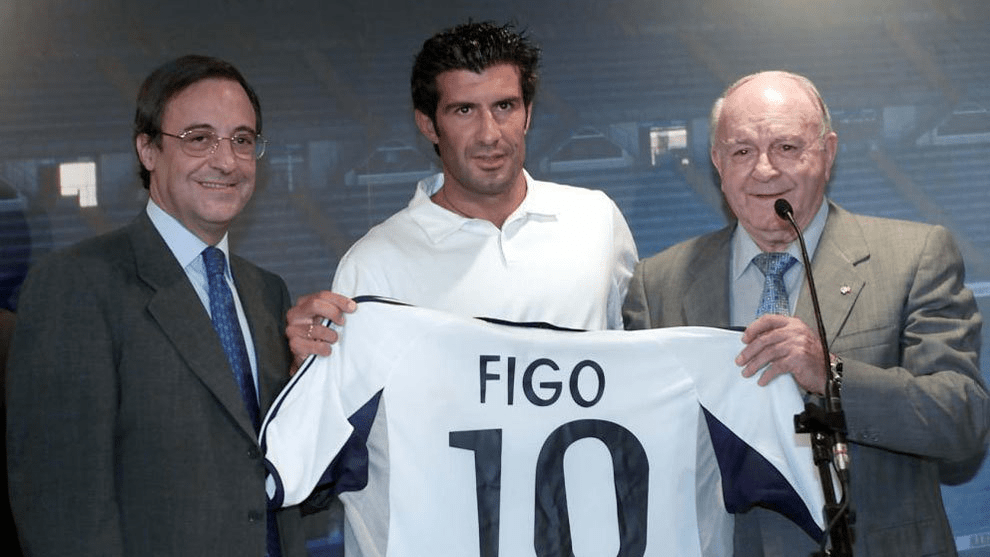
Figo celebrating a victory for players’ rights

Image rights

In response to a change in the taxation rules in 1996, Spanish clubs began to split player compensation into two parts: salary and the use of image rights. This was revolutionary in two ways: first, it helped create a new world of tax avoidance which spread to most other leagues; secondly, it focused marketing attention on the image rights portion of football. Marketing agencies began to specialise in this segment which in turn changed the way the advertising industry used football. Image rights became a major political issue under Florentino Perez’s first Galacticos stint, but by then the Premier League and others had already taken up the baton. The reductio ad absurdum of this arrived through incidents such as Paulo Dybala’s transfer to England falling through in 2019 due to his image rights being sold and owned to third parties. At a club level, Barcelona’s rescue package in 2023, where they sold 25% of their future TV rights, is in some ways a continuation of this.

Salary caps

Before the coming of FFP in Europe, and then PSR and now SCR in England, Spain already developed a (seemingly quite heavy-handed) scheme for cost controls. Taking inspiration from US sports franchising, La Liga implemented a total squad salary cap from 2013 onwards, after several years where smaller clubs had come a cropper in the 2000s trying to chase down Real Madrid’s Galactico model. Many of them, moreover, were incurring ever greater debts to still buy players, while owing money on transfers and even wages to the current squad. In order to protect socio-owned clubs from themselves, La Liga actively calculated budgets and prevented new signings from being registered, a personal project from autocratic president Javier Tebas. The most high profile outcome of this was Barcelona’s inability to re-sign Lionel Messi – who was actually still at the club – on to a new contract in the summer of 2021 and hence pushing him out to PSG. Certainly not a case of the big clubs holding the system to ransom.
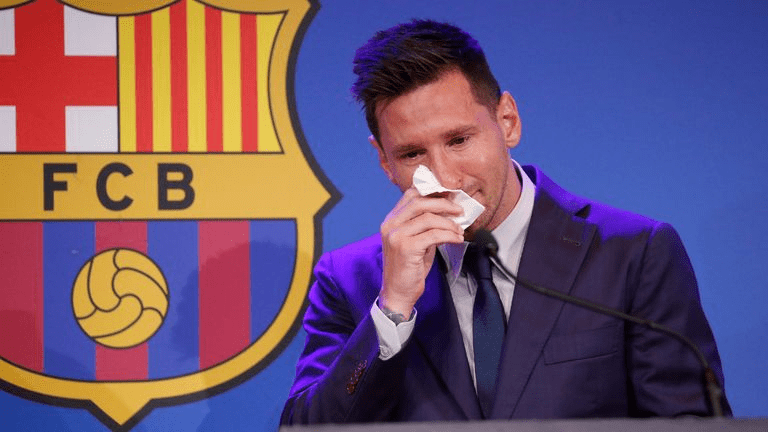
Messi lamenting the financial austerity only La Liga understood

Neutral venue matches

To be fair, in this area the Premier League did technically start earlier through its “39th Week” proposal in 2008, where the idea was to create an entire new round of fixtures to be played in various venues worldwide. However they backed down on it fairly quickly, where ten years later in 2018 Tebas (yes, it be he again) not only signed a new sports rights deal with Relevant Sports but went as far as to organise the Girona vs Barcelona fixture in Miami, scheduled for January 2019. While both clubs agreed to it, pressure from RFEF, UEFA and FIFA caused Tebas to back down – only for Relevant Sports to bring the lawsuits which forced UEFA itself to finally capitulate in 2025. Matches abroad are now permissible, all thanks to Spain.

Not only that, but Spain has been proactive in wanting to host others. The best example was Spain jumping at the chance to own the 2018 Libertadores Cup replay in Madrid between Boca Juniors and River Plate, after violence prevented the original fixture. However even further back, Spain offered to host everyone from Yugoslavian refugees Red Star Belgrade during their civil war, through to a number of Champions League matches during the height of Covid (not the final mini tournament, but several quarter-finals when logistics were much less sure).

Creation of a breakaway big money league

The most historical example of Spanish innovation is the creation of a more commercially orientated league setup, in anticpation of forthcoming revenues such as television rights. Spanish clubs broke away from the RFEF to form La Liga all the way back in 1984, a decade earlier than the Premier League. While in some respects, this act was as reminiscent of the Football League creation in 1888 as anything else, the similarities with more recent examples is the focus on commercialisation (the FA / Football League split was a contest over professionalisation vs amateurism as much as anything). La Liga was followed not only by the Premier League in 1992, but also the Bundesliga (2001), Serie A (2010) and the Ligue 1 (2022).

A side spur of this is the whole Superleague question. La Liga and the RFEF of course vociferously fought the idea of the Superleague, but ironically the culture of La Liga is what first set Real Madrid and Barcelona off on that direction alongside Juventus. And strange though it sounds to English or German ears, the idea of the Superleague is nowhere near as unpopular in Spain as it has been elsewhere, because the long-term culture to try new things has been cultivated over decades.
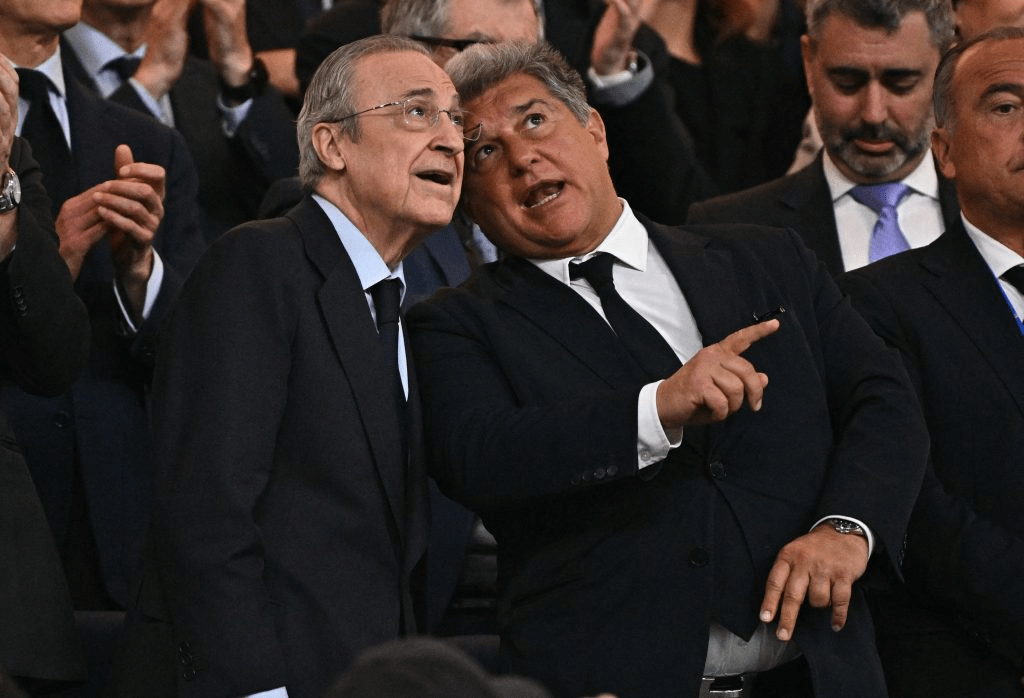
Championing employees and fans

*******

There are numerous reasons why Spain has always been so innovative in football governance. Some of this is deeplying in the legal and corporate culture of the country, including the focus on labour law post the Franco regime and the relatively litigious nature of the economy. Some of it has been driven by individuals such as Tebas or Perez. Above all though, Spanish football has always kept a weary eye on its place in the competitive landscape, particularly with regards Italy in the 1990s and then England since the 2000s. The authorites recognise the marketing strength of the big clubs, but also know that the whole product has to be sustainable in order to leverage that reach.

UEFA has headed off the Superleague for now, but the instincts which that proposal embodied – the innovative, the commercial, the litigious – had its roots mainly in Spain. And while the Premier League leads in revenues and sponsorship deals, it seems very likely that the next wave of innovations around governance will come once again from Spain. Ex Hispania semper aliquid novi, as Pliny might have said.

Why David Plouffe won’t win elections, or get matches on Tinder

Plouffe’s inability to recognise why issues like trans rights swayed votes is the reason why he is bringing the outdated Obama era down with a crash

Having kept his head down (with some justification), David Plouffe recently emerged for the first time since the election to contribute to some of the very worst takes about the 2024 election, on Pod Save America.

It’s very easy these days to understand who has experienced an ad, so we were feeding a lot of digital ads to people who might have saw that spot. But at the end of the day, we were spending a lot of time with voters in these battleground states both quantitatively and quantitatively, and this trans ad was not driving vote.”

To say that Plouffe is from a different era is an understatement – he is now the Paul Krugman of electoral politics belonging to a barely recognisable age. In his defence of the failed Harris campaign, however, we can identify a mental anachronism which will continue to drag the Democrats down, even after being shocked by the force of nature that is Trump in three consecutive presidential elections. As a supporter, historically, of Bill Clinton, Gore, Kerry and even Hillary in her 2008 incarnation (not so much eight years later) this pains me. Everyone is offering their views on how “out of touch” the Democrats have become, so here I offer my own.

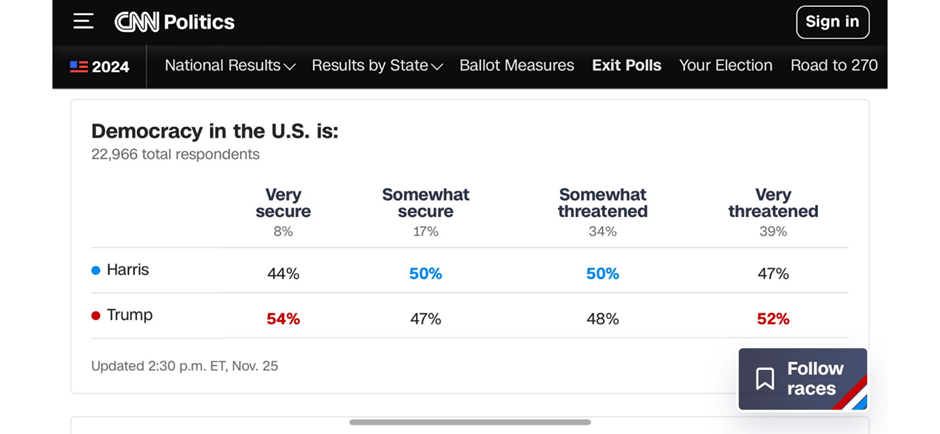
First, the Democrats appeared to make a basic error in interpreting polling on voter priority as monolithic support for their side. The most obvious case was seeing “the state of democracy” as the biggest concern for voters, but assuming that such people must be anti-Trump side. As the exit polls showed, among those who considered democracy threatened around half actually supported Trump, not Harris:

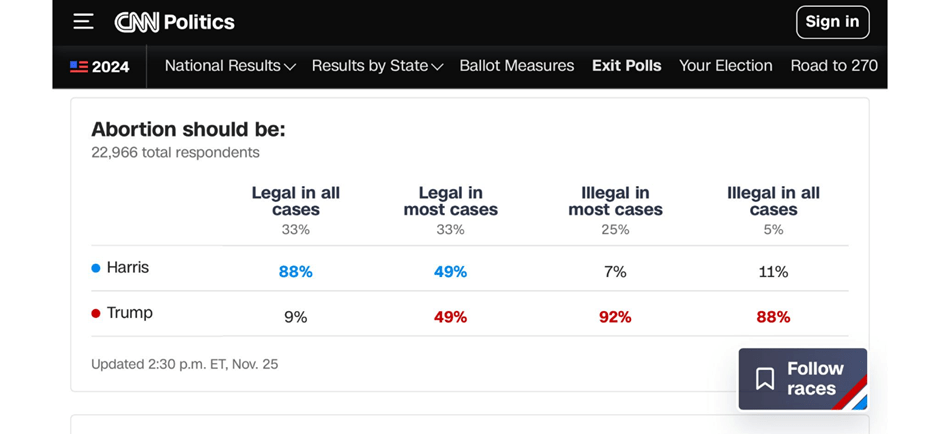
Even if we accept that people voted on the basis of just this one issue, it turns out as many considered the ‘lawfare’ campaign against Trump as a threat to democratic norms as did the events of 6 Jan, and Democrat pursuit of the argument that “Donald Trump is a fascist” were not only failing to gain traction but may actually have been counterproductive. The same applies to abortion, which earlier on in the campaign was considered critical: among the one-third of voters who thought abortion should be “legal in most cases”, voters were split evenly between the two candidates:

If strategists such as Plouffe were not even bothering to dig into the numbers behind the headlines to this basic level, it is hardly surprising that they were wasting their resources based on biased assumptions and projection.

Secondly and more importantly however, is the very use of voter prioritisation polling. Most examples of such polling were single answer (rather than, for instance, allowing respondents to choose as many as were important). This created two problems: the error of forced choice and the error of colouring. Forced choices make people go with obvious and pronounced options even when other issues might cumulatively be more important (eg the economy might be outweighed by adding immigration + crime together). Colouring is the consideration that a seemingly insignificant issue by itself still adds a great deal of colour to the candidate or party, influencing voting subtly.

The fact is that most people do not vote on ‘policies’ other than very occasionally when a policy is so simple that it cuts through all the political noise to become totemic. These are so rare that we are hard-pressed to even recall many instances – although Trump’s promises on trade treaties in 2016 comes to mind (as well, perhaps, as his “no tax on tips” policy this year). Elsewhere, the chance to buy your council house under Margaret Thatcher in 1987 is an example from the UK, as was Jeremy Corbyn’s land value tax proposal in 2017. Rather than policies, voters pit a general sense of where policy proposals are headed (eg “lower taxes”, “tough on crime” etc) against a matrix of what a candidate is ‘famous’ for. If the candidate is not well known for the economy for instance, no amount of policy proposals on that subject will mean anything. People vote for their impressions about a candidate, not so much the content.

Which leads to the issue of trans rights, which Plouffe so airily dismissed as “not driving vote”. He was of course correct that it affects tiny numbers of people, and directly animates only a few more; but he is wrong that Harris’ well known past history on trans matters did not colour voters’ impressions of who she was and what she tends to care about. Certainly, she did not come across as tending to care about immigration or inflation, two subjects Trump did convey; on the other hand the trans dsicussion, while not shifting votes directly, added up to an impression of her priorities. On a broader level, it brought into focus her judgement – “is a politician sanctioning free transgender operations for prisoners really worrying about the same things as me?”. Issues can be obscure without being innocuous.

(The same, by the way, was true of Brexit where for years the polling had told us that the issue of “Europe” was not a priority:

Yet this totally missed the point that while in a forced choice, it was not important, at the same time its many facets coloured huge chunks of the public discourse about Britain and the efficacy and power of its government to effect change on matters such as the economy or immigration. Rightly or wrongly, the democratic overhang created by EU membership far overshadowed the importance of the actual issue in voters’ minds and this manifested as a groundswell of discontent which could barely be contained – if Cameron had not asked the question in 2016, a future prime minister would have had to do so within the ensuing years).

None of this nuance emerges in Plouffe’s narrow and mechanical interpretation of voter issues, but it does not take a genius to see how it all connected in the minds of a voter who is only semi-engaged. I will use the parallel of Tinder, where I doubt David Plouffe would have much success, to illustrate the point.

If we strip away the 50% of women and 99% of men who swipe left or right based purely on the photo (although this, too, may be instructive to campaign directors), we are left users of the app having only a quick glance of the few things written down on a profile to decide their choice. Now, imagine a man includes the sentence “vegetarian” in his profile, and consider the consequences. Few women will be so militantly carnivore that they swipe left for this reason alone; but there is no doubting that it somehow adds colour to the profile which will make them think twice. “What does this guy care about?” “What sort of restaurant would we have to go to?”, “Will he force me to only eat lettuce?” and so on. Nobody will admit to vegetarianism having been the deciding factor for their swiping, but you can be sure that it did its job in making that profile underperform in finding matches.

Such structural misunderstandings significantly weakened the strategy Plouffe and his crew were running, well before we get to the litany of “unforced errors” which surely did not help in what was supposed to be a tight race: bear-hugging the Cheneys on campaign; encouraging abortion ballot initiatives in the same election meaning voters could split their ticket and vote for Trump and for abortion; avoiding Joe Rogan and not distancing from Biden; and the ignored sense of scandal surrounding both pretending Biden was mentally capable until June, and then replacing him without a primary. But these need not be litigated here, because the Plouffe team had made historic mistakes in reading voters’ preferences well before the campaign minutiae.

It is, in a sense, rather poetic that the governing classes in both parties (and in the UK) who for so long have sought to reduce politics to a pseudo-science of well-placed dog whistles and esoteric metrics about the economy, should be hoisted on their own petard. Trump offered little if any direct policy solutions to the questions of immigration or inflation, but voters felt he understood it in his marrow. The Democrats need not had offered policy answers either, they simply needed to find a candidate or a message which showed they too understood the problem. But having spent three decades telling voters that life is all about the statistical evidence, about management, about professionalism and about making sure the ‘system’ worked, voters then went on to rightly judge them on these very metrics. Prices were up, groceries less affordable, government seemingly ineffective. If you live by technocracy, you will die by technocracy.

Lichtman’s model may still be good, even if his 2024 prediction is wrong

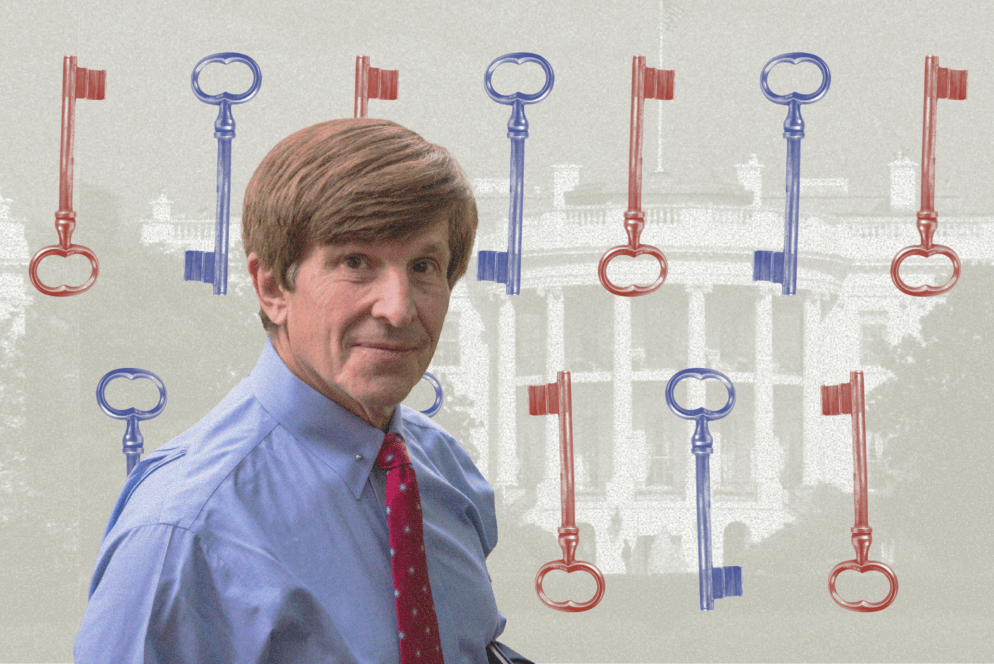
An absurd online tussle has commenced over Allan Lichtman’s ‘Thirteen Keys’ thesis over the coming US presidential elections, where not only are endless amounts wasted on challenging his predictions (“He is biased! No he’s not! He’s pro-Democrat! He wears a wig!” etc), but actually being threatening to the poor septuagenarian. Even in the heated environment of this contest, as JD Vance says, this is not worth it.

Yet it presents a good opportunity to think about how robust his model actually is. For the record, I like this type of macro historical analysis, and I think it has value. In particular I like the discipline it instils in not subjecting the election only to the noise of the latest polling. On the other hand, I have a sneaking suspicion (famous last words, perhaps) that Lichtman’s actual predictions this year, which are for a Harris victory, may be wide of the mark. Would this render the model broken?

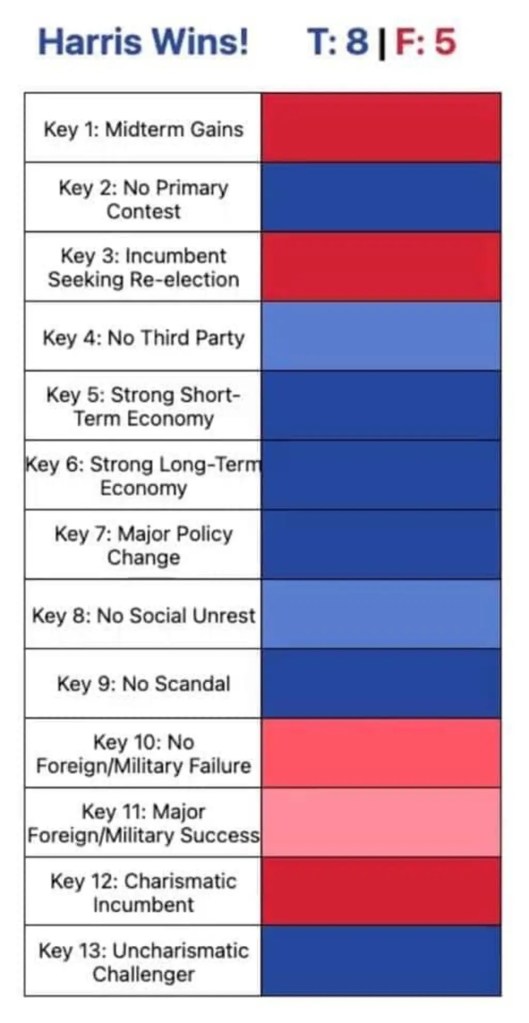
I don’t think so. Trump may well win this year, but if he does so it will be less about Lichtman’s model being wrong so much as Lichtman’s own interpretation of it. Let us bear in mind that the model is just that – a neutral series of tests (explained in detail here) – but Lichtman then has to take these tests and package them into an opinion (below is the most recent I can find). There is plenty of room for subjectivity. Currently, he sees the lie of the land like this:

Critics of Lichtman’s model – and there have been many – mainly focus on the keys that are obviously open to interpretation and are therefore ‘subjective’. Nate Silver for instance notes that the two “charisma” tests are very much in the eye of the beholder, while others would complain that the definition of a “major policy change” or foreign policy “success” or “failure”.

However I am less interested in those tests so much as the supposedly binary ones. Because the problem is that the whole political system has been shaken in the last decade, resulting in what I think are some structural problems in Lichtman’s definitions – his underlying intent is correct but the manifestation of the issue he has identified no longer conforms to how he has set the keys up. Below, I focus on a few examples.

Key 2: No primary contest

Now this may seem obvious and technically true, but I think Lichtman may not be seeing the wood for the trees this year and ignoring his own wisdom. If we take a step back, the point of there being “no primary contest” is essentially that the incumbent party has not had a bruising encounter which exposes disunity in the ranks of the incumbent party seeking re-election (apparently the same is not true for the opposition, which I have some sympathy with).

But considering what has occurred in 2024, I am not clear that this is true in spirit, even if it by letter. The fact is that many Democrat supporters either a) resented Biden being deposed the way he was, or b) did not like Kamala’s unchallenged rise to the nomination. I personally know a few who have not forgiven the party for what appears to have been a hugely opportunistic change (and let’s be clear, it was perfectly possible to have still had some sort of debate leading up to the Convention, something championed by many including Ezra Klein and numerous others here and here). While Harris acceded unopposed at the Convention, her elevation left quite a bitter taste in many corners of the party.

Thus, while technically the incumbent party did not have a divisive primary, there has in fact been discontent around the selection procedure, so awarding the key to the Democrats in this case is structurally dubious.

Key 3: Incumbent seeking re-election

In this case Lichtman has given a key to Trump which is questionable. Of course, again strictly speaking, Harris has not been President and is therefore a new candidate. And even allowing for sitting VPs such as Al Gore not being considered ‘incumbent’, the peculiar issues surrounding 2024 again makes this seemingly binary key more nuanced.

Is Harris an incumbent? Who is the incumbent? Not only has Harris been part of a long-running trend whereby VPs have been more active in the Executive (Gore and Cheney, and now Harris), but she has now basically been Acting President due to Biden’s incapacitation. She was elevated only after the incumbent had been selected and had started to campaign for the presidency; she has inherited almost his entire infrastructure and strategy and by choice or not, has been unable to distance herself from the Biden administration. To my mind, unlike when a VP runs after an 8 year term (such as Gore in 2000, or HW Bush in 1988), I think the public will likely see Harris as a continuity of the regime, for better or ill. In Lichtman’s model she should therefore get credit for more or less being an incumbent.

Key 4: No third party candidate

Here is perhaps the most far-reaching and controversial challenge to Lichtman’s definitions. Again, of course, this is technically true since Lichtman defines “third party candidate” to mean an officially non-aligned candidate who polls more than~5% of the popular vote. In other words he is limiting himself to the Ross Perots and Barry Goldwaters of electoral history. But with 2016, I think this part of the model has been completely blown out of the water.

Trump, in 2016, was essentially the first third party candidate to win the presidency. Yes, he ended up tackling the Republican primary and using that as a vessel into politics, but he famously had previously been a Democrat and moreover, disagreed with much of the incumbent GOP platform and heritage. Trump’s greatest moment in the primaries was arguably his anger at calling out the Republican establishment over the Iraq War, and being roundly booed for his troubles:

To look at the purpose of Lichtman’s key, it exists to highlight that a significant third party usually indicates discontent with the system, which tends to favour the challenger (this I think is a debateable point but generally I can understand his perspective). No third party therefore favours the incumbent. Yet if a challenger has essentially captured the opposition vessel for effectively becoming a third party candidate, this no longer applies. The same would be true, back in 2016, of a potential Sanders candidacy for the Dems would have seem him as an outsider also. I previously expressed the 2016 worldview like this:

PhyPhi - post 2016 politics

So ultimately we are judging Lichtman’s model by his own narrow interpretation, since as far as I know nobody else is doing an independent version using the same system. But just as an example, if I switched the three examples above around, the 8/5 balance becomes 7/6, and we would be left with discussions over imponderables such as the fact that there are millions of Obama-Trump voters, which belies the thinking that Trump does not win over people from the other side (the definition of “charistmatic challenger”). Indeed whether Trump, in or out of power, would ever be not a “challenger” is itself a question for Lichtman.

For the record, my own interpretation of the Lichtman model offers a 8/5 in favour of Trump. In addition to the key changes above, I would change the charismatic challenger key as explained, and I also sense the “scandal” key to be more prominent than Lichtman believes, because I think there is a whiff of wrongdoing around how long or how early senior Democrats have been hiding Biden’s senile incapacitation. But, as others have noted, these are down to personal views and the polls continue to tell us the race is close.

On balance, I would say that Lichtman’s model is one which we can proceed with with caution for fun, but I would urge psephological geeks (such as myself) to drill into the underlying keys and render their own interpretation, rather than rely on Lichtman’s. Separate the man and his keys, and you may be better off.