Don’t forget blockchain – AI will be its catalyst.

AI may finally give blockchain its clear commercial case, by bringing physics into the digital world
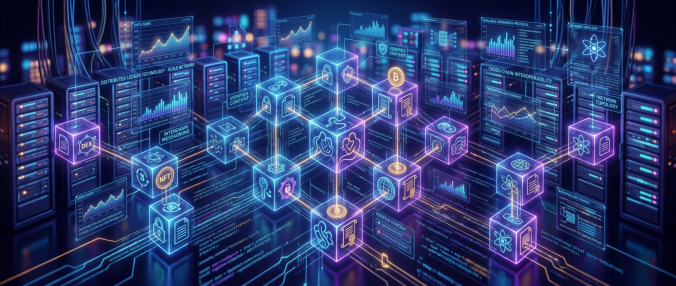
Neon blockchain network linking secure data cubes and verified content

In the face of AI’s popularity with investors, blockchain and its uglier cousin crypto seem like yesterday’s news. Yes, a lot of fortunes were made and they are permanent, but attention and capital have moved on to the latest idea that threatens to change ‘everything’. Where crypto promised to overhaul finance and kill central banks, AI is positioned as the white collar job destroyer – although amusingly nobody really knows which way it will go. The Financial Times, lover of all things based on the 1990s consensus, famously offered this insight – and only partly in jest:

Meanwhile blockchain, while somewhat understood in digital circles, has continued to look for its true ‘moment’ where the use-case becomes compelling and, more importantly, monetizable. What we know is that true digitalisation has, even today, yet to arrive onto the financial services scene. While banks can slap apps on to their front end for customer interface, in truth the vast majority of financial services are still very much analogue – often even paper based – with digital as a gloss on top. In that sense, there is still huge headroom for full real digitalisation to be implemented, but it seems like a boring B2B process which will generate earnings but probably for the Accentures of this world.

But if we take a step back, what does blockchain really achieve which is useful every day? More than anything, the thing to remember is that blockchain brings the laws of physics online. This is an extremely simple point to digest but an equally difficult concept to appreciate the magnitude of. Blockchain means finally that irreplicability, and finity, are possible with digital assets in a way that for the first three decades of the internet’s existence they were not. And this is not about creating NFTs for art, though that is one niche application; it is about mass, common items that we use everyday.

Put simply, consider the real world: if Toyota produces 100,000 examples of a certain car, it is a mass produced item. Almost all the 100,000 vehicles are basically the same. Yet from an atomical perspective, they are each different, and the 100,001st car that Toyota produces requires yet more mass and energy that the first 100,000 did not use (remember, E = mc²). Moreover, while the 100,000 that Toyota produces are all ‘original’, an imitator which produces a similar car cannot produce it exactly, however hard they try. Physics prohibits it since they will use different machinery in a different geography using different materials. Toyota ‘owns’ those cars they produced, at source.

However in the digital world, there are no such constraints. If you receive a pdf file, even with a password protection, you can still replicate it as many times as you want. Yes, your ability to send these to other people costs power and bandwidth resources, but the fact is that the 100,001st copy of this pdf effectively does not differ from the 100,000th, or even the 1st. They can be exact replicas because there is not ‘atomic level’ online. Blockchain however, changes this. The purpose of the proof of work concept is that you now do know if you have one of the original 100,000 copies of a pdf, not the 100,001st pirated copy; and this in turn allows you to trade or sell it, something impossible before.

Now how does this all lead to AI? If my social media is to be judged, AI will fast take over much media content creation including pictures and videos (indeed we should probably coin new terms for these AI-generated outputs). My Instagram feed, for instance, is probably getting close to being 50% AI-generated and the comments sections enjoy calling them out. For the moment, there is still a novelty value in AI imaging and content. AI usage today still represents a clear cost benefit which can be applied across the industry, helping make content more quickly and cheaply. Furthermore, AI output quality still has room to improve (quite a lot of room, frankly).

Yet this improvement is the very reason blockchain becomes relevant again. I am certain that as AI starts to permeate the landscape and especially when it begins to seem indistinguishable from real life, consumers will start to finally want to pay a premium – for the real thing. Real actors in real studios, or God forbid out in the real world, will have its own desirability, for all their imperfections. While AI is driving content towards being almost free, its commoditisation means that the other end of the spectrum is where the monetisation case will be.

Nowhere is this more easily understood than in porn, which famously occupied as much as 30% of total internet usage. This is an industry that is being quickly penetrated by AI content, as both traditional studios and OnlyFans creators use artificial ways to supplement production in order to increase regularity and volume of new output. Intuitively, this will be one of the first areas where discerning consumers will desire – and start paying for – content that in some way is stamped as ‘authentic’. While everyday porn will become increasingly free, authentic human porn will start to command higher and higher prices – indeed the rise of OF is itself already a testament to the demand for this.

Back to blockchain, the best and from what I can see only way for this authentication to occur, is through ‘proof of work’ to be input at source. This means that at the point of production, the raw content is stamped as real life, and whatever edits and production are done afterwards, the veracity of the original filming is kept. It also means that next generation content creation tools such as video recording cameras and equipment, will have blockchain encoded within the machine themselves, going on-chain at the ‘point of click’ – the most logical point of verification. The same of course will be true for audio equipment and music generation and so on.

In this sense, beyond the boring world of financial instruments (crypto exchanges such as Binance now already offer direct trading of conventional securities such as equities and ETFs), blockchain will become the bedrock of how to monetise ‘true content’. So while AI is taking the headlines and absorbing capital and investment bandwidth today, blockchain should find a second wind in terms of its direct relevance to our lives. Physics is back.

Rather than to be feared, AI is just that dysfunctional kid we never liked

The excitement around AI, both from businesses and finance, is as frothy as it is palpable. My LinkedIn wall, that repository of the most commercially obvious, cannot go two posts without someone bringing up a reference to unemployed lawyers or the NVidia share price. Much like the coming of the Internet, the true market will follow the bubble as surely as this bubble has followed the uneducated speculation. Yet I see far fewer posts from actual operators about AI’s current uses or the direction of travel, due no doubt to that fact that we are still at nascency.

Yet even at this early stage, I would offer a few groundless, untechnical observations about how this is heading, based partly on a recent comment made to me that we are heading away from ‘data science’ and towards ‘content science’. I stand to be proved wrong, of course, but I feel some of the underlying truths will be difficult to challenge. Perhaps in three years’ time it will all look very different, but I will put it down for the record.

1. AI is the student, not the teacher 

To some this may seem obvious, but the reality of GPT and its B2B and B2C offshoots, is that they remain permanently there to be taught by humans.

AI will be able to do huge amounts of work for us in the future, no doubt. We are told that they will replace lawyers and accountants for instance, and the workplace will look different. I would agree with this, they are a future colleague – but the question is which colleague will they be? The nature of it indicates that the role they will perform is basically that of the new graduate trainee, or possibly even the intern. They are there, and a useful resource for sure, but they will not be producing finished products until you give them feedback, repeatedly. After a while you will wish they were able to at least fetch the coffee for you. Within our lifetimes, they will never have their own office to lord it over the saps outside and disappear off to play golf at 2.00pm on a Thursday.

2. AI is a pathological liar

It has been well noted that AI tends to ‘lie’ and many wonder how and why a logical entity would do this. But of course the vast majority of content for generative AI comes from content that is already out there, and that content has been written by fallible human hands.

In the same way that ‘the Internet’ lies – or rather, is full of untruths because those producing content are all well-intentioned – so also the likes of ChatGPT. Machine learning can only summarise existent knowledge, which is at best imperfect and at worst malicious. This is a poor kid that has been born of a dysfunctional, almost sociopathic family, so what chance does it really have of being a good boy and living a normal adult life later? AI will find itself divorced with estranged children and alimony of its own in decades to come. Arguably, the power of AI will actually magnify lies and illogic through its distributive power; the calculation error of a second rate accountant in 2006 will now form a permanent fixture within our reservoir of collective knowledge, when it need not have done before.

3. AI will reduce innovation 

More controversial than the two previous points is that the net effect of AI, itself an ‘innovation’ driving rocket-high share prices, will be to dampen innovation whenever it used – certainly unless visionary leaders really manage it well.

Referring again to the automation processes which everyone believes will be the first to go, the fact is that even while people are stunned by the ability of AI to produce a legal opinion that formerly took a highly paid lawyer days, that opinion will be decidedly unexciting. It can, after all, only be the output of decades of other lawyer’s opinions. As a student, AI is that kid who does not really think but is only able to regurgitate the books he happens to have read whilst sat in the corner of the library alone, friendless. Possibly he does this because of his parents’ acrimonious divorce, I don’t know. Either way, by doing this, and by that homework being accepted as a decent B+, it means that room for original thinking is limited. In fact, it basically means the quality of all work will only ever be a B+.

Optimistically, of course, AI frees us up to spend more time on productive, innovative thinking. But be realistic: when robots are cleaning your house, how many people will use that unexpectedly free Saturday afternoon for reading Nietzsche or climbing Everest; and instead, how many will be sitting with a bag of crisps rewatching old Netflix series and shouting “they were on a break!” at Rachel (note: guilty as charged). Again, given the power of AI’s distribution, this shift from data to content will actually amplify this ‘anti-innovation’. When we sit down to raw data, we are forced to think; when we sit down to semi-finished content, we will not.

*********

These three issues – that AI is a child, that it comes from a broken home, and that it only studies other people’s books – all link to the end point: the limitations of AI mean that while the world of work may change radically, as with now, human innovators will be disproportionately rewarded then as now. Lots of processes will be automated, but what will not be is not only painting, music or fiction writing, but even areas such as marketing and advertising. I have friends who know how to sell, and sell hard. They already get the best of the opportunities in business today, and this will be even more pronounced tomorrow. The lesson is: where human beings work at things which are truly ‘human’, rather in jobs where they are poor substitutes for machines (such as road sweepers, or boy bands), they will always find a layer of economic reward above that of the machines which serve us. Good jobs aren’t dead.

Perhaps therefore the scariest thing about AI is the mirror it is holding up to our own faults and shortcomings. It is preserving and multiplying all of our past errors and sentiments, most of which we would rather forget, like a scene out of Monty Python.

And like that self destructive black sheep cousin, or that girlfriend who only likes guys who are bad for her, AI not learning from its mistakes however much people point them out. Because from its agnostic standpoint, AI will tell there is no right and wrong, good or bad, just the content.

And whose content is that? Yours.