Out really means out – why Britain should reject the “WTO option” even under Hard Brexit

brexit-trade-barriers-810x521

The sheer amount of ignorance in British public discourse about how trade works is one of the most disappointing lessons from the whole sorry Brexit drama. As a Remainer I have no qualms in picking out the likes of Dan Hannan as an example of this, whose comprehension of the subject (and of economics in general) seems to have been plucked from half-remembered A-level text books, or, at a stretch, incidental discussion from reading History at Oxford. Amongst his favourite refrains is that which tells us that “at least we will still have WTO to fall back on”. Yet of all the options, this is probably the very worst. In the event of Hard Brexit, Britain should actually reject the WTO too.

This is not the place to get into the minutiae of what the WTO actually is or how it works. There are plenty of people who have written in easier detail that I can about this. Instead there are two common misconceptions about the WTO which need to be digested before we even get onto whether it is good for Britain or not. The first is that the WTO is not actually about regulating tariffs; its core notion is that of making sure that everyone abides by the Most Favoured Nation (MFN) principle, meaning that however you structure your trade (higher tariffs, lower tariffs, no tariffs) you must at least treat everyone the same. Clearly, this is a starting point on lowering tariffs but it does not actually reduce tariffs in and of themselves. Secondly, the WTO is not a single set of regulations, but rather applies to each country differently depending on their schedules of entry. In other words, upon joining the WTO, each country basically agrees to its own unique set of tariffs and commitments.

The blog referred to above gives the helpful example of shoes – a sector in which the UK happens to be an exporter:

8% is charged by the EU on shoes imported from all other WTO members (except under a free trade agreement, such as EU-Japan, or preferences on shoes from developing countries). The import duty rate in other countries will be different. The US’s import duties on shoes vary from duty-free to around 10% or higher. Japan charges 20%–30% duty on many shoe imports.

In other words, the WTO does not set monolithic rules, even at a lowest common denominator, as many casual observers seem to believe. The reason I highlight this is to emphasise that the WTO is not some magic bullet for providing a minimum level of trade freedom. It is merely a mechanism for getting countries to discuss ways to lower tariffs. How much each country has to commit to upon entry to the WTO is, much like any other trade deal or indeed any other non-deal trading relationship (which is how most trade is done), dependent on their economic strengths. A larger economy, offering both greater consumption power and usually some irreplicable exports, will always get a better “deal” out of the WTO as a whole (or any other trade negotiation such as an FTA) than a smaller economy. With or without the WTO, with or without an FTA. That is just the way life works.

Moreover, the WTO largely does not cover services, which matters for Britain. After all according to the ONS, British services exports constituted 44% of total exports in the 2017-2018 fiscal year, representing a trade surplus of +£107bn (+€124bn) compared to the trade deficit of -£139bn (-€161bn) in goods. Contrast this with Germany, France and Italy for instance who have a trade surplus in goods and deficit in services. Yet if you delve into the WTO’s website to look at something like architectural services, something Britain has had some success at, you will find the following wording:

Currently, architectural and engineering services, like all services are included in the new services negotiations, which began January 2000. Principles of trade in architectural and engineering services are contained, like for all services, in the GATS.

In other words, nothing has been agreed. The same wording applies to everything else including finance, law, advertising and so on. GATS itself, the precursor to the services agreement, is essentially toothless. As a result, you might have noticed that prior to the Brexit referendum in 2016 nobody anywhere had been talking about the WTO for almost a decade. Instead, partly in order to cover services, most countries have gone on to think about regionally integrated trade deals like ASEAN, the TPP, APEC, the East African Union, Mercosur and, er, the EU.

The problem for Britain is that the WTO is an unfinished project. People seem to forget that the intention for global “free trade” was supposed to be a multi-step process, starting with the trade in goods before moving onto the trade in services, tackling non-tariff barriers and eventually encompassing freedom of labour and capital. The trade in goods came first, naturally, because in the era in which the GATT discussions commenced, most economies including the OECD were still ones that made stuff. There was no real asymmetry in economic structure at that time and if anything, GATT and WTO were forecast to open up emerging markets to developed nation goods such as industrial equipment whilst the latter continued to develop their basic industries such as agriculture and natural resources.

However over the course of time this changed. The OECD became notably more services-based, including in their export mix. On the other hand the emerging markets, led by China, came to dominate the manufacturing industry not just at the low end but increasingly at the higher ends too – Korean autos for instance, Chinese industrial equipment and so on. It was therefore imperative that the next phase of global “free trade”, that of services, was completed – but it never was. The Doha Round, in the back of everyone’s memories, collapsed ignominiously. China’s accession to the WTO in 2001 on these ossified terms has probably contributed significantly to its rise and America’s comparative decline. It certainly led to Trump. If you are a modern economy, the WTO is probably bad for you.

We have not even touched on the specifics of how and whether Britain could easily join the WTO and on what conditions. The likelihood is that Britain could join pretty quickly – if it did so exactly on the current EU schedules (ie the 8% tariff for shoes above). But as noted, each set of schedules was designed to suit a specific economy and the existent schedules suit the EU as a whole. With a focus on protecting agricultural exports for instance, they are probably not ideal for Britain. If it wanted to join on a different, bespoke set of schedules, this would require agreement from all WTO members which would almost certainly throw up objections both legitimate (British government subsidy for financial services for instance) and illegitimate (Russia or Argentina purposefully creating trouble). Furthermore this would require time, unlike the replication of the EU schedules – the shortest period of time for a WTO accession has been several years.

This brings us to the central conclusion that if Britain goes through with Hard Brexit, it would be better to reject the WTO altogether and act unilaterally. The WTO as it exists today suits some countries like Germany and China and Japan, but specifically ill-suits the UK given the commitments Britain would have to make on accepting manufactured goods but getting no such commitments on services in return. Neither is Britain a big enough an economy to enter into renegotiations to remake the rules in its own favour, as the Quadrilateral could. Moreover, rushing into the WTO would actually undermine Britain’s ability to strike independent trade deals as most of what it has to offer – a market for consumer goods – would be given up already. Leverage in bilateral negotiations by trading goods access for services access, would be eliminated including with the EU.

Indeed in recognition of Britain’s place as a middle-sized economy, it makes more sense to try and protect certain industries, even at the cost of near-term price increases.  Whilst signing up to the WTO does not restrict Britain’s ability to lower tariffs, it would prevent the country from strategically increasing tariffs where necessary, for instance incubating industries struggling to find their feet after seventy years in the wilderness. The fact is that a vibrant SME sector really only exists in economies that have reached a critical mass in exports such as the US, Germany and Japan. For all other economies, creating national champions is a better guarantee of long-term economic survival (more of this in future posts).

Brexit is a political, not an economic, debate. That political choice should be made on its own merits, but decisions about trading relationships need to be clear-headed afterwards. Relying on the WTO sounds like a short-cut for preserving some stability for British trade, but it is a false friend. The reason why nobody else pays attention to the WTO anymore is the same reason why Britain must abandon it too – if indeed it actually ends up with Hard Brexit come 29 March.

Why commentators like Martin Wolf are still firmly thinking inside the box on China

aging-population

China’s rise is not about following the conventional economic norms, and the reality is that an ageing population is probably better than a young one

China has always been a black box. For the whole of my professional life, companies (investment banks being amongst the worst) happily hire someone – anyone at all – who claims to know the Chinese market if they can make even a sliver of money. Consequently, these people are given free rein to build their own silos. For boards in London or New York, China remains “a faraway nation of whom we know nothing”. It is from this mysterious, exotic ignorance that reliably insightful commentators, from publications which should know better, produce some tired answers to tired questions. Sad to say, amongst them was a recent piece from Martin Wolf at the Financial Times titled The Future May Not Belong to China.

Now, the future may very well not belong to China. Much of what Wolf outlines from his Capital Economics report (rather too much from one source for my liking) is unarguably true: the over-investment, the under-consumption, the increasing corporate debt and reliance on exports. But they only change from fact to “problem” when seen through the same old prism of economic development. China though has been disrupting the whole framework through which one sees these issues, confounding a whole mini-industry of untiring China bears. Who can forget the inflation crisis of 2010 – 2011? The Chibor crisis in the summer of 2013? The stock market crisis in 2015? The capital outflow crisis over 2016 – 2017? In each of these and many others besides, China was to be “found out”; it never was, not because the facts were inaccurate but because the basis for observation by outsiders was so incomplete (although to be fair some of the facts were also inaccurate). The fact that the naysayers and doom-mongers have been consistently wrong may be a cheap point to make, but it is worth making nonetheless. The only laws of economics, it seems, are the ones amateur journalists derive from their undergraduate readings of Adam Smith, Ricardo and Keynes.

china bears

A non-exhaustive list of China bear headlines since 1990

However I would submit two additional unrelated and possibly more controversial theses. The first is that the way China encounters these perceived crises is actually a mark of its success in terms of being on a pathway to global power, rather than a failure. There is a reason why China encounters “difficulties” where Japan, during its own precipitous rise in the 1970s, did not: China is actively trying to change the world it is living in. These crises are the tremors generated by moving tectonic plates, as Chinese objectives grate against the rules and outcomes it is being measured against. Currency and capital flows, interest rates, debt and the banking system – these are all examples of Chinese policy that do not make macro-economic sense until you factor in that it wants to change the system and if it plays its cards right, it probably can. We are faced with the first occasion since the United States back in the 1840s, where the world may have to accommodate a new power, and accordingly the rules will change. For China, this friction is good.

japan china gdp

Source: The Economist (2010)

To run through just one example of this, let us look at capital outflows. The reason capital outflows seem like a “crisis” is that the Chinese government wants to control the currency rather than let it be determined by the market. To pay for this, it must use foreign exchange reserves to keep the exchange rate stable. This becomes a huge cost when the environment is weak – except that the reason China does this is to try and make the RMB a regionally accepted trade and reserve currency. This could be done through just trade alone, but in China’s case it will also be done through the crypto-imperialism of the Belt & Road and other initiatives. If it succeeds, it will both eat into America’s ability to project power through the dollar, as well as ultimately encourage greater consumption of Chinese-made goods which in turn once again brings capital flows back into balance. It is a risky and expensive, all-or-nothing gamble; but unlike merely acquiescing into the current world system, if it succeeds it will have changed the regional financial and trade landscape. A price, some would say, worth paying.

The second thesis focuses on the cliché that China may be facing the middle income trap – that it may “get old before it gets rich”. This is typically paired with the curiously British trait of enthusiasm for India as an alternative story. Yet I would argue that with the coming of automation, China is actually on the right side of history on this and that far from fearing age, the adage should be turned on its head: for many comparable countries it is youth, not age, which will be a great peril; and these countries may be too young to ever get rich.

We have for some decades been fed the neoliberal trope that a younger population is good for the economy, and that pursuit of youth, through birthrates or immigration, is a Good Thing. Yet we are fast approaching the point where this notion is being exposed, because automation is actually a process which will eat into youth employment rather than any other. China’s workforce is actually declining and has been for some years, just in time for robots to start taking over.

The process of classic industralisation is just one of various models for a country to develop. But in this particular model, families can contribute labour rather than capital in order to obtain greater earnings, and thereby over time accumulate household assets. For many countries though, this industrialisation may never now be possible. The Economist noted as much when opining that the pathway of development exhibited by the China + ASEAN axis is probably irreplicable by anyone else including markets in Africa and South America. Goods may be manufactured in some of these economies, but it will be robots that do most of it and young median households will never cross either the asset-owning or educational thresholds required to survive automation before it hits.

Now, it may be that these countries find other models to become rich, but I doubt it. Agriculture or resource extraction will be possible for only a precious few. The mercantile model is not stable or sustainable. Services, as we have seen, actually produce a lower return on labour than industrialization does since jobs are often of a lower quality. In any case one of the stark lessons of 2016 was the fact that in 29 out of 50 states in the US, trucking was the single most common form of employment – and this, more so than manufacturing, is where automation will first hit.

us job types

Source: NPR (2015)

The fact is that to weather automation, median family assets need to reach a critical mass enough to be “invested” into the economy such that they can be gainers from robot productivity rather than victims. The most obvious if questionable form of asset-ownership would be home-ownership, but in an ideal world it would take other forms. China’s urban population has just about caught this train (financial income growth has far outstripped wage growth in recent years), but younger populations in India or Vietnam may not make it. Young people inevitable have fewer assets having had less time to earn; if their family does not reach this critical automation-neutralising financial position, they face eternal unemployment. OECD economies mitigate this conundrum somewhat through welfare transfers, but welfare is another privilege of long term asset accumulation by Society – a privilege emerging markets do not have. It is a race against time and any country that fails to achieve this will be left without a chair when the music stops.

In this context, I have little time for those who argue, as Wolf does, that India is “the most interesting other economy” (Americans I have noticed, tend to use Vietnam as their preferred example). As one of my friends commented, “the human race will probably be extinct before India has an airport like Pudong”. Taken individually, each of these points (China’s extra-economic rise and youth being a greater concern than age) have huge implications about the rules and framework for emerging market development theory. Taken together however, they may represent a perfect storm which leading to an inflection point in global economic development. In this case, being wedded to the old ideas, commentators like Wolf are probably missing it.

Why Britain could demand asymmetric labour access to the EU – and why it might be best for both sides

Freedom of movement

The disputes over Brexit negotiations have mostly been premised on the idea of reciprocity – or rather, retaliation. If we do not give them rights, they will not give them to us. This has been particularly true when discussion freedom of movement, possibly the single most important driver of Brexit voting in 2016. On the face of it, there seems to be logic in the EU demanding that EU nationals be allowed to freedom of movement into the UK if the UK wants the same thing in return. However this may belie the reality, which is that asymmetric access is perfectly viable and indeed valid.

To give one example of where this makes sense, let us examine Chinese policy with regards Hong Kong. Here, Hong Kong residents have an almost unhindered access to the Mainland and its economy, not only in terms of movement and residency, but also asset ownership including real estate and businesses. Chinese Mainlanders on the other hand face extremely stringent rules on coming to Hong Kong and particularly for settling here. Work visas are required almost exactly as they are of any foreigners. Yet this is essentially just one country with ultimately one government. And yet it suits both sides.

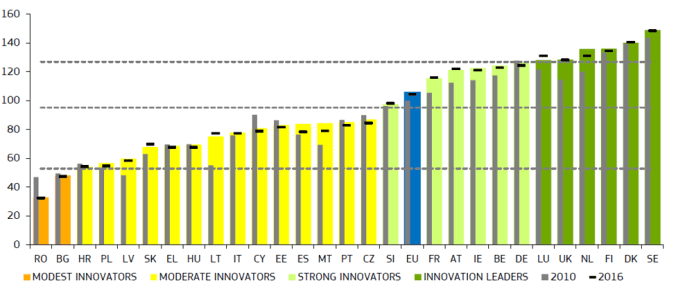
Why? Well there are two main reasons for allow one-way borders. The first is when one area needs skills the other has. This was historically true of Hong Kong and the services it provided to mainland China in terms of capital and skills, although today this is no longer so relevant. In the case of Britain and the EU, there are arguably skills which those across the channel, all things being equal, would prefer to have. Banking and finance might be part of this, but it seems unlikely. Much more relevant is that Britain is far more innovative than the rest of Europe and particularly so compared to the larger countries. In the European Commission’s innovation rankings for instance, Britain comes fifth but well ahead of Germany, as well as France, Italy and Spain. This is something the EU would surely rather not lose: startups and business ideas which could change the world but which need a large market to be tested and improved. For this reason, one-sided migration would be net positive.

European countries ranked by innovation

European innovation

Source: European Innovation Scoreboard 2018 (European Commission)

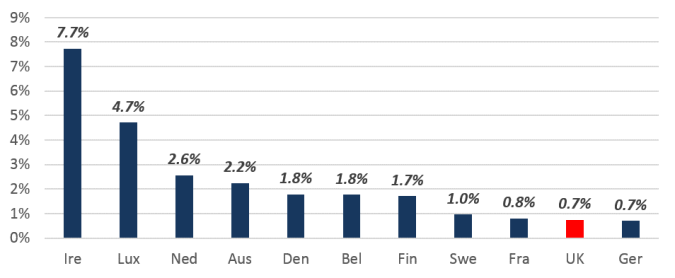
The second reason is the defensive one and relies on a resource Britain has an abundance of: parochialism. One of the reasons China has no particular fear of opening the border to Hong Kong is that there is very little chance that people will want to cross the border and stay there. Oddly enough, Britain is in the same boat, since Britons have historically been far less likely to move to another European country than many others, especially those of a working age. If we look at northern European migrants to other northern European destinations (in other words, intra-EU migration which strips out the retirement population) Britain figures as one of the least mobile populations behind even France. Only Germany is marginally behind and this is due to its outstanding export economy.

Total intra-Northern European emigrants as a percentage of total population

Intra-European migration

Source: People on the Move (Bruegel Jan 2018)

This reflects only “rich” Europe; if eastern and southern Europe were included the numbers would be even more stark. This peculiarly British parochialism can be seen in everything from the lack of language learning in British schools through to the reluctance of British footballers to move to European leagues which are better for their career. In other words, the British are much more disinclined to move and settle in the EU than the other way around, so that offering asymmetric access will only help business without causing any employment displacement.

This is a classic and enjoyable case of hidden asymmetry, the defining theme of this blog. The simple fact is that just because access is unequal does not mean that it is imbalanced or not beneficial to both sides. Reciprocity may seem “fair” on the face of it but may not actually be relevant – when there are cultural asymmetries as in this case, there is a good case to argue that reciprocity is not needed. Unless indeed retaliation is the core objective.

The hidden costs of parenting – why PPP could become PPPP

stress-cost-of-kids

Purchasing power parity or “PPP” has for many years been as good a proxy as any for allowing comparability between figures such as different countries’ GDP. China’s economy, for example, has a nominal GDP of just US$12 trillion, compared to America’s US$19.4 trillion. Yet when re-based on PPP, China’s GDP is actually US$23.2, making it the largest in the world. I for one accept that this is a useful indicator of economic strength, in the sense that China as a country is able to mobilise more economic resources than its nominal GDP would strictly suggest, since labour and capital there are cheaper. Likewise, a preferred measure of living standards is that of GDP per capita at PPP, or sometimes (better) average wages at PPP. In this way, some comparability may be afforded which accounts for street food in China appearing so much cheaper than in the West for instance.

Yet a friend of mine recently noted that in a sense, PPP-based comparisons of wages and living standards were very much geared towards the individual. A great leveler, he reckoned (as a relatively new parent complaining about the costs of the endeavor) was the arrival of children into his life. Because whilst in theory a basket of goods for PPP calculation includes items needed for raising children, in reality behavioral differences distort its reality. PPP, he felt, did not reflect the full costs of parenting and its effects seemed most intuitive to a single person. When considering where to live, PPP in his life could and perhaps should be re-adjusted to Parental PPP or “PPPP”.

There are three main buckets to consider in making any such adjustments:

1. Direct additional costs of education
2. Consumption choices
3. Real estate costs

The theory here is as follows: wherever you live in the world, the likelihood is that you will as a parent attempt to make up for the deficiencies of the world around you as best you can, in the interest of your children. This comes out of your own resources, and actually in many countries where life is “cheap”, when it comes to raising children those expenses shoot right up again. For instance, as a single person one may choose to drink tap water; as a parent one begins to invest in water cleansing machinery or bottled water (especially in Asia). Education is an important element too, since although many countries provide free universal education, parents recognize their limitations and will correspondingly pay for tuition and other aid. A surprisingly large selection of countries such China actually see parents effectively paying for education despite it being notionally free – and this is before getting to the issue of boarding schools paid for by expats. Lastly, real estate requirements are different and in some parts of the world rents / price counter-intuitively increase with the size of a property, commanding a premium due to restricted space.

So a comprehensive, scientific adjustment to PPP would require a sophisticated model which includes all these factors. To test it though, I instead looked at a simplistic account using only one factor that I could readily find, HSBC’s analysis of how much parents pay for their children’s education in several countries:

Cost of parenting
Source: HSBC – The Value of Education report 2017

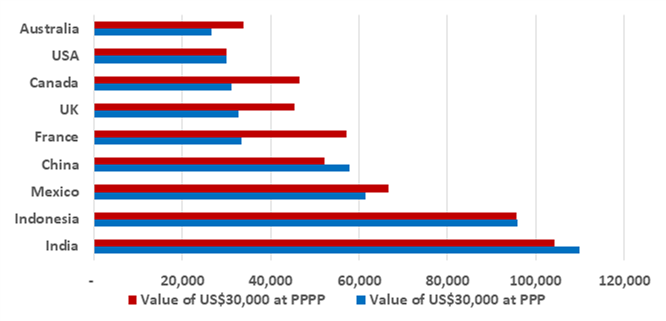
Using this data as a rough proxy for all-in childcare costs (imperfect, but it is all I have to hand) I then readjusted the standard PPP index as provided by the OECD. The assumption I have made is that one-third of a parent’s income is used on children, a figure broadly in-line with statistics also published by the OECD. Thus I left two-thirds of income adjusted on the official OECD PPP basis, whilst the remaining one-third I have adjusted using a new index created by comparing total childcare spend. The results look like this:

Value of 30000

Basic and clumsy though this analysis is, it shows some interesting trends. First, as my friend suspected, the “real” living costs for a parent in places like China and India may be in fact higher than initially assumed, due to a surprisingly high need for private spend. But even more notable is how much value is added by the welfare societies of France and the UK, where the median family does not spend anything like as much for education particularly at the tertiary level. Median wages go a lot further in Europe and Canada than in the US under this system – and indeed US$30,000 almost matches the value of US$30,000 in China. The same kind of logic no doubt applies to issues such as universal healthcare. Assuming my calculations are even remotely accurate, life is fundamentally as cheap in Europe as it is in China, whilst life in the US remains the most expensive.

This methodology is very preliminary, full of assumptions and no doubt lacking. I would be happy to hear opinions on how best to improve it. However the basic theory is strong, namely that PPP may have a simple underlying flaw due to not accounting for changes in life cycle; in some cases PPP probably needs to become PPPP to be meaningful for public policy and for investment purposes alike. Essentially, single life remains localised whilst parenthood is becoming globalised. Since parenting costs are only going to increase as we go forward, the issue becomes particularly prominent. PPPP could be the future.

**************

For those keen to see the underlying data, below is the table of calculations:

PPPP table

How all politics really works – in one simple chart

Introducing the General Theory of Government 

The events of 2016 were curious because of their dichotomy: on the one hand, they were such a shock to the political classes, on the other hand they were also entirely predictable. Yet the commentariat both then and since appeared to miss (or simply forget) the most basic and obvious premise of how all politics works: namely that the ruler has to offer the ruled a mixture of both material and psychological well-being. The desire for identity is as legitimate a concern as any amount of wealth, and any government that fails to provide one or the other over a long period of time will suffer the occasional revolt. Understanding this explains Brexit, Trump and any other examples one might care to mention.

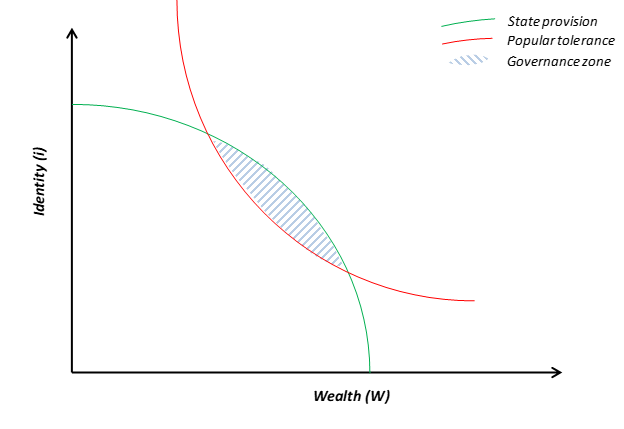
I do not claim this to be revolutionary, but given its lack of profile and given the impending elections in the US which will doubtless cause another round of soul-searching, I think it is useful to visualize this concept in a simple, easy to comprehend model. With no further ado therefore, all politics can be represented in this single chart:

General Theory - basic model

The Wealth-Identity Trade-off Model

It should be easy to see where I am going with this. Into the x-axis goes all those things which politicians want to focus on: taxes, welfare spending, the cost of living. Into the y-axis are all those things politicians seem not to think exist anymore such as ethnicity, religion and language. And, in a democracy at least, any government which consistently offers too little of one or other of these parameters, will find themselves cast out. We have for perhaps too long been living in a world where the governing classes have not only mistaken how to deliver W (Sanders, &c), but completely ignored i (Trump, Farage &c). Political parties across the spectrum have spent the last few decades obsessing over the x-axis whilst assuming that the y-axis will tend to itself. Rectifying this will be, as I have alluded to before, the dominant theme of the next two decades at least in the West.

I would hope this is all intuitive enough not to need vast amounts of explanation, but in a series of posts I intend to outline the basic premise of the General Theory and specifically its core idea, the Wealth-Identity Trade-off Model (WITM™). I will go on to examine how and when a society ceases to function properly; what a society really comprises within the model (“Median Man”, or “MM“); and lastly look at some applied examples in the world today and perhaps yesterday.

What I am proposing is not in itself, I think novel; however like all good things I believe this theory synthesizes simple, intuitive ideas which have at best not been expressed before in such a manner, or perhaps may not have been coherently identified. To anyone who disagrees with this, or who have contrary opinions, I look forward to hearing them. Additionally, since these are blog posts which may one day find their way into a book, I will not footnote everything in detail. However I trust that enough is articulated to allow the reader to comprehend what I intend.

The Kavanaugh debacle

Let me humbly offer my view on what has happened here on Kavanaugh. It’s only a theory but I am pretty convinced of it.

The GOP went for a pretty extreme originalist in picking Kavanaugh (see the positioning below). Unlike Gorsuch, he is far from unimpeachable as a jurist; unlike Amy Barrett, his backstory is not popular. He is a party hack who’s real scandal is not this sexual one but rather his role in the Bush administration in 2003, for which any half competent opposition could have hung him out to dry. Therefore, he was not an easy win for the GOP.

Why then did they do this? I think because they saw the midterms coming and decided on a gamble of enormous proportions: put up a controversial figure and dare the Democrats to vote him down. If he somehow got through, they got their man in (and not just a conservative judge like Gorsuch, but an actual partisan); if he failed or the process was dragged out, it would be the catalyst needed for their midterm turnout which was threatening to be flat.

What they did not count on was the ensuing sexual scandal, which whilst allowing the Democrats to get all excited was not obviously a partisan consolidating issue. The Democrats had a real chance to derail Kavanaugh’s nomination without suffering a backlash. However, the other thing the GOP did not factor in was the total incompetence of the Democrats in taking this easy path rather than the correct path to blocking him.

The Democrats have consequently managed a thing of genius – treading the only narrow, delicate path they could to somehow come out of the Kavanaugh debacle even worse than the Republicans (various recent polls show a closing of the generic congressional voting polls and in Trump’s own approvals, despite the fact that Trump has almost nothing to do with any of this). The GOP had to make another gamble in the end: namely that they, even as a stupid party, were still not the stupidest party in the room. The Democrats managed that honour, and the Republicans’ last gasp gamble seems to have worked.

Extraordinary from all sides.

Critics of the film Crazy Rich Asians don’t really understand it

Family

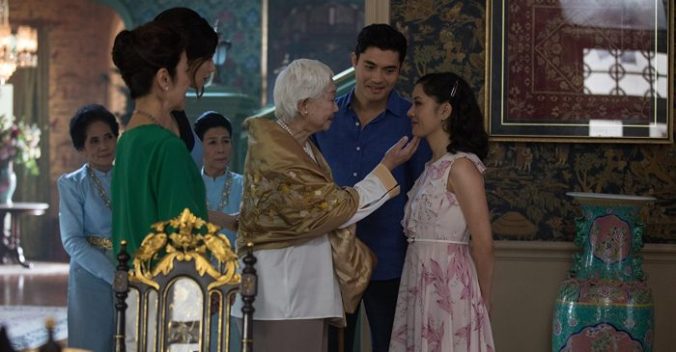
I will admit it: I liked Crazy Rich Asians. In fact, I liked the movie so much that I went to watch it twice at the cinema. This does not appear to put me in good company, since most of the film’s fans seem to be motivated by trite Asian empowerment, whilst normally thoughtful commentators are calling it a “disappointment” and a “missed opportunity”. Inevitably, the film has also fallen victim to those saying it is not representative enough of the Singaporean society it aims to depict.

Yet all of these views rather miss the point, and miss the film’s true genius. Yes, Crazy Rich Asians contains a charming if generic tale of the poor-girl-conquers-rich-family; yes, the film gives uneducated western audiences Asia’s own Lifestyles of the Rich and Famous, of which many would be unaware; and yes, it is a glorious exposition of pan-Asian pride and “arrival” – the film’s opening sequence in a London hotel almost seems a gratuitous assertion of the changing balance of power between Asia and the West. Yet all of this represents only a superficial comprehension of the film, and mostly, one still understood through an inherently western lens.

Rather, Crazy Rich Asians is a profound social commentary about the state of the Chinese diaspora, its diversity and depth, and the gravitational forces that are pulling it apart. What Jon Chu (and author Kevin Kwan) have done is bring into focus the central question vexing much of Beijing, Kuala Lumpur and Los Angeles: who owns Chinese identity? To understand the real meaning of this film is to understand the transcendent nature of what it means to be part of the Greater Chinese world.

There are here essentially two main stereotypes of this Chinese diaspora, and two Chinas, being juxtaposed against each other (at this point I am going to note that I use various monikers with caution, and expect the reader to understand the general thrust of the label rather than be unhelpfully bogged down by the minutiae of definitions). A third China is for now not tackled, but we will touch on it below.

OCs

The first, represented most prominently by Eleanor Young (rather than, I think, by her own mother-in-law) is that of the historic “overseas Chinese” community, who by and large left China before 1949, and in the greatest numbers during the upheavals of the 19th century. These are the communities which populated India, Burmah and Malaya, before sometimes going on to Britain or further afield. The Chinese of Singapore, where Crazy Rich Asians is set, and Malaysia, where it is partly filmed, are central to this, as were the former Chinese communities in Bombay, Calcutta and Rangoon amongst others. Families of this ilk regard themselves immutably as the guardians of true Chinese culture as handed down by millennia of history prior to the 20th century. Their China is “China”; all else, whether the contemporary Mainland or the migrants to America, is ersatz.

The second group, depicted principally by Rachel Chu, is that of the classic American-born Chinese (“ABC”), somewhat unfairly maligned in the film as a “banana”. But the term “ABC” hides a multitude of sins, since there are plenty of families of Chinese descent in the US who are far more traditional and in-line with Eleanor Young, than is the protagonist here. Really, the story is of Rachel’s mother Kerry, whose story is not explicit in the movie but who can readily be inferred as one of the post-1980 New China emigres (as indeed related in the books). This cohort, whilst being “Chinese”, were already Chinese of the post-Cultural Revolution era and bear all the marks of that rootlessness. Their story of emigration is far different to that of the pre-1949 generation and it is telling in attitude, outlook, habits and behavior of their children. This is particularly true of the US where assimilation is most culturally demanded, but also to a lesser extent in Canada and Britain. For them, there is not a lot tying them to the China their parents escaped other than the occasional longing for bubble tea and mahjong.

ABCs

The film also adds a few other Chinese ingredients into mix. The Mainland is barely mentioned, presumably in order not to offend the new owners of Hollywood studios and allow the movie a chance to be shown in the world’s second largest market. Instead though, Hong Kong (through cousin Eddie Cheng) is used as a proxy for the Mainland’s gauche, parvenu ways – and ironically, since Hong Kong is rather more brash and arriviste than they would like to think, this proxy is very fitting. It is perhaps a nuanced little dig at all those Hongkie elites who think so much of themselves. Next the grandmother, Shang Su Yi (again not named in the film but in the books) is a veiled reference at the legendary domineering of Shanghainese women. Taiwan, with all its crypto-Japanese influences, is probably the largest omission from the storyline, being referenced only in passing. Lastly there is Singapore itself which, although portrayed as a centre for overseas Chinese, is actually a modernity unto itself – as represented by the Goh family of nouveau riche ah beng’s and ah lian’s. Much of Singapore is barely recognizable for the traditional Chinese of London or even KL; in terms of “real Chinese culture”, Malaysia actually is what Singapore thinks it is – thus making the filming location at the Villa Carcosa in KL, even more poignant.

Neither the Youngs or the Chus exist in China today, but the conflict between them raging everywhere from Singapore to San Francisco, is deep, passionate and fierce. The overseas Chinese community of pre-1949 are both proud and condescending precisely because the China of their heritage is still so dominant. Crazy Rich Asians is fundamentally a homage to, and the story of, this peculiar overseas Chinese world and the enormous struggle it has faced in being the bearer of the one true Chinese light, whilst being weighed down on one side by the cultural Revolution of Mainland China, and on the other by the cultural dilution amongst ABCs. Even for western audiences, this is obvious: the stereotype of that thrifty family that keeps the plastic wrapping on the dining room chair set (think Fresh Off the Boat) is real – but it is also specific to southern Chinese families who went overseas. Northern culture, which now dominates middle class life in Beijing and even Shanghai, is not thrifty but rather garish profligacy that throws money at anything. Not for them the lessons of trauma and hard work. And as a final insult, we are now in a world where Simplified Chinese characters, by sheer scale of the PRC’s importance, is the default Chinese – no foreigner today would dream of learning anything Traditional.

I would be inclined to make the lazy assertion that those who do not get Crazy Rich Asians are just too shallow to appreciate its many levels. Yet I cannot, because the true beauty of the film is precisely that such people are a part of the story; the very fact that they do not fully comprehend it is emblematic of the great contradictions which Chinese are posing to each other. This movie is aimed at multiple audiences, and satisfies each in its own way. Its enduring strength is the way those audiences will respond differently and no-one really finishes with the same viewpoint on who they sympathise with and support – Eleanor or Rachel? The grandmother or Kerry? Indeed many modern PRC Chinese may not think any of the story is relevant to them; but it is more so than they may ever realise.

Being myself from a Chinese family of southern provenance who arrived via Calcutta to Britain, my instinct is to agree that our true culture is that transmitted through the strict guardianship of overseas Chinese communities. But having spent the greater part of my life in the Mainland and having had the rare privilege of knowing Beijing as far back as the 1980s, I understand also where New China and its impulses comes from. These Three Chinas – the PRC, overseas Chinese and ABCs – are all locked in the kind of conflict which is characterized by the (Anglo-American) maxim of being “separated by a single language”. The reason the film is so successful is that it stirs so much in each of these various Chinas, but does so both severally and collectively. Just one example is the soundtrack, which includes everything from the Shanghai jazz scene of the 1930s to the world of 1970s Cantopop covers, to Chinese contestants on The Voice. The sheer range of the music, its roots and influences, is a story of Chinese culture through the ages.

So whilst Crazy Rich Asians can come across as pedestrian to the uninitiated, the complicated and nuanced realities which its showy aesthetics overlay are important. I am sure that Jon Chu set out to tell this very story of divergence and disruption, knowing that each of his audiences would find something different to enjoy (and criticize it for). But even if he did not, for those who truly understand the complex tapestry that forms the world of the Chinese diaspora, he has created a masterpiece that repays watching, and poses socio-cultural questions of us which will not only not go away, but will only become more prominent. This painful dilemma is the challenge being faced by tens of millions across the world, parents, grandparents and others, who this film is designed to represent and tell the story of. To look at Michelle Yeoh is to feel the grip of generations over our Chinese souls and on some level, to think, “I understand why she is us, and we are her”. It speaks powerfully about our identity, and forces us to contemplate what it is to be without it. This is a seminal work of Chinese cultural existentialism, cleverly wrapped in pop culture – it is an Asian Banksy; it is MC Hotdog expressing Hegel.

It is not so much about “seeing ourselves on screen”, so much as “what is to become of us?”. Perhaps in the next installment, we will be told.

John McCain’s passing poses more questions than answers

McCain Feingold

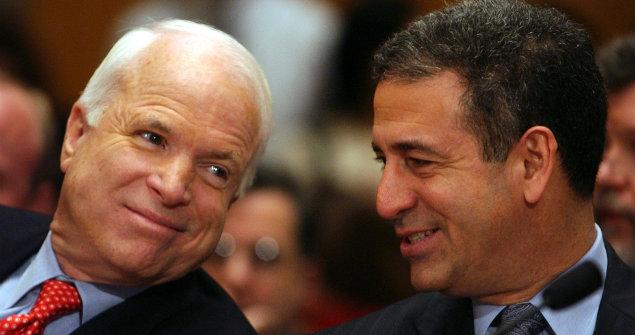
I am not usually interested in talking about “current events” but the death of John McCain is worthy of consideration in terms of all the questions it poses for the long trajectory of politics in the US and elsewhere.

First, cards on the table: I was for many years a card-carrying member of the McCain fan club. I met the man twice, once when I was interning on the Hill in 2001 when he and Joe Leiberman were the Statler and Waldorf of American politics, and again three years later when he came to the Oxford Union; somewhere in the back of my desk drawer is a grainy first-generation camera phone video of the standing ovation he received from all as he left that hall. To my mind, in his 2000 incarnation he was perhaps the greatest President the US never had, combining nobility and grace with a far-reaching sense of mission and destiny for his country. On top of this, he was a patriot and in his own way, had a strong sense of America’s purpose in the world. His defeat at the hands of Karl Rove’s borderline racist campaign in the 2000 Republican primaries was a tragedy all round.

McCain sponsored the only substantial campaign finance reform bill of recent years, and was one of the few sources of bipartisanship in an era of increasing polarisation. He also attempted, being a Western conservative rather than a Southern one, to find a way to reform immigration in such a way that America could still be sensitively preserved before the difficulties set in. He failed, but not before dragging Bush along with him and not before cementing that alternative Republican approach towards success in states that were not whiter than white – including Arizona and Texas. In party terms it might be said that he was the future, once.

Yet by 2008, McCain was a sad shadow of his former self. For the previous few years he had begun to cravenly solicit the support of the GOP machinery by supporting an extension of the Bush tax cuts and in the end turning to Karl Rove, of all people, for advice in the Presidential campaign. For my own part, I struggled to support McCain during that election and only did so in the end as a counter to the vapidity that would prove to characterise Barack Obama; in fact my preferred candidate in early 2008 was Hillary Clinton. Where in 2000 I was so deeply upset at McCain’s failure, by 2008 I could only shrug as his team decided to invite Sarah Palin onto his ticket.

This stark decline was not just a measure of his political choices; it was indicative of the declining relevance of McCain and his whole faction, well-meaning but ultimately anachronistic as they were. For a start, his ideological hawkishness over Iraq showed an antiquated notion of how to manage international relations. Elsewhere, I have written about the idea that greatness can only be achieved through a judicious mixture of both nobility and ruthlessness, not through ideological optimism alone. For a country like the US, some countries may be won over, but others need to be kept down with all the skullduggery in one’s arsenal. McCain was blindly wedded only to the former; his worldview was effectively one of nobility alone – the idea that sheer “rightness” would be enough to win America’s conflicts.

McCain, even in 2000, embodied all too much that post-Cold War complacency which first failed to foresee the emerging threat of militant Islam and then also dealt with it so clumsily and inconclusively. Leaving aside Iraq, it is also difficult to imagine what McCain’s reaction to China would have been in recent decades. The likelihood is that in dealing with what has become the single largest threat to American hegemony, he would have undertaken the same combination of sabre-rattling and indecision which was to inform the Bush and Obama administrations. McCain would also have had nothing to say on China’s post-WTO gamesmanship, because trade, commerce and business were not his strength. He would have been just as distracted by pointless sideshows against Russia and just as obtuse, I am sad to say, about the key issues of wage growth and trade.

McCain young

It is incredibly sad to think of how irrelevant many of the things we put McCain on a pedestal for ten years ago, are today. Yet he does bequeath some traits which remain important, of bipartisanship, integrity and patriotism which are so obviously lacking throughout the ranks of both political parties today. McCain would have taken us into perhaps ten wars and back; but he would always have done so on first principles. Nonetheless his passing closes the chapter on an era when America could still afford to think in clean cut terms about its role in the world; and highlights the fact that his naivety on occasionally doing the cynical thing, is also passed. For McCain, I believe the world was always the world of 2000. I adored the man, but it is time to move onto a new reality.

Guns don’t kill people. Americans kill people.

Time to target the real cause of America’s non-criminal gun violence problem: Americans

Gun family

The perennial scene of a US school shooting brings a timely reminder of American exceptionalism. Typically, this is the time when both sides of the gun control debate rehearse their equally absurd statistics defending their position. So why should I be left out!

There are some unfortunate issues with the gun control lobby. The first is that they often roll out data which talks about total gun deaths and its correlation with gun ownership. The problem with this is, that total gun deaths includes suicides – and in fact, the vast majority of gun deaths are suicides. Arguably, this is also a problem but the gun control debate clearly is not one about regulating how people choose their own way to die. Secondly, and unhelpfully for domestic discourse, many also bring up comparisons with abroad – something which will surely cause more provocation than it solves given the NRA lobby’s notorious rejection of taking signals from foreigners. Two examples of data which commonly does the rounds are below:

But let us look at this in a bit more detail nonetheless, because the comparison with other countries is actually more nuanced than it seems. The US of course has by far the OECD’s highest gun-ownership per capita – but it is not way off the scale. At about 89 guns per 100 people, this is “only” about twice as much as some other perfectly peaceful countries such as Switzerland and Finland, which both have over 40 per 100 people:

Guns per capita

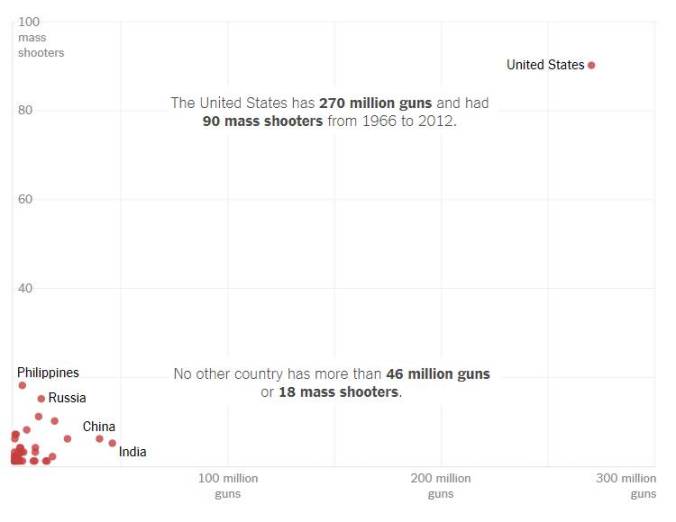
There are all huge numbers compared to countries such as the UK. But the US also has far higher than twice the number of gun deaths and, as per this astute chart from the New York Times, has vastly higher numbers of mass shootings in particular:

NY Times gun mass shootings

Even stripping aside some of the obvious issues with this comparison, such as the facts that gun ownership has actually been much more mature in the US than several other of these countries (the chart looks at mass shootings since 1966) and that gun ownership in some countries is a function of national service (with commensurate training), this tells us something quite important: it is it not actually gun ownership that leads to lots of deaths, it is specifically gun-owning Americans.

This leads to a broader point about national character, of which I have written before in talking about the uniquely brash and ruthless personality of the Anglosphere. The fact is, gun control is not so much a universal human issue so much as one linked specifically to the perfect storm of mass gun ownership and American culture which currently exists. Intuitively, what would apply to the US, UK and Australia may not be true of Switzerland, Germany and Austria, where social discipline is that much stronger. I would be much more sanguine about the need for restricting guns in Japan, for instance, than I would in China, simply based on the type of people there.

This is not to say that other countries do not have problems – Switzerland has certainly not been immune to mass shootings. And it would be churlish to deny the obvious basic rational linkage between possessing guns and using them. But there is clearly something deeper about the American psyche that makes gun control a more poignant issue there than elsewhere.

For the record, I am in favour of gun control. I believe that since guns are actually designed for the purpose of inflicting damage – unlike cars or any other tools that cause harm as a side effect – society through its government ought to minimize its presence. There can be some leeway for practical or recreational use of course, but these should be restricted in both type and regulation. If a farmer needs a gun just as he needs a car, he should get a license for one.

I acknowledge that restricting legal gun ownership will not impact the larger issue of gun violence in the US. In fact it would be marginal. However, there is no evidence that legal gun ownership helps in preventing crime either; and the reality is that the few instances of legal gun-related disaster such as almost every school shooting, are much more high profile and in their way, rather more tragic than mere gang shootings in inner cities. They affect middle class suburbia and are preventable. This alone justifies action by the government.

But let us not assume that taking guns away from Americans is descriptive of the human condition; it is not. Instead it is descriptive of the American condition. “Guns don’t kill people.” Well, people don’t kill people, either. It is Americans that kill people. Time, therefore, to restrict Americans from owning guns …

The Lessons of History – why confabulation may be worse than amnesia

It is normal for any society to look back to their past for paradigms of “greatness”. In Will and Ariel Durant’s masterful work The Lessons of History, they wrote that:

To break sharply with the past is to court the madness that may follow the shock of sudden blows or mutilations. As the sanity of the individual lies in the continuity of his memories, so the sanity of a group lies in the continuity of its traditions; in either case a break in the chain invites a neurotic reaction.

In other words, a grasp of history is important and as a historian myself, I am quite skeptical of those in public life who clearly do not have or act on such a grasp – Tony Blair in the build-up to the Iraq War being a case in point.

But what is the right history to look to? What of the rich tapestry of our past really tells us about the tenets of our national character? History will always be twisted to aid politics; but the current ahistoricism amongst the governing classes has I believe reached something of a new low – and it matters for policy. Reaching for the correct memory is as important as having memories at all.

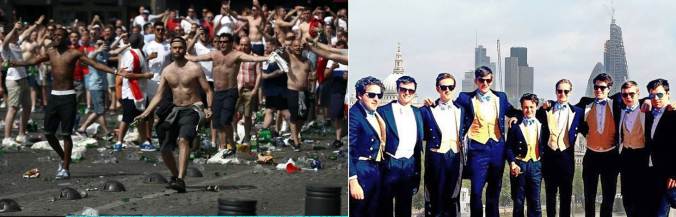
Britain, for instance, has an imperial history which as a nation it has yet to move on from despite the best efforts of the PC brigades. The signs of it – from the remnants of actual empire (now reduced to the Falklands and Gibraltar) to the permanent seat on the UNSC – still pervade much establishment and tabloid newspaper thinking. But whereas many British subconsciously see the height of empire as the regal majesty of the Delhi Durbar, the real Britain was something altogether less dignified. The British character, I would submit, is one of unruly mobbishness at heart which can be seen throughout society from football hooligans through to the Bullingdon Club – perhaps the best representations of contemporary life being the social diversity of rioters in 2011, and the undignified rush to loot cargo from a sinking ship in 2007.

Hooligans

British hooliganism – two sides of the same historical coin

Rather than harking back to formal empire therefore, the British memory should look more to the Gordon Riots, to Clive of India and James Cook, than to parades at Spithead. Because in this riotous assembly, were also the seeds of Britain’s real greatness: as privateers and traders, entrepreneurs and innovators rather than organisers. In the 18th century Britain stumbled across empires in India and America, and created the Industrial Revolution; arguably, as soon as Britain’s organization skills were brought to bear in the 19th century, the Empire started its decline.

America, too, has the Anglospheric trait of tending towards natural lawlessness as shown by moments such as Hurricane Katrina (in contrast to an example like Fukushima). But there is a deeper romance to the American story as told in elementary schools across the land, of idealism, diversity and tolerance. This too, though, is misremembered. America became great not because of its tolerance, but because of its moments of judicious intolerance and plain ruthlessness – against indigenous people, against Britain, and later against Japan and the Soviet Union (the fraught relationship with Britain was the theme of a 2005 paper of mine). Yes, there were waves of immigration which fed into the so-called “melting pot”, but America would be much less of a country today had it been run with the kinder, gentler governance associated with neighbouring Canada for instance (even if this may also be exaggerated).

Some Americans will not like to see this as the basis of their history, but the reality is that the country’s “manifest destiny” – to rule the continent and then the world – was not built on being nice to people. The American Revolution was not mainly a principled stand of Enlightenment values, but an opportunistic socio-economic power grab by one set of elites from another*. There is a reason why Andrew Jackson, until recent events, was held high in the pantheon of bank notes. And this memory, tinged with a harsh edge and violence, is every bit as important for the country as self-congratulatory myths about the Founding Fathers or Abraham Lincoln. Just as Britain is more Clive than Hardinge, so America is more Jackson than Lewis and Clark.

Jackson Lewis Clark

Andrew Jackson,  Meriwether Lewis and William Clark

As an example of how these falsified memories impact policy, let us take the rhetoric surrounding immigration, an issue applicable to both the US and Britain. The common liberal mantra is the fallacy that “this country was built on immigration!”, a cry heard around hipster cafes from Primrose Hill to the West Village. Factually true, but rather irrelevant. Yes, there has been plenty of immigration in the past, although few have come close in scale to what has occurred in recent years. Yes, immigrants by and large contribute enormously to skills, ambition and demographics in both these countries. But it is not immigration itself which has been good; it is appropriate amounts of immigration when building on a platform of strong host culture. It is an “and”, not an “or” – the tired, poor, yearning huddled masses in the US would be nothing had not the violent ruthlessness of mostly white, protestant Anglophone Americans established a country of enormous land and resources. In other words, there are two pillars to this story of progress, not one:

  1. preserve a coherent indigenous identity;
  2. then add immigration as needed.

But the one-dimensional appreciation of history from those that dominate the media and education misses all this. Immigration is put on a pedestal in and of itself, as though it somehow generates positive impacts on a standalone basis. National identity is practically a dirty word – or has been captured by cynics who believe it can be watered down to nothing by adding foreign elements into the mix via the “we were all immigrants once” fallacy. To do this is the sow the seeds of destruction for any nation-state. Just as Blair had no regard for the longer sweep of history in the Middle East, so also the likes of Corbyn or Pelosi for their own country (although strangely Bernie Sanders actually did – and consequently struggled with certain corners of Liberaldom).

But the point is this: whether we are talking about British lack of self-discipline or American violence, these are not actually bad characteristics. People should not be judging these with opprobrium – they can be positives which lead to other strengths. Anglo-American consumerism and short-term thinking helps the whole world in terms of innovation and just plain growth. If Americans did not love spending money so much, the rest of us would not have iPhones. A planet of Germany’s and Japan’s would achieve nothing. Finding a place in the world is partly about adapting – but only on the basis of recognizing what one’s inherent strengths are. Politicians should not be complaining about these characteristics or still less, try to change them. They should be trying to harness them in productive ways – opportunism becomes enterprise, violence becomes robustness. The world certain needs all of these.

I will finish on a macro view. A former boss of mine once asserted that there are three types of competitiveness in the corporate world: price, quality and innovation. Capture one, and you will survive; capture two, and you will succeed; capture all three and you will rule the marketplace. Countries are not dissimilar, and it is no surprise that the one nation which comes closest to an adequate level of all three is also the only hyperpower – America. Historically, even during the Industrial Revolution, Britain was not known for quality, but rather for inventiveness in products and processes. Since emerging, Germany always had a superior record on pure quality, but they have rarely created anything completely new. Nations have their place; national identity will be a determinant of it.

Britain, post-Brexit, needs to thoroughly reflect on which of these features it possesses and how it pursues them (in my opinion, clearly led by innovation not quality)**. It may seem obvious to say that she needs to see herself as an underdog, yet shockingly few statesmen have really digested this fact. America, in this period of potential decline, also needs to rediscover which qualities it still has. Problems like the rise of China and the new “community of empires” will not solve themselves. But for either country to successfully confront their dilemmas, a closer examination of the collective, subconscious social memory is needed; for without it, we face the insanity Durant outlined so long ago.


———————————————————————————————————————————–

* Perhaps this will be a major point of debate, but as something of a historian in the era (see eg my 2005 paper on the Anglican Bishop Controversy) the American Revolution was by and large a moment when local elites, separately in Boston and Virginia, found Britain a convenient scapegoat for directing local discontent against. By the 1740s, ports such as Boston and the southern backcountry were facing, for the very first time in colonial history, economic stagnation and the rise of an underclass. A war (The French & Indian) put this on hold, but by 1763 the Boston families and the Tidewater oligarchies needed to stir a conflict for their legitimacy. They got one with Britain, and this, much more than tiresome debates about Lockean Liberalism vs Republicanism (rf Bailyn, Pocock et al), or “taxation without representation”, lies at the heart of the rebellion – and partly explains the surprisingly strong loyalist sentiment throughout the war.

** I will also add that one of the only intelligible and plausible post-Brexit British identities I have heard comes from a potential future guest blogger here, namely that Britain could become an Israel – in other words, a medium-sized maverick which punches above its weight simply through unpredictability. Better not decommission those nuclear weapons, in which case.