Rather than to be feared, AI is just that dysfunctional kid we never liked

The excitement around AI, both from businesses and finance, is as frothy as it is palpable. My LinkedIn wall, that repository of the most commercially obvious, cannot go two posts without someone bringing up a reference to unemployed lawyers or the NVidia share price. Much like the coming of the Internet, the true market will follow the bubble as surely as this bubble has followed the uneducated speculation. Yet I see far fewer posts from actual operators about AI’s current uses or the direction of travel, due no doubt to that fact that we are still at nascency.

Yet even at this early stage, I would offer a few groundless, untechnical observations about how this is heading, based partly on a recent comment made to me that we are heading away from ‘data science’ and towards ‘content science’. I stand to be proved wrong, of course, but I feel some of the underlying truths will be difficult to challenge. Perhaps in three years’ time it will all look very different, but I will put it down for the record.

1. AI is the student, not the teacher 

To some this may seem obvious, but the reality of GPT and its B2B and B2C offshoots, is that they remain permanently there to be taught by humans.

AI will be able to do huge amounts of work for us in the future, no doubt. We are told that they will replace lawyers and accountants for instance, and the workplace will look different. I would agree with this, they are a future colleague – but the question is which colleague will they be? The nature of it indicates that the role they will perform is basically that of the new graduate trainee, or possibly even the intern. They are there, and a useful resource for sure, but they will not be producing finished products until you give them feedback, repeatedly. After a while you will wish they were able to at least fetch the coffee for you. Within our lifetimes, they will never have their own office to lord it over the saps outside and disappear off to play golf at 2.00pm on a Thursday.

2. AI is a pathological liar

It has been well noted that AI tends to ‘lie’ and many wonder how and why a logical entity would do this. But of course the vast majority of content for generative AI comes from content that is already out there, and that content has been written by fallible human hands.

In the same way that ‘the Internet’ lies – or rather, is full of untruths because those producing content are all well-intentioned – so also the likes of ChatGPT. Machine learning can only summarise existent knowledge, which is at best imperfect and at worst malicious. This is a poor kid that has been born of a dysfunctional, almost sociopathic family, so what chance does it really have of being a good boy and living a normal adult life later? AI will find itself divorced with estranged children and alimony of its own in decades to come. Arguably, the power of AI will actually magnify lies and illogic through its distributive power; the calculation error of a second rate accountant in 2006 will now form a permanent fixture within our reservoir of collective knowledge, when it need not have done before.

3. AI will reduce innovation 

More controversial than the two previous points is that the net effect of AI, itself an ‘innovation’ driving rocket-high share prices, will be to dampen innovation whenever it used – certainly unless visionary leaders really manage it well.

Referring again to the automation processes which everyone believes will be the first to go, the fact is that even while people are stunned by the ability of AI to produce a legal opinion that formerly took a highly paid lawyer days, that opinion will be decidedly unexciting. It can, after all, only be the output of decades of other lawyer’s opinions. As a student, AI is that kid who does not really think but is only able to regurgitate the books he happens to have read whilst sat in the corner of the library alone, friendless. Possibly he does this because of his parents’ acrimonious divorce, I don’t know. Either way, by doing this, and by that homework being accepted as a decent B+, it means that room for original thinking is limited. In fact, it basically means the quality of all work will only ever be a B+.

Optimistically, of course, AI frees us up to spend more time on productive, innovative thinking. But be realistic: when robots are cleaning your house, how many people will use that unexpectedly free Saturday afternoon for reading Nietzsche or climbing Everest; and instead, how many will be sitting with a bag of crisps rewatching old Netflix series and shouting “they were on a break!” at Rachel (note: guilty as charged). Again, given the power of AI’s distribution, this shift from data to content will actually amplify this ‘anti-innovation’. When we sit down to raw data, we are forced to think; when we sit down to semi-finished content, we will not.

*********

These three issues – that AI is a child, that it comes from a broken home, and that it only studies other people’s books – all link to the end point: the limitations of AI mean that while the world of work may change radically, as with now, human innovators will be disproportionately rewarded then as now. Lots of processes will be automated, but what will not be is not only painting, music or fiction writing, but even areas such as marketing and advertising. I have friends who know how to sell, and sell hard. They already get the best of the opportunities in business today, and this will be even more pronounced tomorrow. The lesson is: where human beings work at things which are truly ‘human’, rather in jobs where they are poor substitutes for machines (such as road sweepers, or boy bands), they will always find a layer of economic reward above that of the machines which serve us. Good jobs aren’t dead.

Perhaps therefore the scariest thing about AI is the mirror it is holding up to our own faults and shortcomings. It is preserving and multiplying all of our past errors and sentiments, most of which we would rather forget, like a scene out of Monty Python.

And like that self destructive black sheep cousin, or that girlfriend who only likes guys who are bad for her, AI not learning from its mistakes however much people point them out. Because from its agnostic standpoint, AI will tell there is no right and wrong, good or bad, just the content.

And whose content is that? Yours.

25 years on, who really won the battle over Rolls Royce and Bentley?

Best of German carmaking

Just over 25 years ago, an intricate set of corporate activities led to the former Rolls Royce car business, which included Bentley, to be owned by German acquirers. When all shook out, Volkswagen acquired the operations at Crewe and the Bentley brand, while BMW got the rights to create a new concept using the name “Rolls Royce”.

First, we should be clear that Rolls Royce since 2003, successful though it has been, is a ‘phantom’ [sic] marque. Rather like Mercedes’ attempt with Maybach, it has nothing to do with the Rolls Royce of old but rather is the upscale concept that BMW wanted to create to fill a hole in its offering.

Secondly, it is worth noting that in the real economy, rather differently to much of the digital economy of today, real assets and people are worth money. What VW acquired – and wanted – was the factory, the engineers and designers, the back catalogue and experience – of the Rolls Royce entity. That was, rightly, considered to be worth more than just the brand around the Rolls Royce. In dilettante reporting of the time, it appeared to be some major sleight of hand that BMW emerged with the brand name after VW had handed over £430m for the business. But for observers beyond the bankers and bloggers, VW were perceived to have gotten their money’s worth – and more.

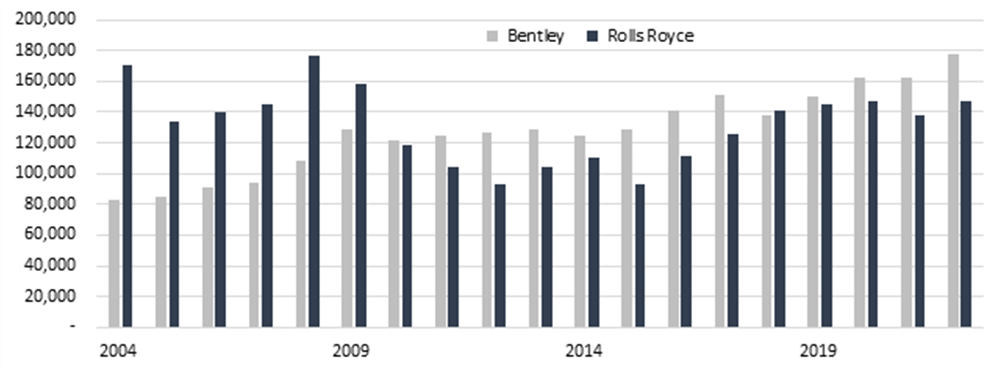
So who has done better since? Well arguably this was a win-win where both carmakers did well with what they took on. While in absolute terms, Bentley has gone on to sell three times the number of vehicles Rolls Royce has (some 200,000 since acquisition, compared to about 65,000 RRs), BMW sell their cars at more than the price of a Bentley.

Total numbers of vehicles sold per year

Source: company accounts

The boring petrol-head bit

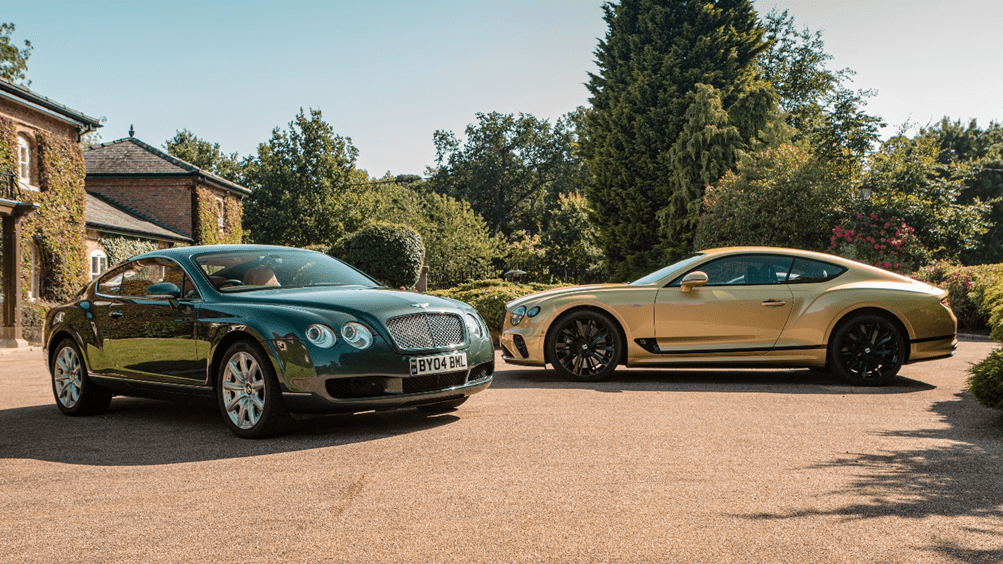
The two brands have pursued rather different strategies given who their owners were. VW, while it already had Audi in the stable (but well before it owned Porsche) wanted Bentley to provide a sporting edge which could be scaled up, rather than owning a ‘limousine’ marque. It therefore pushed the new Continental GT, a model which overnight became a success for London bankers and LA rappers alike. For BMW though, the RR brand was very much about creating a classic luxury saloon (if that can really be used for RR) sitting above their already-premium 7-series.

As mentioned elsewhere, VW went about their strategy by providing the patented W12 engine, a personal project of chairman Ferdinand Piëch, used in their unsuccessful Phaeton luxury saloon adventure, to the team at Crewe. Other than this, and giving the Bentley management a general steer on wanting to see a GT, they left the British business to get on with it – with excellent results. With the arrival of Porsche into the mix a decade later in 2012 though, VW finally started getting serious about the saloon segment, with the launch of the Flying Spur and the Mulsanne. Later again it was coming of the Bentayga, the implausible and slightly absurd Bentley SUV, which has sustained sales in recent years.

BMW went a different direction since they were starting with a clean slate. Working outside of the business over the first five years until 2003, designer and Munich-lifer Marek Djordjevic came up with the Phantom model that would kick-start German ownership of the brand. Sales were boosted again with the launch of the Ghost in 2010, the more affordable line of saloons, but in recent years it is the even more implausible and even more absurd Rolls Royce SUV, the Cullinan, which has been the catalyst – comprising more than 50% of sales since its launch and reaching almost 60% in some years. While Bentley has also had success with the SUV, it has never formed as large a part of its portfolio.

In other words, since 2003 Bentley has really lived off the Continental GT offering, reflecting its racing heritage, while Rolls Royce remained a limousine maker who have evolved into SUVs.

The important bit

Rolls Royce, anecdotally, has always been able to price a like-for-like car at a 30%-50% premium to Bentley since they were each taken over. A Wraith costs more than a Continental GT for instance, and the Ghost costs more than a Flying Spur. However taken as a whole, since introducing the Ghost in 2010 BMW has ended up with a portfolio of cheaper price points on average than VW, as total revenue per vehicle shows:

How this has translated into hard profits for their owners is more complicated. The fact is that neither of these businesses have delivered huge amounts of outright profit. Bentley managed to record a bottom line of £684m in 2022, a record, but since 2003 has dipped in and out of profitability overall. RR has managed to record a small and consistent profit over the same period, culminating in a £97m bottom line in 2022. On an adjusted, pre-R&D basis, Bentley has recorded a 21% profit margin over the last decade, compared with 8% for Rolls Royce. In the context of VW’s and BMW’s overall earnings of €15.8bn and €18.6bn respectively, these are drops in the ocean. Bentley accounts for 4.4% of VW’s earnings; RR just 0.5% of BMW’s.

Moreover, the Rolls Royce profit is overstated since BMW does not push R&D costs into the Goodwood accounts. In fact, it is likely still not profitable after two decades of operation. Bentley, due to its Crewe location being self-sufficient, has spent on average £322m on R&D per year over the last decade, leading to several years in the red. One can assume either that Rolls Royce really is just using BMW 7-series intellectual property, or it is spending similar amounts which would imply substantial ongoing losses, of at least -£100m per year as an educated guess. For what it’s worth, Bentley probably wins the financial battle comfortably.

Of course, both are growing, and as noted previously have been growing faster than their owners as a whole, at high single digit CAGR for revenues and even higher profit growth. However both are yet to fully face the challenges of electrification, though BMW are arguably ahead of VW in technology for that (Volvo / Geely, via its Polestar brand, as a full high end EV performance car which serves as a template for what these two venerable names might look to).

Conclusion

Ultimately, the consensus seems to be that both sides got what they wanted out of these brands when they battled to acquire it in 1998. VW got a sporty brand that could scale, which it has done; BMW got a limousine brand which was not designed to be scalable but to really create a layer above its premium positioning. VW wanted the hard assets of the former business including the factory and staff, given the failure of Phaeton; BMW had most of its platform already available for use and could staff up its new Goodwood facility internally. That explained the difference in pricing – BMW spent £50m on the brand and then some £100m on building the new factory, compared with the £430m VW spent buying a going concern. Bentley is meaningfully profitable though, whereas Rolls Royce has yet to contribute financially.

What neither side anticipated then, but both reacted to, was the rise of the SUV, which perhaps suited the saloon platform better than a sport GT one. Each side has done well but RR has really taken off on its SUV offering; the EV challenge will be next. At the end of the day though, the real benefits will have to be chalked up to ‘intangibles’ including prestige for the owner and, one assumes, spillover benefits from any R&D linked to these luxury marques. It is probably really us, the consumer, who has benefited from these two auto giants deciding to maintain what are basically hobby horses; if the Germans were not so vain, we probably would not have the cars we enjoy today ….

Appendix

How acquirers of car brands – even Chinese ones – can succeed

Cars have had a long innings as possibly the most globalised consumer product around is. By which I mean, they have broadly been the product category about which consumers see supply as a single world-wide market: whether you live in Belgium, Brazil or Brunei, you would still be mostly buying cars from the same top ten or so global producers for the last decades. If you are rich, you would probably be looking at the German makers, and latterly Lexus. If you are middle class you might be settling for other Japanese or European brands. If you were stupid you might buy American – but then, not even Americans do much of that.

Another way of looking at it is that cars have had the longest ‘globalisation window’ of almost any product category. As a country develops, it initially prefers foreign brands and the qualities they bring. But when a country really develops, consumption starts to re-indigenise. For instance, while cars and, say, food products both tend to globalise early, people return to their own taste in food quite soon after they become middle class (partly reflecting the lower barriers to (re-)entry). The speed with which McDonald’s or Yum localise compared to Volkswagen is telling.

In part this is because a carmaking industry is actually difficult to establish: Taiwan, for instance, despite having a steel sector, has never managed to create cars; Korea did manage to, but only after throwing the entire weight of its economic development behind that push; Malaysia threw its weight behind the effort, too, but with mixed results. People often refer to the building of aircraft carriers, or a space programme, as the symbol of a country’s total integrated industrial capability, but on a much more mundane level, so are cars.

All this combines to shape the global landscape in automotive OEMs, which have consequently undertaken enormous amounts of M&A over the years – almost all of which have been unsuccessful. Daimler’s ‘merger of equals’ with Chrysler in 1998 went so poorly that it is subject of business school case studies; while the ‘alliance’ between Renault and Nissan – undertaken a year later and heralded as a counterpoint to that merger – itself became mired in problems. Ford made numerous acquisitions of other brands over the years including Jaguar (1989), Volvo (1999) and Land Rover (2000), before selling all of them at a loss. Aston Martin was an honourable exception which proves the rule. GM did even worse that Ford – both Saab and Daewoo more or less shut down.

So successful automotive acquisitions are worth considering, and when one of those is a rare example of successful Chinese overseas industrial investment, even more so. Below are a few examples of ‘takeovers’ of well-known car brands in recent years, and their performance afterwards.

Vehicle sales CAGR since acquisition

Note: parenthesis indicates year of effective acquisition; Rolls Royce and Aston Martin not strictly ‘acquired’, for different reasons

There are a lot of details which I will not go into here, for instance the story behind Rolls Royce and BMW (the subject of another post), suffice to say that quite a few of these marques have had success over a long period of this century. To put this in context, over the same approximate period as above, the main carmakers have seen growth ranging from +4% (the Germans) to -1% (the Americans). So to understand why these acquisitions have helped practically, I will focus unashamedly on the two cars I personally own: Bentley and Volvo.

The history of Bentley and Rolls Royce is again a post for elsewhere, but Volkswagen essentially bought a faded business selling just 400 cars in 1998. For five years they dwelt on the business and how to get the best from leveraging VW’s broader platform, and in 2003 they completely reinvented the brand. Handing over the patented W12 engine – a slightly eccentric and personal project of chairman Ferdinand Piëch – the new owners steered Bentley back to their sporting roots and create the new Continental GT. The car took off, shooting sales instantly to over the 5,000 unit mark where it has remained and grown. Possibly no car better signifies reinvention than this one and VW undoubtedly gave Bentley a new lease of life.

A few years later in 2010, Chinese carmaker Geely shocked the motor world by buying Volvo, then owned by Ford. Driven by another chairman, Li Shufu, this was a test case for Chinese overseas acquisitions in an age where it was slightly less controversial. Observers expected either a total takeover or completely detachment, but as with VW and Bentley, Geely took a nuanced middle way of gentle guidance and leverage of the broader platform. Again, the new owner mulled for five years or so before pushing the redesign of the XC90 SUV in 2015, which saw Volvo’s sleepy sales take off; in 2018 it trumped this with a new version of the XC60 and Volvo’s position as one of the most popular premium SUV brands was cemented. Volvo grew unit sales by 10% CAGR between 2014-2019 prior to Covid, the vast majority of them these two models.

Both these examples show that automotive M&A can work, when there are clear alignments: first, the buyer needs to have a clear idea of what exactly they are intending to do with the new brand; secondly, they should not rush to impose changes, but take time to understand the asset; and lastly, the buyer needs underlying platform benefits to add. The case of Tata, whose control of JLR has been more mixed, is a case in point: they have not really added much to either Jaguar or Land Rover, and while the latter benefited from the global demand for luxury SUVs, Jaguar has been in stasis. Volvo, on the other hand, will be receiving the full support of Chinese EV technology, future proofing the brand yet further.

My final point reflects an earlier post I made about the quality of FID. For the UK and Sweden, these two acquisitions are exactly as hoped: inbound investment and employment but importantly, technology and IP continuing to grow at home. Bentley and Volvo remain unmistakably British and Swedish endeavours to be proud of, regardless of their owners. The same cannot be said for the low-quality investment that MPs so desperately fuss over, such as Nissan’s ‘flagship’ EV investment into Sunderland. Here, the IP is not British, and neither will the skills be; Britain’s sole role in this is to be cheaper and less regulated than its neighbours – not a desirable or sustainable model. While the volumes coming out of Crewe and Goodwood plants are much fewer, the long-term value-add to the UK is much, much greater.

Mozart and the “Concerto Model” of corporate management

There is a lot to learn from musicians – but it may not be the lessons you might think

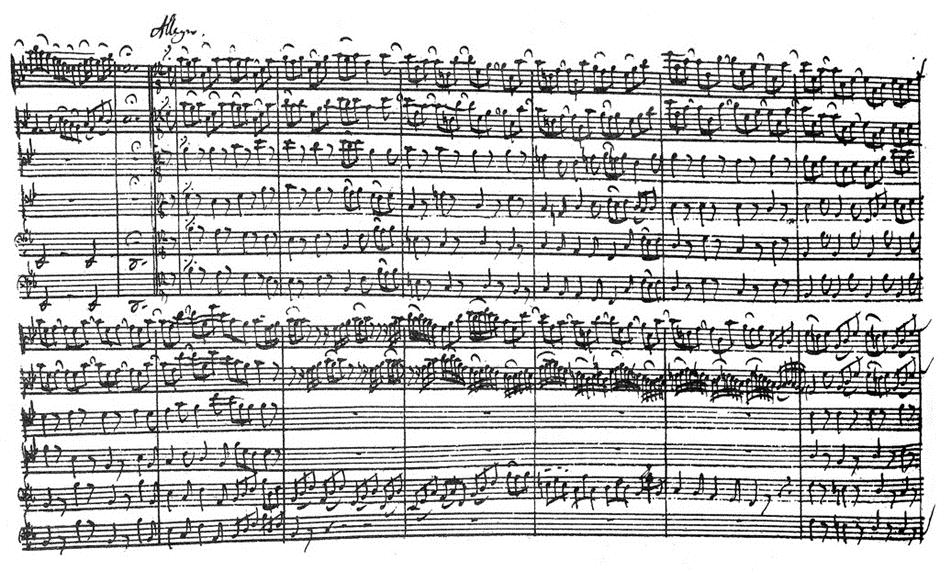
Score of Mozart’s Piano Concerto No. 20 in D minor, K. 466

Mozart is considered one of the the greatest of composers in part because he managed to convey both his iconic lyricism as well as pathos across so many different forms. His piano and violin sonatas are sublime; quartets and chamber music absorbing; the body of his choral work, including the masses, are transcendent; and his symphonies went on to inform the whole genre for a century or more.

But amongst musicians, it is commonly considered that there were two types of composition in which even Mozart reached unfathomable heights not only of musicianship, but of intellect. They are his concertos and his operas. Because whilst he expressed the solo voice with great eloquence, and whilst he marshalled the collective with great aplomb, it was in these two forms where soloist and ensemble combined into the most sophisticated and final state of music.

Concertos are a funny thing. The etymology of the term is sometimes misunderstood to be about working together – the Italian term concertare now means literally “to harmonise”. Yet in fact the origins are not from the Italian but rather the Latin, where the same word means “to compete” or “to struggle”. And here is the rub: concertos juxtapose the incision of the solo voice with a background of the group – both indispensable, both mutually dependent. It is an inherently unstable equilibrium pitting two forces against each other, and from its complications comes the greatest beauty.

There are strong parallels to the world of corporate management. A small startup may be considered like a solo performer, a single person’s aura. As a company grows, it might become like string quartet, then a chamber ensemble, then perhaps a fully fledged orchestra with all the bells and whistles including the office boy whose only job is to strike the triangle once in a while (as was, I believe, the role of Sir Simon Rattle as a boy in the Liverpool Youth Orchestra). As it grows, so also arises the need for a conductor, or a CEO, to set the tempo and steer the style without, usually, being too overbearing.

The CEO as he should be

But, in the corporate world, progress through these ranks of scale – even though they allow for the creation of ever greater music – generally loses the voice of the soloist. One might argue that the Principal Violin survives, perhaps equivalent to a COO. But generally the creativity of the individuals is very much subservient to the collective, and just as for much of the orchestral landscape, discipline in the style of a Lully is prized, so also shareholders (the audience) tend to reward monolithicism in the company.

Yet I believe that as with concertos, a greater result can be had by allowing one or more excessively skilled individuals doing their best, expressing themselves, whilst the majority of the employees get on with doing their day jobs. How do modern companies accommodate the soloist? The short answer is that they more or less do not. Corporate culture is the very definition of stifling of the individual.

Which is a shame, since in many cases they would achieve much more by finding a way to bring the best out of their more mercurial stars. Most such talents will recognise the necessity of the orchestra playing with them hand-in-hand; and most of the orchestra will understand the extent to which their overall performance is being elevated by the “stars” – after all, it brings paying customers through the doors.

The “Concerto Model” of management is not easy to achieve. For a start, it requires a conductor or CEO who is assured of where their work ends and the musicians begins. It also benefits from an orchestra containing enough people of merit, self confidence and experience to understand the music and why the stars are necessary. This model is not always necessary of course, for smaller ensembles simply playing Haydn quartets; or for larger orchestras who want nothing more than to be known for their rendition of Dvorak’s Slavonic Dances rather than his Cello Concerto.

But when it works, it surely is more astonishing a musical offering than anything else. To my mind, a well functioning company should sound like the second movement of Tchaikovsky’s Piano Concerto No 2, in itself one of the great piano expositions, but where the orchestra as a whole, and particularly the violin and cello soloist, and then the full fanfare, play their part:

The point is, that with good leadership, nobody needs to be reduced to the ranks and the audience and the musicians themselves can lean into and enjoy internal the striving and competition – all of which is for the greater good. To quote Heraclitus, polemos pater panton. For those that dare, musicians or managers, the world awaits.

Fiorentina, not Napoli, are the Tottenham of Serie A

Always attacking football; always some of the best players; always a few steps short – this is what unites two top table outsiders

Regular readers of this blog will know of my affinity for Spurs. So deep is it, in fact, that I actually enjoy periods like the current one, where hope and expectation collide with the reality that is, and has for my entire life been, Tottenham.

The side that I first came to support was that of Gary Lineker and Paul Gascoigne; fresh from my footballing consciousness having been waken by Italia ’90, and having just moved to the UK that summer, it was natural that as I cast around London clubs, Spurs were one of the obvious choices. Then came the highs – the FA Cup in 1991 , the arrival of Jurgen Klinsmann, the dazzling play of David Ginola – and the lows. The FA Cup in 1992; the 1995 FA Cup semi-final against Everton and Klinsmann’s departure; eventually the slow, excruciating 2000s. Cutting one’s football teeth on the Spurs of the 1990s was … interesting.

But another thing happened in that decade: my first ever live football match which was an astonishing 7-1 victory that Fiorentina chalked up against lowly Ancona during the 1992-93 season of Serie A, and it is a match worth revisiting for a number of reasons:

Because in a season when Tottenham, with Lineker and Gascoigne gone, were the team of Dean Austin and Vinny Samways, Fiorentina were a world apart. I knew none of these names at that age, but I was watching Gabriel Batistuta, Stefan Effenberg and Brian Laudrup. The season was worth noting too, for Fiorentina were second in Serie A at Christmas that year, only to suffer the ignominy of relegation five months later. Batistuta, some may know, heroically stayed on in Serie B.

And for all the discussion that circulates occasionally about which team is the Spurs of Serie A – and in recent years, that has been Inter and more recently Napoli – I believe Fiorentina offer the best parallel. Not just because I happen to support both, of course, but because of the very real historical similarities which lead, in many ways, to fans with the same mindset. Below are a few reasons why.

Chronology

The first is the alarmingly similar timelines between the two clubs. To put it bluntly, despite always being amongst it, both saw their glory days in the 1950s and 1960s. Fiorentina won their two Scudetti in 1956 and 1969; in between they reached a European Cup final in 1957, losing to the great Real Madrid side, before winning the Cup Winners’ Cup in 1961. Spurs, meanwhile, managed the first ever Double in 1961, and two years later also won the Cup Winners’ Cup. Both teams also made something of a habit of winning their domestic cups, two for Fiorentina and three (including that Double) for Spurs.

Fiorentina’s Cup Winners’ Cup final in 1961 (left) and Tottenham’s winners two years later (right)

Both clubs then had unremarkable 1970s, before making staggered comebacks in the 1980s for Spurs and 1990s for Fiorentina. But it cannot mask the most basic point that both clubs saw their glory days, in absolute terms, many eons ago. To an extent therefore, both clubs’ fan bases live disproportionately off the hero figures of a very different era, the Blanchflowers and Hamrins, the Greavesies and Antognonis – the curse of being a club with long traditions.

Top table

Secondly, despite meaningful success being rather long ago, both clubs frequently occupy a status that is considered at or around the top group within their league. Serie A aficionados will remember the era, in the 1990s, of the so-called ‘Seven Sisters‘, when Fiorentina ranked alongside Juventus, the Milan and Rome teams and agricultural powerhouse Parma in being considered perennial challengers for lo Scudetto.

Tottenham have for some years now been considered part of a Premier League Big Six of course; but the inception of the competition in 1992 is perhaps more telling. Spurs were part of a ‘Big Five’ then, large enough in terms of support and brand to be founders of the Premier League itself, alongside Liverpool, Manchester United, Arsenal and Everton. This confluence of long-running status with mixed recent success is a particularly curious one, and both clubs are to an extent, disliked for it.

Supposed ‘Spursiness’

Thirdly, a feature of both clubs’ mixed success is the perennially favourite issue of what others often referred to as “Spursiness”, the inability to get across the line despite fairly regular progress in competitions. This needs definition, of course, but it basically means failing at the final hurdle or losing matches we really should not, and often based on random things outside of our control. Lasagna-gate and Sissoko’s hand-ball after 22 seconds of the 2019 Champions League Final are marks of this for Spurs, or in my mind, losing the FA Cup semi-final against Manchester United in 2018.

Fiorentina have also lost a European Cup Final, but greater similarities lie in the failure of the side in the 1990s to capitalise on a once-in-a-generation squad to do better. Taking the Champions League by storm once or twice is all very well, but the side of Batistuta and Rui Costa always found themselves against Juventus and Milan who had a touch more, reminiscent of Tottenham’s 2015-2017 period where Kane and Dele consistently came second to Leicester and Chelsea.

Gabriel Batistuta and Manuel Rui Costa in 1998 (left) and Harry Kane and Dele Alli in 2018 (right)

Batistuta had to leave Fiorentina to fulfil his ambition of finally winning Serie A, with Roma in 2001. Hopefully not a portend of things to come with Kane.

Real “Spursiness”

This leads us nicely to the last point: players and style. Because more than anything, what unites Fiorentina and Tottenham is that regardless of how well we are performing, we often have some of the absolute star talents of the age, punching well above our station. Fiorentina are, above all, famous for a line of fantasisti including Giancarlo Antognoni, Roberto Baggio and Manuel Rui Costa. It is difficult to identify three greater creative talents, certainly in the history of Serie A. Even when Fiorentina were not winning trophies, they were still had game-changers.

Tottenham share this heritage too, since like Fiorentina, the club is known for a style of attacking football and the fans demand authentic entertainment even at the expense of winning (the Spurs side of this is well known, but it takes a lot to maintain this mentality in Italy.). Over a similar period, Spurs was the platform for talents like Glenn Hoddle and Paul Gascoigne – both arguably the last examples of game-changing creative talents in English football. Certainly the England team have not seen their like since.

This is not just a cheap point about both teams having good players from time to time. It is about consistently showcasing players who are amongst the very best in the world, in a system that shows them at their best, even when we are not commensurately successful. ‘Spursiness’ disparagingly refers to the lack of success, but surely the most notable thing is that even when we are not winning, we still have great, memorable players that everyone else wish they had.

*****

What’s the point of all this? Well mainly, it’s to satisfy myself that there is some poetic link between the two teams in my heart. But were I to be more pretentious, I would say that the two fan bases are similar and should consider themselves so because of being united in the greatest frustrations, and greatest beauty, of the game. Both clubs’ fans are committed to a side that does it ‘right’, and that does not sacrifice style for the heartless wins. Does it mean we have a weak mentality? Perhaps. But it also means we can continue with a sort of righteousness which, if nothing else, drives other fans up the wall. That is worth celebrating.

Batistuta uniting Tottenham and Fiorentina against the Scum in 1999

In defence of … Empire

The Muse bids me consider the good, the bad and the necessary forms of power

Two decades ago, the subject of empire, which had long fallen under the pall of apologetic navel-gazing in academia and in political discourse, experienced something of a revival. On Home Counties coffee tables in around 2003 emerged books such as Niall Ferguson’s Empire: How Britain Made the Modern World and, a couple of years later, his follow up Colossus: The Rise and Fall of American Empire. Both were made into TV series, leading to rather bitchy comments from my own tutors at Oxford over exactly how much of a sell-out he had become. Ferguson moved on soon to NYU and latterly Harvard, where he continues to be a proponent of sorts, of the imperialist revival.

He was not the only one however. A far more academic book, though still accessible, from a few years later in 2009 was John Darwin’s After Tamerlane, which charted the Asiatic land empires over the period 1400-2000 and took a nuanced view on empires, their existence, longevity and, buried amongst the prose, their benefits. The obvious point being that:

[A] propensity in human communities has been the accumulation of power on an extensive scale: the building of empires. Indeed, the difficulty of forming autonomous states on an ethnic basis, against the gravitational pull of cultural or economic attraction (as well as disparities of military force), has been so great that empire (where different ethnic communities fall under a common ruler) has been the default mode of political organization throughout most of history. Imperial power has usually been the rule of the road.

On the other side of the Atlantic, the process of soul-searching brought on by the foreign policy of George W Bush generated much writing, with 2010 alone producing three prominent volumes in the shape of Empires in World History by Jane Burbank and Frederick Cooper, The Rule of Empires written by Timothy Parsons and Empire for Liberty by Richard H. Immerman; this unsurprisingly coinciding with the accession of Barack Obama, probably the most forthright anti-colonialist (and perhaps anti-British) man to occupy the White House since Grover Cleveland in the 1890s.

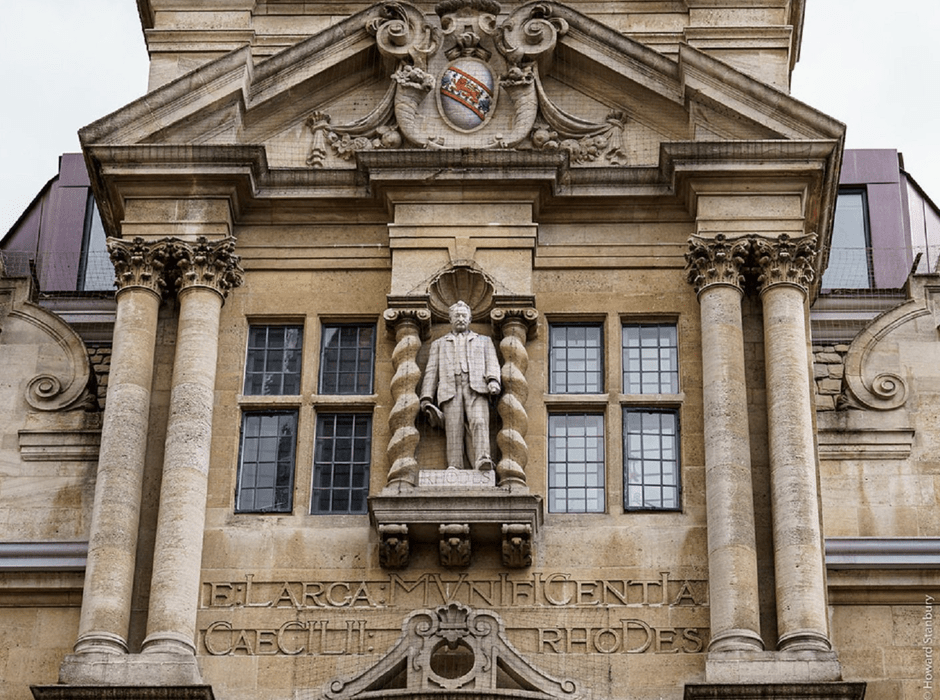
However, after that burst of activity, Empire has again experienced decline in the perceptions of the liberal public – not least through the sophistry of race relations which re-emerged through the 2010s, accelerated by Trump’s election, BLM and in my world, the absurdity of movements such as #RhodesMustFall (though I am glad to report that as of this moment, Rhodes’ statue still looks down majestically from its cupola on the High). Iraq and Afghanistan have gone the way many feared; perceived Russian and Chinese aggrandizement continues. ‘Empire’ has not had a good innings. Yet the lessons about why they are good, bad or necessary are still overlooked, and I feel obligated to rehearse them once more.

First, Empires bring peace; and their decline brings conflict. Whilst this may sit in cognitive dissonance with how history is taught today, the reality is that for a majority of peoples governed under imperial structures, lives were more stable under this regime than what they might otherwise have. This is not only empirically true – Spain and North Africa for instance were largely left in peace for three centuries between the Punic Wars and the Crisis of the Third Century, despite not being Roman “heartland” – but also logically. See also China, Byzantium, the British and French empires and even the dysfunctional American equivalent (though as Ferguson says, Americans just aren’t very good at empire). Ethnically-focused nation states must be more prone to friction with neighbours than an empire which is first and foremost self-interested in minimising that friction. No successful empire has ever seen greater violence and destruction in its borders, than its alternatives.

Secondly, Empires bring prosperity. Much like any political system, the proof is in the pudding and there are very few examples of empires which successfully exist for long based only on coercion. Even the Empire in Star Wars, for instance, would have had more adherents than resistance and the Jedi should probably have asked themselves why they were in such a minority for so long – probably because their own scattergun and slightly racist alternative proposition could not even persuade Ewoks, let alone the merchants, professionals and other middle classes of the Empire that their mess was better. Most complaints about empire comes from self-indulgence, and nowhere was this more plainly set to rights than in Monty Python, whose sketch in The Life of Brian was a thinly-veiled lampoon of anti-colonial opinion across Asia and Africa:

Lastly, empires bring diversity. Given the propensity to celebrate everything “D&I” these days, it is worth pausing to think about how much empires, rather than nation-states, and created and sustained true multi-culturalism. Ultimately, empires are agnostic about the culture they carry, and as they expand absorb ever greater amounts of what they oversee. It is notable for instance, the Prime Ministers such as Thatcher and Blair were eminently more parochial than similar bourgeois classes a century earlier, whose relatives would have grown up in India, the Sudan and elsewhere serving as bureaucrats and engineers. Whilst Europe has provided some remedy to this parochialism, it is not complete: since the decline of empires in the 1960s, modern (western) nation states and their governing classes know less about the world around them than ever before, leading to everything from half-baked trade pacts like the WTO to neo-conservative adventures in the Middle East. The borders of empires are soft and porous; the borders of nation states are hard – and with it hardened views on identity and inclusion.

Coming from a family that emigrated under the auspices of Empire from China to India to Britain, I take a personal pride in the system that allowed for this to occur. Britain offered an attractive cultural and civilisational prospect, of course, and its contemporary weakness in this needs addressing; but more importantly it was the infrastructure of empire that served so many millions of people so well, for so long. It gave opportunity, egality, stability to the very poorest in society, at the expense, ironically, of the “home” nation.

Empire is here to stay, not just because of legacy but because its really quite a popular system. The definitions may vary over time, but the principles of expansion and peaceful, productive dominion of a periphery by the centre will remain permanent. A decade ago I argued that we were witnessing the emergence of a new “community of empires”, given the way not only Russia and China, but also India, Brazil and others were run. Some of this has come to pass, others are slow burning. But before we continue to trample the legacy of empires, we should remember why they appealed; since they are an inevitability, perhaps it is better we embrace their positives rather than engage in futile self-flagellation.

In defence of … Anglicanism

The Muse rallies to the Church Militant

It is perhaps too easy, when reflecting on the Church of England, for one’s mind to come back to Lord Melbourne’s supposed comments, later oft-quoted by Churchill and others. First, he may have mused that “things have come to a pretty past, when religion is allowed to invade the sphere of one’s private life”. Latterly, he is claimed to have said that “I must be considered more of a buttress than a pillar of the Church, since I support it from the outside”. Apocryphal or not, such is the nature of Anglican navel-gazing that it becomes only one short jump from that, to a certain Oxford Chaplain in the early 2000s making the astonishing claim (belied by the monotonous drone of its delivery) that “Anglicanism is practically atheism”.

(Never mind that Melbourne was a Whig, mocking the Tory Party at Prayer; nor also that Melbourne famously was involved in two sex scandals before his term of office was up)

Some may be surprised by the strength of my religiosity, given the rationalist leanings of my writing. However upon leaving Oxford I was at one stage minded to emulate my close friend in taking Orders at St Stephen’s House, even if one of my motivations was a very temporal love of the vestments. Anglicanism in particular burns strong within me. A good friend of mine recently decided that it was of little consequence to convert (in my mind, rather too glibly) from Lutheranism to Catholicism, citing the latter’s stauncher conservatism. This caused a rare rupture between us, and also provoked me to revisit the underpinnings of the faith that called to me all those years ago; because amidst all the clowning of recent decades that brought us everything from schism over gay bishops to payday loans, taking us from Thomas the Beckett to today’s Pound Shop iconoclast Justin Wellby, the underlying reasons for adhering to the Church of England, for all its faults, remain clear.

The first is theological. There is little point dwelling on the underlying arguments for or against Transubstantiation or Grace, or justification through “faith alone”. What you believe is what you believe; but it is important to focus on the fact that for all her bells and smells, Anglicanism is a cornerstone of Protestantism, which itself is, in the words of historian JM Roberts, “the closest thing England came to have as a national identity”. Whilst one can quibble about some of the liturgical and even ecclesiastical disagreements between denominations, the gap between Protestantism and Catholicism is much clearer and unbridgeable. And no amount of watering down of Anglicanism dogma changes the fact that it is not, even at its Highest, Papist.

The second is intellectual. Readers of this blog will note the importance I place on the need for intellectual coherence and defensibility. Of the various Christian denominations, Anglicanism is by far and away the most intellectually capable and rigorous. Arguably, the Church of England is the only mainstream denomination which sustains a robust intellectual tradition, and it is no surprise that we created all the intellectual lights of other denominations too as a result. At opposite ends, both Henry Newman and John Wesley started life in the Church of England before going off to renew Catholicism and found Methodism respectively. Anglicanism’s very Establishment is why this is true, and its interconnectivity with the institutions of education and learning are the evidence. And of course, Newman and Wesley were both intellectually vibrant whilst within the Establishment; and they both atrophied the moment they left.

Why is this important? Well, faith is all well and good, but intelligence is a gift from God also. As intelligent people, it is right and proper that we seek to square the circle between blind faith and the powers granted us to reason. The Divine Clockmaker demands not only belief in the clock, but an understanding of its mechanics. Therefore any religion which emphasises only the spiritual, to the point even of being anti-intellectual, is being irresponsible towards its adherents. The Catholic Church, of course, is successful amongst the global poor precisely because it aims for the spiritual lowest common denominator; it should be of no surprise that it is so warmly welcomed by cults that, for instance, worship rocks since Catholicism more or less engages in rock-worship itself. Only Anglicanism breaks out of this spiral and in a sense, we have been a victim of our own success. However this is a price worth paying.

The last, and possibly most important point, is civilisational. Outsiders will often mock the provenance of the Church of England as being the result simply of Henry VIII’s proclivity for divorce. To that I say: so what? Faith needs to be theologically coherent, as outlined above, but it also must come from and speak for a people. It is right and proper that the Anglican church is an expression of everything Britain and the Commonwealth is. It must reflect the identity and culture of the temporal powers that underpin it – its churches and cathedrals, its social mores, its language. It is entirely wrong to suggest that a Church should not be so specific as to be “local” to one culture or place, that is precisely what it should reflect. The more it is bound and tied to a geography, the stronger it is – much the same as government or currency. Its ‘exportability’ will then reflect the strength of that underlying culture – much like government or currency. And on this is the strength of its civilisational proposition, and its capability of being Universal.

Because I can say that we have pretty much the best of what every other denomination has, and more. You want bishops? We have a proper Episcopalian Succession. You want some Papal States? We have a whole Commonwealth united in Confessionalism under the King as Head of the Church. You want Protestantism? We practically invented Consubstantiation. You want Church Councils? We have the Synod. On top of all this, we have the pre-eminent choral tradition which puts Catholic services to shame – Evensong is basically one long concert and the Establishment means we have some of the best choirs, organists and composers. Last but not least – and perhaps the clearest expression of how Anglicanism is tied to and enhances the national identity from which it emanates and patronises – we have the linguistic contribution to English from the Book of Common Prayer and the King James Version of the Bible.

Anglicanism is decidedly not atheism. Rather, it is the thinking man’s religion and it is, in concentric circles, England, Britain, the Anglosphere and the Commonwealth. The fact that urban liberals are too uninterested in faith today to recognise this, just as they were under Lord Melbourne and for centuries prior, changes none of this. The Church of England is one spiritual, temporal, ecclesiastical and liturgical whole. It is far too polite to demand being taken seriously; but anyone who disagrees with this is not taking religion seriously at all.

In defence of … a Musical education

The Muse demands I consider what is it that makes one look the most clever

I have had a relatively academic-leaning background, particularly at school. Having attended, each in their own right, “name schools” (or 名校 as the Chinese would call it), where my studies have taken in everything from the use of silk as alternative monetary policy in Middle Byzantium, to the human bitchiness which decided large matters of state in colonial American religion, to the surprising retrogradation in literacy in China during the 1990s, I feel well-placed to observe where learning happens. And surprisingly, when I look back on all the years I spent becoming over-qualified and under-educated, by far the most intellectually rigorous subject has been: Music.

To take a step back, I have been a semi-professional musician through most of life, and (time for a humblebrag) have been involved in top tier choral establishments, understudied at the Royal Opera, headlined at St Martin-in-the-Fields and much else besides. However it was at A-level that I last studied music academically – and yet, despite being at Oxford and Tsinghua and having collected reams of letters after my name, that Music A-level remains the most intense course of studies I have undertaken.

Let us consider what the constituent parts of this course were:

  1. Technical exams – as I recall, two 90 minute exams of listening to recordings, identifying musical language and testing one’s “ear” for marginally off-tune notes in a flurry of orchestral music
  2. Composition exams – I think back in amazement at being made to sit at a piano to compose a chorale in the style of JS Bach, on a given tune, in just 60 minutes
  3. Performance exams – by far the easiest, this comprised submission of my Grade 8 exams, but also involved recordings of group participation
  4. Academic exams – I believe my first ever three hour essay paper (these were to come thick and fast later at Oxford) tackling such pressing questions as – I kid you not – “Discuss the contribution of Handelian organ concertos to the development of concerto-sonata form” or “Do Florestan or Eusebius survive deeper into the Romantic era?

I would make three observations about this which build to my central case as to why academic Music is such a strong subject for any child to take.

The first point to make is the sheer range of demands that Music A-level placed on a student. I do not believe any other subject required such a diverse range of talent, and needed decent quality in each one – just being a great pianist was not enough to pass, let alone obtain a high grade, in this subject. It comprised a properly academic core, but also made you perform and be highly technical and abstract. It is perhaps the most multi-dimensional subject that can be studied, certainly at the age of 16. Being made to digest and memorise a complicated score such as Schumann’s piano concerto in A-minor – its structure, language, tradition and technique – is something I have never encountered since.

The second point is the obvious one that Music remains by far and away the most esoteric of subjects, given its requirement for dealing in the abstract and a mathematical mind. In the Medieval curriculum, Music formed part of the Quadrivium, the Greater Four science subjects and more or less represented the study of numbers in the context of time (the other subjects being Arithmetic, or pure numbers; Geometry, or numbers in the context of space; and Astronomy, or numbers in the context of both time and space). To look at it another way, Music as an art is far more intellectual than, for instance, visual arts and far less reliant only on emotional reaction as a measure of its efficacy – the work of Bach combines both the aesthetic of a Rembrandt with the technical skills of a master watchmaker. Is there a higher intellectual form of artist than Wagner, for instance? Is there even a Wagner equivalent within the other “arts”? I would wager, no.

Lastly, Music makes you a rounded, high-brow person in a way little else does. One of the great things it trains you for is performance – you are spending most of every day performing for someone or other. This constant need to “put on a performance”, and not be afraid of the limelight, but also to work in a form of harmony not found in many other parts of life outside of the sports field, is unparalleled; the ability, too, to “make do” and be pragmatic when things go wrong is equally important. Given the way we are headed on automation and the economy, it seems very likely that the ability to “perform” will be more important than ever as the only human jobs remaining will be those focused around selling and marketing – something Music is inherently suited to.

This is what musicianship is all about – and the long-haired kid displays this phlegm even better

Of course I do not attribute all my development to just one subject, and the above is written with a musician’s right to exaggeration; but it is also not completely tongue-in-cheek.  I rarely meet a group of people of a given industry who have a higher median amount of intelligence than musicians; neither are there many industries that would provide better dinner-party company. Yes, musicianship breeds in-jokes and a certain arrogance (humility and music have not, in my experience, been a natural coupling) but by God does it make fun, interesting people – people who can talk big, entertain spontaneously, pull together groups and networks, and who have a vocabulary which articulates and impresses. The fact that most of this is directed towards complaining about others is by the by; the important thing is that Music makes you look very, very clever.

So parents all! If your child is inclined towards Music, do not start hand-wringing. Your precocious offspring is probably just taking the first step towards become future employable, and annoying though they might become, take comfort in the fact that they will be a better sort of person.

The Return of Theresa May?

The shenanigans of the Conservative Party gives me a moment for some fun: what if the Tories really did cast out another leader now, just a few weeks into her tenure?

First, I should emphasise that I do not predict at this point that Liz Truss will be removed. Nonetheless, neither do I think it completely unlikely, since MPs will grasp at almost anything which they think may help them get re-elected and, let’s be honest, nobody wants to face unemployment in this current environment.

So my logic is as follows:

  1. Liz Truss may be deposed by MPs seeking to try and move on quickly from the current crisis (25% chance)
  2. MPs will not give members a choice again, if this occurs. Instead, they will avoid the whole thing by presenting a single candidate as a fait accomplis (100% certain).
  3. MPs will look to the past, not the future, when seeking their consensus candidate. With an election only two years away, I do not believe many will want to “try something new”, but rather look for a caretaker that minimises the damage from an election that seems almost certainly lost (70% likely).
  4. There are only a few candidates suitable for this role, balancing out their status, past experience and willingness to serve. I believe only former PMs, Chancellors or high profile leadership candidates would be options. May is on obvious candidate (100% true).

There are really only a few names who can make this list. Boris is too recent and probably uninterested. Sunak and Javid, two former Chancellors, will both want to distance themselves from this irretrievable mess and believe they still have future careers. Several others, such as Hammond or Rory Stewart, are no longer MPs. To my mind, only three people would “do their duty” and lead in the current circumstances” Michael Gove, Jeremy Hunt and Theresa May.

So who knows what will happen? Gove seems too opportunist. Hunt might work but is a little faceless. I do think Theresa May has one quality, which is that she is dogged and hard-working and will provide some reassurance. Moreover, she has dealt almost entirely in crises. As a caretaker, there would be many worse. All this gives me the chance to return to one of my favourite memes:

The Five Blogs of Christmas V – How the Empire was built

My muse has given me leeway until the end of January to complete “Christmas”, giving me just enough time to examine the bigger picture

*************

Between 1781, when Lord Cornwallis surrendered to the Americans at Yorktown marking the end of the First Empire, to 1942 when Percival surrendered to the Japanese at Singapore and effectively marked the end of the Third Empire, Britain did pretty well. By and large there was not a single concession in between those two dates – with British phlegm being marked by a few remarkable victories interspersed with some even more glorious catastrophes, such as the Retreat from Kabul; the Charge of the Light Brigade; the Sieges of Cawnpore and Khartoum; Isandlwana; and the Somme. The noble, defiant ignorance of the lower classes characterised Empire and was the basis on which it was built.

Since that time, we have had sailors like Arthur Batchelor blubbing away “when the Iranians, who called him Mr Bean, took away his iPod.” We have had a second withdrawal from Kabul where pets were being prioritized over people. Foreign policy has been of a somewhat reduced nature, and with that comes the question: have the British changed? Are we now a weaker nation, no longer capable of seizing the moment and battling for a greater cause?

I say, no. And I think we can see exactly where Britain remains as strong as she ever was. Here I examine the keystones of the imperial character, and how they still manifest themselves.

*************

Defiance

At the Battle of Jellalabad in 1842, Sir Robert Sale organised the Somerset Light Infantry to hold off thousands of Afghan jezails (after the inglorious / glorious massacre of British forces to the last man at Jugdulluk) for five months. Not only did these men of Taunton refuse to concede, but went on to capture 300 sheep from their assailants for provisioning.

Today this obstinacy and refusal to lie down continues, as shown by these courageous characters, who dressed as traffic cones for a stag do, blocking a local road and finally having to be arrested by the police:

Competitivity

Such was his desire to serve his country, Captain Scott and his four companions famously died in 1912, frozen to death in their vain attempt to be first to reach the South Pole. Yet this was a theme which had centuries of tradition for Britain, particularly in its rivalry with France. The imperial race that took us to the Americas and later the colonisation of Africa before they could, created much of the land holdings which allowed for the idea that Britain had an empire “on which the sun never set”.

And who are the heirs to Captain Scott? Step forward these men:

Cunning

The Great Game raged between Britain and Russia over the Northwest Frontier region over much of the 19th century. A war that never quite was, Britain strove to counter and undermine the Russian ambitions in the East at every turn, leaving no stone unturned to do so including setting up trade routes and client states. Likewise, when Britain wanted a war with Spain or France, she relied on privateers and pirates to harass her rivals until a war was inevitable – perhaps none more so than the provocations that led to the Second Anglo-Dutch War, where the Royal Africa Company was established to seize Dutch ships and outposts along West African coast.

This guile remains in the blood of the British, as shown by Surrey farmer Robert Fidler, who for four years between 2001-2005 fought the tyranny of the Planning Permission board of Reigate, by hiding an enormous folie de grandeur behind haystacks. The local council was not aware of this military build-up until the it was revealed with a flourish:

(Note: Fidler ultimately lost the case and had to tear down the house in 2016, but it was the effort that counted)

Opportunism

Many wrongly see the height of the British Empire as that conveyed through the formal life of Late Victoriana: reviews at Spithead, Great Exhibitions, the Delhi Durbar. Yet as I have noted before, the real peak of Empire was a century or more earlier, with James Wolfe’s victory at Quebec in 1759, and Robert Clive’s victory over local warlords at Plassey two years earlier. Throughout this period, the British displayed unparalleled buccaneering spirit, just as they had in battling the French in the pirate wars. Britain stumbled into her Empire accidentally, on the whole, but she never missed a chance to assert herself at the expense of others.

This remains perhaps Britain’s greatest trait. When a container ship sank off Devon in 2007 – before the financial crisis when household balance sheets were still bloated by overvaluation and there was no desperation in the air – the reaction of the Great British Public was to scavenge as much as possible before anyone could catch them.

This was magnified a few years later, when rioters in London turned out to be just as keen to loot from JD Sports as they were for social justice.

*************

And what of the French?

Our cousins across the Channel had a slightly different imperial experience. For a start, due to losing key engagements such as the Battle of the Saintes, France was largely left with bin-ends of empire such as the bone-dry sub-sahara. In Indochine, their most enduring contribution to civilization was the forcing of Vietnamese to eat baguettes and pate.

But they too were famed, whilst the contest lasted, for a sort of cunning. In the Americas for instance, the French were willing constantly to get into bed with local tribes in order to align short term interests against competitors such as British or Dutch. This came to a head in the French & Indian War (the Seven Years’ War) where they used the Delawares and Shawnees against the British colonists. However, whereas in the British this was a noble astucity, a dignified shrewdness of mind, in the French this can only be seen as double-faced artifice, the constant scheming of a younger brother who can never quite get what he wants.

Nowadays, French ingenuity is demonstrated in such activities as getting a free ride in defence spending through NATO, hijacking the European Union for their own ends, and this:

So I suppose we are all back to where we started …