The three things Tottenham really need

Battle of Stamford Bridge

Usually my football postings try at least nominally to make the link with economics. But with the transfer deadline approaching, I feel like offering up a more qualitative analysis of where Pochettino needs to improve the squad. These are not specifics, but rather some broad principles.

So what is it that Spurs need?

1. A first XV (not a first XI)

I find it staggering the number of commentators who still get caught up on the idea that it is difficult for us to recruit because we cannot improve much on our supposed “first team”. As I have written before, whatever the level of your club and corresponding objectives, there is a basic threshold for quality. In our case, as potential title challengers, that is of the very highest level. Once that level has been determined, any squad will need at least 15 or so players who are of the required standard. They must all be “first team” players, even though only 11 play on the day. This is so basic that I just do not understand why it is still discussed.

For Tottenham in their current tactical style, this means:

  • 2 strikers
  • 3-4 attacking midfielders
  • 3 central / defensive midfielders
  • 3-4 central defenders

Only the goalkeeper can be expected to be a single regular and an understudy. Full-backs and wing-backs (the latter becoming one of the most high profile and specialized role across Europe) are perhaps also forgiven due to their relatively specialist nature, though the Kyle Walker / Kieran Trippier combination was really the very least we needed in terms of quality.

Some flexibility helps alleviate this, for instance Eric Dier’s switching between midfield and defence. But if you add it all up, we are talking about a “first team” of between 14 – 16 players, ideally a few more. I would say that we currently have about 11, excluding Davies and Trippier but including Son and Lamela. That is not enough for a title challenge.

2. Game changers

In the two recent defeats against Chelsea, much was made of the strength of the respective squads, which is true as far as it goes. But I have noticed that Poch also does not really have players who can really change things against the run of play “out of nothing”. Dele is the possible exception, Eriksen inconsistent. The point is that these players can all play well – but only if the team plays well. A game changer is a player who, like Hazard or the much-underestimated Willian at Chelsea, can pull things out when the team is playing poorly.

Our lack of this ability is why we seem to win relatively few games when we are not playing well – Crystal Palace away was one of the few occasions last season that I can remember. But the problem is: game changers are typically not great team players. The whole point is that they are egotistical prima donnas who pull something out of the bag precisely because at that moment, they are ignoring their team mates’ performances and just doing what they want. If the team is functioning, that’s wasteful selfishness; if the team is not functioning, it can be a life-saver. But game-changers are not Poch players.

3. Bastards

Lastly, we have the ongoing issue of our relative naivety at controlling matches (something which has reared its head this season against Burnley and arguably against Chelsea too). There is a valid accusation that Poch demonstrates a lack of stylistic flexibility, namely sticking at all times to the pressing style, but at this point last season he was also accused of tactical rigidity and ended up coming up with the 3-4-2-1 as a “Plan B”, so perhaps he just needs time to work on a more Mourinho-esque counter-attacking style.

But what he lacks in the squad are real bastards. People with experience and the skills to wind opponents up in big games. Chelsea is once again a great example of a squad almost any of whom would be bottled round the back of the pub just because they are annoying. Spurs, on the other hand, are not only too naïve, but too “nice”. There are glimpses of something more edgy from Rose and Dembele on occasion, and Dele is beginning to learn how to wind people up. But really, we have not had a really aggressive little bastard since Edgar Davids – it is the very definition of our historic “soft underbelly”.

Again, though, I suspect that bastards really are not considered suitable for Poch’s teams. One reason our squad is so nice is that they are so young, and have been growing up as Poch’s children effectively. How do you generate a Roy Keane or John Terry in that situation? Almost all the great “nearly” sides, from Newcastle in 1995 to Liverpool in 2013 have shown this weakness. We look set to join them.

*******

So with two days left, what are some answers? Well strengthening the wing-backs will be crucial – Aurier and possibly Sessignon would be good news (or eventually a Rose for Shaw swap). Adding more creative firepower would be great. But really we also need a gritty central man who has a bit of a temper. I have said it before and will say it again: perhaps it is time to reinvent Sissoko as that man. He showed a great elbow last year at Bournemouth!

Why Barcelona are still not learning their lesson

Messi sad

Ousmane Dembele has just arrived at Barcelona for a “club record fee” of €105m plus add-ons which could take the total paid to around €140m, far eclipsing even the official updated €86m paid for Neymar that the club had to admit to two years afterwards (although the real cost may still be somewhat higher, and we may never know). Whether Dembele can emulate his predecessor in footballing terms is anyone’s guess; but more intriguing is the fact that he may emulate the superstar as a future exit – curiously, Barcelona seem not to have learned their lesson and set a buyout clause of only €400m.

€400m may seem a lot, but this summer has shown that numbers we could barely believe have a habit of becoming reality; if TV revenues increase, the figure will not seem excessive. But in any case, and more importantly, it is already not very high in the world of preventative buyout clauses. If any proof be needed that Real Madrid are better run than Barça at the moment, it can be seen in the buyout clauses currently in place. Not only is Dembele’s price, their newest signing, still way below the sums set by their arch-rivals, but so are all the rest of the squad – by some distance, too. Eight of Real’s stars have clauses higher than Lionel Messi, the best player in the world. Suarez and Busquets look at snip at just €200m.

Real Barca transfers

Source: Gab Marcotti via ESPNFC.com, updated for Asensio, Isco and Dembele

Why have Barça been so remiss and what explains this imbalance? Well first, to be fair, the Barça squad is just that much worse than Real’s. Other than the MSN, most of the others have passed their Pique (lol) and their clauses were signed in another era. Having said that, Cristiano Ronaldo’s €1bn clause was set as long ago as 2015, a full year before Neymar (Barcelona’s youngest and most marketable star) was set at only €200m rising to €250m over three years. Is it perhaps that Barcelona do not have the pull to get players to agree to prohibitive buyout numbers? Or is the board still arrogant enough to believe that players go to Barcelona for its “philosophy”? Either way, it is a failing of their fiduciary duties which would be prosecutable under UK company law.

Furthermore, Barcelona really have encountered a perfect storm. The inflation in this year’s transfer window has hit them just as an irreplaceable star has gone. To be clear, buyout clauses work very differently from normal transfer fees in terms of distorting the market. This is because a normal fee is, these days, usually paid out over a number of years; so that a transfer fee of €222m might only be about €55m per year. The rest of the market (though not the idiot fans) will “know” that the extra money available to the club who has just sold their star asset is only €55m at that point. But with a buyout, the money arrives instantly, meaning that the market is aware of both an entire €222m overhang, as well as the necessity to frantically spend most of it on a replacement. Furthermore, buyout clauses are by their very nature “supernormal”, higher than market valuations. This means that in turn they are causing inflation above normal market values when the money is spent in turn. In other words, it is not just usual “football inflation” (see my previous) but a buyout-driven super inflation. Barcelona this summer have become a footballing version of Mansa Musa I.

Of course in today’s world, only a few clubs are true “buyers”: Real Madrid, who do so from their own resources, and then PSG and Man City, who do not. Barcelona have ultimately been left on the heap as just another “selling club”, the dreadful epithet that even Man Utd had to understand when they lost Ronaldo to Real all those years ago. Barça just have not learned their lesson.

Are transfer fees really exploding?

camp_nou_coreografia_mes_que_un_club

With Neymar’s transfer to PSG, the football media has moved from just excitable to the swooning and fainting associated with young Victorian debutantes laying eyes on returning officers of the Household Cavalry. The “world record” (we will get to this in a moment) has seen the football experts go into overdrive in trying to explain how it is that so much has been paid, and how it can be justified.

Among the more interesting commentators were the crew on last week’s Guardian Football podcast, specifically award-winning Jonathan Wilson who made a couple of insightful points. The first was the likening of the football transfer market not to the clichéd and overused Dutch tulipmania of the 17th century, but to a more subtle historical event that I had not heard of before, the Indian horse market of the same period. Although Wilson does not spell it out, the point here is not that best-in-class assets become expensive (Neymar for €222m is comprehensible); it is rather what Mourinho has been warning about, that mediocre asset prices get dragged up too and that is where things become unsustainable. In other words, the Man Utd’s of this world will always spend top dollar; the real danger is when Middlesbrough are doing the same.

The second intriguing point surrounds the role of Qatar in the Neymar move. Barcelona have for many years irritated a majority of neutral fans with their holier-than-thou attitude about all matters football. It does not take a hard-core royalist like myself to be sickened by the constant nonsense about being “mes que un club”, or the self-indulgent refusal to have a shirt sponsor for so many years. But recently, the club have taken to criticizing Qatar over the forthcoming World Cup – the very people they finally took their blood money from when the caved into for money. Was this criticism a result of failing to agree a new sponsorship deal? Was PSG’s bid for Neymar driven by a Qatari government keen to demonstrate they still had retaliatory power? Both, it seems, may be a firm “yes”. Well, it couldn’t have happened to nicer people …

But really, how big a transfer fee is Neymar, anyway? Clearly a direct comparison of nominal fees is useless; so is a basic use of inflation to recalculate them. Only one analysis I have seen attempts to bring fees into historical perspective, the excellent Paul Tomkins’ blog. For the purposes of analyzing which transfers have had what impact, Tomkins and his team have used a form of “football inflation” based on average transfer prices from year to year, and inflating the nominal figures this way. Since football inflation has far outstripped CPI, this produces a top ten looking something like this:

Tomkins table

Source: https://tomkinstimes.com/2017/07/shock-transfers-now-cost-more-plus-top-100-signings-after-inflation/

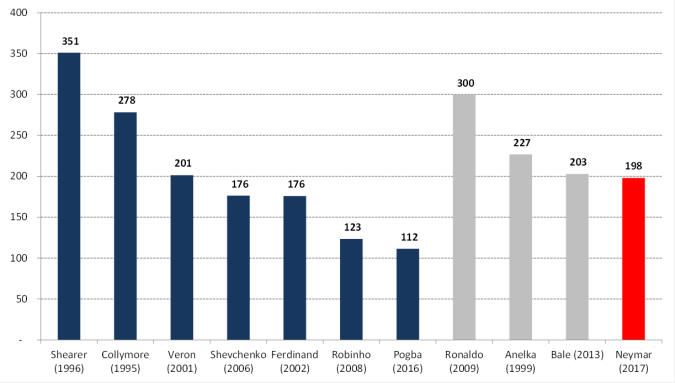
Now, I like this approach. It has much to recommend it. However I believe it understates the impact of TV money on the psyche of football clubs – Tomkins’ analysis looks at correlation between the two but does not integrate them. I believe that – for the Premier League at least – another interesting way of looking at transfer prices is rebasing nominal transfer fees against the growth in TV deals. In my model, “inflation” is based entirely on the growth of TV deals struck over time (which have grown at an impressive 17.2% CAGR since 1992). In particular, I think this better reflects the thinking behind those headline-grabbing, record transfer deals as opposed to the median ones. The thesis being, that record transfers experience inflation different to normal transfers.

When this principle is applied – the Pang Index – the following numbers are generated:

Transfer records re-based to Premier League TV deal sizes

Football transfers

The blue bars represent record transfer fees paid by English clubs since the Premier League came into effect in today’s money. The grey bars were record transfers out of England (as it happens, all to Real Madrid). In this context, I have thrown in the Neymar transfer for fun. Of course this is not a perfect comparison – European clubs have very different TV deal structures and have not earned as much as English clubs have anyway; moreover the likes of PSG are barely “commercial” clubs at all these days, throwing the numbers out. Nonetheless, it makes some sense: Neymar’s fee is probably the same as a proportion of the kinds of TV money sloshing around as Veron’s transfer to Man Utd was all those years ago. No-one old enough to remember, can really be in doubt that Shearer’s £15m fee shocked us rather more than Neymar’s (let’s perhaps forget Stan Collymore for a moment).

The basic lesson is: money is here to stay; it is growing at a pace; but it makes surprises more and more difficult. Already this summer, there have been several moves rumoured to be in the same ballpark (£131m for a 31-year old Ronaldo, for instance). Actually, for the bigger clubs, it seems superstars are getting cheaper, not more expensive.

A squad of two halves – the drag from Tottenham’s wage structure

Tottenham NY Post

Frustrations are beginning to appear around my beloved Tottenham Hotspur. Obviously, we have yet to make any new signings, even as all around us in the top six have done so – including from us with Kyle Walker’s move to Man City. It is well known that we have a shortage of money compared with our rivals – the subject of a neat video produced by Joe Devine last year. But, there has also been much commentary about how Tottenham are struggling to find the right kind of players to fit into the squad – especially as “understudies” to key players like Harry Kane and Dele.

The reality is that Tottenham faces structural problems of its own making. First, the wage cap in place is enforcing a concept of a First XI vs secondary players. Most clubs have some sort of wage structure in place, of course, but rarely at the top level is such a fuss made about it or is it so well known. A look at the figures as last season commenced (below) demonstrate this clearly: Lloris and Kane were the top earners but the whole first team plateau out before a sudden drop off as one reaches Trippier and Davies (both now ironically effectively first team players).

Tottenham wages

Source: sillyseason.com (http://sillyseason.com/salary/tottenham-hotspur-players-salaries-69471/)

Compare this with the three biggest paying clubs in the Premier League and the contrast is stark. It is not just the absolute amounts that are different; it is the distribution, and with it an entire philosophy of creating star players with a large pool of players below them. A new arrival at Spurs would question how inelastic the first team appears to be; a new arrival at Man Utd may know he won’t oust Paul Pogba, but the rest is up for grabs. Tottenham have allowed themselves to create too rigid a playing structure.

This leads onto the second structural point: no other team has quite such a disparity between the quality of our First XI and the bench. Title winning teams do not have a set first team; asking “who is willing to sit on the bench?” is to ask the wrong question altogether. The real measure is the quality of the first team squad – the 18 or so players who should be interchangeable in quality terms. This is more difficult for the striker position, since there is only one match day position available. But for the attacking midfield positions, where we play at least two (in the 3-4-2-1 formation) or three (in the 4-2-3-1), we should have at least n + 2 players of comparable quality competing.

So what is the answer? Well, one or two rumours have emerged which are of real interest: Iheanacho from Man City for instance, or Kovacic from Real Madrid (incidentally Ross Barkley is not the answer). But it seems like under the financial constraints we have, and under the wage structure we enforce, Pochettino is going to have to further rely on coaching youth players. It’s not a bad way to do it – Josh Onomah has had an excellent summer with the England U-20s, as has Kyle Walker-Peters; Harry Winks and Cameron Carter-Vickers already made their appearances last season too. I also believe that some players can be reinvented – Moussa Sissoko into a deep-lying central midfielder for instance.

Ultimately though, Spurs are going to have to rejig the way they pay their team even if they do not raise the total amounts being spent, and even to keep existing squad members happy. The current system reflects something static, sacrificing flexibility on the altar of stability. It might serve for another season, but what happens when our ambitions expand?