British politics is now unconnected to power – we need leaders who understand this

We should look to candidates who prioritise things they can actually do something about

Politics is fundamentally about power, one would think. Liz Truss barely had any when she arrived; now she has gone. Sunak has a little, but not a lot, more. Boris had it in spades in December 2019, but had lost it by earlier this year. Elsewhere I have written about the extent to which Cameron’s 2015 election victory represents something of a modern high, by mandate and power, albeit subsequently wasted.

Yet the politics of the UK these days is largely reminding me of the quote, usually misattributed to Kissinger, that “academic politics is the most vicious and bitter form of politics, because the stakes are so low”, aka Sayre’s Law. The fact is that, like academics eyeing each other warily across the High Table (Maurice Bowra’s adage that he felt “more dined against than dining” was just such an exposition), politicians of the United Kingdom of Great Britain and Northern Ireland are now squabbling over an ever-diminishing realm of authority, and this should impact electoral choices.

The Truss-Kwarteng debacle a few weeks ago demonstrates the limitations of what an “independent” medium-sized country actually are. Whilst on the face of it we can deplore financial markets and globalisation, and say to ourselves that this happens even to the greatest powers – Bill Clinton’s healthcare reform in 1994 foundered “fucking bond traders” – we also know that size matters. Taking on the financial markets as a large economy is different to taking one on as a small one. This is a rather Manichean world and Britain is showing itself to have neared the dividing line.

Of course, this could all have been better managed and the specifics of the Truss administration made a bad situation worse. But with Sunak coming in, we can judge whether simply a more articulate and deft touch would make the difference, much as Leopold II succeeded Joseph’s reforms in the 1790s. In fact, he will not, because Sunak understands precisely that Britain can ill-afford to operate outside the bounds of economic convention dictated to us, from the major institutions via the capital markets. Britain cannot have a truly independent monetary or fiscal policy, and Sunak will not want to test this again. This is because of two factors: first, Britain simply is not big enough, with an economic hinterland of adequate heft, to support Sterling and the government borrowing markets on its own. It is almost uniquely globalised in terms of its financing and the shift to this model in recent decades (see my previous note on exchange rates) means that Brexit or not, this will not improve. Secondly, Britain is buffeted about by two economic forces – the EU and the US – who do carry their weight. Interest rates in both will effectively dictate British interest rates; the only scope for freedom are in those occasional periods of divergence between the two:
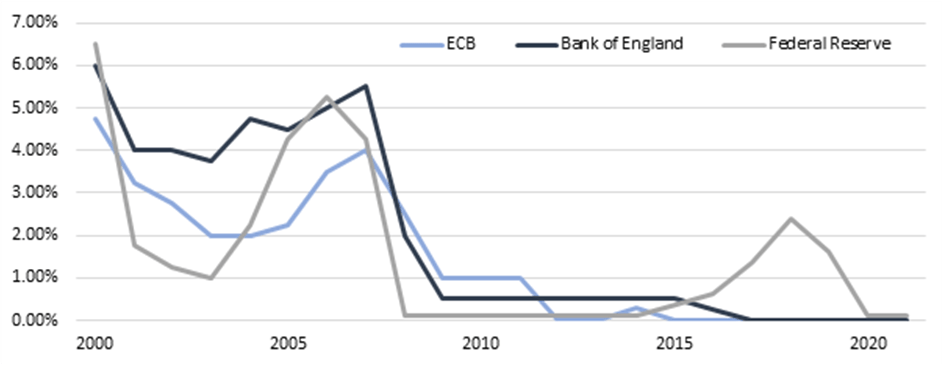
Source: IMF database, figures annual

Interest rates are of course only one lever of economic power (albeit an important one in a financialised economy); but the recent reaction to Kwarteng’s budget shows that fiscal tools are equally to be judged by the narrow minds of financiers of little imagination, and it was not only the exchange rate that collapsed for a time, but also the cost of borrowing which rose (Clinton’s “bond traders” in action). The notions that Britain could just “do its own thing” was always fanciful, at least without accompanying “pain” which no politicians are as yet prepared for.

So what does all this mean? Well for me, as an active Conservative Party campaigner and even one-time candidate, it means thinking about leaders who will actually will do something because they are focused on areas which a domestic agenda can still influence. Truss vs Sunak was a false dichotomy because neither promised actionable agendas. I supported Kemi during the last leadership contest, first because I agree with her, and secondly because those areas were one a Prime Minister of the United Kingdom of Great Britain and Northern Ireland can actually do something about.

I am more or less talking about kulturkampf in a broad sense. Readers of this blog will know that I prioritise issues of identity above most other things because nation-building is both important and something of a lost art in the globalisation age. Kemi’s most impressive speech for me was her response to the House during Black History Month in 2020, where she laid out some very obvious but important points about British culture:

“Our history is our own; it is not America’s. Too often, those who campaign against racial inequality import wholesale a narrative and assumptions that have nothing to do with this country’s history and have no place on these islands. Our police force is not their police force. Since its establishment by Robert Peel, our police force has operated on the principle of policing by consent. It gives me tremendous pride to live, in 2020, in a nation where the vast majority of our police officers are still unarmed.

On the history of black people in Britain, again, our history of race is not America’s. Most black British people who came to our shores were not brought here in chains, but came voluntarily because of their connections to the UK and in search of a better life. I should know: I am one of them. We have our own joys and sorrows to tell. From the Windrush generation to the Somali diaspora, it is a story that is uniquely ours. If we forget that story and replace it with an imported Americanised narrative of slavery, segregation and Jim Crow, we erase the history of not only black Britain, but of every other community that has contributed to society.”

I commend everyone to watch this.

We can debate the specifics of her message here, but the important point is that she can campaign and do something about this. There is a culture war to be won, through the media, through institutions, through agency capture and other machinations if we really want. These are all within the remit of a leader. What she cannot do anything about, is bring interest rates into the realm of fairness for savers and the hard working rather than constantly inflating domestic household debt. At least, not for now – although if you get the identity question right, at some point down the line you can begin to ask the people for the sacrifice needed to finally rectify the economy and bring it back to something which serves the population and not the other way around.

Britain needs to break out of its mindset that it still carries the kind of status and power which allows for true independence. It is this wrongheadedness which led to one specific strand of Brexit support for which I have no sympathy whatsoever – the Dan Hannan school of “Singapore on Thames”. If these politicians spent half as much of their time trying to change things that are changeable, instead of pursuing doctrinaire dreams of economic engineering, Brexit might actually be made to work. In the meantime, the economic shackles we live under continue to demonstrate what a poor economic choice Brexit was. Better panem et circenses.

Not all emerging markets are the same (Part 2)

Tent vs marquee economies (or why Indonesia is bad and Vietnam is good)

I previously looked at the SE Asia economic picture overall and drew out some pretty stark contrasts. I want now to focus specifically on two markets I know well, both of whom have cheerleaders: Indonesia and Vietnam. Only one of them, I would suggest, has a bright future. Against these, as ever, I find it useful to benchmark against China, the one regional example of an economy that has made progress.

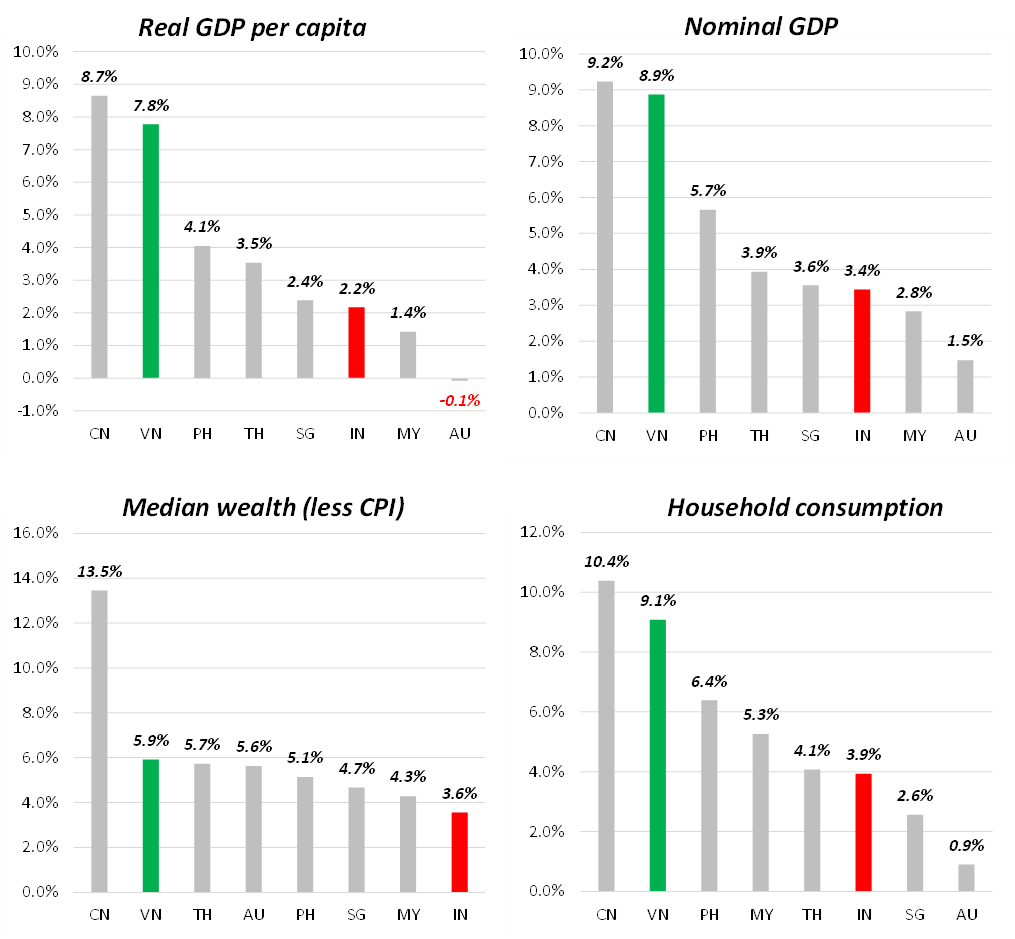
In fact, based on statistics previously discussed, even in a basic way Indonesia has constantly under-performed Vietnam (and indeed most peers) over the period 2010-2020:

Source: World Bank, Credit Suisse Global Wealth Report 2022

It is poignant that once we move beyond real GDP, the variation is marked. Both Indonesia and Vietnam have experienced significant population growth – but even factoring that in, Vietnam has sped ahead on a per capita basis. In terms of nominal GDP, Vietnam comes close to China levels of growth and, incidentally, does so with a currency which has not depreciated against the dollar anywhere near as much. In median wealth, Vietnam, coming from a low base and with CPI not much less than Indonesia, is still notably ahead. And lastly in household consumption – that portion of GDP growth that we consider “good growth” – Vietnam is more than double Indonesia even though the latter experienced the greater part of a commodity boom during the period. In other words, Vietnam, from a standing start, has led everyone in the region bar China; and is the only country to come close to matching China’s remarkable overall levels of growth.

So much for the past – but what about the future? Well the problem comes in understanding the structure of the economy, and in particular the effects of inequality, inflation and where relevant, currency depreciation. Indonesia’s under-performance is due to both a long-standing inequality and inability to distribute the proceeds of growth into a mass middle class, as well as peculiar governmental weakness at tackling inflation and currency depreciation, which are linked.

Source: World Bank, Credit Suisse Global Wealth Report 2022, Bloomberg

As a demonstration of the former, I tend to use my own measure of inequality, which is to look at the “wealth multiple” of mean-to-median assets per capita. The higher the multiple, the more unequal the economy. I find Gini coefficients to be too muted in their outcomes, and most of the public sources such as the World Bank still inhabit a pre-Piketty world focusing on income distribution rather than asset distribution – but all this will be in a future post. What is important is how much higher Indonesia’s wealth multiple is compared to the two post-Communist economies which are doing better (for the record, others such as the Philippines are unsurprisingly even worse). Both Indonesia and Vietnam have experienced high levels of inflation – but, of course, this comes against the background of Vietnam’s much higher rates of nominal GDP growth. And above all, whilst most of currencies have weakened against the dollar, none have been so spectacular in their depreciation as the Rupiah.

2020 exports by industry for Indonesia (left) and Vietnam (right)

Source: The Observatory of Economic Complexity

Indonesia has been sustained by commodity cycles in the past and may benefit from another which has recently commenced – but the problem is, this is only arrow in its quiver. For me, there are two broad models of economic emergence, which I visualise as “tents” and “marquees”. A tent is simple, and has a couple of simple poles which hoist the whole fabric. These poles can raise a high summit point, but they are frail and narrow. A marquee takes longer to assemble, but has multiple poles and is usually more robust. Indonesia’s reliance on commodities – and its marked inability to produce an export-quality value-adding sector (for instance, manufacturing) – makes it a tent. Vietnam, whilst its summit point is still lower than that of Indonesia, is supported by multiple sectors. Importantly, this also means producing a wider “middle”, which somewhat depicts the creation of a real middle class.

Tent vs marquee models of economic development

In short, whether you are an entrepreneur, a foreign investor, or just the common man on the street, Vietnam is a much better prospect than Indonesia. This reality belies the generic theoretical focus on demographics and real GDP, and correlates to the empirical and anecdotal evidence from the streets. Anyone who goes to Jakarta and then Saigon will feel a difference in energy and enterprise. In Indonesia – much like Thailand or the Philippines – a few rich incumbent families own practically everything. Jakarta, by another shorthand metric I like to use, has no pavements: the rich go by car and the poor have nowhere to go. Saigon has middle classes who walk around urban landscapes. Likewise, the streets of Saigon are full of absurd little shops where the emerging consumer is upgrading their life (not anything I would personally buy, but nonetheless); Indonesia instead has little between the gleaming malls and the warung.

From a business level, it shows through as well: the long-hoped-for mass ownership of four-wheel vehicles in Indonesia has never really materialised – passenger car growth over the decade is half that of China and Vietnam, and behind even Thailand. Modern retail (for instance hypermarkets) has never yet had its day in the sun, instead being swamped with by the low-end providers like Alfamart and Indomaret. Banking has not had the traction expected, particularly in additional services; but meanwhile low-end app-based financing is common place. And at the end of the day, Indonesia’s new economy champions still tend to feel much lower in quality of management than even their regional competitors – Go-Jek vs Grab, for instance.

The reasons for all this are manifold, and would warrant a full academic paper (although some of the topics around cultural traditions may not even make it past the censors of modern publishing). But what is clear is that, following from the previous post, there are better and worse markets and Vietnam and Indonesia, often compared together amidst a group, are good examples of this contrast. I would hazard that Indonesia’s presumed consumption take-off may simply never materialise. People talk of Indonesia sitting at the heart of the revolution in EVs – which is questionable – but even if it happens this may never feed through to the population. Certainly, alone amongst the beneficiaries of the last commodity boom over 2006-2012, Indonesia saw little gain for median families, and such wage growth as came was washed out by its rampant inflation. Indonesia seems destined only to be constantly extracted from, by local families or foreigners. Personally, if I had a dollar to invest today, the choice between these two is pretty clear.

Not all emerging markets are the same (Part 1)

ASEAN is not a single place – there are winners and losers

Emerging markets have frequently been grouped together in the expectation that evolution in one could be carried across to others, and thereby allow investors in particular to draw large thematic lessons. The Asian Tigers was one example, BRIC was another; the Economist even spent an inordinate amount of time trying to find a successor to BRIC, all versions of which were unsatisfying. Southeast Asian economies are often put into one bucket, too, given what appears to be a similar stage of development between several of them, their proximity to the regional influences from Japan and China, and most of all due to the supposed progress of ASEAN.

However, taking a dispassionate view there is little reason to see these markets as similar enough to have a common investment principle. Indeed, I would argue that several of them face diverging fortunes and I very much like some of these markets and do not have time for others. There is a surprisingly limited amount of analysis from the outside on these markets individually; and when they are written, they are often quite amateurish.

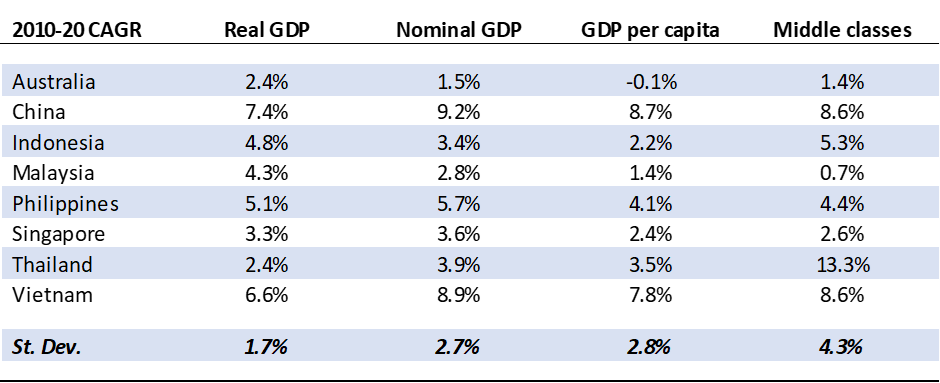
So let me get to who is Good and who is Bad in SE Asia. To begin with, it is worth looking at the macro numbers over recent times to consider which countries if any, have actually made progress. On the face of it, many in the region have performed decently compared to their OECD brethren. Yet ultimately the variation beyond real GDP, to which analysts are constantly beholden, shows quite a difference.

Source: World Bank, Credit Suisse Global Wealth Report 2022
Note: “Middle classes” refers to population with greater than US$10,000 of wealth per capita; standard deviation calculation excludes Australia which is only included for comparative purposes

For a start, whilst real GDP numbers look somewhat comparable and almost clustered towards the 4%-6% range, this becomes markedly less so when looking at other metrics, and the standard deviation shows this. These others are important, too: we look at nominal GDP from an investment perspective because earnings and returns are nominal, not real. Per capita numbers wash out the effects of rapid population growth as an artificial bolster for underlying growth. Middle class population tell us how any of this notional growth is actually converting into mass consumers.

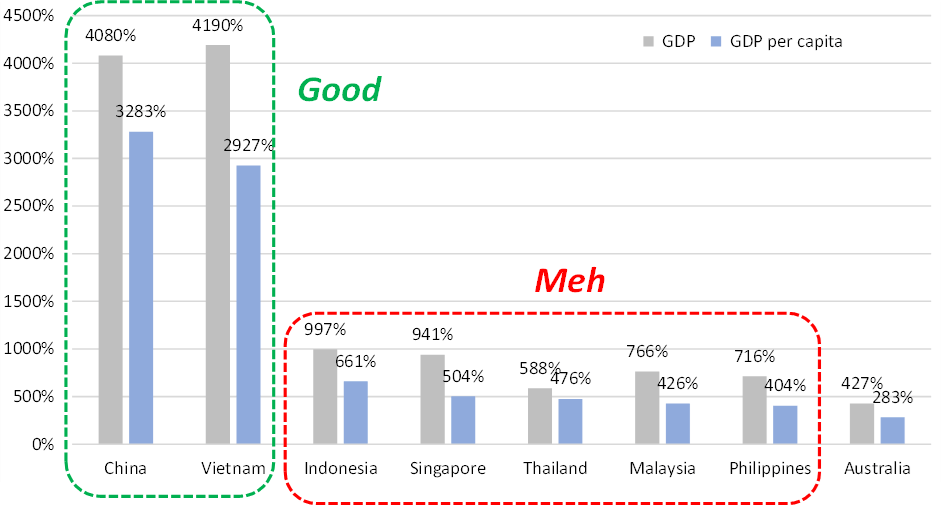
Much can be read into these figures but the most stark representation of it all, for me, is looking at total growth in recent years. Below is the total cumulative nominal GDP growth since 1990 for all the main countries in the region:

Source: World Bank

It turns out there are really only two groups of economies in emerging Asia: those that have generated huge amounts of growth and those which are just trundling along. China and Vietnam come from different bases but share the enormous benefits of a post-Communist economic surge; almost everyone else is unremarkable – both developed Singapore and Australia are not all that different to supposed stars such as Indonesia, Malaysia or the Philippines. China and Vietnam have performed not just better, but better by an order of magnitude.

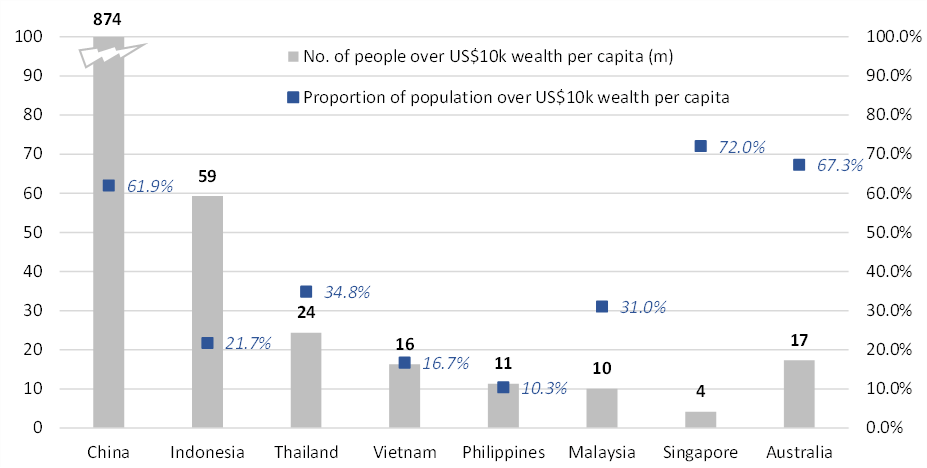
This has a knock-on effect on middle class consumption. Using the Credit Suisse data, I tend to look at the numbers of people who have US$10,000 in assets as a guide – what I call “true population”. China of course has created a huge true population who can and do consume – but elsewhere we can see why our views should be moderated. Indonesia, for instance, has 250m people; but only a fifth of them are real and – as per the table above – their track record of growing this has been poor compared to Vietnam for instance, which has a smaller true population but is growing it quickly.

Source: Credit Suisse Global Wealth Report 2022, own calculations

I will delve more deeply into Indonesia and Vietnam in future posts, but the overall message here is clear: SE Asia is not a single type of market and there are clear winners and losers. The reasons why can be explored elsewhere but simply having a large population is not going to mean a country will develop within the time-frames we need to make money. Demographics is not destiny, and political and economic systems matter. Investors and companies ignore this at their peril.

This devaluation exposes how poor Britain really has been for two decades

The decline of Sterling in recent days has caused the kinds of panic amongst MPs and commentators usually reserved for global warming, Brexit and early England exits from finals tournaments. As an economist, I can testify that currency economics is amongst the more arcane and complex – at least, to model. What traders do on a whim may reflect current issues, or longer term ones; but precious few really know – certainly not politicians.

First, we should be clear about what the exchange rate is or is not. It is not, for instance, a broad measure of “a country’s strength”, a term that has been bandied around by gammons and globalists alike as they face the prospect of achingly expensive holiday costs to Mallorca and Miami, respectively. Nor does it reflect “how rich we are”, as though a 20% fall in the pound makes people, in any real sense, 20% poorer than they were weeks ago. Exchange rates are a measure of value, particularly for lubricating cross-border trade, and more than anything are a measure of demand for money and assets within an economy, from abroad.

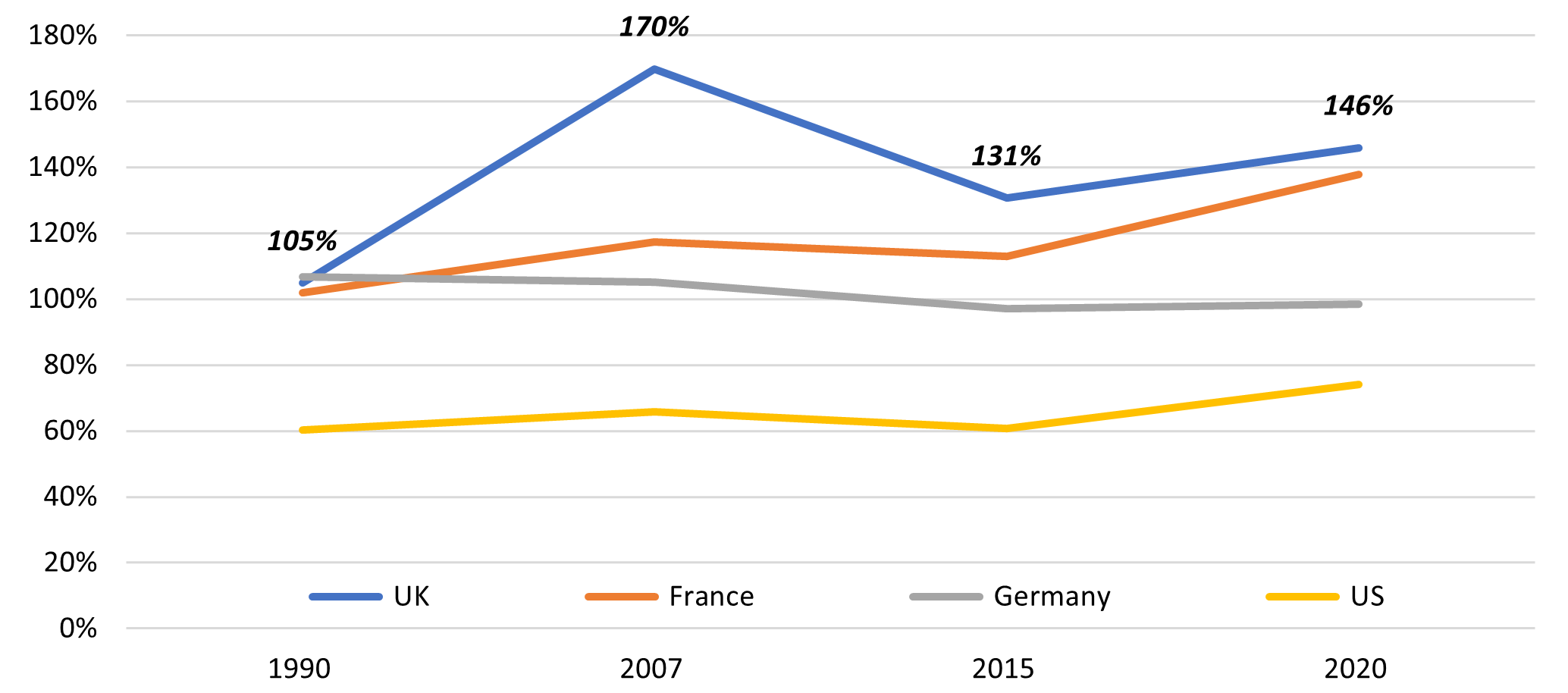
A strong economy can of course lead to a strong currency as people seek to invest into your country. Over time though, much of this will be ironed out through PPP as import prices start to rise over time reflecting demand. But currencies can also be artificially high, often for prolonged periods, due to trends such as the continued opening up of various asset classes to foreign capital, which can happen without the underlying economy producing anything more than it did before. I refer to this as the financialisation of an economy, a common feature throughout the Anglosphere from the 1990s onwards. Britain is particularly guilty, as seen below, and these numbers do not even reflect the unseen financial burden placed on UK taxpayers from housing foreign banks.

Ratio of bank assets to GDP

Source: TheGlobalEconomy

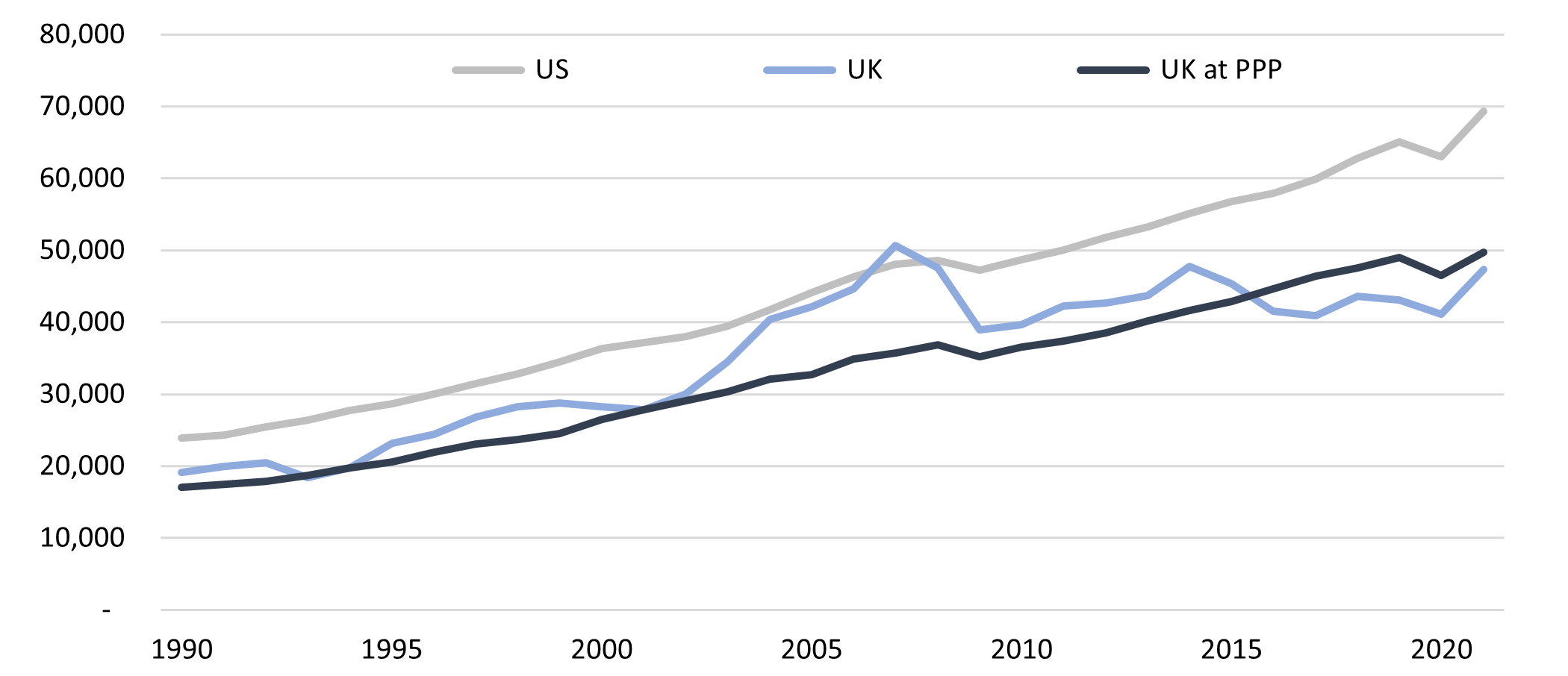
The consequence of all this is important: Sterling has been over-valued on a real economy basis for years – since well before Brexit or even the global financial crisis. The 2:1 exchange rate against the dollar reached in 2007, for instance, may be seen as the height of a monetary hubris unleashed by Thatcher but really bedded in by Gordon Brown, her true son. Everything was thrown into the financialisation of the economy and, as a second layer of back-up, the property market which saw Britons become richer by gross asset value but not usually by income or net assets. One way in which this washed through, therefore, was through looking at the gap between nominal exchange rates and PPP, where it could be seen that Britain was getting no richer compared to America than it had before or since. The yawning gap in the mid-2000s was totally driven by things other than the UK economy.

GDP per capita at PPP, US vs UK since 1990

Source: World Bank

In my humble opinion, something approaching parity between Sterling and the dollar had been due for a long while. I must admit to quite some surprise at how small the fall in Sterling was after the referendum in 2016, and had always assumed a rate of closer to 1.1-1.2 over the succeeding years. That it has taken a second crisis to cause the devaluation speaks more of the limited attention span and economic comprehension of currency traders, than it does of any lingering strength of the post-Brexit economy to punch above its weight.

The decline has now gone beyond my own instinct of where the “natural” level. This may be an exaggerated response to the budget from the markets, it may be my underestimation of British strength, or it may just be, like so much else, a temporary feature of the vagaries of the markets. On the other hand, it could signal a further long term deterioration of the structure of the UK economy. Either way, this decline had been coming for years and should have been expected. Even without Truss – indeed even without Brexit – we should have been at lower levels than what has been the case.

Because this “crisis” has really exposed how weak Britain had been for so long: continued poor productivity, an enormously skewed domestic economy with a whole political apparatus focused on maintaining house prices, and rampant financialisation to the detriment of the real economy. It is an unedifying sight to see semi-literate, over-reacting traders being observed and reflected by even less literate and even more hyperactive MPs and journalists. However more than anything, we should be digesting this new normal as the correct reflection of where we have been – and it may even help us plan properly going forward.

The asymmetries of Putin vs the West (or, why The Economist keeps looking stupid)

It has been some time since this blog has taken its title at face value and looked at some of the large scale asymmetries at work in the world around us. The Ukraine conflict, however, presents just such a chance. Plenty has been written on the subject now by armchair experts in Eastern European strategy, many of whom no doubt only recently become epidemiology experts too. I offer a few simple thoughts about the asymmetric nature of the game Putin is playing, and in every case I start with the panacean truisms one finds in the media.

“Russian GDP is not even as big as South Korea, it is overreaching itself!”

The globalist response to almost any conflict has been to look to economic indicators – at least, the ones we are familiar with – as a measure of how powerful a country is or can be. I will give such commentators the benefit of the doubt that in most cases, they are aware there is some nuance and that localised imbalances can affect outcomes; but still, by and large, they will believe that historical determinism tells us that a country’s GDP will indicate the way the winds are blowing.

What Putin is exposing, however, is that for Russia (and China, amongst others), expenditure in materiel capital has to be matched with the commitment to expend human capital. On a GDP basis, many others will be more powerful than Russia; but judged on the basis of its hard resources multiplied by the factor with which it is willing to use them, Russia’s position on the world stage is not one of punching “above its weight”; it is very much a significant player (which, let’s be honest, is exactly how it is treated within the world of realpolitik). This is a case of asymmetric capital deployment.

The Western response in offering the Ukraine arms and supplies is a case in point: it costs the West nothing to do this. Indeed, given the realities of the military-industrial complex, offering military equipment which is in turn paid for through loose monetary policy actually helps the West. The problem is, it does not do much to help the Ukraine. Putin knows that no Western government at this stage is willing to lose the life of a single soldier in defence of Kiev; China knows likewise about Taiwan. And they are able to gamble that even with the best of wills in armament support, if the West has no boots on the ground, its commitment will be as fickle as the next budget discussion in Cabinet. Only blood counts.

So whilst it is absolutely true that Russia is not rich enough to match much of the West, it really does not matter because that is not the game being played. I suspect not a single Ukrainian soldier coming under a rocket attack is thinking to himself, “well the joke is on you, you’re overreaching your GDP base”. Unless the West changes its tune on how to respond, the Russian bear is not going to be paying too much attention. Instead, as one of my friends pointed out, “there is no significant military force standing between Russia and Paris today, a situation we have not faced for generations”. Another added, “but there is a lot of GDP standing in the way”.

“Russia is on the decline anyway, in ten years time this will be seen as a massive mistake!”

Again, this is very possibly true. After all, the big difference between the Russian threat and the Chinese threat is that it seems difficult to imagine Russia being more important in ten years time than today. Again however, I suspect this is cold comfort to the dying Ukrainian civilian, who is most probably not shouting to the incoming tanks “well you’re on the wrong side of history!”. As Keynes says, in the long run, we’re all dead.

The fact is that in this kind of game, a grenade in the hand is worth two on the production line. Most incidents like the Ukraine are not played out over the kinds of timeframe that the Cold War was; once an aggressor gets its way, it can be almost impossible to dig them out again other than at enormous costs which, as described above, people are unwilling to pay. Yet the fact is that Russia is doing this today, not years down the line when history has come to bite it. This is a case of asymmetric timing.

All powers are likely to rise and fall cyclically. Russia doubtless is on a down cycle already – but so what? History is not decided by trajectories (much as historical determinists and progressivists would love to believe), and still less are real objectives today affected by those long term trends. A power willing to punch today can easily and consistently outcompete the larger power waiting for things to fall into the natural order of things. Obama’s pushing of this wording is perhaps his most pernicious legacy as a clarion call to inaction.

“The whole world is watching this and will be judging Russia!”

Whilst the first two popular claims may well hold true, even if they are irrelevant, this last one is questionable due to one last great asymmetry, which constitutes the eternal dilemma of the policeman. The West is of course judging Putin – for now. Sanctions will come in. There is discussion of banning Russia from the SWIFT payment system for instance, as well as the removal of this season’s Champions’ League final from St Petersburg (Russia’s involvement in the Eurovision Song Contest however, has been subject to confusion).

The problem though, is precisely that the whole world is watching this – through the 24 hour news cycle, through social media, through memes. Yet the policeman’s dilemma is, why do I prioritise this over anything else? And with the fragmentation of Western attention, through so many channels, the cohesion of Western attention is less than in generations past, even as the volume of that attention is more. This is asymmetric focus.

The Russians know that Western observers struggle with creating a hierarchy of what is supposed to be important. Modern media has dampened our sense of proportionality, meaning that there is a perception of crying wolf. How much better or worse is Biden’s performance over the Ukraine, compared to the retreat from Kabul for instance? Or Obama’s red lines in Syria? Or his response to the last time Russia invaded the Ukraine? In the heat of the moment, everyone is entitled (as many are) to believe this is the most important issue in the world today; yet that same raw sensation will also see it be less to tomorrow. Maybe another invasion, maybe another form of Covid, maybe just forest fires will do the trick. Our lack of media curation has brought us to this.

I would additionally add that, in all of human history, sanctions have only ever to my knowledge worked in one example: South Africa. In this case, it worked because the target society of the sanctions (white South Africans) looked up to and respected those sanctioning them – they cared. Not the case with Russia, or with China. Probably not even the case with India. The corollary is that asymmetric focus is only solved when the matter is close to home – culturally, ethnically. Sweden, for instance, is not a member of NATO, but will still be able to count on American and European physical support in the event of a Russian invasion in a way the Baltic states might struggle with. Let’s be honest, because they’re white. This is the only thing which cuts through the ADHD of modern life. Are the Ukrainians really white enough and middle class enough for people to sustain their care? We will find out.

*********

If this sounds cynical, that is because it is. Asymmetries unlock many of the answers where there is more heat than light and war has been so unknown for so long. As long as Putin is playing a different game, the constant refrains about meaningless measures will remain rhetoric whilst real people are suffering. Grasping these asymmetries can lead to small but very effective changes in policy, and consequently enormously different outcomes. Given that the US purported to know about the coming invasion so long ago, a single battalion of American soldiers, under the guise of ordinary joint training exercises, would have made Putin pause for thought.

One must always ask oneself, “what would Putin do?“.

*********

PS – where now those anti-nuclear deterrent voices?

North Shropshire was never much of a surprise

Tory mauling in North Shropshire by-election was self-inflicted by Boris  Johnson | Financial Times

Since the by-election in North Shropshire, described variously by lazy journalists and commentators as “stunning” and “shocking“, a lot has been written about how historic the North Shropshire result has been. Clearly, it was an extremely poor showing for the Tories and, arguably, for Boris personally. The actual historical context, of the seat being held by the Tories for two centuries, is also somewhat true – it certainly has not been held by Labour or the current Liberal Democrat party before this. However, the Tories of two centuries ago were clearly not the Tories of today, so unlike some of the Red Wall seats which fell to the Tories in 2019, the historicity of this claim is rather tenuous – those seats, for instance Workington or the Don Valley, were literally in the camp of just one party (Labour) since 1918.

So much for the soft stuff. The statistical context is even more important. The fact is that whilst North Shropshire was a bad result, it nonetheless was much to be expected. Most obviously, incumbent governments will of course always suffer during mid-term by-elections, since there is little reason for voters to turn out for anything other than “sending a message. In the 146 contested Parliamentary by-elections since 1979, only 7 have resulted in the incumbent party of government not losing vote share. Most of these have some particular backstory to them as well, such as the Blaenau Gwent or Glenrothes by-elections under Labour. Gains by the Tories such as Copeland or Hartlepool are, by definition, remarkable.

The second most obvious point to make is that by-elections in the aftermath of major crises – domestic or global – will always magnify this swing effect. The statistical evidence is more limited here, but it is worth noting that the greatest swings against have tended to come in the wake of enormous economic dislocations, in the early 1990s for the Tories (Newbury and Christchurch) and in a statistical basis of one, in 2009 for Labour (Norwich North). These represent the only times since 1979 that real GDP growth has slipped into negative territory, and it shows. Since Covid-19 has created an economy dislocation some 2.5x greater than the 2008 crisis, it stands to reason that anti-government swings will be larger still. It is imperfect but it stands up to scrutiny.

Most importantly however, it should also be noted that swings against incumbent governments have, over time, been larger and larger. This is a secular trend divorced from specific party politics, since it has continued as a trend throughout various Tory and Labour governments. Below is a chart of the swing against in all by-elections since 1979 where the ruling party has lost a seat. Not only can you visually see the increasing size of the swings against, but statistically it also works out that whereas in the 1980s a government could expect an average swing of ~-15% against at an election, by the 2010s one could expect a ~25% swing against on average. Swings have increased by 10% in and of themselves.

The obvious question to ask is why this has occurred, to which I will only for now speculate. The first reason is the ongoing evidence of partisan de-alignment since 1979, which has become more pronounced even after 2010. The second could be the ongoing evolution of social media and its impact on the 24 hour news cycle, something which actually affects by-elections more than general elections. After all, electorates are used to being inundated during a general election and have done since the 1930s. But the amount of national focus on individual by-elections, first from television and now through social media, has made both dealignment as well as the “bloody nose” concept more pronounced. Regardless of the specifics, governments are going to find it ever harder to win by-elections.

This is not to say that the Conservatives had anything other than a poor result. But long-term increases in anti-government swing + largest economic dislocation in a century = almost certain defeat for a government. Boris still did worse than he needed to; but anyone believing this was not the opposition’s to lose is kidding themselves.

What Covid-19 mortality might look like if we all counted like the Germans

Germany Covid

One of the less covered aspects of the Covid-19 crisis has been the wildly differing ways in which countries – and within the US even states – count the dead. This in turn has made comparability between countries almost meaningless, with very little to be learned between the numbers of deaths in Italy for instance, and those in Sweden. And by the time you bring China into the discussion, comparability ceases even to be mentioned. The singular failing of the WHO is not failure to combat the virus (which it has little power to do), but failure to at least coordinate consistent numbers. On this basis alone, the WHO has been a fiasco.

The problem is that how one counts deaths, even though it sounds like it should be scientific process, is actually an art. There will always be huge amounts of subjectivity in interpreting whether a virus like Covid-19 constitutes the “primary cause” of death, or whether it is merely a “contributary factor”. The discipline with which a group of medical practitioners understand and stay within guidelines on this reflects all sorts of local conventions and culture. Generally, one might assume that the more technocratic a society is, the more strict they would be.

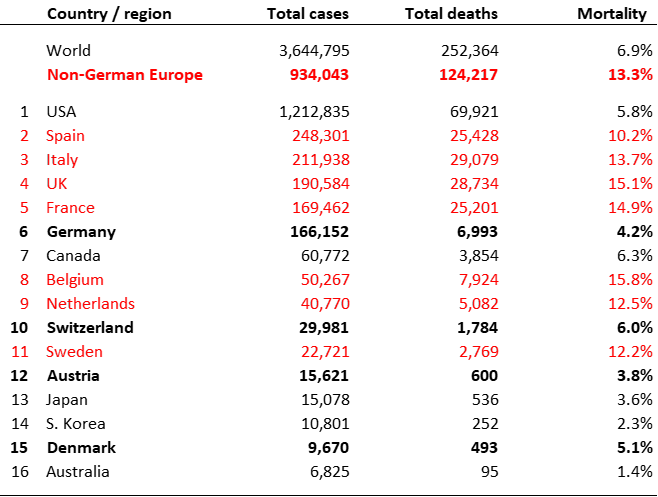
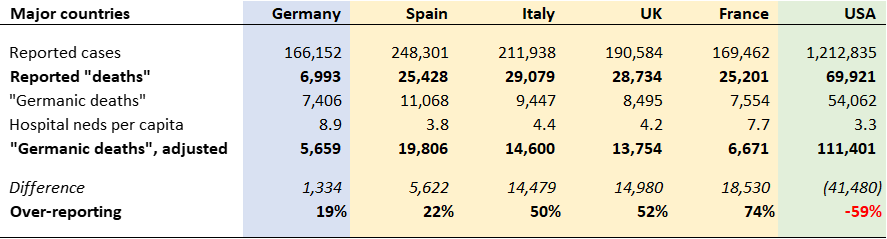
Step forward Germany. Throughout recent months, German numbers have been hailed as an example of what good governance should look like, with early testing being seen as key. Yet if you look at the details, a puzzle is presented: although German total deaths are much lower than that of France, for instance, its total numbers of infections are almost the same.

Total Covid deaths

Note: mortality rate defined as reported Covid deaths as % of total infections “Non-German Europe” are countries coloured in red; Source: Worldometer.info

All the good governance in Germany would, one assumes, mostly have led to lower deaths through lower infections, yet this has not occurred. Rather, the gap between total deaths is partly filled by the differences in counting methodology. In fact broadly speaking “Greater Germany”, encompassing Austria, Switzerland and Denmark, together average a mortality-to-infection rate at around one-third that of Non-German Western Europe (and this is already distorted by the fact that in Switzerland, non-German cantons are reporting much higher mortality than their German brethren).

So what is going on? Whilst I have no doubt that the Germans are doing better, they are not doing that much better. But at present, if there is a difference in counting methodology, I also have no doubt that I would lean towards the German over the non-German way. What then would the UK and other countries’ mortality rates look like under the German system?

First, I have assumed a simple re-basing of these mortality rates to the Greater German average, creating a like-for-like “Germanic deaths” number for each country. This lowers them substantially. “But”, I hear you cry, “is the German healthcare system not better?” Well, perhaps it is – though in fact there does not appear to be much consensus on this from various authorities. But let us say for the sake of argument that there is a qualitative difference, we might use a simple proxy such as the number of hospital beds per capita to readjust this number and make it more apples-for-apples.

Greater Germany Covid

Source (for beds): Nationmaster.com

Greater Germany does have a better-than-average provision of hospital facilities, particularly in Austria and in Germany itself. Taken together, the Germanic average of hospital beds per capita is higher than most other Western European countries, although France is also quite high. If we then adjust the “Germanic deaths” number upward again, by the number of beds, we have an indicator of what German-style Covid-19 death counts might look like.

European Covid like for like

Note: “adjusted” figures adjusted for hospital beds per capita compared to Greater Germany

Despite making this adjustment upwards, non-German Covid-19 deaths, whilst higher than Germany’s (and almost certainly correctly so), are still substantially below the current reported numbers. In other words, if the UK used German-style death counting, its numbers of Covid-19 deaths might be about half the current number and possibly well below. The same applies to all other countries in the region. I would posit that this is the basis of real comparability, not the published statistics.

Of course, this is all back-of-the-envelope stuff and many will complain that this does not take into account all the nuances of each country’s policies and virus reactions. But there can be no doubt that:

  1. Each country is counting in a different way;
  2. If the UK were counting along German lines, reported deaths would be much lower; and
  3. Conversely, if Germany were counting along UK lines, their numbers would be higher.

However taking into account what has been happening in each country, if I were to guess at who’s numbers are a better and more accurate representation of the real situation, I know where my money would be. But then, I am Austrian.


*******************

(For reference I did the same analysis incorporating the Asian OECD statistics, which seem remarkably similar to Germanic numbers. China in particular, whatever else is may have covered up, has a stringent policy of how it reports Covid deaths and the region as a whole would likely be similar. However the outcomes from this analysis did not move the needle enough to start having to justify commonality between Asia and Europe)

Asia OECD Covid

Physics, philosophy and why people don’t want “Centrism”

Physics & Philosophy

For a while, it seemed that “centrism” was back on the agenda. In the US, Howard Schultz, the “burnt coffee magnate”, was considering a run for Presidency and was only one of a long queue that included Beto O’Rourke and Michael Bloomberg (who has decided not to run). In Britain, renegade Labour and Tory MPs founded The Independent Group, designed to coral a fragmented anti-Brexit sentiment in into a movement, replete with the usual platitudes about a “new type of politics”. Every centrist potential presidential candidate is feted by the media as an answer to Trump and AOC; the TIG has actually had success in forcing policy changes from the Labour Party. It seems that, three years after the events that led to 2016, and two decades after the Third Way of Bill Clinton and Tony Blair, sensible politics was hoisting itself back into the public consciousness and relevance.

But here’s the problem: people don’t actually want “centrism”. Politicians on both sides of the Atlantic have taken onboard the very real desire for non-partisanship and somehow mangled this interpretation into support for centrism which is about as far from reality as they could be. It is unclear whether this misunderstanding is at least rooted in good faith about what ordinary people want, or whether it is part of a more sinister move to hijack the non-partisan agenda into something more appealing to those who only ever considered Trump and Brexit as aberrations. Indeed, from some parts of the spectrum supporters of these centrist trends are even preparing themselves for failure, by raising the red herring of “polarisation”. According to this, it is the public’s problem – they are too polarised these days to accept the logic of centrism. Shame on them.

There are two principal reasons why centrism is destined for failure, and none are the problem of the electorate. They are rooted in the two things which centrism stands for. First is compromise. There is some truth to the idea that the electorate is too polarised for compromise today; but this has always been the case. In politics, compromise has rarely been highly regarded since it inevitably results in the worst of all worlds, and usually are a by-word for kicking the can down the road. The Missouri Compromise or “Don’t Ask, Don’t Tell” come to mind for US history. The Barnett Formula, the EVEL answer to the West Lothian Question, and even the British opt-outs at Maastricht in 1992, are cases in point for Britain. The fact is that compromise is rarely satisfactory and tells of an inherently unstable equilibrium which as yet still needs to be resolved. Voters are quite tired of this given the questions thrown up by two decades of globalisation, automation and the 2008 financial crisis, and compromise is not going to answer them.

The second reason is that “centrism” above all (be it consciously or surreptitiously) is about defending the status quo – the exact opposite of popular opinion today. Whether Schultz or the TIG, advocates of the new politics are effectively trying to preserve a now discredited consensus around major issues of the day including free trade of the sort we have come to know, liberal immigration, a focus on GDP, the pursuit of “growth” and exports, keeping interest rates and inflation low and above all the protection of large corporates rather than SMEs. But that is from a pre-2016 world. Today the electorate, having been woke by the events of that year want something quite different – in a weird way, what they want is not centrism but extremism at both ends. Yes, they want to break the deadlock of existing parties, but they don’t want to return the consensus of old. Yes, they do not want the old “Left” vs “Right”, but neither do they want the compromise and consensus of the old “Centre”.

I have previously referred to what I call the Physics and Philosophy paradigm, and it is perhaps worth explaining more here. The problem with studying physics and philosophy is that each seems so different at the beginning and none of it makes sense until the loop completes at the end. Nothing makes sense until everything makes sense – whether in academia, business or anything else.

PhyPhi

Politics, too, is like this. At the beginning, one only sees things labelled for us as “Left” and “Right”, and the expanse of the political firmament is limited by lines of sight from traditional perspectives. Hence, at the beginning of 2016, this is what the American political world imagined it was seeing:

PhyPhi - pre 2016 politics

What we do not see at first glance is how these two ostensibly opposed directions may link up again at the other end of the circle. Yet if we tilt the planet up to peak behind, it is revealed what the political firmament had become by the end of the that year:

PhyPhi - post 2016 politics

Trump and Sanders were not, at the end, all too far away from each other in many of the crucial questions being posed on a number of areas such as trade, international companies and overseas cash-piles, and even infrastructure and healthcare. Both had moved right around the planetary orbit until they almost met again at the other side – the dark side of the planet invisible to the conventional commentariat sitting comfortably on the light side. And in that dark side are all the commonalities which are so hard to digest, principally amongst them the sense that the starting point for policy had to be the domestic and national, not the trade or people beyond the borders. In a sense, Trump and Sanders were in the “centre”, but a “centre” a world away from the “centre” prescribed by Bloomberg. The old centrists are wrong: their centrism was not being rejected due to cultural, regional and partisan polarization – it was not because the two sides were too different, but rather because they were too similar.

And this, ultimately, is where we are today. The TIG’s polling numbers have dramatically collapsed in the face of Nigel Farage’s new Brexit Party, declining from the mid-teens to low single digits since the party’s inception earlier this year. Bloomberg never ran. Howard Schultz has been non-committal about a presidential campaign and Democrats have been begging him not to run; the likes of known centrist Amy Klobuchar are failing to gain traction whilst complete outsiders like Andrew Yang are doing so. Yang, if anyone, is the 2020 heir to the 2016 dark-side-of-planet movement.

“Centrism” is an idea of a bygone age, one where the recent past was a story of success, where defending the status quo seemed like common sense and where just a small amount of compromise would be enough to navigate through foreseeable difficulties. But politics has changed in the last few years. Whether you are for or against Brexit, or whether you are for or against Trump or Sanders or Andrew Yang, the stasis engendered by the old “centre” is as irrelevant as defeating Communism or the Nazis. Although much of the mainstream media remain seduced by the familiarity of what was, voters on both sides have moved on; and most of them have now marched so far around the unseen side of the planet that only candidates who themselves see the future, will be positioned to reap its rewards. Centrism is dead; long live the Dark Side!


Out really means out – why Britain should reject the “WTO option” even under Hard Brexit

brexit-trade-barriers-810x521

The sheer amount of ignorance in British public discourse about how trade works is one of the most disappointing lessons from the whole sorry Brexit drama. As a Remainer I have no qualms in picking out the likes of Dan Hannan as an example of this, whose comprehension of the subject (and of economics in general) seems to have been plucked from half-remembered A-level text books, or, at a stretch, incidental discussion from reading History at Oxford. Amongst his favourite refrains is that which tells us that “at least we will still have WTO to fall back on”. Yet of all the options, this is probably the very worst. In the event of Hard Brexit, Britain should actually reject the WTO too.

This is not the place to get into the minutiae of what the WTO actually is or how it works. There are plenty of people who have written in easier detail that I can about this. Instead there are two common misconceptions about the WTO which need to be digested before we even get onto whether it is good for Britain or not. The first is that the WTO is not actually about regulating tariffs; its core notion is that of making sure that everyone abides by the Most Favoured Nation (MFN) principle, meaning that however you structure your trade (higher tariffs, lower tariffs, no tariffs) you must at least treat everyone the same. Clearly, this is a starting point on lowering tariffs but it does not actually reduce tariffs in and of themselves. Secondly, the WTO is not a single set of regulations, but rather applies to each country differently depending on their schedules of entry. In other words, upon joining the WTO, each country basically agrees to its own unique set of tariffs and commitments.

The blog referred to above gives the helpful example of shoes – a sector in which the UK happens to be an exporter:

8% is charged by the EU on shoes imported from all other WTO members (except under a free trade agreement, such as EU-Japan, or preferences on shoes from developing countries). The import duty rate in other countries will be different. The US’s import duties on shoes vary from duty-free to around 10% or higher. Japan charges 20%–30% duty on many shoe imports.

In other words, the WTO does not set monolithic rules, even at a lowest common denominator, as many casual observers seem to believe. The reason I highlight this is to emphasise that the WTO is not some magic bullet for providing a minimum level of trade freedom. It is merely a mechanism for getting countries to discuss ways to lower tariffs. How much each country has to commit to upon entry to the WTO is, much like any other trade deal or indeed any other non-deal trading relationship (which is how most trade is done), dependent on their economic strengths. A larger economy, offering both greater consumption power and usually some irreplicable exports, will always get a better “deal” out of the WTO as a whole (or any other trade negotiation such as an FTA) than a smaller economy. With or without the WTO, with or without an FTA. That is just the way life works.

Moreover, the WTO largely does not cover services, which matters for Britain. After all according to the ONS, British services exports constituted 44% of total exports in the 2017-2018 fiscal year, representing a trade surplus of +£107bn (+€124bn) compared to the trade deficit of -£139bn (-€161bn) in goods. Contrast this with Germany, France and Italy for instance who have a trade surplus in goods and deficit in services. Yet if you delve into the WTO’s website to look at something like architectural services, something Britain has had some success at, you will find the following wording:

Currently, architectural and engineering services, like all services are included in the new services negotiations, which began January 2000. Principles of trade in architectural and engineering services are contained, like for all services, in the GATS.

In other words, nothing has been agreed. The same wording applies to everything else including finance, law, advertising and so on. GATS itself, the precursor to the services agreement, is essentially toothless. As a result, you might have noticed that prior to the Brexit referendum in 2016 nobody anywhere had been talking about the WTO for almost a decade. Instead, partly in order to cover services, most countries have gone on to think about regionally integrated trade deals like ASEAN, the TPP, APEC, the East African Union, Mercosur and, er, the EU.

The problem for Britain is that the WTO is an unfinished project. People seem to forget that the intention for global “free trade” was supposed to be a multi-step process, starting with the trade in goods before moving onto the trade in services, tackling non-tariff barriers and eventually encompassing freedom of labour and capital. The trade in goods came first, naturally, because in the era in which the GATT discussions commenced, most economies including the OECD were still ones that made stuff. There was no real asymmetry in economic structure at that time and if anything, GATT and WTO were forecast to open up emerging markets to developed nation goods such as industrial equipment whilst the latter continued to develop their basic industries such as agriculture and natural resources.

However over the course of time this changed. The OECD became notably more services-based, including in their export mix. On the other hand the emerging markets, led by China, came to dominate the manufacturing industry not just at the low end but increasingly at the higher ends too – Korean autos for instance, Chinese industrial equipment and so on. It was therefore imperative that the next phase of global “free trade”, that of services, was completed – but it never was. The Doha Round, in the back of everyone’s memories, collapsed ignominiously. China’s accession to the WTO in 2001 on these ossified terms has probably contributed significantly to its rise and America’s comparative decline. It certainly led to Trump. If you are a modern economy, the WTO is probably bad for you.

We have not even touched on the specifics of how and whether Britain could easily join the WTO and on what conditions. The likelihood is that Britain could join pretty quickly – if it did so exactly on the current EU schedules (ie the 8% tariff for shoes above). But as noted, each set of schedules was designed to suit a specific economy and the existent schedules suit the EU as a whole. With a focus on protecting agricultural exports for instance, they are probably not ideal for Britain. If it wanted to join on a different, bespoke set of schedules, this would require agreement from all WTO members which would almost certainly throw up objections both legitimate (British government subsidy for financial services for instance) and illegitimate (Russia or Argentina purposefully creating trouble). Furthermore this would require time, unlike the replication of the EU schedules – the shortest period of time for a WTO accession has been several years.

This brings us to the central conclusion that if Britain goes through with Hard Brexit, it would be better to reject the WTO altogether and act unilaterally. The WTO as it exists today suits some countries like Germany and China and Japan, but specifically ill-suits the UK given the commitments Britain would have to make on accepting manufactured goods but getting no such commitments on services in return. Neither is Britain a big enough an economy to enter into renegotiations to remake the rules in its own favour, as the Quadrilateral could. Moreover, rushing into the WTO would actually undermine Britain’s ability to strike independent trade deals as most of what it has to offer – a market for consumer goods – would be given up already. Leverage in bilateral negotiations by trading goods access for services access, would be eliminated including with the EU.

Indeed in recognition of Britain’s place as a middle-sized economy, it makes more sense to try and protect certain industries, even at the cost of near-term price increases.  Whilst signing up to the WTO does not restrict Britain’s ability to lower tariffs, it would prevent the country from strategically increasing tariffs where necessary, for instance incubating industries struggling to find their feet after seventy years in the wilderness. The fact is that a vibrant SME sector really only exists in economies that have reached a critical mass in exports such as the US, Germany and Japan. For all other economies, creating national champions is a better guarantee of long-term economic survival (more of this in future posts).

Brexit is a political, not an economic, debate. That political choice should be made on its own merits, but decisions about trading relationships need to be clear-headed afterwards. Relying on the WTO sounds like a short-cut for preserving some stability for British trade, but it is a false friend. The reason why nobody else pays attention to the WTO anymore is the same reason why Britain must abandon it too – if indeed it actually ends up with Hard Brexit come 29 March.

The Chinese New Economy: Alibaba as Sauron and why the old economy will be the winners

Sauron eye

Anyone familiar with the Chinese new economy will be aware of the rise of the internet giants of Alibaba and Tencent, along with their satellite businesses. Most will also be aware of the largely exclusive ecosystems within which Chinese online life is led – platforms that encompass everything from messaging to shopping to transport to payments and beyond.

It seems astonishing to remember that barely five years ago many commentators fretted over whether China could ever achieve real innovation. The Harvard Business Review for instance posed the question “Why Can’t China Innovate?”, baldly stating:

Can China lead? Will the Chinese state have the wisdom to lighten up and the patience to allow the full emergence of what Schumpeter called the true spirit of entrepreneurship? On this we have our doubts.

This of course is all rather a fading memory now. Innovation can broadly be divided into three areas: upstream (essentially, “how it works”), midstream (“how it’s made”) and downstream (“how it’s used”). For years, China as a manufacturing hub had made quite noteworthy progress on midstream innovation but most uneducated observers – including many in government – have an unhealthy obsession with upstream blue-sky invention. Yet as we can see with the likes of Berners-Lee, inventors are rarely rewarded and rightly so, since the real creativity and invention from the likes of Steve Jobs, Mark Zuckerberg and Jeff Bezos is in the downstream. Jobs was an arch innovator in how technology is actually used and therefore spread through an economy, with a vision of how lives are actually impacted and changed. Chinese companies, particularly through the big online giants, are clearly doing the same: modern life in China is now lived in quite an advanced but different manner to modern life in OECD countries. Alibaba and Tencent have contributed towards the creation of a real and organic Chinese modernity and technological innovation within China arguably outpaces even the US even leaving aside issues of theft.

So it is worth spending a moment to look at these two major ecosystems and how they really behave – who they are, as it were. First, there is a question of why ecosystems exist in China in the first place in a way which outside of China they do not. Amazon comes the closest of the American tech players to demand a closed ecosystem but even they seem to find limits. Western shareholders have always rewarded single-capacity specialization, and often find the idea of any conglomerate absurd, let alone a tech company offering bicycles and banking.

In China though, this has been natural, for two reasons. First, there is the historical socio-anthropological tendency within Chinese society to build a “closed loop universe” within one’s own family or clan, which has extended to the national level through the Communist Party and SOEs. My own preference for explaining this remains Karl Wittfogel’s hydraulic empire theory, which tells us that most ancient civilisations relied on centralized power to deliver water to its people, enshrining the principles of autocracy and top-down governance at the government and family level. This in turn typically leads to closed-loop systemic thinking since everything has to work together or else nothing works – diversity of thought is only bad news. Secondly though, and somewhat ironically, these ecosystems have become so broad precisely because they are making up for assurances which the Chinese government cannot offer. When you make a purchase on TMall, you have more faith in the Alibaba-backed guarantee that your products will be delivered and that your payment is safe, than one does with the disparate parts of the national banking, postal or legal system offered by the government. The tech giants had to offer a total universe, or else consumers would have been reluctant to actually engage with the new business model in the first place.

Chinese ecosystems (2)

Source: SCMP

So much for why they exist – the bigger issue is how to understand who they are, what their personalities and identities are and how they should be understood from the outside. One possibly analogy, given their conflict, is that of the Cold War. In this world, Alibaba are the Soviet Union – a sprawling empire with a strong centralized view on how things are supposed to be done. Tencent on the other hand are the United States, a beacon of freedom and inspiration but which has its own agenda focused on generating and owning consumption. JD.com are Britain: commercially-minded, focused on trade and fully acquiescent into the American (Tencent) world. Lastly you have Meituan – which owes its existence to Tencent, but like France to the US is entirely ungrateful and maintains the pretence of wanting an ecosystem of its own.

Upon reflection however, a new analogy came to me which may be a touch more accurate, which is Middle Earth. In this version of events, Alibaba are indisputably Sauron, the lurking, evil presence which looks across the lands of men with an unrelenting will to dominion. They provide you the tools to “help” only so that they can own them and you. They invest in you because they need to control your system from the inside. Resistance is futile; eventual subjugation can be the only outcome. The interesting one is Tencent, who I liken to the High Elves of Rivendell. The things about the Elves is this: they are generally on the side of good, and can facilitate it; but they are not themselves a force for good since they sit far away from the battle, detached from it all. They too provide tools, but they may not tell you how to use them; their attention is ultimately elsewhere. The forces of Men ranged against Sauron – let us assume these are essentially a proxy for traditional retail and consumer business in the region – ultimately have to find the solution for themselves, aided at times by the Elves but not reliant on them. If I were to stretch this analogy ad absurdum, perhaps this makes the Dwarves JD.com with their grubby focus on gold and commerce; whilst Meituan the slightly nobler Rohirrim, since they, er, move around a lot on delivery scooters like the horses of the Riddermark. Which start-up will be the valiant hobbit which destroys Alibaba, God only knows.

The serious point to all this is that for old economy companies, it feels like making a choice is inevitable. But the more one looks at the giants of the new economy, the more apparent it is that in the conflict of “internet+” vs “+internet”, it will likely be the latter – especially established asset owners – that win out. In particular, it is difficult to imagine that in this inflated global asset price environment, that the business which need, as Alibaba and JD.com especially are doing, to build out a network of physical infrastructure can be the eventual winner. Well, maybe one early mover can, but the world is not about to be flooded with online victors – by and large, the winners will be whoever of the old economy players adapts best to the new, rather than a new economy player.

And this then comes down to the vision thing. I have another analogy: I call it the “Physics & Philosphy” dilemma™. P&P is a little known but highly intellectual degree at Oxford (arguably the most esoteric of all) which combines two subjects that are not immediately connected. Yes, it is true that in the first term, courses such as Logic may play a part in both areas but then it would appear the two diverge. Yet we should see this like the rings of Saturn: you start off at one point travelling in two opposite directions on the ring, and whilst they move far apart to begin with in the end they meet again. In P&P, the questions at the other end of the circle see the two disparate subjects poetically rejoin on questions such as: what lies beyond the Universe? What happens if time stops? What if light bends? What is not obvious when you start the degree, become enormously obvious by the time you end it.

And seeing what is on the other end of this ring – what exists on the “dark side of the planet” as it were – is the very thing that marks out business geniuses from mere mortals. It took Amazon 14 years to become profitable, but there seems little doubt that Bezos had an idea of what lurked out of his sight in the distance. Likewise Jobs as he labored through various versions of Apple. But the point is, old economy companies can equally achieve this. We know the famous examples of IBM and Intel reinventing themselves based on their competencies; Apple itself did so. Further back in history are companies like Berkshire Hathaway and General Electric, and even Nokia who started life in rubber products. Reinvention is hard, but the world has not ended just because a series of new giants seem to own everything in sight. If the old economy is to learn anything, it is that with courage and vision, and a will to innovate internally if imperfectly, the future is still going to be theirs. For every Amazon which succeeds, there will still be a dozen Walmarts and Targets which make it, stronger than before.

The technology giants will go down in history mostly as the midwives of change, delivering the new baby to their old economy counterparts. We are already seeing them do this, below the surface as Alibaba and JD.com start to crystalise value in real businesses where they can (finance, technology etc rather than the core e-commerce platforms which have rarely made money for anyone). In many ways they are merely pioneering the examples of what the future looks like, so that old economy companies can learn from it but probably implement it better – the Chinese O2O supermarket businesses are a case in point. Indeed the cheerleading nature of the new economy player’s roles in businesses like retail, ahead of its time, loss-leading and ultimately doomed as a standalone business, begs another more controversial comparison. The tech giants are St John the Baptist, crying in the wilderness; the old economy players are Jesus.