It’s the net tariff differential, stupid

Free trade was never supposed to be the end-game
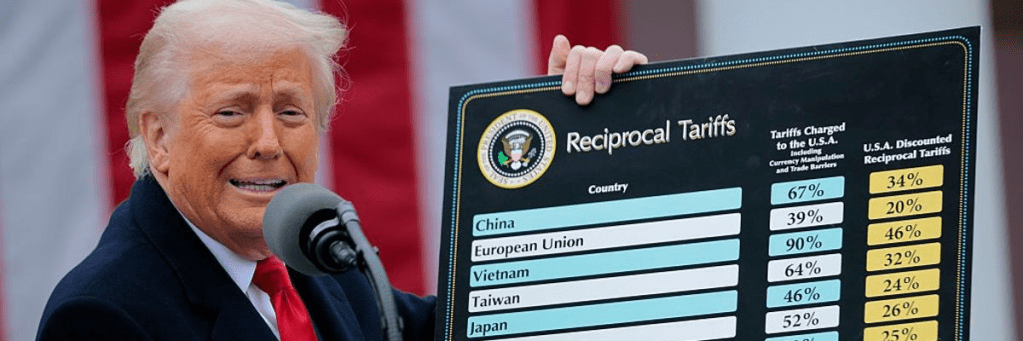
With the dust settling on tariffs, it is opportune to take a moment to consider the sheer scale of change ushered in by Trump on global trade since 2016, and especially with recent events. Trump’s policy is often confused by a vast amount of ‘noise’, which tends to undermine even his own news cycle (see the recent Iran nuclear facility bombing, for instance). Which is a shame, because he has almost entirely remade the landscape, and whether one supports or opposes the theory behind it, it seems irrevocable.

There have been two major components of this earthquake. First, Trump has instated and effectively normalised a global 10% tariff on all US imports, regardless of origin. As noted elsewhere, a ‘universal’ tool like this is by far the most efficient mechanism to charge the world a cost of doing business with America (a concept the youth of today will more easily liken to “gas fees” paid in the world of crypto). It has also raises the policy ‘baseline’ to a figure greater than zero, which I discuss below.

This baseline 10% has both more or less been accepted without reciprocation, by every major trading partner including the EU and China, regardless of vehement struggles over additional duties on top. Whether this 10% is the only tariff, like Britain, or whether it is just the minimum, like Japan and Korea who currently have 25%, the standard has been set and moreover will be very likely here to stay – any future US administration may renegotiate on specifics, but will almost certainly leave the baseline in place. It is now quite simply a fact of commercial life.

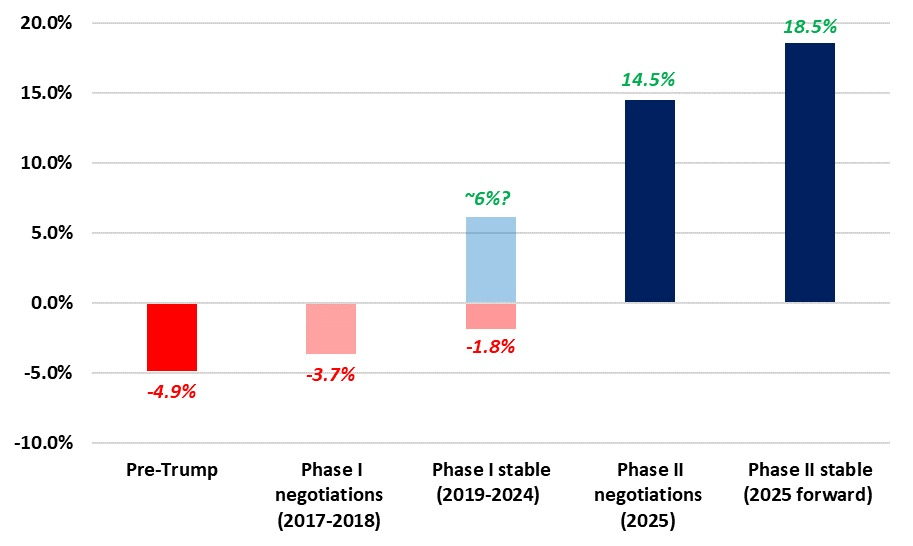
Secondly, there is China. Amidst all the turmoil (which may be part of a grand plan, but frankly who knows), Trump has continued his decade long trade strategy of increasing tariffs and daring China to fight back and contest who holds the most leverage. This bluff has been called several times, and has resulted in the US turning the net tariff differential (the principal measure of ‘success’ in any tariff strategy) in its favour for the first time in living memory.

US net tariff differential with China, 2016-2025

Sources: PIIE, underlying sources
Notes: 1. Trade-weighted tariff rates in 2016 were 8.0% on US exports to China vs 3.9%  on imports; 2. While the notional differential achieved in Phase I was -1.8%, in reality China unofficially suspended many import duties leading to a positive differential under Trump’s first administration; 3. 2025 forward numbers based on latest round of negotiations ending May 2025.

When Trump first emerged on the scene, the institutional trade nexus between the US and China, comprising both WTO and bilateral arrangements, was such that China imposed about 5% more duty on the US than vice versa. Liberal economists contended rather tritely that this was a price worth paying. Yet over the course of both the 2016-2020 presidency and now in his second term, this negative differential was first reduced and now into a major surplus. China, despite raising tariffs of its own, has acquiesced to the new normal that it must pay the US more than the US pays it, for trade. If anything can be considered a ‘win’, this is what it looks like.

In the meantime, we have seen no sign of the supposed economic slowdown as a consequence of the “trade wars” [sic]; there have been plenty of anecdotal examples of exporters eating the additional cost into their bottom lines; and after the initial volatility, the markets have settled down into a rally. Personally, I regard none of these as important for long term strategic reorientation, but among the breathless commentariat fainting at news from the bond markets, it seems to matter.

And what is the point of all this, might you ask? For me, on the subject of tariffs themselves, this policy has been a triumph of common sense. I have argued for years that the US and others needed to ramp up tariffs for several reasons.

One main consideration is that today’s global economy is no longer that of Ricardo’s. The applicability to free trade theory to a landscape of non-tariff barriers, unfungible services, and complexities of cross-border supply chains are extremely limited. Furthermore Ricardo assumed (as all economists tend to) agnostic counterparties motivated and constrained by economic incentives including public wealth and living standards; he did not factor in malevolent strategic actors who would happily pay a cost to bend a supposedly neutral system to their own agenda. Let us be in no doubt: if Ricardo were alive today, he would be pushing for trade tariffs.

Another outcome is the pushing back on the idiot savancy© which has led the technocratic classes to glorify “zero” targets – tariffs, interest rates, inflation, exchange volatility, even carbon emissions (though strangely not taxes or immigration). In most areas of public policy, however, zero is convenient for bureaucracy but wrong for the public. Low rates can occasionally be enjoyed as an output, not an input, but freedom to raise them are the safety valves required for cyclical management of the economy – sometimes you want inflation; sometimes you need currency devaluation. Tariffs, too, are a tool whose starting point (the ‘baseline’) needs room for manoeuvre both up and down – as a decade of near-zero interest rates have demonstrated, autistic ambitions hamstring policy tools needed to meet new challenges (I will write separately about this whole topic). So 10% or so suits the US quite nicely.

How tariffs will end up functioning is an unknown, due in part to how long OECD governments have allowed their muscles to atrophy in recent decades. And nothing scares technocrats more than the unknown. Yet beyond the anecdotal evidence of implementation, we also now know that the first round of Trump’s changes in 2018 led to substantial fiscal outcomes, with customs revenue doubling from US$35bn per year to US$70bn and well beyond.

Source: Bloomberg

This income is forecast to continue rising unless the economy tanks, but little sign of this. How the US government chooses to use this windfall is a separate matter, but the income certainly exists and one reason Biden chose to continue Trump’s tariff policy was that nobody wanted to look this gift horse in the mouth. While revenue raised is not central to the justification for tariffs, they offer an important lesson in how erroneous predictions on effects can be.

Most importantly of all, regardless of whether one supports increased trade protectionism or not (and I accept there are plenty of arguments to be had on either side), Trump continues to challenge the orthodoxy that such sharp directional changes are not even possible. Because for every protagonist arguing against the economics of tariffs, several more are usually hiding behind the sophistry that “he will never be able to do it, anyway”. These are the people cheering on the bond market turmoil or China’s retaliatory duties, unwilling to admit out loud that if it could be done, it might actually make sense for people, even at the cost of being vastly more inconvenient for the beneficiaries of globalisation.

As with defence or immigration, Trump has shown that none of these shibboleths are untouchable. The governing classes, while self-interested in keeping the policies of the last fifty years in place, has been surprisingly ineffective at stopping Trump from turning 180 degrees on tariffs or NATO or Iran, despite loudly arguing that it could “never be achieved”. So it turns out that the system, for better or worse, can be changed. Perhaps after all it is actually Trump who is living Obama’s best life, as he surveys the world around him and tells voters “yes, we can”.

Why companies in Asia are finally going to need real strategy (even if they don’t know it yet)

Most think they have been strategic, when in reality they have just been gambling

My LinkedIn has been showing the first signs of waking up, in recent months, to roles centred around ‘strategy’. This broad term takes into account a range of positions, all of which are yet nebulous, but which nonetheless are being formulated by leadership. This reflects the changing nature of corporate life in the Asia region, where companies are struggling to grow the way they want – but most have not yet worked out why.

To quote one friend of mine, with a background in family offices, “a lot of Asian fortunes are going to be lost in the next decade or two” – principally (though not solely) due to declining asset prices in real estate. Urgency and heroism at these family groups are what is needed, but either these characteristics are not present in the generation governing them, or that energy does not have a constructive home.

The true scale of slowdown in the region has not yet been recognised. Corporate owners generally are too illiterate to distinguish between real and nominal GDP growth (an issue I have written plenty about before); comfortable board rooms in Hong Kong, Singapore or London survey Asia as a market which has slowed – but just a little. After all, real GDP in China dropped from some 10% on average in the first decade of the millennium, to some 7% in the second until 2019 (it has since spooked markets by generating only 5% over the Covid years). SE Asia was never quite that high, with GDP averaging around 5% in both decades. All pretty healthy.

But corporate top lines and bottom-lines are not real, they are nominal. And importantly, nominal GDP fell precipitously over the same period, almost halving in local currency terms from over 18% to 10% over the two decades (in USD term, growth rates have been even lower).

Source: World Bank (full notes at end)

In other words, the age of Asian growth is over. We are well past the phase of the rising tide – not just in China, but more or less across the region. This impacts both corporate performance, as well as property prices. Asian groups have, on the whole, seen their returns stagnate over the last decade compared to the decade before; and importantly they have fallen in line with nominal GDP growth – in other words they are ‘maxing out’ their ability to squeeze more. They have been able to outstrip GDP here and there, but it started running out of wiggle room well before the change in interest rates which seems likely to be with us for some time. Now, the future of growth looks even bleaker.

Source: CapIQ (full notes at end)

So where does this leave us? The reality is that most corporates in Asia have not really had a ‘strategy’ per se, even if they claimed to have. Instead, they made bets in a benign environment, where they really did not have to be very clever to make money. Most sectors across the board grew decently in a +18% CAGR world. Furthermore, a majority of these family groups already owned assets – principally prime real estate – which rewarded rent-seeking and minimised the need for innovation. Where such groups did venture into the unknown (Adrian Cheng in Hong Kong being perhaps the most prominent), things did not go so well. These businesses do not just need a new strategy, they need a strategy in the first place.

So what is ‘strategy’? Well first, it is easier to understand what strategy for such groups is not, particularly some frequent misperceptions and conflations.

  1. Strategy is not tactics (destination is needed before details)
  2. Strategy is not budgets (even though finance is how control is maintained)
  3. Strategy is not transactions (deals come only after we know direction)

Strategy is about what you want to be as an entity, and the broad direction of how to get there. In Asia, the biggest omission from corporate owners (who tend to be family) is not focusing enough on coherence and identity. Conglomerates are perfectly acceptable in their way; we have, since the rise of the tech giants on either side of the Pacific, witnessed a renewed era of conglomeration in the form of Google, Amazon, Tencent and Alibaba. Single sector focus is not important or the only key to generating shareholder value. Rather, bringing together wildly different businesses can be successful where the overall narrative of who you are still holds. You do not need to have operational synergies in order to have an ownership cohesion of even a sprawling empire.

‘Strategy’ is also about power. The preeminent objective for family groups in Asia, with minorities playing a lesser role, is preservation and the ability to keep your destiny in your own hands. Near-term returns are important; dividends are crucial; but above all else, is it control which is paramount. Life is a constant battle for control – against the government, against competitors, against suppliers, against customers. Strategic thinking is designed to look beyond the financials to the power dynamics in the market – for instance owning the loss-making delivery business which allows control of consumption for your upstream FMCG, or owning the low margin bank that finances speculative capital in new industries.

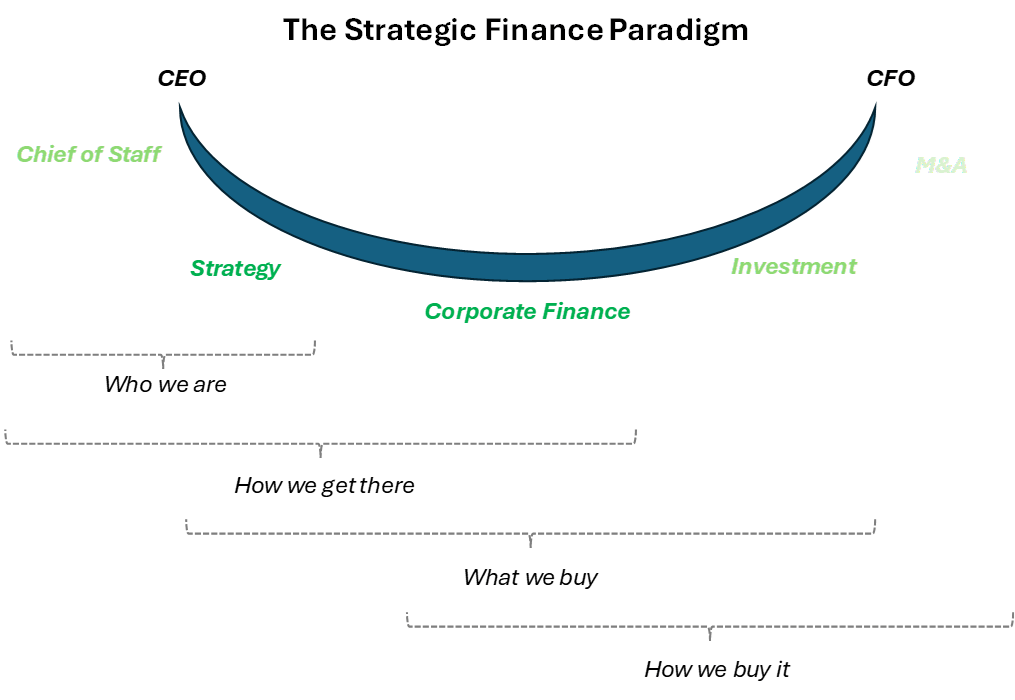
The purpose of ‘strategy’ is therefore to solve the triangle of dynamic forces which determine how a group can move forward. Capabilities either exist or need to be cultivated or acquired; opportunities need to be identified, sourced and validated; and the ability to invest, either through equity or debt or partnerships, has to be planned.

The tricky part is that moving each of these impacts the other two, and ‘strategy’ is therefore about determining how best to balance them to reach the overall aim and keep your identity. Buying new capability through M&A, say, might expand your opportunity set, but weigh on your balance sheet. Restricting your gearing risks not just limiting your opportunities to invest, but also stretch your existing resources in management.

But central to all of this – and where Asian family businesses are particularly lacking – is the need to build or maintain a true identity about who you are and where you are doing. In this region in particular, business owners undervalue how much identity is needed as a pay-off for lack of financial incentivisation and a demand for loyalty (same in politics). Hence identity sits and the very heart of how to think about ‘strategy’, a sine qua non from which all other plans flow. You need a cadre of people who remain loyal to the cause and hence work to protect a family’s interests across generations. They need, more or less, to feel like they are part of a partnership in the traditional sense; mercenary superstar management is the death-knell of the family conglomerate.

Which brings us to organisation. Lots of people think that they “do” strategy; yet more others have such a title; a third group really need to be strategic. The problem is, the three rarely converge. People confuse strategy with tactics, ‘strategy’ titles often mean doing M&A, and leadership is often bogged down trying to manage stakeholders and incremental decisions to really think strategically. Divisions and subsidiaries cannot be left alone to decide their own fates; their management is rightly limited to seeing things through the prism of their own industry. They cannot offer holistic views about the portfolio and they are not positioned to leverage the strengths of a group overall.

Yet ‘strategy’ is too much for just the Chairman or CEO to undertake, and still less the CFO – although financial control remains key. Getting ownership to think about identity and vision is a skill, and it needs focus. It needs one or more thoroughly invested people at or near the top to shape it and keep the flame alive. As discussed above, there are a range of titles or roles that reach across the spectrum of what I call “strategic finance” – both vision and execution.

And ‘strategy’ will only get more important. Some family groups still live under the auspices of an all-dominant chairman; others want to believe that they should interfere less in their businesses. But one thing binds them both: they underestimate the necessity of a wider, more bought-in middle who understand both the family and the firm, and who are invested in the strategic long-term wellbeing of both. Doing better is not about doing less or doing more, it is about understanding what is strategic and what is not – whether in capital allocation, M&A, organisational structure, portfolio evolution, employment programmes, partnerships or even investor relations.

The urgency and heroism mentioned at the beginning is what Asian family groups will need to survive. They may get lucky with the scion which comes to power, but with or without that, they will need to embrace all those things they found too intellectual, too esoteric, too academic; they will have to start doing ‘strategy’.

Notes:

  1. For GDP growth, data set is in GDP current LCU
  2. “Emerging Asia” comprises China, Hong Kong, Singapore, Thailand, Vietnam, Malaysia, Philippines and Indonesia
  3. “Total Asia” comprises above plus Japan and Korea
  4. “Asian conglomerates” comprises Jardine Matheson, Astra International, CP ALL, Keppel, YTL, First Pacific, Uni-President, Sime Darby, Swire Pacific, ThaiBev, SM, CITIC, Ayala and JG Summit
  5. “Asian property groups” comprises Hongkong Land, Sun Hung Kai, Swire Properties, Henderson, New World, CK ASSET and Wharf REIC
  6. “Japanese trading houses” comprises Marubeni, Itochu, Mitsui, Mitsubishi and Toyota Tsusho

Why Palestine – like Tibet and Kashmir – is just boring

A less boring version of events

With the latest conflict now settling down to the usual name-calling and posturing, we are once again confronted with the insolubility of the Middle East problem. For those like myself who grew up with another version of this – the sectarian tensions in Northern Ireland and its impact on politics and society in the UK at large – this is all too familiar. And for myself, much as I felt with that episode of history, I cannot help but be bored each time it starts again, because there is actually no solution which will bring a lasting peace until, as with Northern Ireland, we start to move beyond political conceptions on which states and borders are based.

Before I get to my historical analysis however, I would also give a nod towards the issue of foreign observers and their inability to grasp real motivations of those on the ground. Graeme Wood made the point, during the rise of ISIS in 2015, that the hand-wringing in Washington and Brussels would never help until they acknowledged the underlying religious inspiration behind the Caliphate. People do genuinely act on matters of theology; it is not all (or even mainly) a matter of economics and the Marxist interpretations. But of course, western observers, whose political classes are by and large either atheist or at best agnostic, could never comprehend this and would therefore keep wanting to bring a knife to a gun fight. The naive but enduring hope that improving the economy and jobs would somehow solve the problem that Islam presents is really a problem of the observer, not the subject.

However to return to a more Realist angle, I have no interest in how to solve the current Palestinian problem, but I do have an interest in the historical provenance. Because like it or not, the Israel issue is one of several which have their roots in intellectual limitations of state-makers in the immediate aftermath of World War II, roughly from 1946-1954. We saw the same problems erupt as India gained independence and split between Hindu, Muslim and Sikh; and in the slower issues built up in the corners of China as Mao consolidated around the Qing Dynasty imperial borders. In every case, conflict and bloodshed were born of trying to fit the square peg of empire into the round holes of nation-statehood.

The ‘nation-state’ itself is, of course, a somewhat recent phenomenon. While it is a little trite to date them specifically to Westphalia in 1648, it is certainly true that a century earlier at the Peace of Augsburg, the connection between rulers and the ruled based on ethno-cultural identity was barely existent. The splendid Charles V, in his twilight in 1555, was the legitimate ruler of inheritances including Spain and the New World, Austria and the Holy Roman Empire, and Burgundy. Nobody on the streets of Vienna, Antwerp or Madrid complained about his ethnicity – even if they might complain about misrule. This detachment between where a ruler came from and his authority only changed with the advent of new weapons, increasingly expensive wars, and the compensation offered by rulers to their subjects for ever-higher taxes to fund the military. ‘Nationality’ was a part payment for the debt being incurred by princes as they required greater blood and treasure – “we need more from you, but you’re now fighting for your own people!”.

Allegory on the abdication of Emperor Charles V in Brussels

So nation-states, in other words, with their hard borders and inherent desire for ethnic, cultural, religious and linguistic cohesion, were a creation of European diplomacy just a few hundred years ago. And it served them fine, even as the rest of the world tended still towards the more nuanced and subtle lines of empire – today a byword for violence but in actual fact a creator of peace for most people. In simple terms, for instance, it made perfect sense for Tibet to exist within the Chinese imperial sphere; but made very little sense for it to be incorporated into a new Chinese nation-state. Likewise the Northwest Territories to the Raj. Most of all, in Jerusalem the centuries of occasionally tense but balanced coexistence between Arab, Jew and Christian was brought to an end with the creation of the Israeli state in 1947.

All three of these examples – and plenty of others besides – would have benefited from revolutionaries who looked past the (even then already dated) concept of European nation-statehood. In each case a forward-looking, more federalised concept of governance could easily have been introduced. In Europe itself, political leadership was looking at a post-national world which would lead eventually to the European Union. So why was none of this progressiveness around in Israel, India or China?

First is pure laziness. A vast number of unfounded charges are laid at the feet of the British Empire (which left the majority of its people better off than before), but the one criticism which sticks is the undignified rush to decolonisation, and the unintellectual approach used for it. Britain of course, as demonstrated with the EU, is in any case the wrong source of inspiration for ‘post-nationalism’, but at the time the navel-gazing was due to self-obsession. The credit for all the good that Empire brought, was more than a little diminished by the inglorious process of its end.

But the bigger issue was the lack of imagination from the heroes seeking to create new countries of China, India and Israel. Mao and Zhou, Gandhi and Nehru, Weizmann and Ben-Gurion were all leaders steeped in the orthodoxy of western historical teaching, and could conceptualise of nothing else other than the national structure of western powers (despite, ironically, the fact that those same imperial powers tended not to apply statehood in the empire, resulting in a measure of peace). When Churchill called Gandhi “a seditious Middle Temple lawyer, now posing as a fakir… striding half-naked up the steps of the Viceregal Palace” it was as much a comment about his cultural background as it was about his privilege. Gandhi suffered, as they all did, from a sort of Stockholm syndrome where because Europe comprised all nation-states, so should their newly independent post-imperial entities.

Not all such Westphalian myopia ended in disaster. A few successful examples included Lee Kwan-Yew’s establishment of Singapore, or the stability achieved for long periods in Thailand or Japan. But in general, the larger conflicts today still exist because someone, somewhere, could not get their minds around the temporary and cyclical nature of national constructs, instead pursuing hard-bordered strategies that had to end in bloodshed. They were not helped by their former masters, to be sure; but ultimately it is difficult for these founding fathers, all of whom played up their own supposed knowledge of history, not to take the majority of the blame.

The crises in Palestine and elsewhere, such as they are, are the fault of aspirant statesmen who could not think outside the box. None of them had a proper historical grounding, and generations since are paying for it. This insolubility deserves ennui, not obsession.

How acquirers of car brands – even Chinese ones – can succeed

Cars have had a long innings as possibly the most globalised consumer product around is. By which I mean, they have broadly been the product category about which consumers see supply as a single world-wide market: whether you live in Belgium, Brazil or Brunei, you would still be mostly buying cars from the same top ten or so global producers for the last decades. If you are rich, you would probably be looking at the German makers, and latterly Lexus. If you are middle class you might be settling for other Japanese or European brands. If you were stupid you might buy American – but then, not even Americans do much of that.

Another way of looking at it is that cars have had the longest ‘globalisation window’ of almost any product category. As a country develops, it initially prefers foreign brands and the qualities they bring. But when a country really develops, consumption starts to re-indigenise. For instance, while cars and, say, food products both tend to globalise early, people return to their own taste in food quite soon after they become middle class (partly reflecting the lower barriers to (re-)entry). The speed with which McDonald’s or Yum localise compared to Volkswagen is telling.

In part this is because a carmaking industry is actually difficult to establish: Taiwan, for instance, despite having a steel sector, has never managed to create cars; Korea did manage to, but only after throwing the entire weight of its economic development behind that push; Malaysia threw its weight behind the effort, too, but with mixed results. People often refer to the building of aircraft carriers, or a space programme, as the symbol of a country’s total integrated industrial capability, but on a much more mundane level, so are cars.

All this combines to shape the global landscape in automotive OEMs, which have consequently undertaken enormous amounts of M&A over the years – almost all of which have been unsuccessful. Daimler’s ‘merger of equals’ with Chrysler in 1998 went so poorly that it is subject of business school case studies; while the ‘alliance’ between Renault and Nissan – undertaken a year later and heralded as a counterpoint to that merger – itself became mired in problems. Ford made numerous acquisitions of other brands over the years including Jaguar (1989), Volvo (1999) and Land Rover (2000), before selling all of them at a loss. Aston Martin was an honourable exception which proves the rule. GM did even worse that Ford – both Saab and Daewoo more or less shut down.

So successful automotive acquisitions are worth considering, and when one of those is a rare example of successful Chinese overseas industrial investment, even more so. Below are a few examples of ‘takeovers’ of well-known car brands in recent years, and their performance afterwards.

Vehicle sales CAGR since acquisition

Note: parenthesis indicates year of effective acquisition; Rolls Royce and Aston Martin not strictly ‘acquired’, for different reasons

There are a lot of details which I will not go into here, for instance the story behind Rolls Royce and BMW (the subject of another post), suffice to say that quite a few of these marques have had success over a long period of this century. To put this in context, over the same approximate period as above, the main carmakers have seen growth ranging from +4% (the Germans) to -1% (the Americans). So to understand why these acquisitions have helped practically, I will focus unashamedly on the two cars I personally own: Bentley and Volvo.

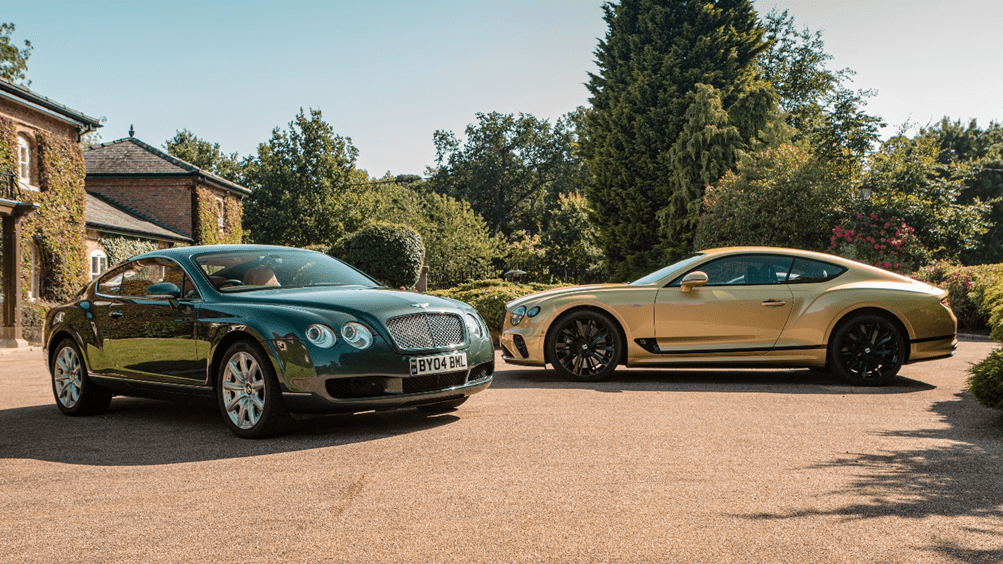
The history of Bentley and Rolls Royce is again a post for elsewhere, but Volkswagen essentially bought a faded business selling just 400 cars in 1998. For five years they dwelt on the business and how to get the best from leveraging VW’s broader platform, and in 2003 they completely reinvented the brand. Handing over the patented W12 engine – a slightly eccentric and personal project of chairman Ferdinand Piëch – the new owners steered Bentley back to their sporting roots and create the new Continental GT. The car took off, shooting sales instantly to over the 5,000 unit mark where it has remained and grown. Possibly no car better signifies reinvention than this one and VW undoubtedly gave Bentley a new lease of life.

A few years later in 2010, Chinese carmaker Geely shocked the motor world by buying Volvo, then owned by Ford. Driven by another chairman, Li Shufu, this was a test case for Chinese overseas acquisitions in an age where it was slightly less controversial. Observers expected either a total takeover or completely detachment, but as with VW and Bentley, Geely took a nuanced middle way of gentle guidance and leverage of the broader platform. Again, the new owner mulled for five years or so before pushing the redesign of the XC90 SUV in 2015, which saw Volvo’s sleepy sales take off; in 2018 it trumped this with a new version of the XC60 and Volvo’s position as one of the most popular premium SUV brands was cemented. Volvo grew unit sales by 10% CAGR between 2014-2019 prior to Covid, the vast majority of them these two models.

Both these examples show that automotive M&A can work, when there are clear alignments: first, the buyer needs to have a clear idea of what exactly they are intending to do with the new brand; secondly, they should not rush to impose changes, but take time to understand the asset; and lastly, the buyer needs underlying platform benefits to add. The case of Tata, whose control of JLR has been more mixed, is a case in point: they have not really added much to either Jaguar or Land Rover, and while the latter benefited from the global demand for luxury SUVs, Jaguar has been in stasis. Volvo, on the other hand, will be receiving the full support of Chinese EV technology, future proofing the brand yet further.

My final point reflects an earlier post I made about the quality of FID. For the UK and Sweden, these two acquisitions are exactly as hoped: inbound investment and employment but importantly, technology and IP continuing to grow at home. Bentley and Volvo remain unmistakably British and Swedish endeavours to be proud of, regardless of their owners. The same cannot be said for the low-quality investment that MPs so desperately fuss over, such as Nissan’s ‘flagship’ EV investment into Sunderland. Here, the IP is not British, and neither will the skills be; Britain’s sole role in this is to be cheaper and less regulated than its neighbours – not a desirable or sustainable model. While the volumes coming out of Crewe and Goodwood plants are much fewer, the long-term value-add to the UK is much, much greater.

In defence of … Empire

The Muse bids me consider the good, the bad and the necessary forms of power

Two decades ago, the subject of empire, which had long fallen under the pall of apologetic navel-gazing in academia and in political discourse, experienced something of a revival. On Home Counties coffee tables in around 2003 emerged books such as Niall Ferguson’s Empire: How Britain Made the Modern World and, a couple of years later, his follow up Colossus: The Rise and Fall of American Empire. Both were made into TV series, leading to rather bitchy comments from my own tutors at Oxford over exactly how much of a sell-out he had become. Ferguson moved on soon to NYU and latterly Harvard, where he continues to be a proponent of sorts, of the imperialist revival.

He was not the only one however. A far more academic book, though still accessible, from a few years later in 2009 was John Darwin’s After Tamerlane, which charted the Asiatic land empires over the period 1400-2000 and took a nuanced view on empires, their existence, longevity and, buried amongst the prose, their benefits. The obvious point being that:

[A] propensity in human communities has been the accumulation of power on an extensive scale: the building of empires. Indeed, the difficulty of forming autonomous states on an ethnic basis, against the gravitational pull of cultural or economic attraction (as well as disparities of military force), has been so great that empire (where different ethnic communities fall under a common ruler) has been the default mode of political organization throughout most of history. Imperial power has usually been the rule of the road.

On the other side of the Atlantic, the process of soul-searching brought on by the foreign policy of George W Bush generated much writing, with 2010 alone producing three prominent volumes in the shape of Empires in World History by Jane Burbank and Frederick Cooper, The Rule of Empires written by Timothy Parsons and Empire for Liberty by Richard H. Immerman; this unsurprisingly coinciding with the accession of Barack Obama, probably the most forthright anti-colonialist (and perhaps anti-British) man to occupy the White House since Grover Cleveland in the 1890s.

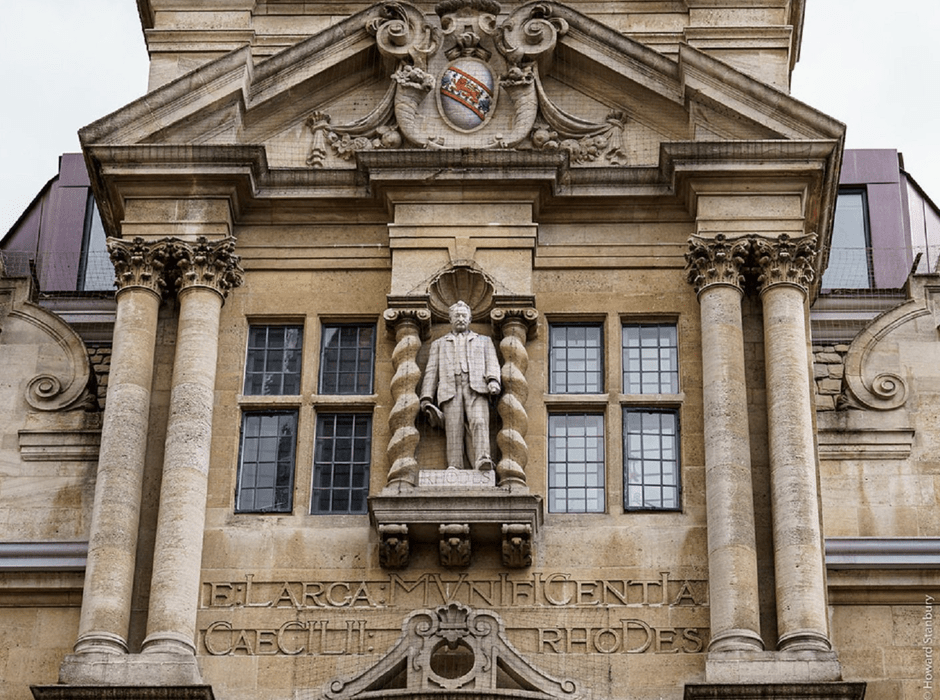
However, after that burst of activity, Empire has again experienced decline in the perceptions of the liberal public – not least through the sophistry of race relations which re-emerged through the 2010s, accelerated by Trump’s election, BLM and in my world, the absurdity of movements such as #RhodesMustFall (though I am glad to report that as of this moment, Rhodes’ statue still looks down majestically from its cupola on the High). Iraq and Afghanistan have gone the way many feared; perceived Russian and Chinese aggrandizement continues. ‘Empire’ has not had a good innings. Yet the lessons about why they are good, bad or necessary are still overlooked, and I feel obligated to rehearse them once more.

First, Empires bring peace; and their decline brings conflict. Whilst this may sit in cognitive dissonance with how history is taught today, the reality is that for a majority of peoples governed under imperial structures, lives were more stable under this regime than what they might otherwise have. This is not only empirically true – Spain and North Africa for instance were largely left in peace for three centuries between the Punic Wars and the Crisis of the Third Century, despite not being Roman “heartland” – but also logically. See also China, Byzantium, the British and French empires and even the dysfunctional American equivalent (though as Ferguson says, Americans just aren’t very good at empire). Ethnically-focused nation states must be more prone to friction with neighbours than an empire which is first and foremost self-interested in minimising that friction. No successful empire has ever seen greater violence and destruction in its borders, than its alternatives.

Secondly, Empires bring prosperity. Much like any political system, the proof is in the pudding and there are very few examples of empires which successfully exist for long based only on coercion. Even the Empire in Star Wars, for instance, would have had more adherents than resistance and the Jedi should probably have asked themselves why they were in such a minority for so long – probably because their own scattergun and slightly racist alternative proposition could not even persuade Ewoks, let alone the merchants, professionals and other middle classes of the Empire that their mess was better. Most complaints about empire comes from self-indulgence, and nowhere was this more plainly set to rights than in Monty Python, whose sketch in The Life of Brian was a thinly-veiled lampoon of anti-colonial opinion across Asia and Africa:

Lastly, empires bring diversity. Given the propensity to celebrate everything “D&I” these days, it is worth pausing to think about how much empires, rather than nation-states, and created and sustained true multi-culturalism. Ultimately, empires are agnostic about the culture they carry, and as they expand absorb ever greater amounts of what they oversee. It is notable for instance, the Prime Ministers such as Thatcher and Blair were eminently more parochial than similar bourgeois classes a century earlier, whose relatives would have grown up in India, the Sudan and elsewhere serving as bureaucrats and engineers. Whilst Europe has provided some remedy to this parochialism, it is not complete: since the decline of empires in the 1960s, modern (western) nation states and their governing classes know less about the world around them than ever before, leading to everything from half-baked trade pacts like the WTO to neo-conservative adventures in the Middle East. The borders of empires are soft and porous; the borders of nation states are hard – and with it hardened views on identity and inclusion.

Coming from a family that emigrated under the auspices of Empire from China to India to Britain, I take a personal pride in the system that allowed for this to occur. Britain offered an attractive cultural and civilisational prospect, of course, and its contemporary weakness in this needs addressing; but more importantly it was the infrastructure of empire that served so many millions of people so well, for so long. It gave opportunity, egality, stability to the very poorest in society, at the expense, ironically, of the “home” nation.

Empire is here to stay, not just because of legacy but because its really quite a popular system. The definitions may vary over time, but the principles of expansion and peaceful, productive dominion of a periphery by the centre will remain permanent. A decade ago I argued that we were witnessing the emergence of a new “community of empires”, given the way not only Russia and China, but also India, Brazil and others were run. Some of this has come to pass, others are slow burning. But before we continue to trample the legacy of empires, we should remember why they appealed; since they are an inevitability, perhaps it is better we embrace their positives rather than engage in futile self-flagellation.

Not all emerging markets are the same (Part 2)

Tent vs marquee economies (or why Indonesia is bad and Vietnam is good)

I previously looked at the SE Asia economic picture overall and drew out some pretty stark contrasts. I want now to focus specifically on two markets I know well, both of whom have cheerleaders: Indonesia and Vietnam. Only one of them, I would suggest, has a bright future. Against these, as ever, I find it useful to benchmark against China, the one regional example of an economy that has made progress.

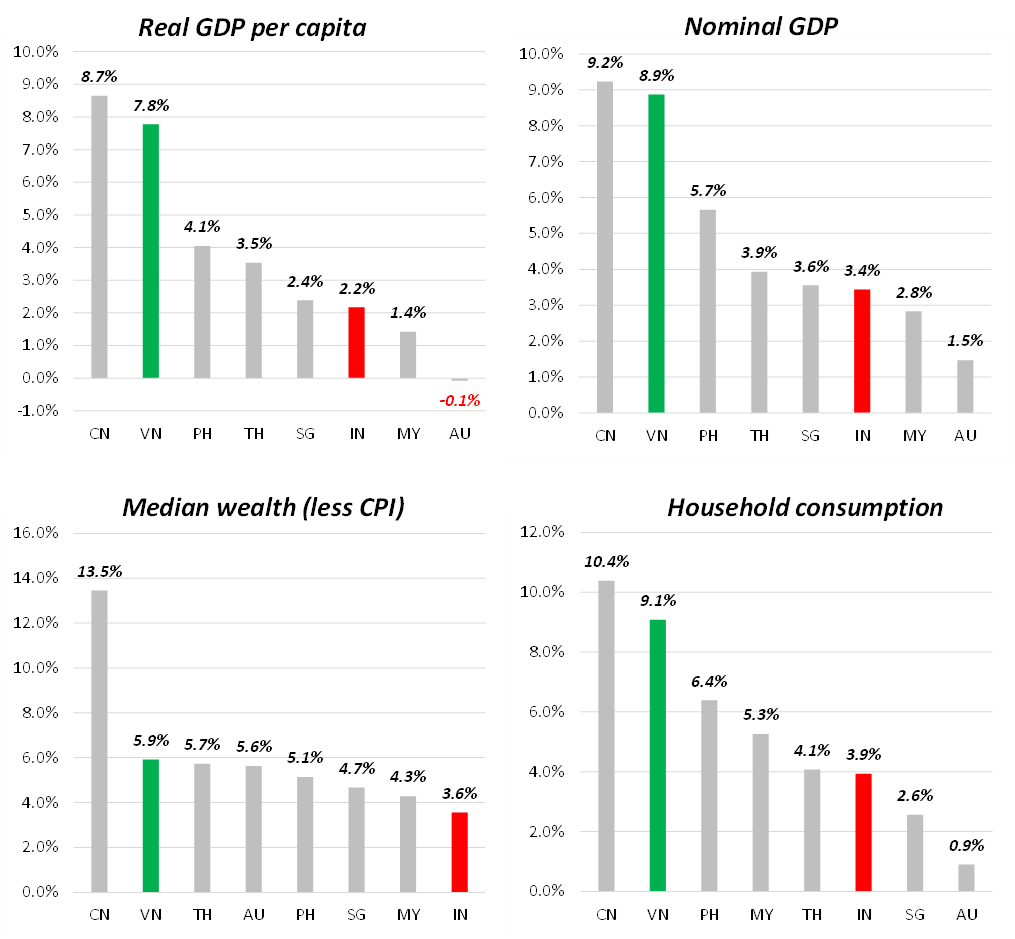
In fact, based on statistics previously discussed, even in a basic way Indonesia has constantly under-performed Vietnam (and indeed most peers) over the period 2010-2020:

Source: World Bank, Credit Suisse Global Wealth Report 2022

It is poignant that once we move beyond real GDP, the variation is marked. Both Indonesia and Vietnam have experienced significant population growth – but even factoring that in, Vietnam has sped ahead on a per capita basis. In terms of nominal GDP, Vietnam comes close to China levels of growth and, incidentally, does so with a currency which has not depreciated against the dollar anywhere near as much. In median wealth, Vietnam, coming from a low base and with CPI not much less than Indonesia, is still notably ahead. And lastly in household consumption – that portion of GDP growth that we consider “good growth” – Vietnam is more than double Indonesia even though the latter experienced the greater part of a commodity boom during the period. In other words, Vietnam, from a standing start, has led everyone in the region bar China; and is the only country to come close to matching China’s remarkable overall levels of growth.

So much for the past – but what about the future? Well the problem comes in understanding the structure of the economy, and in particular the effects of inequality, inflation and where relevant, currency depreciation. Indonesia’s under-performance is due to both a long-standing inequality and inability to distribute the proceeds of growth into a mass middle class, as well as peculiar governmental weakness at tackling inflation and currency depreciation, which are linked.

Source: World Bank, Credit Suisse Global Wealth Report 2022, Bloomberg

As a demonstration of the former, I tend to use my own measure of inequality, which is to look at the “wealth multiple” of mean-to-median assets per capita. The higher the multiple, the more unequal the economy. I find Gini coefficients to be too muted in their outcomes, and most of the public sources such as the World Bank still inhabit a pre-Piketty world focusing on income distribution rather than asset distribution – but all this will be in a future post. What is important is how much higher Indonesia’s wealth multiple is compared to the two post-Communist economies which are doing better (for the record, others such as the Philippines are unsurprisingly even worse). Both Indonesia and Vietnam have experienced high levels of inflation – but, of course, this comes against the background of Vietnam’s much higher rates of nominal GDP growth. And above all, whilst most of currencies have weakened against the dollar, none have been so spectacular in their depreciation as the Rupiah.

2020 exports by industry for Indonesia (left) and Vietnam (right)

Source: The Observatory of Economic Complexity

Indonesia has been sustained by commodity cycles in the past and may benefit from another which has recently commenced – but the problem is, this is only arrow in its quiver. For me, there are two broad models of economic emergence, which I visualise as “tents” and “marquees”. A tent is simple, and has a couple of simple poles which hoist the whole fabric. These poles can raise a high summit point, but they are frail and narrow. A marquee takes longer to assemble, but has multiple poles and is usually more robust. Indonesia’s reliance on commodities – and its marked inability to produce an export-quality value-adding sector (for instance, manufacturing) – makes it a tent. Vietnam, whilst its summit point is still lower than that of Indonesia, is supported by multiple sectors. Importantly, this also means producing a wider “middle”, which somewhat depicts the creation of a real middle class.

Tent vs marquee models of economic development

In short, whether you are an entrepreneur, a foreign investor, or just the common man on the street, Vietnam is a much better prospect than Indonesia. This reality belies the generic theoretical focus on demographics and real GDP, and correlates to the empirical and anecdotal evidence from the streets. Anyone who goes to Jakarta and then Saigon will feel a difference in energy and enterprise. In Indonesia – much like Thailand or the Philippines – a few rich incumbent families own practically everything. Jakarta, by another shorthand metric I like to use, has no pavements: the rich go by car and the poor have nowhere to go. Saigon has middle classes who walk around urban landscapes. Likewise, the streets of Saigon are full of absurd little shops where the emerging consumer is upgrading their life (not anything I would personally buy, but nonetheless); Indonesia instead has little between the gleaming malls and the warung.

From a business level, it shows through as well: the long-hoped-for mass ownership of four-wheel vehicles in Indonesia has never really materialised – passenger car growth over the decade is half that of China and Vietnam, and behind even Thailand. Modern retail (for instance hypermarkets) has never yet had its day in the sun, instead being swamped with by the low-end providers like Alfamart and Indomaret. Banking has not had the traction expected, particularly in additional services; but meanwhile low-end app-based financing is common place. And at the end of the day, Indonesia’s new economy champions still tend to feel much lower in quality of management than even their regional competitors – Go-Jek vs Grab, for instance.

The reasons for all this are manifold, and would warrant a full academic paper (although some of the topics around cultural traditions may not even make it past the censors of modern publishing). But what is clear is that, following from the previous post, there are better and worse markets and Vietnam and Indonesia, often compared together amidst a group, are good examples of this contrast. I would hazard that Indonesia’s presumed consumption take-off may simply never materialise. People talk of Indonesia sitting at the heart of the revolution in EVs – which is questionable – but even if it happens this may never feed through to the population. Certainly, alone amongst the beneficiaries of the last commodity boom over 2006-2012, Indonesia saw little gain for median families, and such wage growth as came was washed out by its rampant inflation. Indonesia seems destined only to be constantly extracted from, by local families or foreigners. Personally, if I had a dollar to invest today, the choice between these two is pretty clear.

Not all emerging markets are the same (Part 1)

ASEAN is not a single place – there are winners and losers

Emerging markets have frequently been grouped together in the expectation that evolution in one could be carried across to others, and thereby allow investors in particular to draw large thematic lessons. The Asian Tigers was one example, BRIC was another; the Economist even spent an inordinate amount of time trying to find a successor to BRIC, all versions of which were unsatisfying. Southeast Asian economies are often put into one bucket, too, given what appears to be a similar stage of development between several of them, their proximity to the regional influences from Japan and China, and most of all due to the supposed progress of ASEAN.

However, taking a dispassionate view there is little reason to see these markets as similar enough to have a common investment principle. Indeed, I would argue that several of them face diverging fortunes and I very much like some of these markets and do not have time for others. There is a surprisingly limited amount of analysis from the outside on these markets individually; and when they are written, they are often quite amateurish.

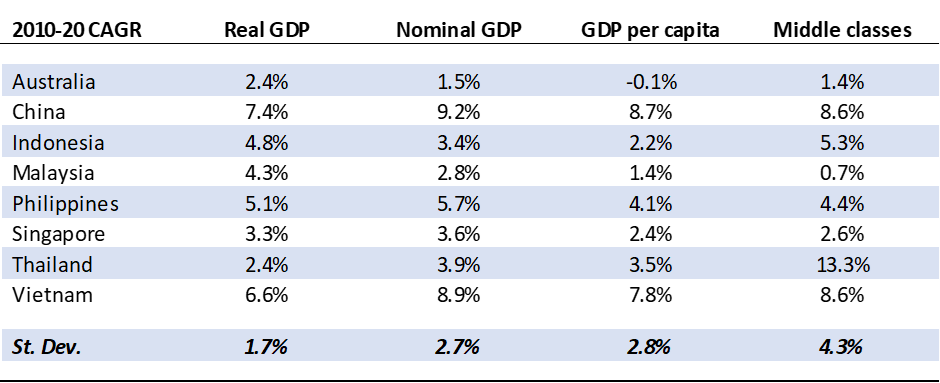
So let me get to who is Good and who is Bad in SE Asia. To begin with, it is worth looking at the macro numbers over recent times to consider which countries if any, have actually made progress. On the face of it, many in the region have performed decently compared to their OECD brethren. Yet ultimately the variation beyond real GDP, to which analysts are constantly beholden, shows quite a difference.

Source: World Bank, Credit Suisse Global Wealth Report 2022
Note: “Middle classes” refers to population with greater than US$10,000 of wealth per capita; standard deviation calculation excludes Australia which is only included for comparative purposes

For a start, whilst real GDP numbers look somewhat comparable and almost clustered towards the 4%-6% range, this becomes markedly less so when looking at other metrics, and the standard deviation shows this. These others are important, too: we look at nominal GDP from an investment perspective because earnings and returns are nominal, not real. Per capita numbers wash out the effects of rapid population growth as an artificial bolster for underlying growth. Middle class population tell us how any of this notional growth is actually converting into mass consumers.

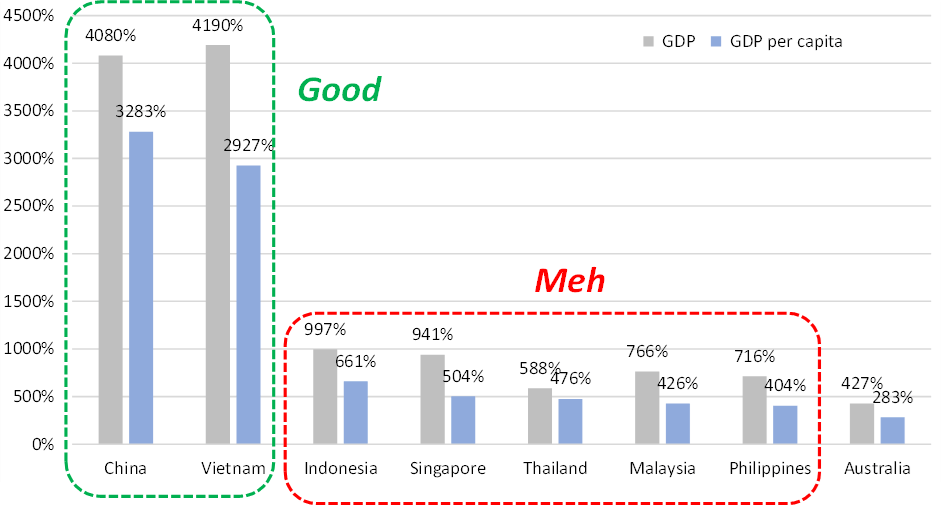
Much can be read into these figures but the most stark representation of it all, for me, is looking at total growth in recent years. Below is the total cumulative nominal GDP growth since 1990 for all the main countries in the region:

Source: World Bank

It turns out there are really only two groups of economies in emerging Asia: those that have generated huge amounts of growth and those which are just trundling along. China and Vietnam come from different bases but share the enormous benefits of a post-Communist economic surge; almost everyone else is unremarkable – both developed Singapore and Australia are not all that different to supposed stars such as Indonesia, Malaysia or the Philippines. China and Vietnam have performed not just better, but better by an order of magnitude.

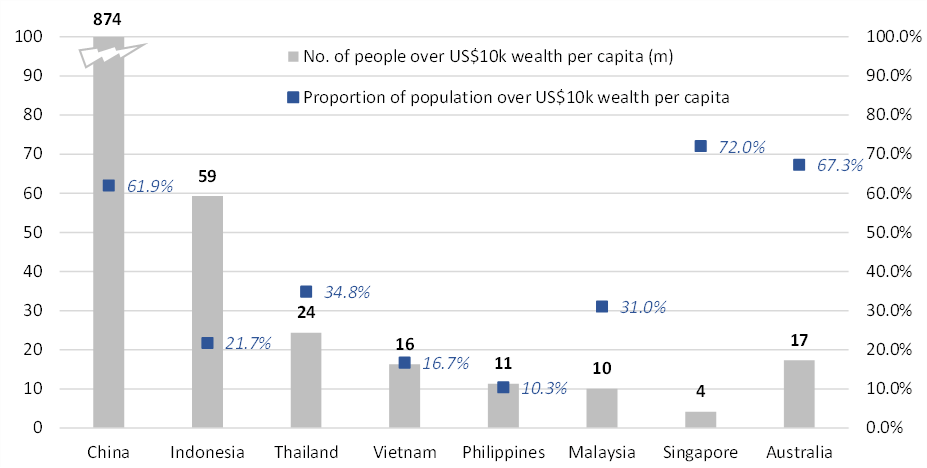
This has a knock-on effect on middle class consumption. Using the Credit Suisse data, I tend to look at the numbers of people who have US$10,000 in assets as a guide – what I call “true population”. China of course has created a huge true population who can and do consume – but elsewhere we can see why our views should be moderated. Indonesia, for instance, has 250m people; but only a fifth of them are real and – as per the table above – their track record of growing this has been poor compared to Vietnam for instance, which has a smaller true population but is growing it quickly.

Source: Credit Suisse Global Wealth Report 2022, own calculations

I will delve more deeply into Indonesia and Vietnam in future posts, but the overall message here is clear: SE Asia is not a single type of market and there are clear winners and losers. The reasons why can be explored elsewhere but simply having a large population is not going to mean a country will develop within the time-frames we need to make money. Demographics is not destiny, and political and economic systems matter. Investors and companies ignore this at their peril.

The asymmetries of Putin vs the West (or, why The Economist keeps looking stupid)

It has been some time since this blog has taken its title at face value and looked at some of the large scale asymmetries at work in the world around us. The Ukraine conflict, however, presents just such a chance. Plenty has been written on the subject now by armchair experts in Eastern European strategy, many of whom no doubt only recently become epidemiology experts too. I offer a few simple thoughts about the asymmetric nature of the game Putin is playing, and in every case I start with the panacean truisms one finds in the media.

“Russian GDP is not even as big as South Korea, it is overreaching itself!”

The globalist response to almost any conflict has been to look to economic indicators – at least, the ones we are familiar with – as a measure of how powerful a country is or can be. I will give such commentators the benefit of the doubt that in most cases, they are aware there is some nuance and that localised imbalances can affect outcomes; but still, by and large, they will believe that historical determinism tells us that a country’s GDP will indicate the way the winds are blowing.

What Putin is exposing, however, is that for Russia (and China, amongst others), expenditure in materiel capital has to be matched with the commitment to expend human capital. On a GDP basis, many others will be more powerful than Russia; but judged on the basis of its hard resources multiplied by the factor with which it is willing to use them, Russia’s position on the world stage is not one of punching “above its weight”; it is very much a significant player (which, let’s be honest, is exactly how it is treated within the world of realpolitik). This is a case of asymmetric capital deployment.

The Western response in offering the Ukraine arms and supplies is a case in point: it costs the West nothing to do this. Indeed, given the realities of the military-industrial complex, offering military equipment which is in turn paid for through loose monetary policy actually helps the West. The problem is, it does not do much to help the Ukraine. Putin knows that no Western government at this stage is willing to lose the life of a single soldier in defence of Kiev; China knows likewise about Taiwan. And they are able to gamble that even with the best of wills in armament support, if the West has no boots on the ground, its commitment will be as fickle as the next budget discussion in Cabinet. Only blood counts.

So whilst it is absolutely true that Russia is not rich enough to match much of the West, it really does not matter because that is not the game being played. I suspect not a single Ukrainian soldier coming under a rocket attack is thinking to himself, “well the joke is on you, you’re overreaching your GDP base”. Unless the West changes its tune on how to respond, the Russian bear is not going to be paying too much attention. Instead, as one of my friends pointed out, “there is no significant military force standing between Russia and Paris today, a situation we have not faced for generations”. Another added, “but there is a lot of GDP standing in the way”.

“Russia is on the decline anyway, in ten years time this will be seen as a massive mistake!”

Again, this is very possibly true. After all, the big difference between the Russian threat and the Chinese threat is that it seems difficult to imagine Russia being more important in ten years time than today. Again however, I suspect this is cold comfort to the dying Ukrainian civilian, who is most probably not shouting to the incoming tanks “well you’re on the wrong side of history!”. As Keynes says, in the long run, we’re all dead.

The fact is that in this kind of game, a grenade in the hand is worth two on the production line. Most incidents like the Ukraine are not played out over the kinds of timeframe that the Cold War was; once an aggressor gets its way, it can be almost impossible to dig them out again other than at enormous costs which, as described above, people are unwilling to pay. Yet the fact is that Russia is doing this today, not years down the line when history has come to bite it. This is a case of asymmetric timing.

All powers are likely to rise and fall cyclically. Russia doubtless is on a down cycle already – but so what? History is not decided by trajectories (much as historical determinists and progressivists would love to believe), and still less are real objectives today affected by those long term trends. A power willing to punch today can easily and consistently outcompete the larger power waiting for things to fall into the natural order of things. Obama’s pushing of this wording is perhaps his most pernicious legacy as a clarion call to inaction.

“The whole world is watching this and will be judging Russia!”

Whilst the first two popular claims may well hold true, even if they are irrelevant, this last one is questionable due to one last great asymmetry, which constitutes the eternal dilemma of the policeman. The West is of course judging Putin – for now. Sanctions will come in. There is discussion of banning Russia from the SWIFT payment system for instance, as well as the removal of this season’s Champions’ League final from St Petersburg (Russia’s involvement in the Eurovision Song Contest however, has been subject to confusion).

The problem though, is precisely that the whole world is watching this – through the 24 hour news cycle, through social media, through memes. Yet the policeman’s dilemma is, why do I prioritise this over anything else? And with the fragmentation of Western attention, through so many channels, the cohesion of Western attention is less than in generations past, even as the volume of that attention is more. This is asymmetric focus.

The Russians know that Western observers struggle with creating a hierarchy of what is supposed to be important. Modern media has dampened our sense of proportionality, meaning that there is a perception of crying wolf. How much better or worse is Biden’s performance over the Ukraine, compared to the retreat from Kabul for instance? Or Obama’s red lines in Syria? Or his response to the last time Russia invaded the Ukraine? In the heat of the moment, everyone is entitled (as many are) to believe this is the most important issue in the world today; yet that same raw sensation will also see it be less to tomorrow. Maybe another invasion, maybe another form of Covid, maybe just forest fires will do the trick. Our lack of media curation has brought us to this.

I would additionally add that, in all of human history, sanctions have only ever to my knowledge worked in one example: South Africa. In this case, it worked because the target society of the sanctions (white South Africans) looked up to and respected those sanctioning them – they cared. Not the case with Russia, or with China. Probably not even the case with India. The corollary is that asymmetric focus is only solved when the matter is close to home – culturally, ethnically. Sweden, for instance, is not a member of NATO, but will still be able to count on American and European physical support in the event of a Russian invasion in a way the Baltic states might struggle with. Let’s be honest, because they’re white. This is the only thing which cuts through the ADHD of modern life. Are the Ukrainians really white enough and middle class enough for people to sustain their care? We will find out.

*********

If this sounds cynical, that is because it is. Asymmetries unlock many of the answers where there is more heat than light and war has been so unknown for so long. As long as Putin is playing a different game, the constant refrains about meaningless measures will remain rhetoric whilst real people are suffering. Grasping these asymmetries can lead to small but very effective changes in policy, and consequently enormously different outcomes. Given that the US purported to know about the coming invasion so long ago, a single battalion of American soldiers, under the guise of ordinary joint training exercises, would have made Putin pause for thought.

One must always ask oneself, “what would Putin do?“.

*********

PS – where now those anti-nuclear deterrent voices?

“Success” against the virus ≠ zero deaths

Covid beach

One of the most fascinating aspects of the reaction to Covid-19 in the West, has been the near-perfect alignment between the political Left vs Right, and the sides of caution vs courage. Almost without exception – after a few early weeks of confusion – those who favour big government and intervention, also favour lockdown, wearing masks, almost permanent health screening and continued economic dislocation. Those that favour small government, lean towards Swedish-style herd immunity, and want an end to the lockdown and for people to just get back to work. Anecdotally, there are very few people crossing over at all, which I find remarkable.

In East Asia, by contrast, the response has been uniformly lock-step: everyone tolerates intrusive government and everyone supports the (virtue-signalling*) wearing of masks. Expats in Hong Kong, for instance, have felt heavily the weight of – effectively – racial prejudice for their differing attitudes on what constitutes “best practice”. All pretense of those traits of modernity – self-reliance, independence and adventure – which were driving urban Asia forward have vanished as these societies demonstrate their true colours of sheepish governmental dependency and open embrace of social closure.

The economic debate has raged for some time. Just to take headlines from recent days, one side (rather too gleefully for my liking) posits “Four reasons state plans to open up may backfire — and soon”, while the other retorts that “The lockdown left is no friend of the working class”. But for me the most pernicious rhetoric is that of men like Andrew Cuomo, whose popularity is premised on the logically fallacious claim that:

“ … if you ask the American people to choose between public health and the economy, then it’s no contest. No American is going to say, ‘accelerate the economy at the cost of human life.’ Because no American is going to say how much a life is worth.”

In this assertion we see the defeatist and absurd idea that lives should be protected at all costs. The fawning view that “Asian countries focused on containment in a bid to minimise mortality” has been accepted as the rightful moral goal of virus policymaking. The economics debate is fruitless, since it pits logic against emotion; but the moral point is important.

The analogy between Covid-19 and the common ‘flu is compelling and purposefully misunderstood: it is not a biological parallel per se, but rather one of social morality. It is an impossible and unnecessary task of government to eliminate death from natural causes. There is such a thing as “natural attrition” from disease and old age; and the ‘flu, which kills tens of thousands each year in the UK and US, remains the last bastion of socially accepted, blameless death on a large scale. The ‘flu is not like dying from traffic accidents, which might arguably be prevented; it is natural process of life and if this virus does not come to get you, the next one will. To try to prevent this is to commit yourself to a problem with no solution other than feeding an unquenchable appetite for resources – and in turn would ultimately spell the end for universal public healthcare which would be burdened intolerably by the expense. I will say this again: an acceptable level of deaths from Covid-19 in the UK should number in the tens of thousands before severe economic dislocation is necessary; several times more again in the US. “Success” was never, and should not be measured against, negligible mortality – for this virus or future ones.

Both Trump and Boris have thus made significant errors in their response; but the error was not so much their technocratic plans on testing and quarantines. Rather, the biggest blunder they made was to allow the narrative to move on to the grounds of protecting all life. From inception, both governments suddenly found themselves on the hook for an unachievable and undesirable objective: limiting deaths to zero or almost zero. This put them on a hiding to nothing and set a terrible precedent for both – though Trump and the US is likely to escape a touch more lightly. But Trump has also made a rod for his own back with his China rhetoric – since however true it is that the virus came from China, externalizing the cause, rather than making people accept it as a normal part of existence, strengthens their belief that “success” means stopping it like one would a foreign invader.

By the same token, for the first time in my recent life, I now no longer feel China is necessarily the long-term “winner” it might be. The government is very nearly promising its people protection against the unprotectable, setting expectations that may not long from now see them demand healthcare instead of military expenditure. All very well, but it will build no independent Great Power status like that.

I for one do not believe we should – or will – inhabit a world where major viruses lead again and again to the necessity for lockdowns. By the same token, neither do I believe that we should inhabit a world “safe” from such lockdowns only through constant testing, screening and health surveillance. Instead, we simply have to become a society of humans capable of digesting the idea that death is a fact of life; deaths from viruses and other natural causes, all the more so. To be constantly worried about death of this nature (as opposed, for instance, to war) is to be petty, parochial and apathetic, unable to see the bigger picture. I liken it to a company whose employees and management are constantly focused on cost-control and the bottom line; all the while forgetting the visionary focus on growing the top-line. Such a company is one living in the past, occupying the twilight of its existence, not looking to the future. It constitutes a lack of ambition.

Speaking personally, for all the distress and heartache that any disease or event incurs, I would rather not live in a society which exerts its time and resources, however good the intention, in trying to protect its people from life rather than encouraging them to jump into it. I would always favour courage over caution. Perhaps in this, I have finally discovered my true, core, Toryism.


* Curiously, a piece written by Jason Ng, an anti-government activist and lawyer, which vocally disapproved of expats during the virus and pretty much specifically called for expats to wear masks in order to “show solidarity” with locals – the very definition of virtue signalling – has been taken down from the Hong Kong FP website where it had been posted.

The Chinese New Economy: Alibaba as Sauron and why the old economy will be the winners

Sauron eye

Anyone familiar with the Chinese new economy will be aware of the rise of the internet giants of Alibaba and Tencent, along with their satellite businesses. Most will also be aware of the largely exclusive ecosystems within which Chinese online life is led – platforms that encompass everything from messaging to shopping to transport to payments and beyond.

It seems astonishing to remember that barely five years ago many commentators fretted over whether China could ever achieve real innovation. The Harvard Business Review for instance posed the question “Why Can’t China Innovate?”, baldly stating:

Can China lead? Will the Chinese state have the wisdom to lighten up and the patience to allow the full emergence of what Schumpeter called the true spirit of entrepreneurship? On this we have our doubts.

This of course is all rather a fading memory now. Innovation can broadly be divided into three areas: upstream (essentially, “how it works”), midstream (“how it’s made”) and downstream (“how it’s used”). For years, China as a manufacturing hub had made quite noteworthy progress on midstream innovation but most uneducated observers – including many in government – have an unhealthy obsession with upstream blue-sky invention. Yet as we can see with the likes of Berners-Lee, inventors are rarely rewarded and rightly so, since the real creativity and invention from the likes of Steve Jobs, Mark Zuckerberg and Jeff Bezos is in the downstream. Jobs was an arch innovator in how technology is actually used and therefore spread through an economy, with a vision of how lives are actually impacted and changed. Chinese companies, particularly through the big online giants, are clearly doing the same: modern life in China is now lived in quite an advanced but different manner to modern life in OECD countries. Alibaba and Tencent have contributed towards the creation of a real and organic Chinese modernity and technological innovation within China arguably outpaces even the US even leaving aside issues of theft.

So it is worth spending a moment to look at these two major ecosystems and how they really behave – who they are, as it were. First, there is a question of why ecosystems exist in China in the first place in a way which outside of China they do not. Amazon comes the closest of the American tech players to demand a closed ecosystem but even they seem to find limits. Western shareholders have always rewarded single-capacity specialization, and often find the idea of any conglomerate absurd, let alone a tech company offering bicycles and banking.

In China though, this has been natural, for two reasons. First, there is the historical socio-anthropological tendency within Chinese society to build a “closed loop universe” within one’s own family or clan, which has extended to the national level through the Communist Party and SOEs. My own preference for explaining this remains Karl Wittfogel’s hydraulic empire theory, which tells us that most ancient civilisations relied on centralized power to deliver water to its people, enshrining the principles of autocracy and top-down governance at the government and family level. This in turn typically leads to closed-loop systemic thinking since everything has to work together or else nothing works – diversity of thought is only bad news. Secondly though, and somewhat ironically, these ecosystems have become so broad precisely because they are making up for assurances which the Chinese government cannot offer. When you make a purchase on TMall, you have more faith in the Alibaba-backed guarantee that your products will be delivered and that your payment is safe, than one does with the disparate parts of the national banking, postal or legal system offered by the government. The tech giants had to offer a total universe, or else consumers would have been reluctant to actually engage with the new business model in the first place.

Chinese ecosystems (2)

Source: SCMP

So much for why they exist – the bigger issue is how to understand who they are, what their personalities and identities are and how they should be understood from the outside. One possibly analogy, given their conflict, is that of the Cold War. In this world, Alibaba are the Soviet Union – a sprawling empire with a strong centralized view on how things are supposed to be done. Tencent on the other hand are the United States, a beacon of freedom and inspiration but which has its own agenda focused on generating and owning consumption. JD.com are Britain: commercially-minded, focused on trade and fully acquiescent into the American (Tencent) world. Lastly you have Meituan – which owes its existence to Tencent, but like France to the US is entirely ungrateful and maintains the pretence of wanting an ecosystem of its own.

Upon reflection however, a new analogy came to me which may be a touch more accurate, which is Middle Earth. In this version of events, Alibaba are indisputably Sauron, the lurking, evil presence which looks across the lands of men with an unrelenting will to dominion. They provide you the tools to “help” only so that they can own them and you. They invest in you because they need to control your system from the inside. Resistance is futile; eventual subjugation can be the only outcome. The interesting one is Tencent, who I liken to the High Elves of Rivendell. The things about the Elves is this: they are generally on the side of good, and can facilitate it; but they are not themselves a force for good since they sit far away from the battle, detached from it all. They too provide tools, but they may not tell you how to use them; their attention is ultimately elsewhere. The forces of Men ranged against Sauron – let us assume these are essentially a proxy for traditional retail and consumer business in the region – ultimately have to find the solution for themselves, aided at times by the Elves but not reliant on them. If I were to stretch this analogy ad absurdum, perhaps this makes the Dwarves JD.com with their grubby focus on gold and commerce; whilst Meituan the slightly nobler Rohirrim, since they, er, move around a lot on delivery scooters like the horses of the Riddermark. Which start-up will be the valiant hobbit which destroys Alibaba, God only knows.

The serious point to all this is that for old economy companies, it feels like making a choice is inevitable. But the more one looks at the giants of the new economy, the more apparent it is that in the conflict of “internet+” vs “+internet”, it will likely be the latter – especially established asset owners – that win out. In particular, it is difficult to imagine that in this inflated global asset price environment, that the business which need, as Alibaba and JD.com especially are doing, to build out a network of physical infrastructure can be the eventual winner. Well, maybe one early mover can, but the world is not about to be flooded with online victors – by and large, the winners will be whoever of the old economy players adapts best to the new, rather than a new economy player.

And this then comes down to the vision thing. I have another analogy: I call it the “Physics & Philosphy” dilemma™. P&P is a little known but highly intellectual degree at Oxford (arguably the most esoteric of all) which combines two subjects that are not immediately connected. Yes, it is true that in the first term, courses such as Logic may play a part in both areas but then it would appear the two diverge. Yet we should see this like the rings of Saturn: you start off at one point travelling in two opposite directions on the ring, and whilst they move far apart to begin with in the end they meet again. In P&P, the questions at the other end of the circle see the two disparate subjects poetically rejoin on questions such as: what lies beyond the Universe? What happens if time stops? What if light bends? What is not obvious when you start the degree, become enormously obvious by the time you end it.

And seeing what is on the other end of this ring – what exists on the “dark side of the planet” as it were – is the very thing that marks out business geniuses from mere mortals. It took Amazon 14 years to become profitable, but there seems little doubt that Bezos had an idea of what lurked out of his sight in the distance. Likewise Jobs as he labored through various versions of Apple. But the point is, old economy companies can equally achieve this. We know the famous examples of IBM and Intel reinventing themselves based on their competencies; Apple itself did so. Further back in history are companies like Berkshire Hathaway and General Electric, and even Nokia who started life in rubber products. Reinvention is hard, but the world has not ended just because a series of new giants seem to own everything in sight. If the old economy is to learn anything, it is that with courage and vision, and a will to innovate internally if imperfectly, the future is still going to be theirs. For every Amazon which succeeds, there will still be a dozen Walmarts and Targets which make it, stronger than before.

The technology giants will go down in history mostly as the midwives of change, delivering the new baby to their old economy counterparts. We are already seeing them do this, below the surface as Alibaba and JD.com start to crystalise value in real businesses where they can (finance, technology etc rather than the core e-commerce platforms which have rarely made money for anyone). In many ways they are merely pioneering the examples of what the future looks like, so that old economy companies can learn from it but probably implement it better – the Chinese O2O supermarket businesses are a case in point. Indeed the cheerleading nature of the new economy player’s roles in businesses like retail, ahead of its time, loss-leading and ultimately doomed as a standalone business, begs another more controversial comparison. The tech giants are St John the Baptist, crying in the wilderness; the old economy players are Jesus.