It’s the net tariff differential, stupid

Free trade was never supposed to be the end-game
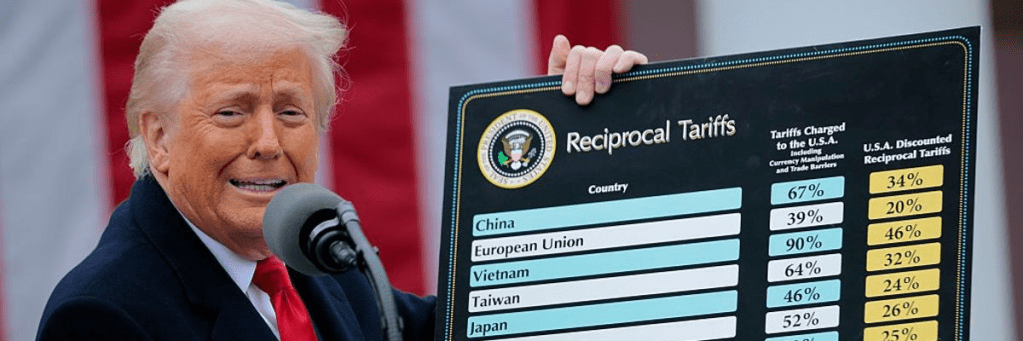
With the dust settling on tariffs, it is opportune to take a moment to consider the sheer scale of change ushered in by Trump on global trade since 2016, and especially with recent events. Trump’s policy is often confused by a vast amount of ‘noise’, which tends to undermine even his own news cycle (see the recent Iran nuclear facility bombing, for instance). Which is a shame, because he has almost entirely remade the landscape, and whether one supports or opposes the theory behind it, it seems irrevocable.

There have been two major components of this earthquake. First, Trump has instated and effectively normalised a global 10% tariff on all US imports, regardless of origin. As noted elsewhere, a ‘universal’ tool like this is by far the most efficient mechanism to charge the world a cost of doing business with America (a concept the youth of today will more easily liken to “gas fees” paid in the world of crypto). It has also raises the policy ‘baseline’ to a figure greater than zero, which I discuss below.

This baseline 10% has both more or less been accepted without reciprocation, by every major trading partner including the EU and China, regardless of vehement struggles over additional duties on top. Whether this 10% is the only tariff, like Britain, or whether it is just the minimum, like Japan and Korea who currently have 25%, the standard has been set and moreover will be very likely here to stay – any future US administration may renegotiate on specifics, but will almost certainly leave the baseline in place. It is now quite simply a fact of commercial life.

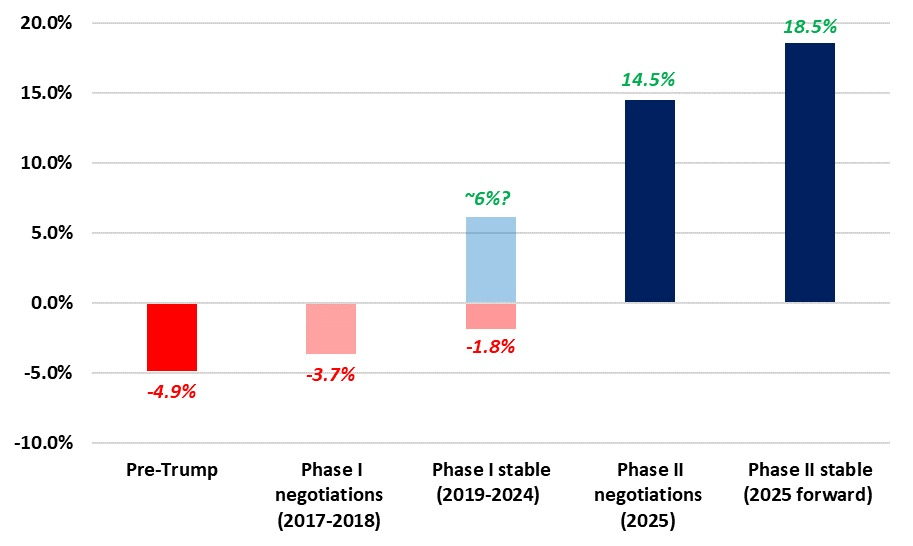
Secondly, there is China. Amidst all the turmoil (which may be part of a grand plan, but frankly who knows), Trump has continued his decade long trade strategy of increasing tariffs and daring China to fight back and contest who holds the most leverage. This bluff has been called several times, and has resulted in the US turning the net tariff differential (the principal measure of ‘success’ in any tariff strategy) in its favour for the first time in living memory.

US net tariff differential with China, 2016-2025

Sources: PIIE, underlying sources
Notes: 1. Trade-weighted tariff rates in 2016 were 8.0% on US exports to China vs 3.9%  on imports; 2. While the notional differential achieved in Phase I was -1.8%, in reality China unofficially suspended many import duties leading to a positive differential under Trump’s first administration; 3. 2025 forward numbers based on latest round of negotiations ending May 2025.

When Trump first emerged on the scene, the institutional trade nexus between the US and China, comprising both WTO and bilateral arrangements, was such that China imposed about 5% more duty on the US than vice versa. Liberal economists contended rather tritely that this was a price worth paying. Yet over the course of both the 2016-2020 presidency and now in his second term, this negative differential was first reduced and now into a major surplus. China, despite raising tariffs of its own, has acquiesced to the new normal that it must pay the US more than the US pays it, for trade. If anything can be considered a ‘win’, this is what it looks like.

In the meantime, we have seen no sign of the supposed economic slowdown as a consequence of the “trade wars” [sic]; there have been plenty of anecdotal examples of exporters eating the additional cost into their bottom lines; and after the initial volatility, the markets have settled down into a rally. Personally, I regard none of these as important for long term strategic reorientation, but among the breathless commentariat fainting at news from the bond markets, it seems to matter.

And what is the point of all this, might you ask? For me, on the subject of tariffs themselves, this policy has been a triumph of common sense. I have argued for years that the US and others needed to ramp up tariffs for several reasons.

One main consideration is that today’s global economy is no longer that of Ricardo’s. The applicability to free trade theory to a landscape of non-tariff barriers, unfungible services, and complexities of cross-border supply chains are extremely limited. Furthermore Ricardo assumed (as all economists tend to) agnostic counterparties motivated and constrained by economic incentives including public wealth and living standards; he did not factor in malevolent strategic actors who would happily pay a cost to bend a supposedly neutral system to their own agenda. Let us be in no doubt: if Ricardo were alive today, he would be pushing for trade tariffs.

Another outcome is the pushing back on the idiot savancy© which has led the technocratic classes to glorify “zero” targets – tariffs, interest rates, inflation, exchange volatility, even carbon emissions (though strangely not taxes or immigration). In most areas of public policy, however, zero is convenient for bureaucracy but wrong for the public. Low rates can occasionally be enjoyed as an output, not an input, but freedom to raise them are the safety valves required for cyclical management of the economy – sometimes you want inflation; sometimes you need currency devaluation. Tariffs, too, are a tool whose starting point (the ‘baseline’) needs room for manoeuvre both up and down – as a decade of near-zero interest rates have demonstrated, autistic ambitions hamstring policy tools needed to meet new challenges (I will write separately about this whole topic). So 10% or so suits the US quite nicely.

How tariffs will end up functioning is an unknown, due in part to how long OECD governments have allowed their muscles to atrophy in recent decades. And nothing scares technocrats more than the unknown. Yet beyond the anecdotal evidence of implementation, we also now know that the first round of Trump’s changes in 2018 led to substantial fiscal outcomes, with customs revenue doubling from US$35bn per year to US$70bn and well beyond.

Source: Bloomberg

This income is forecast to continue rising unless the economy tanks, but little sign of this. How the US government chooses to use this windfall is a separate matter, but the income certainly exists and one reason Biden chose to continue Trump’s tariff policy was that nobody wanted to look this gift horse in the mouth. While revenue raised is not central to the justification for tariffs, they offer an important lesson in how erroneous predictions on effects can be.

Most importantly of all, regardless of whether one supports increased trade protectionism or not (and I accept there are plenty of arguments to be had on either side), Trump continues to challenge the orthodoxy that such sharp directional changes are not even possible. Because for every protagonist arguing against the economics of tariffs, several more are usually hiding behind the sophistry that “he will never be able to do it, anyway”. These are the people cheering on the bond market turmoil or China’s retaliatory duties, unwilling to admit out loud that if it could be done, it might actually make sense for people, even at the cost of being vastly more inconvenient for the beneficiaries of globalisation.

As with defence or immigration, Trump has shown that none of these shibboleths are untouchable. The governing classes, while self-interested in keeping the policies of the last fifty years in place, has been surprisingly ineffective at stopping Trump from turning 180 degrees on tariffs or NATO or Iran, despite loudly arguing that it could “never be achieved”. So it turns out that the system, for better or worse, can be changed. Perhaps after all it is actually Trump who is living Obama’s best life, as he surveys the world around him and tells voters “yes, we can”.


Why David Plouffe won’t win elections, or get matches on Tinder

Plouffe’s inability to recognise why issues like trans rights swayed votes is the reason why he is bringing the outdated Obama era down with a crash

Having kept his head down (with some justification), David Plouffe recently emerged for the first time since the election to contribute to some of the very worst takes about the 2024 election, on Pod Save America.

It’s very easy these days to understand who has experienced an ad, so we were feeding a lot of digital ads to people who might have saw that spot. But at the end of the day, we were spending a lot of time with voters in these battleground states both quantitatively and quantitatively, and this trans ad was not driving vote.”

To say that Plouffe is from a different era is an understatement – he is now the Paul Krugman of electoral politics belonging to a barely recognisable age. In his defence of the failed Harris campaign, however, we can identify a mental anachronism which will continue to drag the Democrats down, even after being shocked by the force of nature that is Trump in three consecutive presidential elections. As a supporter, historically, of Bill Clinton, Gore, Kerry and even Hillary in her 2008 incarnation (not so much eight years later) this pains me. Everyone is offering their views on how “out of touch” the Democrats have become, so here I offer my own.

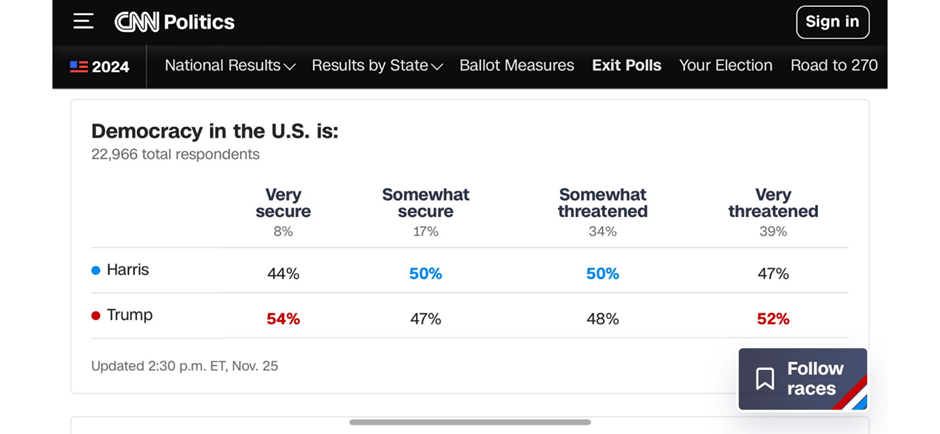
First, the Democrats appeared to make a basic error in interpreting polling on voter priority as monolithic support for their side. The most obvious case was seeing “the state of democracy” as the biggest concern for voters, but assuming that such people must be anti-Trump side. As the exit polls showed, among those who considered democracy threatened around half actually supported Trump, not Harris:

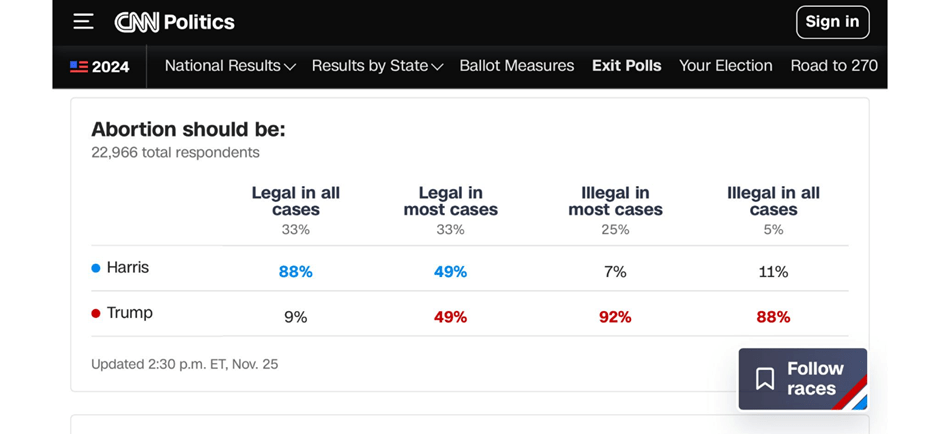
Even if we accept that people voted on the basis of just this one issue, it turns out as many considered the ‘lawfare’ campaign against Trump as a threat to democratic norms as did the events of 6 Jan, and Democrat pursuit of the argument that “Donald Trump is a fascist” were not only failing to gain traction but may actually have been counterproductive. The same applies to abortion, which earlier on in the campaign was considered critical: among the one-third of voters who thought abortion should be “legal in most cases”, voters were split evenly between the two candidates:

If strategists such as Plouffe were not even bothering to dig into the numbers behind the headlines to this basic level, it is hardly surprising that they were wasting their resources based on biased assumptions and projection.

Secondly and more importantly however, is the very use of voter prioritisation polling. Most examples of such polling were single answer (rather than, for instance, allowing respondents to choose as many as were important). This created two problems: the error of forced choice and the error of colouring. Forced choices make people go with obvious and pronounced options even when other issues might cumulatively be more important (eg the economy might be outweighed by adding immigration + crime together). Colouring is the consideration that a seemingly insignificant issue by itself still adds a great deal of colour to the candidate or party, influencing voting subtly.

The fact is that most people do not vote on ‘policies’ other than very occasionally when a policy is so simple that it cuts through all the political noise to become totemic. These are so rare that we are hard-pressed to even recall many instances – although Trump’s promises on trade treaties in 2016 comes to mind (as well, perhaps, as his “no tax on tips” policy this year). Elsewhere, the chance to buy your council house under Margaret Thatcher in 1987 is an example from the UK, as was Jeremy Corbyn’s land value tax proposal in 2017. Rather than policies, voters pit a general sense of where policy proposals are headed (eg “lower taxes”, “tough on crime” etc) against a matrix of what a candidate is ‘famous’ for. If the candidate is not well known for the economy for instance, no amount of policy proposals on that subject will mean anything. People vote for their impressions about a candidate, not so much the content.

Which leads to the issue of trans rights, which Plouffe so airily dismissed as “not driving vote”. He was of course correct that it affects tiny numbers of people, and directly animates only a few more; but he is wrong that Harris’ well known past history on trans matters did not colour voters’ impressions of who she was and what she tends to care about. Certainly, she did not come across as tending to care about immigration or inflation, two subjects Trump did convey; on the other hand the trans dsicussion, while not shifting votes directly, added up to an impression of her priorities. On a broader level, it brought into focus her judgement – “is a politician sanctioning free transgender operations for prisoners really worrying about the same things as me?”. Issues can be obscure without being innocuous.

(The same, by the way, was true of Brexit where for years the polling had told us that the issue of “Europe” was not a priority:

Yet this totally missed the point that while in a forced choice, it was not important, at the same time its many facets coloured huge chunks of the public discourse about Britain and the efficacy and power of its government to effect change on matters such as the economy or immigration. Rightly or wrongly, the democratic overhang created by EU membership far overshadowed the importance of the actual issue in voters’ minds and this manifested as a groundswell of discontent which could barely be contained – if Cameron had not asked the question in 2016, a future prime minister would have had to do so within the ensuing years).

None of this nuance emerges in Plouffe’s narrow and mechanical interpretation of voter issues, but it does not take a genius to see how it all connected in the minds of a voter who is only semi-engaged. I will use the parallel of Tinder, where I doubt David Plouffe would have much success, to illustrate the point.

If we strip away the 50% of women and 99% of men who swipe left or right based purely on the photo (although this, too, may be instructive to campaign directors), we are left users of the app having only a quick glance of the few things written down on a profile to decide their choice. Now, imagine a man includes the sentence “vegetarian” in his profile, and consider the consequences. Few women will be so militantly carnivore that they swipe left for this reason alone; but there is no doubting that it somehow adds colour to the profile which will make them think twice. “What does this guy care about?” “What sort of restaurant would we have to go to?”, “Will he force me to only eat lettuce?” and so on. Nobody will admit to vegetarianism having been the deciding factor for their swiping, but you can be sure that it did its job in making that profile underperform in finding matches.

Such structural misunderstandings significantly weakened the strategy Plouffe and his crew were running, well before we get to the litany of “unforced errors” which surely did not help in what was supposed to be a tight race: bear-hugging the Cheneys on campaign; encouraging abortion ballot initiatives in the same election meaning voters could split their ticket and vote for Trump and for abortion; avoiding Joe Rogan and not distancing from Biden; and the ignored sense of scandal surrounding both pretending Biden was mentally capable until June, and then replacing him without a primary. But these need not be litigated here, because the Plouffe team had made historic mistakes in reading voters’ preferences well before the campaign minutiae.

It is, in a sense, rather poetic that the governing classes in both parties (and in the UK) who for so long have sought to reduce politics to a pseudo-science of well-placed dog whistles and esoteric metrics about the economy, should be hoisted on their own petard. Trump offered little if any direct policy solutions to the questions of immigration or inflation, but voters felt he understood it in his marrow. The Democrats need not had offered policy answers either, they simply needed to find a candidate or a message which showed they too understood the problem. But having spent three decades telling voters that life is all about the statistical evidence, about management, about professionalism and about making sure the ‘system’ worked, voters then went on to rightly judge them on these very metrics. Prices were up, groceries less affordable, government seemingly ineffective. If you live by technocracy, you will die by technocracy.

Lichtman’s model may still be good, even if his 2024 prediction is wrong

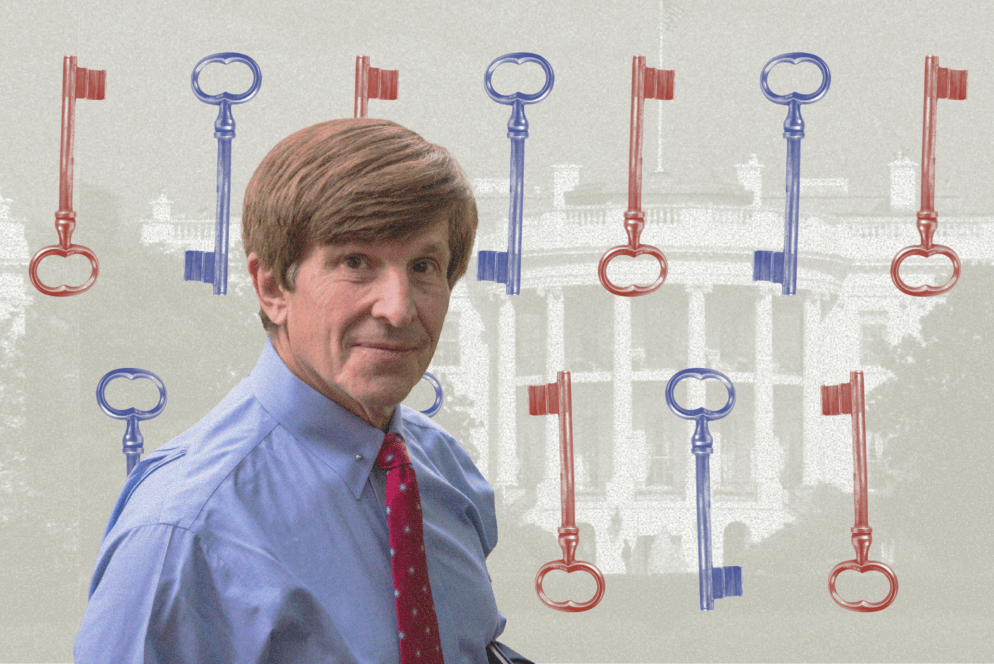
An absurd online tussle has commenced over Allan Lichtman’s ‘Thirteen Keys’ thesis over the coming US presidential elections, where not only are endless amounts wasted on challenging his predictions (“He is biased! No he’s not! He’s pro-Democrat! He wears a wig!” etc), but actually being threatening to the poor septuagenarian. Even in the heated environment of this contest, as JD Vance says, this is not worth it.

Yet it presents a good opportunity to think about how robust his model actually is. For the record, I like this type of macro historical analysis, and I think it has value. In particular I like the discipline it instils in not subjecting the election only to the noise of the latest polling. On the other hand, I have a sneaking suspicion (famous last words, perhaps) that Lichtman’s actual predictions this year, which are for a Harris victory, may be wide of the mark. Would this render the model broken?

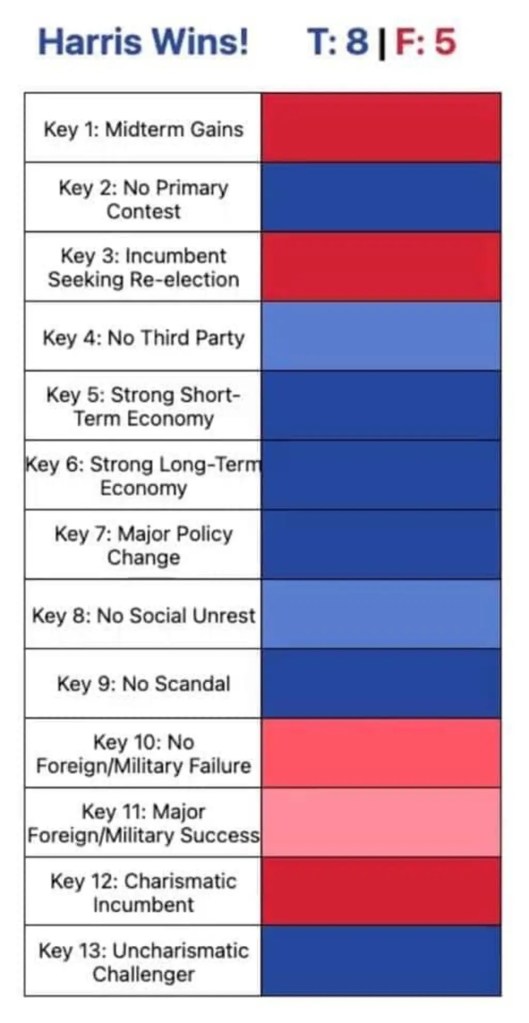
I don’t think so. Trump may well win this year, but if he does so it will be less about Lichtman’s model being wrong so much as Lichtman’s own interpretation of it. Let us bear in mind that the model is just that – a neutral series of tests (explained in detail here) – but Lichtman then has to take these tests and package them into an opinion (below is the most recent I can find). There is plenty of room for subjectivity. Currently, he sees the lie of the land like this:

Critics of Lichtman’s model – and there have been many – mainly focus on the keys that are obviously open to interpretation and are therefore ‘subjective’. Nate Silver for instance notes that the two “charisma” tests are very much in the eye of the beholder, while others would complain that the definition of a “major policy change” or foreign policy “success” or “failure”.

However I am less interested in those tests so much as the supposedly binary ones. Because the problem is that the whole political system has been shaken in the last decade, resulting in what I think are some structural problems in Lichtman’s definitions – his underlying intent is correct but the manifestation of the issue he has identified no longer conforms to how he has set the keys up. Below, I focus on a few examples.

Key 2: No primary contest

Now this may seem obvious and technically true, but I think Lichtman may not be seeing the wood for the trees this year and ignoring his own wisdom. If we take a step back, the point of there being “no primary contest” is essentially that the incumbent party has not had a bruising encounter which exposes disunity in the ranks of the incumbent party seeking re-election (apparently the same is not true for the opposition, which I have some sympathy with).

But considering what has occurred in 2024, I am not clear that this is true in spirit, even if it by letter. The fact is that many Democrat supporters either a) resented Biden being deposed the way he was, or b) did not like Kamala’s unchallenged rise to the nomination. I personally know a few who have not forgiven the party for what appears to have been a hugely opportunistic change (and let’s be clear, it was perfectly possible to have still had some sort of debate leading up to the Convention, something championed by many including Ezra Klein and numerous others here and here). While Harris acceded unopposed at the Convention, her elevation left quite a bitter taste in many corners of the party.

Thus, while technically the incumbent party did not have a divisive primary, there has in fact been discontent around the selection procedure, so awarding the key to the Democrats in this case is structurally dubious.

Key 3: Incumbent seeking re-election

In this case Lichtman has given a key to Trump which is questionable. Of course, again strictly speaking, Harris has not been President and is therefore a new candidate. And even allowing for sitting VPs such as Al Gore not being considered ‘incumbent’, the peculiar issues surrounding 2024 again makes this seemingly binary key more nuanced.

Is Harris an incumbent? Who is the incumbent? Not only has Harris been part of a long-running trend whereby VPs have been more active in the Executive (Gore and Cheney, and now Harris), but she has now basically been Acting President due to Biden’s incapacitation. She was elevated only after the incumbent had been selected and had started to campaign for the presidency; she has inherited almost his entire infrastructure and strategy and by choice or not, has been unable to distance herself from the Biden administration. To my mind, unlike when a VP runs after an 8 year term (such as Gore in 2000, or HW Bush in 1988), I think the public will likely see Harris as a continuity of the regime, for better or ill. In Lichtman’s model she should therefore get credit for more or less being an incumbent.

Key 4: No third party candidate

Here is perhaps the most far-reaching and controversial challenge to Lichtman’s definitions. Again, of course, this is technically true since Lichtman defines “third party candidate” to mean an officially non-aligned candidate who polls more than~5% of the popular vote. In other words he is limiting himself to the Ross Perots and Barry Goldwaters of electoral history. But with 2016, I think this part of the model has been completely blown out of the water.

Trump, in 2016, was essentially the first third party candidate to win the presidency. Yes, he ended up tackling the Republican primary and using that as a vessel into politics, but he famously had previously been a Democrat and moreover, disagreed with much of the incumbent GOP platform and heritage. Trump’s greatest moment in the primaries was arguably his anger at calling out the Republican establishment over the Iraq War, and being roundly booed for his troubles:

To look at the purpose of Lichtman’s key, it exists to highlight that a significant third party usually indicates discontent with the system, which tends to favour the challenger (this I think is a debateable point but generally I can understand his perspective). No third party therefore favours the incumbent. Yet if a challenger has essentially captured the opposition vessel for effectively becoming a third party candidate, this no longer applies. The same would be true, back in 2016, of a potential Sanders candidacy for the Dems would have seem him as an outsider also. I previously expressed the 2016 worldview like this:

PhyPhi - post 2016 politics

So ultimately we are judging Lichtman’s model by his own narrow interpretation, since as far as I know nobody else is doing an independent version using the same system. But just as an example, if I switched the three examples above around, the 8/5 balance becomes 7/6, and we would be left with discussions over imponderables such as the fact that there are millions of Obama-Trump voters, which belies the thinking that Trump does not win over people from the other side (the definition of “charistmatic challenger”). Indeed whether Trump, in or out of power, would ever be not a “challenger” is itself a question for Lichtman.

For the record, my own interpretation of the Lichtman model offers a 8/5 in favour of Trump. In addition to the key changes above, I would change the charismatic challenger key as explained, and I also sense the “scandal” key to be more prominent than Lichtman believes, because I think there is a whiff of wrongdoing around how long or how early senior Democrats have been hiding Biden’s senile incapacitation. But, as others have noted, these are down to personal views and the polls continue to tell us the race is close.

On balance, I would say that Lichtman’s model is one which we can proceed with with caution for fun, but I would urge psephological geeks (such as myself) to drill into the underlying keys and render their own interpretation, rather than rely on Lichtman’s. Separate the man and his keys, and you may be better off.