Why Palestine – like Tibet and Kashmir – is just boring

A less boring version of events

With the latest conflict now settling down to the usual name-calling and posturing, we are once again confronted with the insolubility of the Middle East problem. For those like myself who grew up with another version of this – the sectarian tensions in Northern Ireland and its impact on politics and society in the UK at large – this is all too familiar. And for myself, much as I felt with that episode of history, I cannot help but be bored each time it starts again, because there is actually no solution which will bring a lasting peace until, as with Northern Ireland, we start to move beyond political conceptions on which states and borders are based.

Before I get to my historical analysis however, I would also give a nod towards the issue of foreign observers and their inability to grasp real motivations of those on the ground. Graeme Wood made the point, during the rise of ISIS in 2015, that the hand-wringing in Washington and Brussels would never help until they acknowledged the underlying religious inspiration behind the Caliphate. People do genuinely act on matters of theology; it is not all (or even mainly) a matter of economics and the Marxist interpretations. But of course, western observers, whose political classes are by and large either atheist or at best agnostic, could never comprehend this and would therefore keep wanting to bring a knife to a gun fight. The naive but enduring hope that improving the economy and jobs would somehow solve the problem that Islam presents is really a problem of the observer, not the subject.

However to return to a more Realist angle, I have no interest in how to solve the current Palestinian problem, but I do have an interest in the historical provenance. Because like it or not, the Israel issue is one of several which have their roots in intellectual limitations of state-makers in the immediate aftermath of World War II, roughly from 1946-1954. We saw the same problems erupt as India gained independence and split between Hindu, Muslim and Sikh; and in the slower issues built up in the corners of China as Mao consolidated around the Qing Dynasty imperial borders. In every case, conflict and bloodshed were born of trying to fit the square peg of empire into the round holes of nation-statehood.

The ‘nation-state’ itself is, of course, a somewhat recent phenomenon. While it is a little trite to date them specifically to Westphalia in 1648, it is certainly true that a century earlier at the Peace of Augsburg, the connection between rulers and the ruled based on ethno-cultural identity was barely existent. The splendid Charles V, in his twilight in 1555, was the legitimate ruler of inheritances including Spain and the New World, Austria and the Holy Roman Empire, and Burgundy. Nobody on the streets of Vienna, Antwerp or Madrid complained about his ethnicity – even if they might complain about misrule. This detachment between where a ruler came from and his authority only changed with the advent of new weapons, increasingly expensive wars, and the compensation offered by rulers to their subjects for ever-higher taxes to fund the military. ‘Nationality’ was a part payment for the debt being incurred by princes as they required greater blood and treasure – “we need more from you, but you’re now fighting for your own people!”.
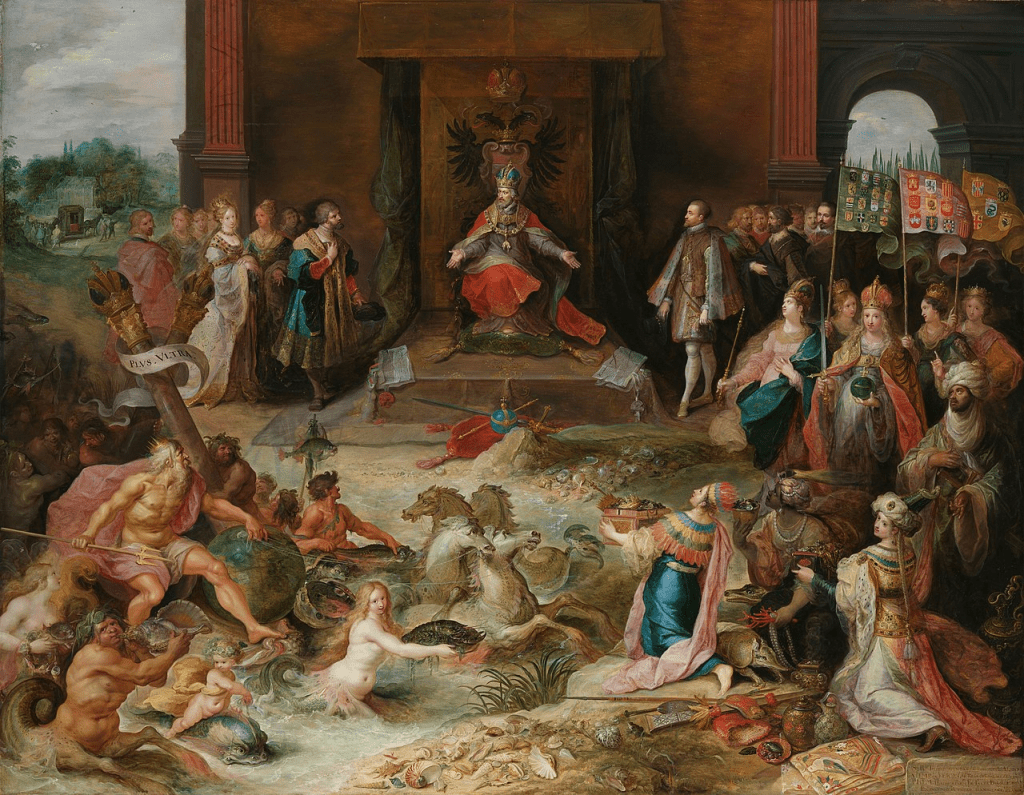
Allegory on the abdication of Emperor Charles V in Brussels

So nation-states, in other words, with their hard borders and inherent desire for ethnic, cultural, religious and linguistic cohesion, were a creation of European diplomacy just a few hundred years ago. And it served them fine, even as the rest of the world tended still towards the more nuanced and subtle lines of empire – today a byword for violence but in actual fact a creator of peace for most people. In simple terms, for instance, it made perfect sense for Tibet to exist within the Chinese imperial sphere; but made very little sense for it to be incorporated into a new Chinese nation-state. Likewise the Northwest Territories to the Raj. Most of all, in Jerusalem the centuries of occasionally tense but balanced coexistence between Arab, Jew and Christian was brought to an end with the creation of the Israeli state in 1947.

All three of these examples – and plenty of others besides – would have benefited from revolutionaries who looked past the (even then already dated) concept of European nation-statehood. In each case a forward-looking, more federalised concept of governance could easily have been introduced. In Europe itself, political leadership was looking at a post-national world which would lead eventually to the European Union. So why was none of this progressiveness around in Israel, India or China?

First is pure laziness. A vast number of unfounded charges are laid at the feet of the British Empire (which left the majority of its people better off than before), but the one criticism which sticks is the undignified rush to decolonisation, and the unintellectual approach used for it. Britain of course, as demonstrated with the EU, is in any case the wrong source of inspiration for ‘post-nationalism’, but at the time the navel-gazing was due to self-obsession. The credit for all the good that Empire brought, was more than a little diminished by the inglorious process of its end.

But the bigger issue was the lack of imagination from the heroes seeking to create new countries of China, India and Israel. Mao and Zhou, Gandhi and Nehru, Weizmann and Ben-Gurion were all leaders steeped in the orthodoxy of western historical teaching, and could conceptualise of nothing else other than the national structure of western powers (despite, ironically, the fact that those same imperial powers tended not to apply statehood in the empire, resulting in a measure of peace). When Churchill called Gandhi “a seditious Middle Temple lawyer, now posing as a fakir… striding half-naked up the steps of the Viceregal Palace” it was as much a comment about his cultural background as it was about his privilege. Gandhi suffered, as they all did, from a sort of Stockholm syndrome where because Europe comprised all nation-states, so should their newly independent post-imperial entities.

Not all such Westphalian myopia ended in disaster. A few successful examples included Lee Kwan-Yew’s establishment of Singapore, or the stability achieved for long periods in Thailand or Japan. But in general, the larger conflicts today still exist because someone, somewhere, could not get their minds around the temporary and cyclical nature of national constructs, instead pursuing hard-bordered strategies that had to end in bloodshed. They were not helped by their former masters, to be sure; but ultimately it is difficult for these founding fathers, all of whom played up their own supposed knowledge of history, not to take the majority of the blame.

The crises in Palestine and elsewhere, such as they are, are the fault of aspirant statesmen who could not think outside the box. None of them had a proper historical grounding, and generations since are paying for it. This insolubility deserves ennui, not obsession.

The Lessons of History – why confabulation may be worse than amnesia

It is normal for any society to look back to their past for paradigms of “greatness”. In Will and Ariel Durant’s masterful work The Lessons of History, they wrote that:

To break sharply with the past is to court the madness that may follow the shock of sudden blows or mutilations. As the sanity of the individual lies in the continuity of his memories, so the sanity of a group lies in the continuity of its traditions; in either case a break in the chain invites a neurotic reaction.

In other words, a grasp of history is important and as a historian myself, I am quite skeptical of those in public life who clearly do not have or act on such a grasp – Tony Blair in the build-up to the Iraq War being a case in point.

But what is the right history to look to? What of the rich tapestry of our past really tells us about the tenets of our national character? History will always be twisted to aid politics; but the current ahistoricism amongst the governing classes has I believe reached something of a new low – and it matters for policy. Reaching for the correct memory is as important as having memories at all.

Britain, for instance, has an imperial history which as a nation it has yet to move on from despite the best efforts of the PC brigades. The signs of it – from the remnants of actual empire (now reduced to the Falklands and Gibraltar) to the permanent seat on the UNSC – still pervade much establishment and tabloid newspaper thinking. But whereas many British subconsciously see the height of empire as the regal majesty of the Delhi Durbar, the real Britain was something altogether less dignified. The British character, I would submit, is one of unruly mobbishness at heart which can be seen throughout society from football hooligans through to the Bullingdon Club – perhaps the best representations of contemporary life being the social diversity of rioters in 2011, and the undignified rush to loot cargo from a sinking ship in 2007.

Hooligans

British hooliganism – two sides of the same historical coin

Rather than harking back to formal empire therefore, the British memory should look more to the Gordon Riots, to Clive of India and James Cook, than to parades at Spithead. Because in this riotous assembly, were also the seeds of Britain’s real greatness: as privateers and traders, entrepreneurs and innovators rather than organisers. In the 18th century Britain stumbled across empires in India and America, and created the Industrial Revolution; arguably, as soon as Britain’s organization skills were brought to bear in the 19th century, the Empire started its decline.

America, too, has the Anglospheric trait of tending towards natural lawlessness as shown by moments such as Hurricane Katrina (in contrast to an example like Fukushima). But there is a deeper romance to the American story as told in elementary schools across the land, of idealism, diversity and tolerance. This too, though, is misremembered. America became great not because of its tolerance, but because of its moments of judicious intolerance and plain ruthlessness – against indigenous people, against Britain, and later against Japan and the Soviet Union (the fraught relationship with Britain was the theme of a 2005 paper of mine). Yes, there were waves of immigration which fed into the so-called “melting pot”, but America would be much less of a country today had it been run with the kinder, gentler governance associated with neighbouring Canada for instance (even if this may also be exaggerated).

Some Americans will not like to see this as the basis of their history, but the reality is that the country’s “manifest destiny” – to rule the continent and then the world – was not built on being nice to people. The American Revolution was not mainly a principled stand of Enlightenment values, but an opportunistic socio-economic power grab by one set of elites from another*. There is a reason why Andrew Jackson, until recent events, was held high in the pantheon of bank notes. And this memory, tinged with a harsh edge and violence, is every bit as important for the country as self-congratulatory myths about the Founding Fathers or Abraham Lincoln. Just as Britain is more Clive than Hardinge, so America is more Jackson than Lewis and Clark.

Jackson Lewis Clark

Andrew Jackson,  Meriwether Lewis and William Clark

As an example of how these falsified memories impact policy, let us take the rhetoric surrounding immigration, an issue applicable to both the US and Britain. The common liberal mantra is the fallacy that “this country was built on immigration!”, a cry heard around hipster cafes from Primrose Hill to the West Village. Factually true, but rather irrelevant. Yes, there has been plenty of immigration in the past, although few have come close in scale to what has occurred in recent years. Yes, immigrants by and large contribute enormously to skills, ambition and demographics in both these countries. But it is not immigration itself which has been good; it is appropriate amounts of immigration when building on a platform of strong host culture. It is an “and”, not an “or” – the tired, poor, yearning huddled masses in the US would be nothing had not the violent ruthlessness of mostly white, protestant Anglophone Americans established a country of enormous land and resources. In other words, there are two pillars to this story of progress, not one:

  1. preserve a coherent indigenous identity;
  2. then add immigration as needed.

But the one-dimensional appreciation of history from those that dominate the media and education misses all this. Immigration is put on a pedestal in and of itself, as though it somehow generates positive impacts on a standalone basis. National identity is practically a dirty word – or has been captured by cynics who believe it can be watered down to nothing by adding foreign elements into the mix via the “we were all immigrants once” fallacy. To do this is the sow the seeds of destruction for any nation-state. Just as Blair had no regard for the longer sweep of history in the Middle East, so also the likes of Corbyn or Pelosi for their own country (although strangely Bernie Sanders actually did – and consequently struggled with certain corners of Liberaldom).

But the point is this: whether we are talking about British lack of self-discipline or American violence, these are not actually bad characteristics. People should not be judging these with opprobrium – they can be positives which lead to other strengths. Anglo-American consumerism and short-term thinking helps the whole world in terms of innovation and just plain growth. If Americans did not love spending money so much, the rest of us would not have iPhones. A planet of Germany’s and Japan’s would achieve nothing. Finding a place in the world is partly about adapting – but only on the basis of recognizing what one’s inherent strengths are. Politicians should not be complaining about these characteristics or still less, try to change them. They should be trying to harness them in productive ways – opportunism becomes enterprise, violence becomes robustness. The world certain needs all of these.

I will finish on a macro view. A former boss of mine once asserted that there are three types of competitiveness in the corporate world: price, quality and innovation. Capture one, and you will survive; capture two, and you will succeed; capture all three and you will rule the marketplace. Countries are not dissimilar, and it is no surprise that the one nation which comes closest to an adequate level of all three is also the only hyperpower – America. Historically, even during the Industrial Revolution, Britain was not known for quality, but rather for inventiveness in products and processes. Since emerging, Germany always had a superior record on pure quality, but they have rarely created anything completely new. Nations have their place; national identity will be a determinant of it.

Britain, post-Brexit, needs to thoroughly reflect on which of these features it possesses and how it pursues them (in my opinion, clearly led by innovation not quality)**. It may seem obvious to say that she needs to see herself as an underdog, yet shockingly few statesmen have really digested this fact. America, in this period of potential decline, also needs to rediscover which qualities it still has. Problems like the rise of China and the new “community of empires” will not solve themselves. But for either country to successfully confront their dilemmas, a closer examination of the collective, subconscious social memory is needed; for without it, we face the insanity Durant outlined so long ago.


———————————————————————————————————————————–

* Perhaps this will be a major point of debate, but as something of a historian in the era (see eg my 2005 paper on the Anglican Bishop Controversy) the American Revolution was by and large a moment when local elites, separately in Boston and Virginia, found Britain a convenient scapegoat for directing local discontent against. By the 1740s, ports such as Boston and the southern backcountry were facing, for the very first time in colonial history, economic stagnation and the rise of an underclass. A war (The French & Indian) put this on hold, but by 1763 the Boston families and the Tidewater oligarchies needed to stir a conflict for their legitimacy. They got one with Britain, and this, much more than tiresome debates about Lockean Liberalism vs Republicanism (rf Bailyn, Pocock et al), or “taxation without representation”, lies at the heart of the rebellion – and partly explains the surprisingly strong loyalist sentiment throughout the war.

** I will also add that one of the only intelligible and plausible post-Brexit British identities I have heard comes from a potential future guest blogger here, namely that Britain could become an Israel – in other words, a medium-sized maverick which punches above its weight simply through unpredictability. Better not decommission those nuclear weapons, in which case.