Why Palestine – like Tibet and Kashmir – is just boring

A less boring version of events

With the latest conflict now settling down to the usual name-calling and posturing, we are once again confronted with the insolubility of the Middle East problem. For those like myself who grew up with another version of this – the sectarian tensions in Northern Ireland and its impact on politics and society in the UK at large – this is all too familiar. And for myself, much as I felt with that episode of history, I cannot help but be bored each time it starts again, because there is actually no solution which will bring a lasting peace until, as with Northern Ireland, we start to move beyond political conceptions on which states and borders are based.

Before I get to my historical analysis however, I would also give a nod towards the issue of foreign observers and their inability to grasp real motivations of those on the ground. Graeme Wood made the point, during the rise of ISIS in 2015, that the hand-wringing in Washington and Brussels would never help until they acknowledged the underlying religious inspiration behind the Caliphate. People do genuinely act on matters of theology; it is not all (or even mainly) a matter of economics and the Marxist interpretations. But of course, western observers, whose political classes are by and large either atheist or at best agnostic, could never comprehend this and would therefore keep wanting to bring a knife to a gun fight. The naive but enduring hope that improving the economy and jobs would somehow solve the problem that Islam presents is really a problem of the observer, not the subject.

However to return to a more Realist angle, I have no interest in how to solve the current Palestinian problem, but I do have an interest in the historical provenance. Because like it or not, the Israel issue is one of several which have their roots in intellectual limitations of state-makers in the immediate aftermath of World War II, roughly from 1946-1954. We saw the same problems erupt as India gained independence and split between Hindu, Muslim and Sikh; and in the slower issues built up in the corners of China as Mao consolidated around the Qing Dynasty imperial borders. In every case, conflict and bloodshed were born of trying to fit the square peg of empire into the round holes of nation-statehood.

The ‘nation-state’ itself is, of course, a somewhat recent phenomenon. While it is a little trite to date them specifically to Westphalia in 1648, it is certainly true that a century earlier at the Peace of Augsburg, the connection between rulers and the ruled based on ethno-cultural identity was barely existent. The splendid Charles V, in his twilight in 1555, was the legitimate ruler of inheritances including Spain and the New World, Austria and the Holy Roman Empire, and Burgundy. Nobody on the streets of Vienna, Antwerp or Madrid complained about his ethnicity – even if they might complain about misrule. This detachment between where a ruler came from and his authority only changed with the advent of new weapons, increasingly expensive wars, and the compensation offered by rulers to their subjects for ever-higher taxes to fund the military. ‘Nationality’ was a part payment for the debt being incurred by princes as they required greater blood and treasure – “we need more from you, but you’re now fighting for your own people!”.
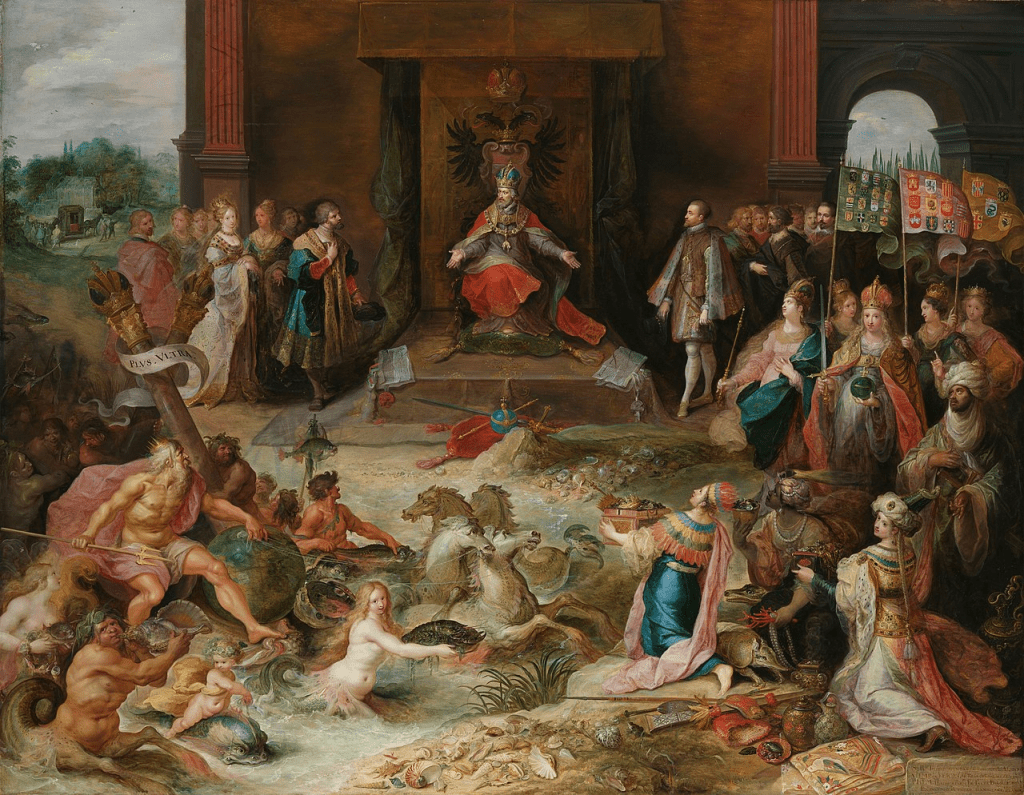
Allegory on the abdication of Emperor Charles V in Brussels

So nation-states, in other words, with their hard borders and inherent desire for ethnic, cultural, religious and linguistic cohesion, were a creation of European diplomacy just a few hundred years ago. And it served them fine, even as the rest of the world tended still towards the more nuanced and subtle lines of empire – today a byword for violence but in actual fact a creator of peace for most people. In simple terms, for instance, it made perfect sense for Tibet to exist within the Chinese imperial sphere; but made very little sense for it to be incorporated into a new Chinese nation-state. Likewise the Northwest Territories to the Raj. Most of all, in Jerusalem the centuries of occasionally tense but balanced coexistence between Arab, Jew and Christian was brought to an end with the creation of the Israeli state in 1947.

All three of these examples – and plenty of others besides – would have benefited from revolutionaries who looked past the (even then already dated) concept of European nation-statehood. In each case a forward-looking, more federalised concept of governance could easily have been introduced. In Europe itself, political leadership was looking at a post-national world which would lead eventually to the European Union. So why was none of this progressiveness around in Israel, India or China?

First is pure laziness. A vast number of unfounded charges are laid at the feet of the British Empire (which left the majority of its people better off than before), but the one criticism which sticks is the undignified rush to decolonisation, and the unintellectual approach used for it. Britain of course, as demonstrated with the EU, is in any case the wrong source of inspiration for ‘post-nationalism’, but at the time the navel-gazing was due to self-obsession. The credit for all the good that Empire brought, was more than a little diminished by the inglorious process of its end.

But the bigger issue was the lack of imagination from the heroes seeking to create new countries of China, India and Israel. Mao and Zhou, Gandhi and Nehru, Weizmann and Ben-Gurion were all leaders steeped in the orthodoxy of western historical teaching, and could conceptualise of nothing else other than the national structure of western powers (despite, ironically, the fact that those same imperial powers tended not to apply statehood in the empire, resulting in a measure of peace). When Churchill called Gandhi “a seditious Middle Temple lawyer, now posing as a fakir… striding half-naked up the steps of the Viceregal Palace” it was as much a comment about his cultural background as it was about his privilege. Gandhi suffered, as they all did, from a sort of Stockholm syndrome where because Europe comprised all nation-states, so should their newly independent post-imperial entities.

Not all such Westphalian myopia ended in disaster. A few successful examples included Lee Kwan-Yew’s establishment of Singapore, or the stability achieved for long periods in Thailand or Japan. But in general, the larger conflicts today still exist because someone, somewhere, could not get their minds around the temporary and cyclical nature of national constructs, instead pursuing hard-bordered strategies that had to end in bloodshed. They were not helped by their former masters, to be sure; but ultimately it is difficult for these founding fathers, all of whom played up their own supposed knowledge of history, not to take the majority of the blame.

The crises in Palestine and elsewhere, such as they are, are the fault of aspirant statesmen who could not think outside the box. None of them had a proper historical grounding, and generations since are paying for it. This insolubility deserves ennui, not obsession.

In defence of … Empire

The Muse bids me consider the good, the bad and the necessary forms of power

Two decades ago, the subject of empire, which had long fallen under the pall of apologetic navel-gazing in academia and in political discourse, experienced something of a revival. On Home Counties coffee tables in around 2003 emerged books such as Niall Ferguson’s Empire: How Britain Made the Modern World and, a couple of years later, his follow up Colossus: The Rise and Fall of American Empire. Both were made into TV series, leading to rather bitchy comments from my own tutors at Oxford over exactly how much of a sell-out he had become. Ferguson moved on soon to NYU and latterly Harvard, where he continues to be a proponent of sorts, of the imperialist revival.

He was not the only one however. A far more academic book, though still accessible, from a few years later in 2009 was John Darwin’s After Tamerlane, which charted the Asiatic land empires over the period 1400-2000 and took a nuanced view on empires, their existence, longevity and, buried amongst the prose, their benefits. The obvious point being that:

[A] propensity in human communities has been the accumulation of power on an extensive scale: the building of empires. Indeed, the difficulty of forming autonomous states on an ethnic basis, against the gravitational pull of cultural or economic attraction (as well as disparities of military force), has been so great that empire (where different ethnic communities fall under a common ruler) has been the default mode of political organization throughout most of history. Imperial power has usually been the rule of the road.

On the other side of the Atlantic, the process of soul-searching brought on by the foreign policy of George W Bush generated much writing, with 2010 alone producing three prominent volumes in the shape of Empires in World History by Jane Burbank and Frederick Cooper, The Rule of Empires written by Timothy Parsons and Empire for Liberty by Richard H. Immerman; this unsurprisingly coinciding with the accession of Barack Obama, probably the most forthright anti-colonialist (and perhaps anti-British) man to occupy the White House since Grover Cleveland in the 1890s.

However, after that burst of activity, Empire has again experienced decline in the perceptions of the liberal public – not least through the sophistry of race relations which re-emerged through the 2010s, accelerated by Trump’s election, BLM and in my world, the absurdity of movements such as #RhodesMustFall (though I am glad to report that as of this moment, Rhodes’ statue still looks down majestically from its cupola on the High). Iraq and Afghanistan have gone the way many feared; perceived Russian and Chinese aggrandizement continues. ‘Empire’ has not had a good innings. Yet the lessons about why they are good, bad or necessary are still overlooked, and I feel obligated to rehearse them once more.

First, Empires bring peace; and their decline brings conflict. Whilst this may sit in cognitive dissonance with how history is taught today, the reality is that for a majority of peoples governed under imperial structures, lives were more stable under this regime than what they might otherwise have. This is not only empirically true – Spain and North Africa for instance were largely left in peace for three centuries between the Punic Wars and the Crisis of the Third Century, despite not being Roman “heartland” – but also logically. See also China, Byzantium, the British and French empires and even the dysfunctional American equivalent (though as Ferguson says, Americans just aren’t very good at empire). Ethnically-focused nation states must be more prone to friction with neighbours than an empire which is first and foremost self-interested in minimising that friction. No successful empire has ever seen greater violence and destruction in its borders, than its alternatives.

Secondly, Empires bring prosperity. Much like any political system, the proof is in the pudding and there are very few examples of empires which successfully exist for long based only on coercion. Even the Empire in Star Wars, for instance, would have had more adherents than resistance and the Jedi should probably have asked themselves why they were in such a minority for so long – probably because their own scattergun and slightly racist alternative proposition could not even persuade Ewoks, let alone the merchants, professionals and other middle classes of the Empire that their mess was better. Most complaints about empire comes from self-indulgence, and nowhere was this more plainly set to rights than in Monty Python, whose sketch in The Life of Brian was a thinly-veiled lampoon of anti-colonial opinion across Asia and Africa:

Lastly, empires bring diversity. Given the propensity to celebrate everything “D&I” these days, it is worth pausing to think about how much empires, rather than nation-states, and created and sustained true multi-culturalism. Ultimately, empires are agnostic about the culture they carry, and as they expand absorb ever greater amounts of what they oversee. It is notable for instance, the Prime Ministers such as Thatcher and Blair were eminently more parochial than similar bourgeois classes a century earlier, whose relatives would have grown up in India, the Sudan and elsewhere serving as bureaucrats and engineers. Whilst Europe has provided some remedy to this parochialism, it is not complete: since the decline of empires in the 1960s, modern (western) nation states and their governing classes know less about the world around them than ever before, leading to everything from half-baked trade pacts like the WTO to neo-conservative adventures in the Middle East. The borders of empires are soft and porous; the borders of nation states are hard – and with it hardened views on identity and inclusion.

Coming from a family that emigrated under the auspices of Empire from China to India to Britain, I take a personal pride in the system that allowed for this to occur. Britain offered an attractive cultural and civilisational prospect, of course, and its contemporary weakness in this needs addressing; but more importantly it was the infrastructure of empire that served so many millions of people so well, for so long. It gave opportunity, egality, stability to the very poorest in society, at the expense, ironically, of the “home” nation.

Empire is here to stay, not just because of legacy but because its really quite a popular system. The definitions may vary over time, but the principles of expansion and peaceful, productive dominion of a periphery by the centre will remain permanent. A decade ago I argued that we were witnessing the emergence of a new “community of empires”, given the way not only Russia and China, but also India, Brazil and others were run. Some of this has come to pass, others are slow burning. But before we continue to trample the legacy of empires, we should remember why they appealed; since they are an inevitability, perhaps it is better we embrace their positives rather than engage in futile self-flagellation.