It’s the net tariff differential, stupid

Free trade was never supposed to be the end-game
With the dust settling on tariffs, it is opportune to take a moment to consider the sheer scale of change ushered in by Trump on global trade since 2016, and especially with recent events. Trump’s policy is often confused by a vast amount of ‘noise’, which tends to undermine even his own news cycle (see the recent Iran nuclear facility bombing, for instance). Which is a shame, because he has almost entirely remade the landscape, and whether one supports or opposes the theory behind it, it seems irrevocable.

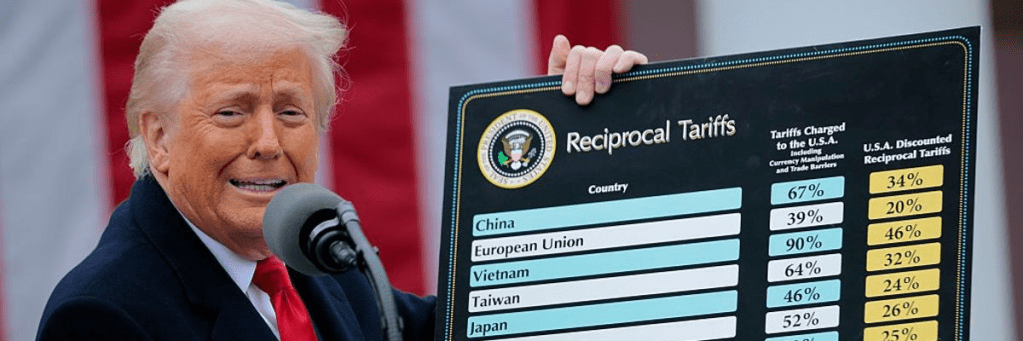
There have been two major components of this earthquake. First, Trump has instated and effectively normalised a global 10% tariff on all US imports, regardless of origin. As noted elsewhere, a ‘universal’ tool like this is by far the most efficient mechanism to charge the world a cost of doing business with America (a concept the youth of today will more easily liken to “gas fees” paid in the world of crypto). It has also raises the policy ‘baseline’ to a figure greater than zero, which I discuss below.

This baseline 10% has both more or less been accepted without reciprocation, by every major trading partner including the EU and China, regardless of vehement struggles over additional duties on top. Whether this 10% is the only tariff, like Britain, or whether it is just the minimum, like Japan and Korea who currently have 25%, the standard has been set and moreover will be very likely here to stay – any future US administration may renegotiate on specifics, but will almost certainly leave the baseline in place. It is now quite simply a fact of commercial life.

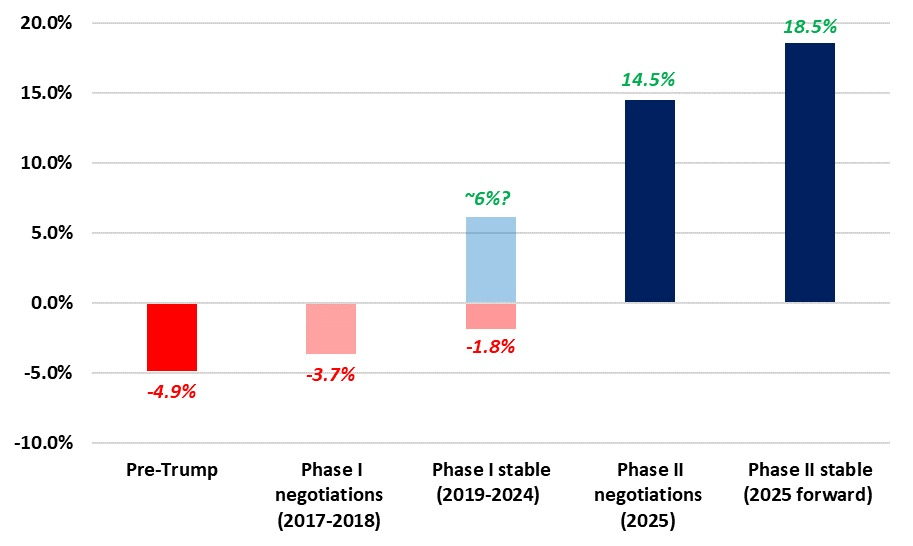
Secondly, there is China. Amidst all the turmoil (which may be part of a grand plan, but frankly who knows), Trump has continued his decade long trade strategy of increasing tariffs and daring China to fight back and contest who holds the most leverage. This bluff has been called several times, and has resulted in the US turning the net tariff differential (the principal measure of ‘success’ in any tariff strategy) in its favour for the first time in living memory.

US net tariff differential with China, 2016-2025

Sources: PIIE, underlying sources
Notes: 1. Trade-weighted tariff rates in 2016 were 8.0% on US exports to China vs 3.9%  on imports; 2. While the notional differential achieved in Phase I was -1.8%, in reality China unofficially suspended many import duties leading to a positive differential under Trump’s first administration; 3. 2025 forward numbers based on latest round of negotiations ending May 2025.

When Trump first emerged on the scene, the institutional trade nexus between the US and China, comprising both WTO and bilateral arrangements, was such that China imposed about 5% more duty on the US than vice versa. Liberal economists contended rather tritely that this was a price worth paying. Yet over the course of both the 2016-2020 presidency and now in his second term, this negative differential was first reduced and now into a major surplus. China, despite raising tariffs of its own, has acquiesced to the new normal that it must pay the US more than the US pays it, for trade. If anything can be considered a ‘win’, this is what it looks like.

In the meantime, we have seen no sign of the supposed economic slowdown as a consequence of the “trade wars” [sic]; there have been plenty of anecdotal examples of exporters eating the additional cost into their bottom lines; and after the initial volatility, the markets have settled down into a rally. Personally, I regard none of these as important for long term strategic reorientation, but among the breathless commentariat fainting at news from the bond markets, it seems to matter.

And what is the point of all this, might you ask? For me, on the subject of tariffs themselves, this policy has been a triumph of common sense. I have argued for years that the US and others needed to ramp up tariffs for several reasons.

One main consideration is that today’s global economy is no longer that of Ricardo’s. The applicability to free trade theory to a landscape of non-tariff barriers, unfungible services, and complexities of cross-border supply chains are extremely limited. Furthermore Ricardo assumed (as all economists tend to) agnostic counterparties motivated and constrained by economic incentives including public wealth and living standards; he did not factor in malevolent strategic actors who would happily pay a cost to bend a supposedly neutral system to their own agenda. Let us be in no doubt: if Ricardo were alive today, he would be pushing for trade tariffs.

Another outcome is the pushing back on the idiot savancy© which has led the technocratic classes to glorify “zero” targets – tariffs, interest rates, inflation, exchange volatility, even carbon emissions (though strangely not taxes or immigration). In most areas of public policy, however, zero is convenient for bureaucracy but wrong for the public. Low rates can occasionally be enjoyed as an output, not an input, but freedom to raise them are the safety valves required for cyclical management of the economy – sometimes you want inflation; sometimes you need currency devaluation. Tariffs, too, are a tool whose starting point (the ‘baseline’) needs room for manoeuvre both up and down – as a decade of near-zero interest rates have demonstrated, autistic ambitions hamstring policy tools needed to meet new challenges (I will write separately about this whole topic). So 10% or so suits the US quite nicely.

How tariffs will end up functioning is an unknown, due in part to how long OECD governments have allowed their muscles to atrophy in recent decades. And nothing scares technocrats more than the unknown. Yet beyond the anecdotal evidence of implementation, we also now know that the first round of Trump’s changes in 2018 led to substantial fiscal outcomes, with customs revenue doubling from US$35bn per year to US$70bn and well beyond.

Source: Bloomberg

This income is forecast to continue rising unless the economy tanks, but little sign of this. How the US government chooses to use this windfall is a separate matter, but the income certainly exists and one reason Biden chose to continue Trump’s tariff policy was that nobody wanted to look this gift horse in the mouth. While revenue raised is not central to the justification for tariffs, they offer an important lesson in how erroneous predictions on effects can be.

Most importantly of all, regardless of whether one supports increased trade protectionism or not (and I accept there are plenty of arguments to be had on either side), Trump continues to challenge the orthodoxy that such sharp directional changes are not even possible. Because for every protagonist arguing against the economics of tariffs, several more are usually hiding behind the sophistry that “he will never be able to do it, anyway”. These are the people cheering on the bond market turmoil or China’s retaliatory duties, unwilling to admit out loud that if it could be done, it might actually make sense for people, even at the cost of being vastly more inconvenient for the beneficiaries of globalisation.

As with defence or immigration, Trump has shown that none of these shibboleths are untouchable. The governing classes, while self-interested in keeping the policies of the last fifty years in place, has been surprisingly ineffective at stopping Trump from turning 180 degrees on tariffs or NATO or Iran, despite loudly arguing that it could “never be achieved”. So it turns out that the system, for better or worse, can be changed. Perhaps after all it is actually Trump who is living Obama’s best life, as he surveys the world around him and tells voters “yes, we can”.

Why commentators like Martin Wolf are still firmly thinking inside the box on China

aging-population

China’s rise is not about following the conventional economic norms, and the reality is that an ageing population is probably better than a young one

China has always been a black box. For the whole of my professional life, companies (investment banks being amongst the worst) happily hire someone – anyone at all – who claims to know the Chinese market if they can make even a sliver of money. Consequently, these people are given free rein to build their own silos. For boards in London or New York, China remains “a faraway nation of whom we know nothing”. It is from this mysterious, exotic ignorance that reliably insightful commentators, from publications which should know better, produce some tired answers to tired questions. Sad to say, amongst them was a recent piece from Martin Wolf at the Financial Times titled The Future May Not Belong to China.

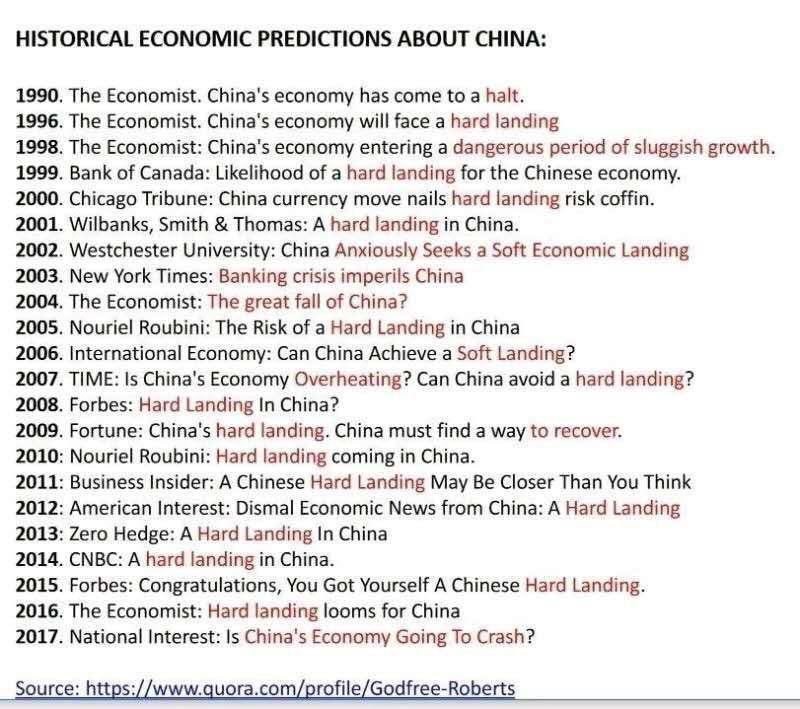
Now, the future may very well not belong to China. Much of what Wolf outlines from his Capital Economics report (rather too much from one source for my liking) is unarguably true: the over-investment, the under-consumption, the increasing corporate debt and reliance on exports. But they only change from fact to “problem” when seen through the same old prism of economic development. China though has been disrupting the whole framework through which one sees these issues, confounding a whole mini-industry of untiring China bears. Who can forget the inflation crisis of 2010 – 2011? The Chibor crisis in the summer of 2013? The stock market crisis in 2015? The capital outflow crisis over 2016 – 2017? In each of these and many others besides, China was to be “found out”; it never was, not because the facts were inaccurate but because the basis for observation by outsiders was so incomplete (although to be fair some of the facts were also inaccurate). The fact that the naysayers and doom-mongers have been consistently wrong may be a cheap point to make, but it is worth making nonetheless. The only laws of economics, it seems, are the ones amateur journalists derive from their undergraduate readings of Adam Smith, Ricardo and Keynes.

china bears

A non-exhaustive list of China bear headlines since 1990

However I would submit two additional unrelated and possibly more controversial theses. The first is that the way China encounters these perceived crises is actually a mark of its success in terms of being on a pathway to global power, rather than a failure. There is a reason why China encounters “difficulties” where Japan, during its own precipitous rise in the 1970s, did not: China is actively trying to change the world it is living in. These crises are the tremors generated by moving tectonic plates, as Chinese objectives grate against the rules and outcomes it is being measured against. Currency and capital flows, interest rates, debt and the banking system – these are all examples of Chinese policy that do not make macro-economic sense until you factor in that it wants to change the system and if it plays its cards right, it probably can. We are faced with the first occasion since the United States back in the 1840s, where the world may have to accommodate a new power, and accordingly the rules will change. For China, this friction is good.

japan china gdp

Source: The Economist (2010)

To run through just one example of this, let us look at capital outflows. The reason capital outflows seem like a “crisis” is that the Chinese government wants to control the currency rather than let it be determined by the market. To pay for this, it must use foreign exchange reserves to keep the exchange rate stable. This becomes a huge cost when the environment is weak – except that the reason China does this is to try and make the RMB a regionally accepted trade and reserve currency. This could be done through just trade alone, but in China’s case it will also be done through the crypto-imperialism of the Belt & Road and other initiatives. If it succeeds, it will both eat into America’s ability to project power through the dollar, as well as ultimately encourage greater consumption of Chinese-made goods which in turn once again brings capital flows back into balance. It is a risky and expensive, all-or-nothing gamble; but unlike merely acquiescing into the current world system, if it succeeds it will have changed the regional financial and trade landscape. A price, some would say, worth paying.

The second thesis focuses on the cliché that China may be facing the middle income trap – that it may “get old before it gets rich”. This is typically paired with the curiously British trait of enthusiasm for India as an alternative story. Yet I would argue that with the coming of automation, China is actually on the right side of history on this and that far from fearing age, the adage should be turned on its head: for many comparable countries it is youth, not age, which will be a great peril; and these countries may be too young to ever get rich.

We have for some decades been fed the neoliberal trope that a younger population is good for the economy, and that pursuit of youth, through birthrates or immigration, is a Good Thing. Yet we are fast approaching the point where this notion is being exposed, because automation is actually a process which will eat into youth employment rather than any other. China’s workforce is actually declining and has been for some years, just in time for robots to start taking over.

The process of classic industralisation is just one of various models for a country to develop. But in this particular model, families can contribute labour rather than capital in order to obtain greater earnings, and thereby over time accumulate household assets. For many countries though, this industrialisation may never now be possible. The Economist noted as much when opining that the pathway of development exhibited by the China + ASEAN axis is probably irreplicable by anyone else including markets in Africa and South America. Goods may be manufactured in some of these economies, but it will be robots that do most of it and young median households will never cross either the asset-owning or educational thresholds required to survive automation before it hits.

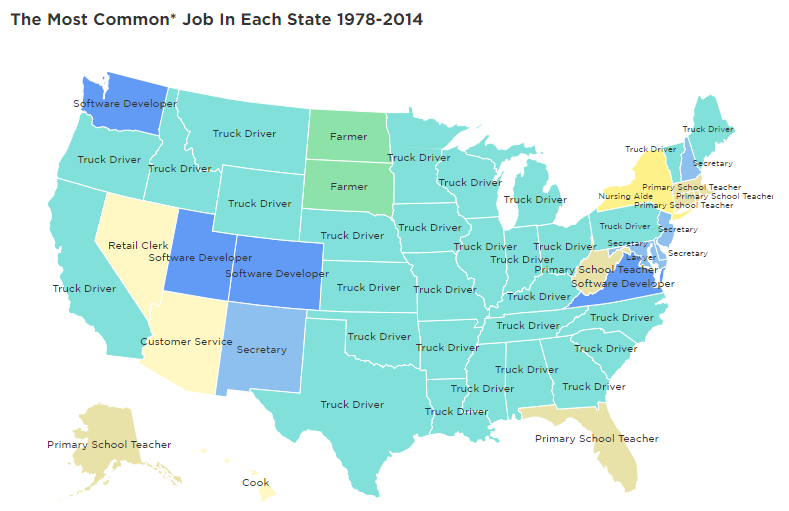
Now, it may be that these countries find other models to become rich, but I doubt it. Agriculture or resource extraction will be possible for only a precious few. The mercantile model is not stable or sustainable. Services, as we have seen, actually produce a lower return on labour than industrialization does since jobs are often of a lower quality. In any case one of the stark lessons of 2016 was the fact that in 29 out of 50 states in the US, trucking was the single most common form of employment – and this, more so than manufacturing, is where automation will first hit.

us job types

Source: NPR (2015)

The fact is that to weather automation, median family assets need to reach a critical mass enough to be “invested” into the economy such that they can be gainers from robot productivity rather than victims. The most obvious if questionable form of asset-ownership would be home-ownership, but in an ideal world it would take other forms. China’s urban population has just about caught this train (financial income growth has far outstripped wage growth in recent years), but younger populations in India or Vietnam may not make it. Young people inevitable have fewer assets having had less time to earn; if their family does not reach this critical automation-neutralising financial position, they face eternal unemployment. OECD economies mitigate this conundrum somewhat through welfare transfers, but welfare is another privilege of long term asset accumulation by Society – a privilege emerging markets do not have. It is a race against time and any country that fails to achieve this will be left without a chair when the music stops.

In this context, I have little time for those who argue, as Wolf does, that India is “the most interesting other economy” (Americans I have noticed, tend to use Vietnam as their preferred example). As one of my friends commented, “the human race will probably be extinct before India has an airport like Pudong”. Taken individually, each of these points (China’s extra-economic rise and youth being a greater concern than age) have huge implications about the rules and framework for emerging market development theory. Taken together however, they may represent a perfect storm which leading to an inflection point in global economic development. In this case, being wedded to the old ideas, commentators like Wolf are probably missing it.